The Architecture of Connection: A Guide to Multiplayer Game Development
In 2026, the gaming landscape has reached a monumental scale, with the global market projected to grow to $386.04 billion. Central to this…
The Architecture of Connection: A Guide to Multiplayer Game Development
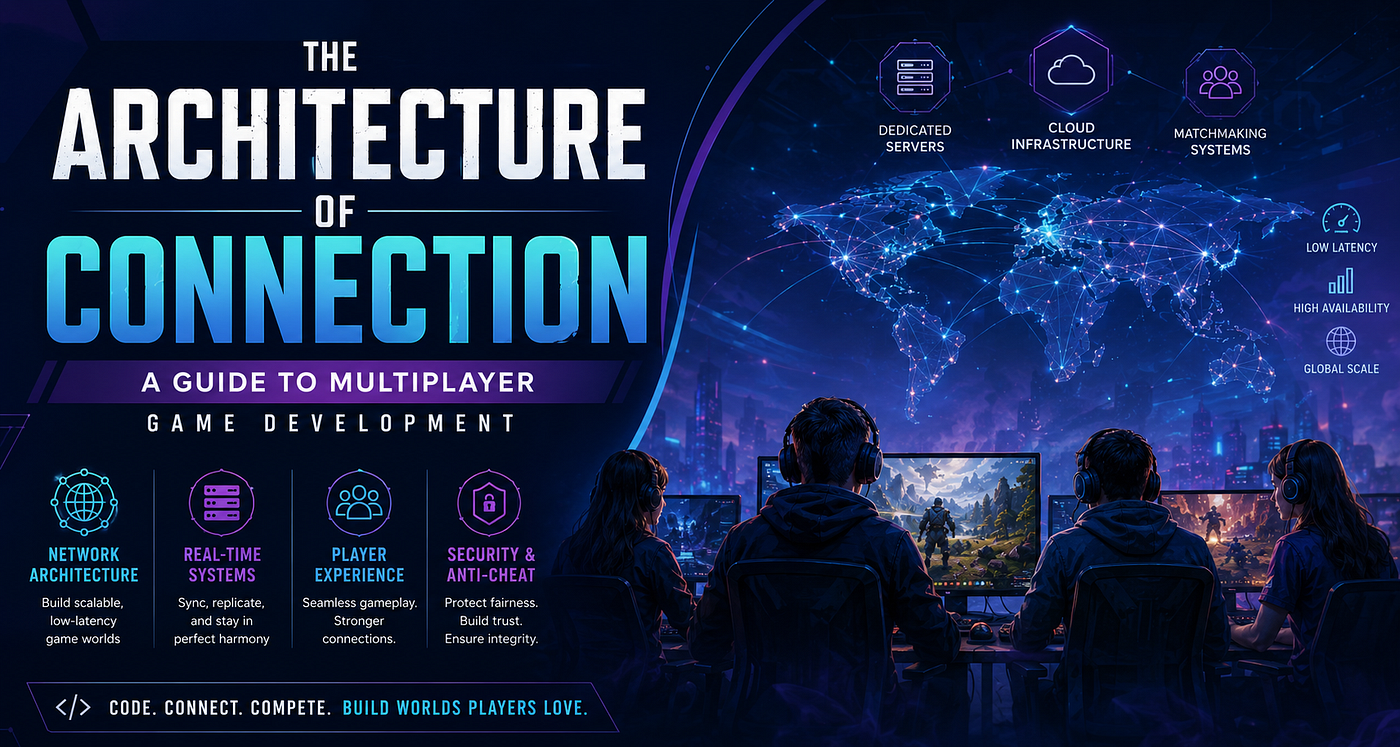
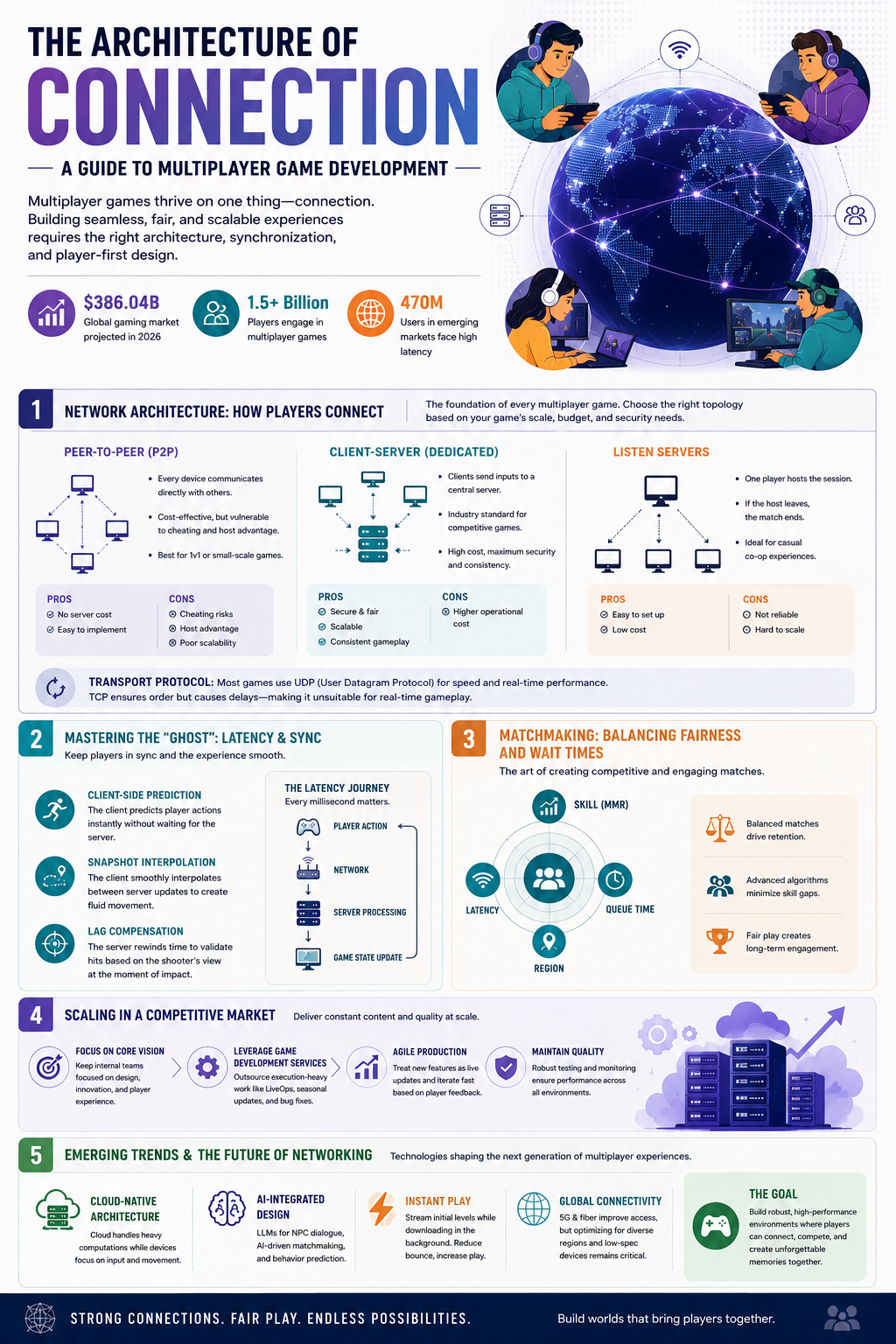
In 2026, the gaming landscape has reached a monumental scale, with the global market projected to grow to $386.04 billion. Central to this expansion is the rise of multiplayer gaming, where over 1.5 billion players regularly engage in competitive or cooperative formats. As players increasingly demand real-time, socially interactive experiences, the complexity of the underlying systems — networking, matchmaking, and synchronization — has become the defining challenge for any **Multiplayer Game Development Company**.
1. Network Architecture: How Players Connect
Before a single frame is rendered, developers must choose a network topology. This foundational decision influences everything from security to operational costs.
- Peer-to-Peer (P2P): Every player’s device communicates directly with others. While this is cost-effective because it requires no central server, it is highly susceptible to cheating and “host advantage,” where the player with the best connection gains a physical edge. It is primarily suited for 1v1 titles.
- Client-Server (Dedicated Servers): This is the industry standard for competitive gaming. Clients send inputs to a high-performance central server, which calculates outcomes and broadcasts the state back. While expensive, it provides maximum consistency and security.
- Listen Servers: A hybrid model where one player acts as the host. If that player disconnects, the match often ends, making this model ideal only for casual co-op sessions.
Regardless of the architecture, developers must decide on the transport protocol. While TCP ensures data arrives in order, its tendency to wait for lost packets makes it unsuitable for real-time play. Instead, most games use UDP, a “fire-and-forget” protocol that prioritizes speed over perfect reliability, leaving developers to implement their own custom reliability layers.
2. Mastering the “Ghost”: Latency and Sync
In an ideal world, every player would see the same thing at the same time. In reality, data takes time to travel through fiber-optic cables, resulting in latency (or “ping”). High latency leads to frustrating lag, where actions feel delayed, and players might experience “rubberbanding,” where the game corrects a character’s position after realizing the client’s prediction was wrong.
To mitigate this, developers use sophisticated synchronization techniques:
- Client-Side Prediction: When a player moves, the client updates the character position instantly without waiting for the server, effectively “predicting” the server’s approval.
- Snapshot Interpolation: Since servers typically send updates at a fixed rate (e.g., 20–60 ticks per second), the client smoothly interpolates between positions to prevent movement from looking like a slideshow.
- Lag Compensation: Known as the “favor the shooter” rule, the server keeps a history of positions and “rewinds” its simulation to verify if an attack hit at the exact moment the opponent triggered it on their screen.
3. Matchmaking: Balancing Fairness and Wait Times
Matchmaking is the art of grouping players into sessions that are competitive and engaging. A good matchmaking system must account for skill ratings (MMR), latency, and queue times.
Modern matchmaking goes beyond simple skill-based sorting. It increasingly relies on real-time ranking systems to enhance engagement. Developers now utilize sophisticated algorithms to ensure that the “skill gap” between players is minimized, as balanced matches are a primary driver of long-term player retention.
4. Scaling in a Competitive Market
As game complexity increases, managing production capacity and quality standards becomes a significant hurdle. Studios are no longer just hiring internally; they are utilizing **Game Development Services** to handle specialized tasks like live operations, seasonal content updates, and ongoing bug fixes.
Scaling effectively requires a systematic approach. Many studios now treat new features as live game updates, externalizing execution-heavy work only after design specifications are finalized. This strategy allows internal teams to focus on the core vision while maintaining the high-frequency update loops that modern players expect.
5. Emerging Trends and the Future of Networking
In 2026, networking is being transformed by several key trends:
- Cloud-Native Architecture: Developers are moving toward cloud-native builds where the cloud handles massive computations — such as global illumination or physics — while the local device focuses on input and movement.
- AI-Integrated Design: Artificial Intelligence is now fundamental, with LLMs being used for context-aware NPC dialogue and AI-driven matchmaking that can better predict player behavior.
- Instant Play: By streaming initial levels while the rest of the game downloads in the background, developers are drastically reducing the “initial bounce rates” that once occurred during long installation periods.
While 5G and fiber-optic rollouts continue to improve access, developers must still optimize for diverse regions. With nearly 470 million users still experiencing high latency in emerging markets, designing for low-spec devices and region-specific infrastructure remains a critical opportunity for growth. By mastering these fundamentals of networking, synchronization, and matchmaking, studios can build the robust, high-performance environments that the next generation of players demands.
메타데이터
- post_id
- f43383dd55fc
- slug
- the-architecture-of-connection-a-guide-to-multiplayer-game-development-f43383dd55fc
- url
- https://medium.com/@redappletechnologies/the-architecture-of-connection-a-guide-to-multiplayer-game-development-f43383dd55fc
- canonical_url
- https://medium.com/@redappletechnologies/the-architecture-of-connection-a-guide-to-multiplayer-game-development-f43383dd55fc
- author_url
- https://medium.com/@redappletechnologies
- status
- ok
- fetched_at
- 2026-06-21 23:24:37