355. Real-World Implementations in Java and Python: Merge Sort vs. QuickSort
Both Java and Python use optimized sorting algorithms based on hybrid approaches rather than pure QuickSort or Merge Sort. Let’s break it…
355. Real-World Implementations in Java and Python: Merge Sort vs. QuickSort
Photo by Michiel Leunens on Unsplash
Both Java and Python use optimized sorting algorithms based on hybrid approaches rather than pure QuickSort or Merge Sort. Let’s break it down.
1. Java’s Sorting Implementation (Timsort & Dual-Pivot QuickSort)
Arrays.sort() (for Primitives: int[], double[]) → Dual-Pivot QuickSort
Algorithm Used: Dual-Pivot QuickSort (introduced in Java 7)
Why?
- Faster in practice than classic QuickSort.
- Uses two pivots instead of one, reducing the worst-case risk.
- In-place sorting, saving memory.
Complexity:
Best/Average Case: O(n log n)
Worst Case: O(n^2) (rare due to dual-pivot optimization)
🔹 Example in Java:
import java.util.Arrays;

public class QuickSortExample {
    public static void main(String[] args) {
        int[] numbers = {4, 1, 7, 9, 3, 2};
        Arrays.sort(numbers); // Uses Dual-Pivot QuickSort
        System.out.println(Arrays.toString(numbers));
    }
}
📌 Best for: Sorting primitive arrays efficiently in RAM.
Arrays.sort() (for Objects: Integer[], String[]) → Timsort
Algorithm Used: Timsort (Hybrid of Merge Sort + Insertion Sort)
Why?
- Stable sorting (maintains order of equal elements).
- Uses Merge Sort for large arrays and Insertion Sort for small ones.
- Efficient for partially sorted data.
Complexity:
- Best Case: O(n) (if nearly sorted)
- Average/Worst Case: O(n log n)
🔹 Example in Java:
import java.util.Arrays;

public class TimsortExample {
    public static void main(String[] args) {
        Integer[] numbers = {4, 1, 7, 9, 3, 2};
        Arrays.sort(numbers); // Uses Timsort
        System.out.println(Arrays.toString(numbers));
    }
}
📌 Best for: Sorting objects (Integer[], String[]) when stability is required.
2. Python’s Sorting Implementation (sorted() & list.sort()) → Timsort
Algorithm Used: Timsort (Hybrid Merge Sort + Insertion Sort)
Why?
- Optimized for real-world data.
- Stable sorting (preserves order of equal elements).
- Handles nearly sorted data efficiently.
Complexity:
- Best Case: O(n)O(n)
- Average/Worst Case: O(nlogn)O(nlogn)
🔹 Example in Python:
numbers = [4, 1, 7, 9, 3, 2]
sorted_numbers = sorted(numbers)  # Uses Timsort
print(sorted_numbers)
📌 Best for: Sorting lists in Python, ensuring stability and efficiency.
Java vs. Python Sorting Summary
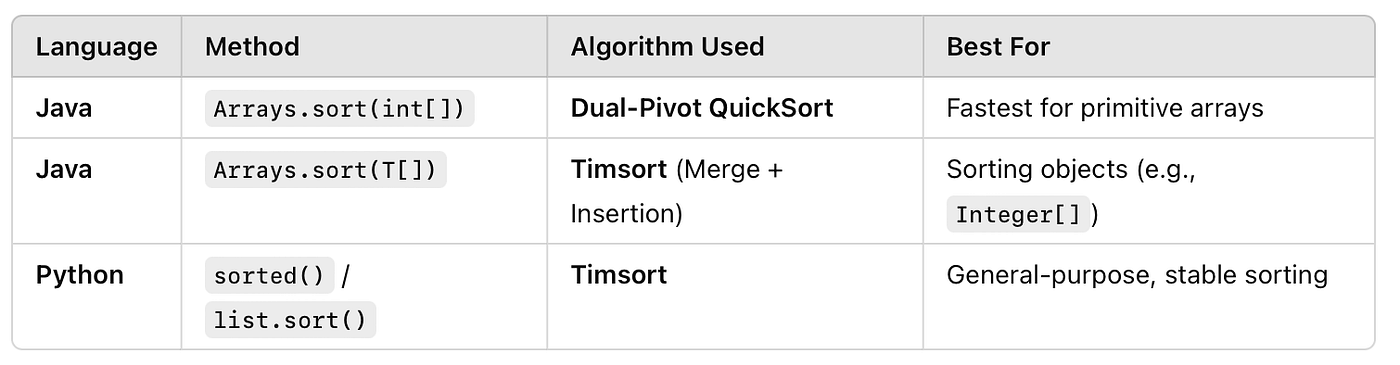
Which One Should You Use?
- For small in-memory arrays → Java’s Dual-Pivot QuickSort (
Arrays.sort(int[])) is best. - For object-based sorting (like Strings, Integers, Lists) → Java and Python both use Timsort, which is efficient and stable.
- For nearly sorted data → Python’s Timsort and Java’s Timsort (for objects) outperform QuickSort.
Final Thoughts
- Java optimizes for in-place sorting using Dual-Pivot QuickSort for primitive types.
- Both Java and Python rely on Timsort for object-based sorting due to its stability and efficiency.
- If you need strict worst-case guarantees, Merge Sort (used in Timsort) is a safer choice.
메타데이터
- post_id
- f433d79c42b4
- slug
- 355-real-world-implementations-in-java-and-python-merge-sort-vs-quicksort-f433d79c42b4
- url
- https://medium.com/@ilakk2023/355-real-world-implementations-in-java-and-python-merge-sort-vs-quicksort-f433d79c42b4
- canonical_url
- https://medium.com/@ilakk2023/355-real-world-implementations-in-java-and-python-merge-sort-vs-quicksort-f433d79c42b4
- author_url
- https://medium.com/@ilakk2023
- status
- ok
- fetched_at
- 2026-07-25 14:00:21