A Journey to Jordan (Part 18)
Petra, ‘A Rose Red City, Half as Old as Time’
A Journey to Jordan (Part 18)
Petra, ‘A Rose Red City, Half as Old as Time’
The ancient, lost city of Petra (‘Petra’ is Greek for ‘Rock’) is one of the ‘New Seven Wonders of the World’ and a ‘World Heritage Site’. It figures in the list of “28 places to see before you die” put out by the Smithsonian Museum. A sprawling, magnificent city carved out of the red sandstone mountains of Wadi Mousa (The Valley of Moses) in the desert of southern Jordan, its origins are shrouded in the mists of mystery and antiquity.
It was built by the Nabateans, a nomadic tribe of Bedouin people from western Arabia, who held sway in this region from around the 4th century BC. They gradually gave up their itinerant lifestyle and settled down to become traders and peasants. They are thought to have built Petra as their capital city during the period from the 4th century BC to the first century AD although the precise period is not known.
Building such an opulent city in a remote, water-scarce, mountainous region was no mean task. This incredible feat was made possible by the Nabateans through an amazing water-harvesting and water-management system involving dams, reservoirs and conduits, the remnants of which can be seen even today. These also served the purpose of controlling flash floods which occur in this region and harnessing the flood waters for later use.
The Nabatean language was a mixture of Arabic and Aramaic (Aramaic was the mother tongue of Jesus Christ). The Nabateans were accomplished traders and Petra grew into a vital hub in the caravan trade routes between Egypt, Greece, Rome, Syria etc. and Mesopotamia, Arabia, India, China and the Far East. They traded in spices, silks, frankincense, gold, ivory, perfumes and various other goods. With the wealth that they amassed through trade, they built up Petra into a magnificent city. In its heyday, it is thought to have been home to a cosmopolitan population of about thirty thousand people.
The Nabateans were exposed to outside influences and cultures, thanks to trade. They imbibed these and Petra became a melting pot of various cultures. The various temples, tombs and other structures here are examples of a syncretism of architectural styles blending Hellenistic features with those of the Nabateans native to this region. Egyptian, Greek, Roman and Byzantine influences over the centuries had helped shape this ancient cosmopolitan city. By the second century AD, the Romans took over Petra and assimilated and gradually annihilated the Nabatean culture.
Petra began to decline with the development of trade routes along the sea. Another factor is said to be the growth of Christianity which led to the decline in demand for frankincense (early Christianity discouraged its use which was looked upon as a form of idolatry). Frankincense or Olibanum is a resin derived from the stem of a tree called Boswelia sacra, or Olibanum Tree, and is used to make perfumes and incense. The tree is so hardy that it can grow even on rock! Frankincense was one of the three gifts brought for Infant Jesus by the Three Wise Men, or Magi, the other two being gold and myrrh (myrrh is also derived from the resin obtained from the stem of another small, thorny desert tree belonging to the genus, Commiphora. It is used in medicine, perfumes and as incense).
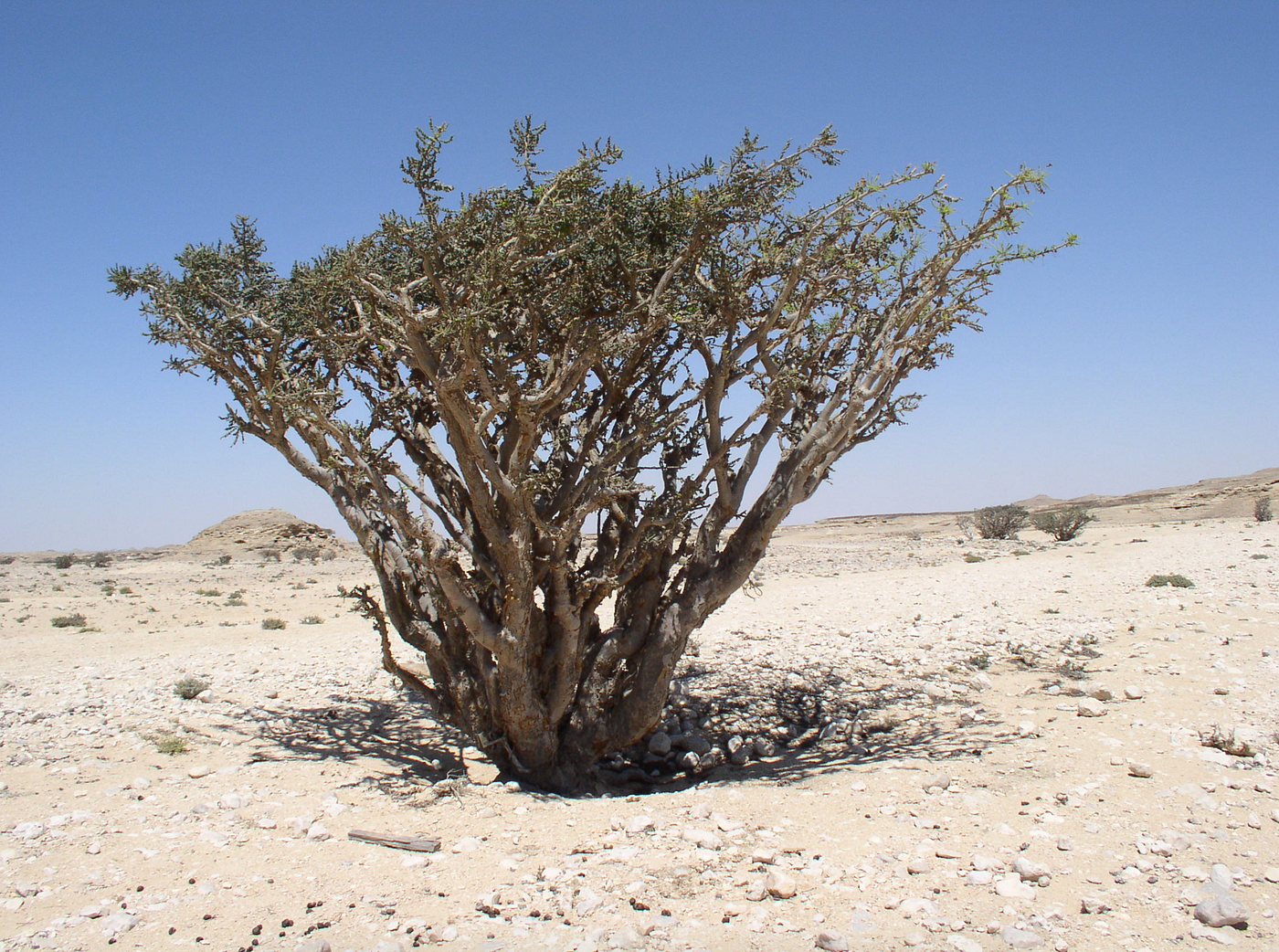
Olibanum tree or Boswelia sacra. Frankincense (Olibanum) is derived from its sap (image from Wikimedia)

Olibanum tree or Boswelia sacra flowers (image from Wikipedia)

Commiphora myrrha, from which myrrh is obtained (image from Wikipedia)
Petra’s decline was hastened and sealed after it was devastated by two earthquakes in the 4th and, later, the 8th century AD. Gradually, the city was abandoned and it slipped into total obscurity, unknown to the outside world. Only the local Bedouin tribes knew about its existence, but they kept it a closely guarded secret.
Petra lay hidden, unknown to the world for several centuries, till it was discovered by an intrepid Swiss explorer, Johann Ludwig Burckhardt, in 1812. Burckhardt, who was fluent in Arabic and was also known as ‘Sheikh Ibrahim’, smuggled himself into Petra piercing the veil of secrecy around the place disguised as a Bedouin. In the mid-19th century, a Scottish artist, David Roberts, visited Petra. His evocative drawings, published in the 1840s, took the first images of Petra to the outside world.

Johann Ludwig Burckhardt alias ‘Sheikh Ibrahim’ (image from Wikipedia)

One of the paintings of Petra by David Roberts

Another painting of Petra by David Roberts
These beautiful paintings caught the imagination of the public across many countries. As a result, tourists started to trickle into Petra as early as the latter half of the 19th century.
Petra was immortalised in an 1845 poem, ‘Petra’ by John William Burgon, a Victorian poet. His lines,
“…match me such marvel save in Eastern clime,
a rose-red city half as old as time.”
which have been widely used to describe Petra as “a rose-red city half as old as time”, added to the allure of the place.
Since then, Petra has figured in a number of novels, including Agatha Christie’s Hercule Poirot story, ‘Appointment with Death’, published in 1938, and other works of fiction, popular movies and even in a Tintin comic by Herge (‘The Red Sea Sharks’).


Agatha Christie’s 1938 Hercule Poirot novel, ‘Appointment with Death’, was set in Petra

Tintin arrives in Petra (The Red Sea Sharks)
It is said that 85 per cent of the ruins of this magnificent, ancient city, visited by over a million tourists annually, still remains to be excavated.
(To be continued in Part 19)
메타데이터
- post_id
- f43d8b1d29c8
- slug
- a-journey-to-jordan-part-18-f43d8b1d29c8
- url
- https://medium.com/@ranjitrajan.ent/a-journey-to-jordan-part-18-f43d8b1d29c8
- canonical_url
- https://medium.com/@ranjitrajan.ent/a-journey-to-jordan-part-18-f43d8b1d29c8
- author_url
- https://medium.com/@ranjitrajan.ent
- status
- ok
- fetched_at
- 2026-07-28 07:07:08