MOVIE REVIEW: Swing Vote (2008)
An incorrect, wish fulfillment movie sold as civics lesson.
MOVIE REVIEW: Swing Vote (2008)
[CW: 2000 US presidential election, voter fraud]
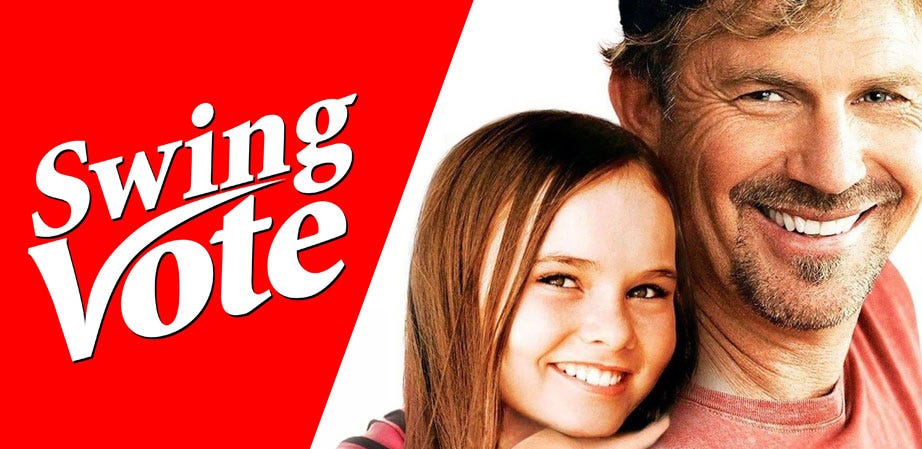
I have an immigrant friend who obtained their citizenship during the early 2000s. When they were studying for their entry test, they would ask me questions about the branches of government, the names and positions of the states, and how voting worked. That last one was a bit confusing, as I was in town when the 2000 US presidential election was decided for Texas governor George W. “Dubya” Bush by then-Florida Secretary of State Katherine Harris. Considering all that came after Dubya’s first election, I wasn’t sure how voting worked anymore despite hearing calls in the years following from several fringe political groups to dissolve the electoral college. The years would roll on and a movie would come out that would touch on the most commonly-known decider of elected leaders — the popular vote — in a partially fictional lesson on politics, civic duty, and the voting process called Swing Vote.

YOUR VOTE MATTERS: Incumbent US president Andrew Boone (Kelsey Grammer) needs the vote of Bud (Kevin Costner) to defeat the challenger, Senator Donald Greenleaf (Dennis Hopper).
The character of New Mexico native Bud (Kevin Costner, Tin Cup [1996]) could be considered a multi-hyphenate one: he’s a blue-collar worker, a good-hearted drunk, and an absent-minded father. His daughter Molly (Madeleine Carroll, Indivisible [2018]) is a very focused child, doing most of the things Bud’s supposed to do as an adult like sending off bills with their checks in the mail. She wants to see her dad and mom Larissa (Mare Winningham, Turner & Hooch [1988]) back together again, but it’s hard when both your parents have substance abuse issues. So she throws herself into school and learns about the civic duty of voting. A presidential election’s coming up…but has her dad voted yet? Bud’s the type to forget his own head if it wasn’t screwed onto a beer, and he misses the cutoff to vote because he got drunk at the bar and passed out. Molly was waiting at the polling office with all his voting info, and when he doesn’t show up she votes in his place. The machine malfunctions and does not register the vote correctly, and Molly leaves before she can be confronted. As a result, Bud’s vote got counted but for whom he voted for was unclear on the ballot.
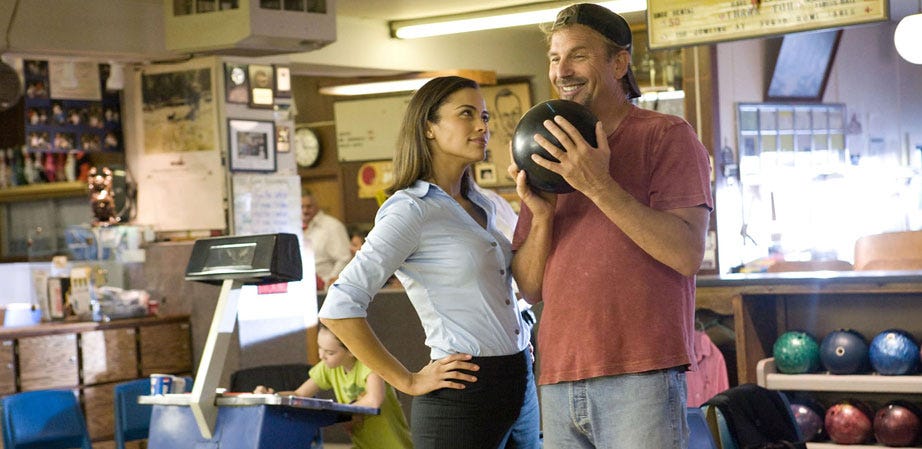
UP-CLOSE INTERVIEW: Reporter Kate Madison (Paula Patton) does her best to get the scoop on Bud during a game of bowling.
When the votes are reported by TV presenter Kate Madison (Paula Patton, *Warcraft [2016]), it comes down to ONE vote — Bud’s unclear vote. The two politicians vying to win — Republican incumbent President Andrew Boone (Kelsey Grammer, “Frasier” [TV-NBC]) and Democratic challenger Senator Donald Greenleaf (Dennis Hopper, Speed [1995]) — find out Bud’s information and send their agents to learn more about this lone voter. Art Crumb (Nathan Lane, The Lion King [1994]) works for Greenleaf and tries to appeal to Bud’s down-home roots, while Boone’s man Martin Fox (Stanley Tucci, The Devil Wears Prada 2 [2026]) abuses the government’s legal authority pull strings for Bud so he sees them favorably. These fixers go all-out to give Bud whatever he wants before he wants it: famous people drop by and invite him to amazing events, pardoning his old buddies and freeing them from jail, he starts receiving gifts from anonymous donors, and the candidates change their talking points and directions based on Bud’s understanding of the situation. One of the candidates even goes so far as to directly bribe Bud with a potential lobbying job for his vote. The fame of being the sole deciding vote in a presidential election carries its own celebrity, and every news commentator has Bud’s name on their lips. This leads Kate into an interview with Bud at the behest of her boss Jerry (George Lopez, “The George Lopez Show” [TV-ABC], Blue Beetle [2023]), when she learns that the man who’s about to decide the direction of the nation with his vote knows absolutely nothing* about the candidates or their platforms.
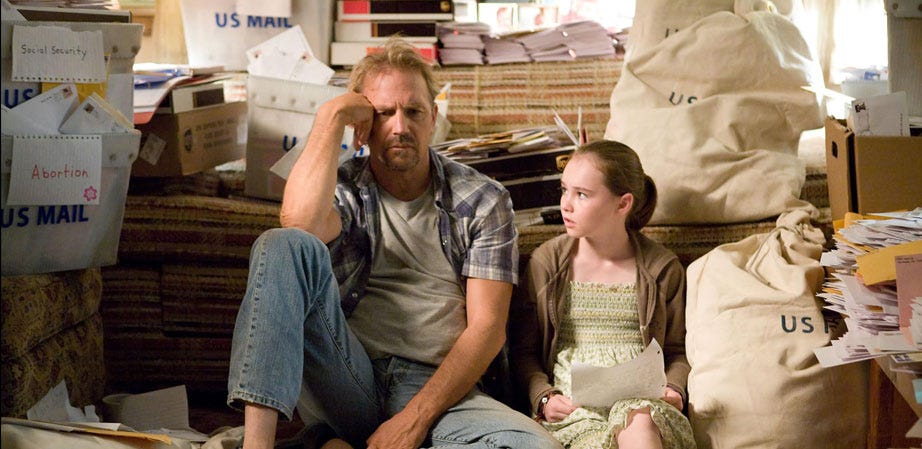
VOTING ON THE ISSUES IS HARD: Bud and Molly (Madeleine Carroll) work on understanding the issues of voters, so he can make the right choice at the ballot box.
What comes after is very important, because when Bud’s home address gets leaked everyone starts to write to him about how he should vote. The hate mail and death threats get filtered out, while Molly sorts the concerns: abortion, Social Security, and so-on. It’s all very stressful to deal with, in addition to the family drama between Bud and Larissa and the growing relationship between father and daughter. Eventually Kate and Molly get Bud up to speed on the issues, culminating in a televised debate between Greenleaf and Boone…with Bud as the moderator. It all ends on a cliffhanger, with Bud casting his vote as a Molly looks on with pride.
The audience never finds out who Bud voted for, because it’s less about who he voted for…but that he voted with a well-informed mind about the candidates and their platforms to ensure his vote would be the right one for everyone.
My immigrant friend saw this film and thought it was the dumbest ending he’d ever seen. Why would the movie put us through all this foolishness, he reasoned, to NOT tell us who the man voted for in the end? I took the time to explain to him that part of the voting process in America is to not tell anyone about your voting choice before or after casting your vote. This maintains the integrity of the ID security of all voters and spreads the responsibility made by some voters across the entire spectrum. This also means we would have to look at what decisions we make as voters and how they affect our neighbors. Normally this works in a mostly homogenous community, but when people start making political decisions about others based on factors they can’t change (race, creed, color, national origin, sexual orientation, etc.) and labeling one or the other as “good” or “evil”, then dangerous assumptions are made and can lead to grave consequences about the future of our world. Take into consideration that most international refugees are political — that they left their countries because they could not vote freely, and face social ostracization at least or summary execution at worst if they express political decisions openly. Knowing my immigrant friend still thought it would be a good idea to make a snap moral judgement about Bud’s vote tells me a lot about how those assumptions can keep someone from learning the lesson.
Swing Vote was unlike most politically-themed movies of the early 2000s. Most political films could be considered comedies or dramas or rare combination genres like Oliver Stone’s biographical film W. [2008] to keep the audience focused, yet Swing Vote doesn’t do that. It’s dead-set on delivering a lesson to the viewer on the civic duty of voting. Sadly, most contemporary voters had to sit through two presidential terms of Dubya and didn’t want to be lectured to about how voting works. So many people I know simply shrug and say “it’s all rigged”, “abolish the electoral college”, and don’t vote as a result. Even more people can’t vote because they were educated in a particular mindset that ultimately led to them losing their voting rights. Worse are the ones who don’t register to vote and complain about those that do vote…or even stranger, hold themselves higher than eligible and active voters on religious grounds. Swing Vote was an antidote to this kind of thinking, as it tried to educate those who may not know what voting is all about and portray the educational aspect and voting process in a positive light. Unfortunately the film leans more towards individual and immediate wish fulfillment as a prerequisite to gain a vote, which is how populist demagogues without any plans for leadership get into power. Because while a cheap red hat, a beer, or a big party featuring a live performance from Willie Nelson might feel like a win in the moment, these tokens won’t secure your future and they can be taken away at the flash of a pen or a word. And too many people have taken the token rather than do the work to learn about the candidates and ensure their future.
Be like Bud and Molly: Do the work.
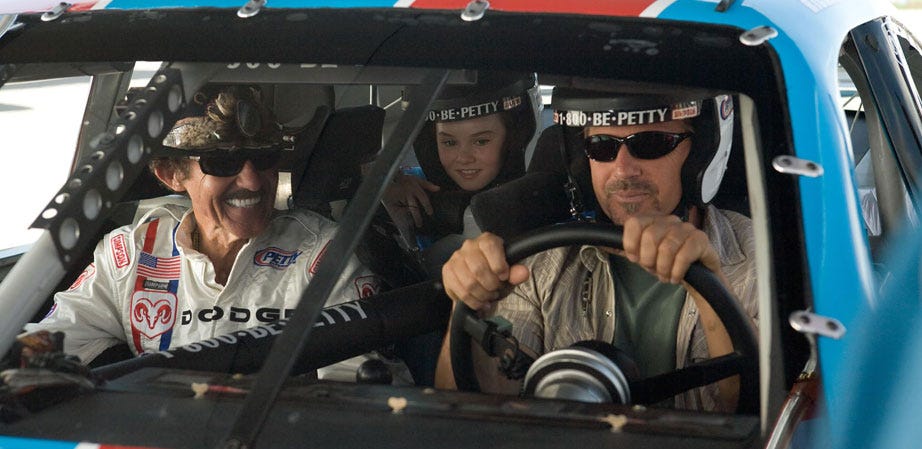
WISH FULFILLMENT: Bud gets to tool around in a NASCAR stock car with Richard “The King” Petty riding shotgun, and young Molly in the back.
CHOICE CUTS:
- This movie is not to be confused with the 1999 ABC made-for-TV movie *Swing Vote, set in an alt-universe where [Roe v. Wade](https://en.wikipedia.org/wiki/Roe_v._Wade)* is overturned and one of the southern American states charges a woman with first-degree murder for having an abortion. In case you missed it, we currently live in that alternate universe.
- The malfunctioning voting machine gives me nightmare flashbacks to the “hanging chads” controversy of the early 2000s.
- FUN FACT: There are very few extenuating circumstances where an entire national election will be paused until ONE person votes. Normally, if a person misses their chance to vote, their vote is not counted and the election moves on without their vote.
- CAMEO: Nana Visitor (“Star Trek: Deep Space Nine” [TV-CBS]) plays Senator Greenleaf’s wife Galena, who gives him an amazing slap to the face for switching on his policy promises to get Bud’s vote.
- Fraudulent voting in the state of New Mexico (as Molly did for her father) is a fourth-degree felony as listed in the 2025 New Mexico Statutes.
메타데이터
- post_id
- f44f00443420
- slug
- movie-review-swing-vote-2008-f44f00443420
- url
- https://medium.com/@swatson7856/movie-review-swing-vote-2008-f44f00443420
- canonical_url
- https://medium.com/@swatson7856/movie-review-swing-vote-2008-f44f00443420
- author_url
- https://medium.com/@swatson7856
- status
- ok
- fetched_at
- 2026-07-29 07:49:46