7 Post-Processing Shaders That Change Your Godot 4 Game's Entire Visual Identity
Lo-Fi Retro, Manga Halftone, Oil Painting, ASCII Cyberpunk and more — 7 single-pass shaders for Godot 4.7+, $9 this week with EARLYBIRD40.
7 Screen-Space Shaders That Will Transform Your Godot 4 Game’s Visual Identity
Your Godot 4 game’s art style is a first impression. Players decide in seconds whether your game looks intentional or thrown together ; and default PBR shading is not an answer.
Most indie games ship with the exact same lighting model, the same material responses, the same visual language. Nothing wrong with Godot’s renderer; it’s genuinely excellent. But if every game in your genre looks the same, your art style stops being a differentiator and starts being a liability.
Post-processing shaders solve this at the screen level. One full-screen pass, applied after the scene renders, and your entire game looks like a different artistic medium entirely.
What’s in the Shader Showroom Pack
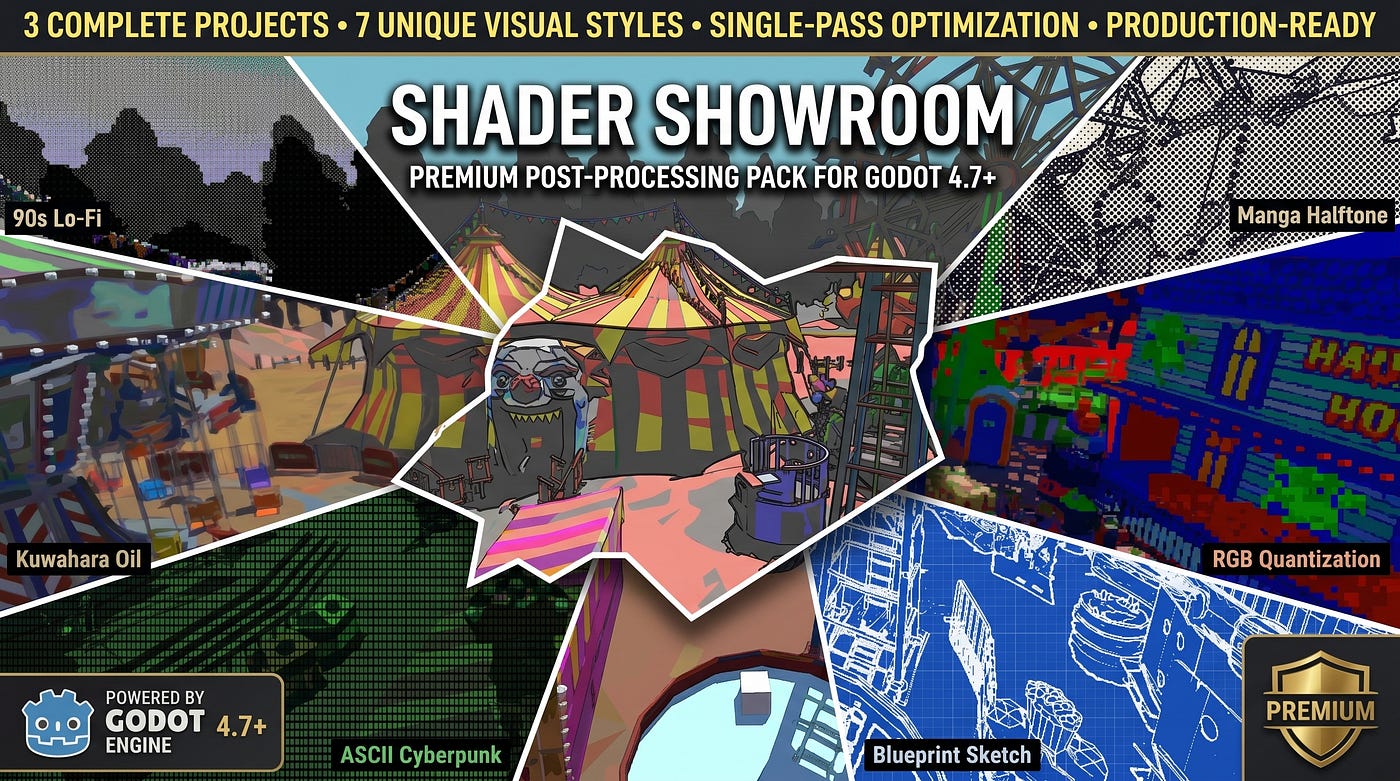
The Shader Showroom Pack is 7 production-ready screen-space post-processing shaders for Godot 4.7+, each one transforming your entire scene into a distinct visual identity. No per-object material swaps, no complex node setups, drop the shader onto a ColorRect in a CanvasLayer and it works.
Before we get into the pack I would like to tell that the shader Showroom pack is at 40% sale till 1 June 2026
→ SO PICK IT FAST AND DON’T REGRET and lets continue with our tour.
Here’s what you get:
1. 90s Lo-Fi Retro

Pixelation, ordered Bayer dithering, and color quantization down to 8 levels per channel. Captures the exact texture of PS1-era 3D: crunchy, nostalgic, and immediately readable as intentional. Single texture sample, runs on anything.
2. Manga Halftone

A 45° circular dot-matrix with luminance-driven dot sizing, composited over a full 3×3 Sobel edge detection pass for thick ink outlines. The result looks like a scanned comic page: high contrast, graphic, tactile. Works especially well on environments with strong silhouettes.
3. Anime Cel-Shading

4-band flat posterization with a 15% shadow lift to keep detail in dark areas, plus 1.4× saturation boost and 4-neighbor edge detection that bleeds to dark brown instead of pure black. Bright, clean, and high-energy: the look you see in budget anime productions done right.
4. Oil Painting (Kuwahara Filter)
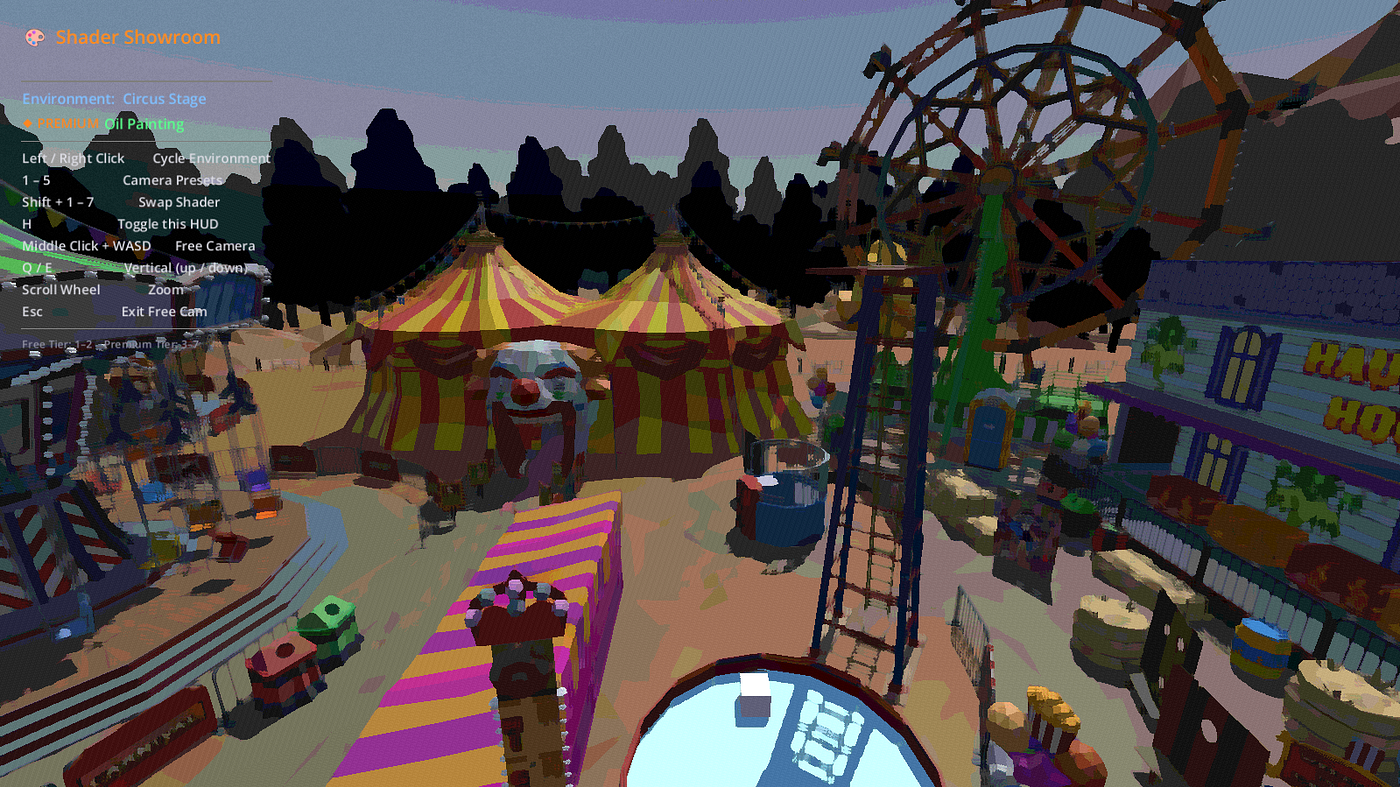
The most visually impressive shader in the pack. A 4-quadrant Kuwahara smoothing pass selects the region of lowest variance per pixel, turning every frame into something that reads like a hand-painted canvas. Color banding and subtle hash-based grain finish the effect. Adjustable brush radius from 2 to 5.
5. ASCII Cyberpunk

Divides the screen into 8×12 pixel character cells, samples luminance per cell, generates a pseudo-glyph mask from local cell coordinates, and outputs everything in green phosphor: vec3(0, 1, 0.2). High-luminance areas become solid blocks, low-luminance areas become sparse characters. One texture sample, near-zero performance cost, maximum personality.
6. Blueprint Sketch

A drafting-board aesthetic: deep blueprint blue background with a minor 20px grid and major 100px grid, then Laplacian edge detection using 4 cardinal neighbors thresholded at 0.12 for crisp chalk-white lines. **Architectural, minimalist, technical.** Turns any 3D scene into a design document.
7. RGB Quantization

Snaps every pixel block to its dominant color channel: pure red, green, or blue; then scales output by average luminance to preserve brightness variation across the scene. Bold, graphic, aggressively neon. The most polarizing shader in the pack, and the most memorable.
The Interactive Showroom
Every shader ships alongside a fully interactive 3D showroom built in Godot 4.7 (Forward+). Three distinct environments: a circus stage, a modern apartment interior, and a classic Mercedes-Benz 190E. Five preset camera angles, a free-cam mode with WASD movement and scroll zoom, and real-time shader swapping via keyboard shortcuts.
This matters because testing a screen-space shader on a floating test sphere tells you almost nothing. You need geometry variety, lighting contrast, and spatial depth to actually evaluate how a shader transforms a scene. The showroom gives you that across three completely different visual contexts, so you know exactly what it looks like, before you drop it into your project.
Technical Specs
- Engine: Godot 4.7+, Forward+ renderer
- Architecture: All 7 shaders are single-pass canvas_item shaders
- Compatibility: Direct3D 12, Vulkan, Metal
- Integration: Full-screen ColorRect inside CanvasLayer — no scene modifications required
All shaders use correct sampler declarations and are built around the actual constraints of Godot’s Forward+ pipeline. Drop them in, they work.
Launch Week Pricing
The pack is $9 this week with code EARLYBIRD40 — that’s 40% off the regular $15 price. The discount expires June 1st.
If your game needs a visual identity and you’re tired of staring at default PBR, this is the fastest way to find one.
**Grab the Shader Showroom Pack at $9 →**
Use code EARLYBIRD40 at checkout. Offer ends June 1st.
메타데이터
- post_id
- f45fda9b2dbf
- slug
- 7-post-processing-shaders-that-change-your-godot-4-games-entire-visual-identity-f45fda9b2dbf
- url
- https://medium.com/@weasert/7-post-processing-shaders-that-change-your-godot-4-games-entire-visual-identity-f45fda9b2dbf
- canonical_url
- https://medium.com/@weasert/7-post-processing-shaders-that-change-your-godot-4-games-entire-visual-identity-f45fda9b2dbf
- author_url
- https://medium.com/@weasert
- status
- ok
- fetched_at
- 2026-06-16 19:09:56