Cognitive Consent
How AI Platforms Engineer Permission While the Law Still Regulates Paperwork
Cognitive Consent
How AI Platforms Engineer Permission While the Law Still Regulates Paperwork

There is a screenshot that deserves more attention than it will probably receive. Someone opens Google Photos on an Android device and searches for the word "clipper." The search returns nothing. No matching photos. No suggestions. Just the standard empty-state interface and a line that says "Try searching for a similar word." But before the user’s eyes can even process that nothing was found, Google places something else directly in front of them. A banner.
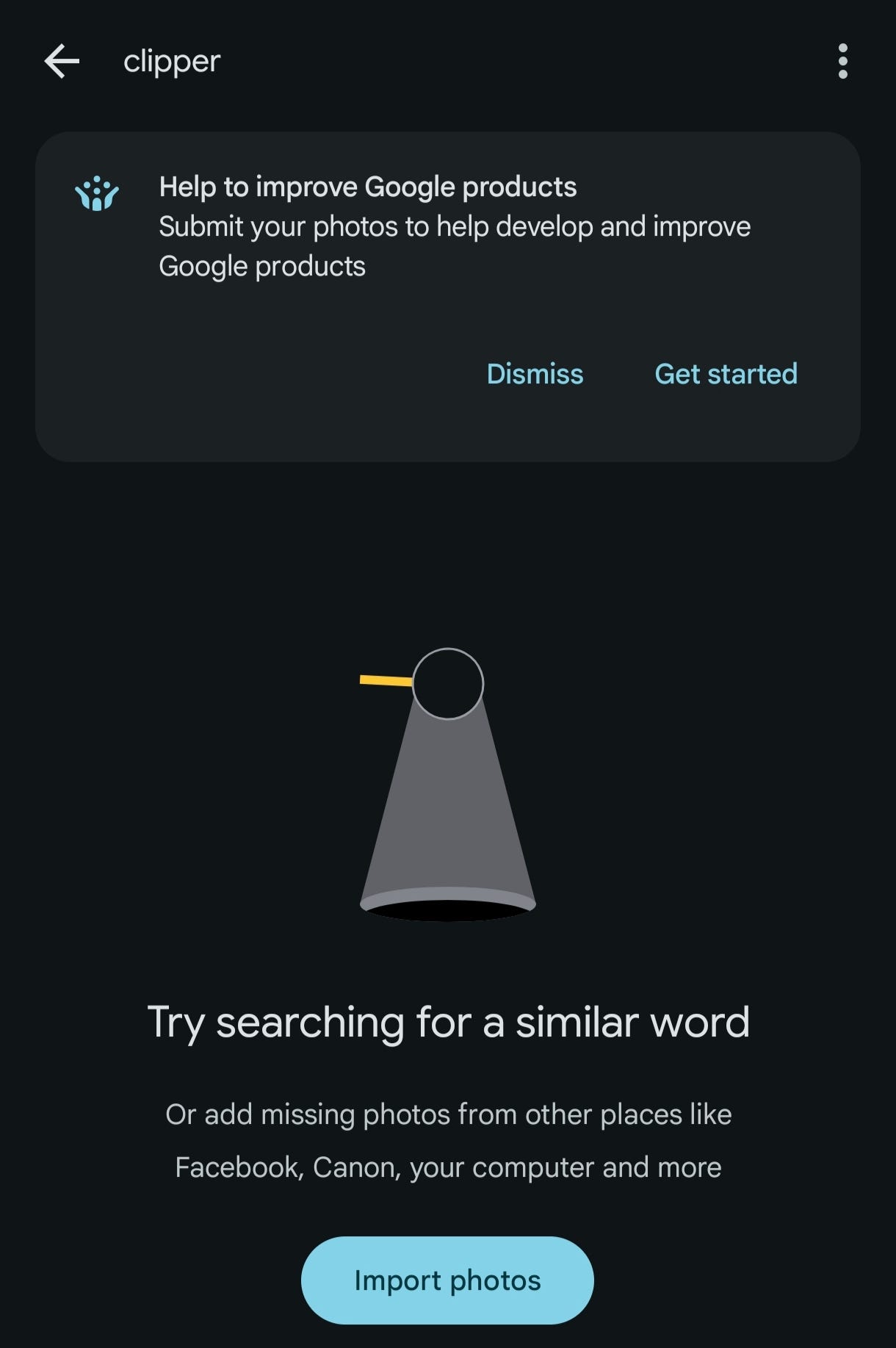
"Help improve Google products. Submit your photos to help develop and improve Google products." Two choices. Dismiss. Get started. To most people, this looks like another harmless prompt. To a UX researcher, it is a carefully engineered behavioral intervention. To a privacy scholar, it is an example of modern consent architecture. To a regulator, it should be evidence. Because nothing about that screen is accidental. And the problem is not that Google asked. The problem is when they asked, how they asked, and what the law has decided to make of it.
The Empty Page Is the Hook
Technology companies spend enormous resources studying what happens inside your mind when you interact with their products. Not metaphorically. Entire research divisions exist to map attention, hesitation, frustration, curiosity, disappointment, reward, and habit formation. These are not side projects. They are competitive advantages. Google employs behavioral scientists, UX researchers, cognitive psychologists, economists, and machine learning engineers whose collective job reduces to one question: how do people behave at every moment of interaction? That knowledge is then translated into interface design. Every button, every animation, every delay, every color, every placement, every word is tested. Nothing survives by accident. So when Google decides that a request for your personal photographs should appear precisely after a failed search, that decision passed through dozens of discussions, prototypes, A/B tests, usability studies, and legal reviews. The location was not chosen aesthetically. It converted better. Modern AI interfaces are designed around predictable cognitive vulnerabilities. Behavioral economics has identified several that appear with enough consistency to be considered reliable engineering inputs. Four of them are visible in the Google Photos banner. Interruption. One of the most reliable moments of reduced cognitive resistance occurs immediately after an expectation fails. You expected a result. You received none. Your brain enters a state of interrupted goal pursuit, where the original objective is blocked and attention becomes unusually receptive to alternatives. This is exactly why empty-state interfaces are among the most valuable real estate in modern software. Users do not know where to look next. So they look where the platform tells them. Framing. The banner reads "Help improve Google products." Not "Provide commercially valuable training data for our AI systems." Those two sentences describe the same transaction. But they feel entirely different. One sounds charitable. The other sounds commercial. Language changes perception without changing fact. Behavioral scientists call this framing. The law calls it disclosure and treats both versions as equivalent. Default bias. "Get started" appears on the right, which is the position the eye naturally reaches for when expecting a primary action on mobile. "Dismiss" appears on the left. The buttons carry equal visual weight. They do not carry equal psychological weight. Authority cues. The request comes from inside an application the user already trusts with their most personal memories. That relationship, built through years of storing photographs, creates a credibility transfer. The platform asking is not a stranger. It is a custodian. Requests from custodians feel different from requests from strangers, even when what is being requested is substantively different from what the custodian relationship originally implied. Each of these mechanisms is individually defensible. Together they constitute what might be called a consent architecture: an environment engineered to produce a specific behavioral outcome in a population of users who are not examining the environment, because they are busy looking for a photograph. The banner does not merely inform. It redirects. You came looking for your own memories. Google uses that moment to capture something it needs.
What Is Actually Being Collected
Google is not collecting photographs. Google is collecting permission. Photographs are the medium through which permission becomes scalable. To understand why permission is the more accurate description, you need to understand what a photograph is in 2026. A photo is not pixels. Modern smartphone images carry EXIF metadata embedded in the file itself: precise GPS coordinates, timestamps to the second, device model and identifiers, lens specifications, camera settings, and altitude. To a human, one picture. To a machine learning model, thousands of labeled variables. Beyond metadata, the images are processed through computer vision systems that identify faces, recognize objects, suggest memories, and enable content-based search. This is how Google Photos lets you search for "dog," "birthday," "blue car," or "graduation" without manual tagging. That capability exists because billions of images have trained increasingly sophisticated vision models over many years. What changes when you submit photos through the improvement program is the license under which that processing occurs. Your photos shift from being processed to serve you to being used to train models that serve Google’s products, which is to say, Google’s revenue. The submitted content enters a pipeline with different retention policies, different use permissions, and different anonymization standards than your regular photo backup. But the deeper point is not what happens to this photo. It is what this photo authorizes for the future. Every piece of consent obtained today expands the surface area of data extraction for uses that do not yet exist. Photographs submitted to "improve Google products" in 2026 may contribute to AI systems whose architecture has not yet been designed. The consent is forward-dated by default. Users have no mechanism to anticipate, evaluate, or withdraw from applications that have not yet been conceived. This is why the banner is not asking for a photograph. It is asking for a permission that will outlive the photograph’s immediate utility. Real-world photographs are extraordinarily valuable for training vision models precisely because they are diverse, unscripted, constantly updated, and geographically varied in ways that curated or synthetic datasets cannot replicate. The platform needs them. The banner exists because the platform needs them. The cognitive architecture surrounding the banner is a direct reflection of how much.
The Two Kinds of Consent
The law currently recognizes one kind of consent: procedural. A checkbox appeared. The user clicked. A timestamp was recorded. Consent was obtained. The legal requirement is satisfied. What the law has not yet seriously confronted is cognitive consent, which asks a different and harder question: did the user understand, in the conditions under which they were asked, what they were actually agreeing to, and did those conditions preserve the kind of deliberation that makes agreement meaningful? Procedural consent is a documentation standard. Cognitive consent is a comprehension standard. They are not the same thing. And the gap between them is where most of the AI economy currently operates. To meaningfully consent in the cognitive sense, an individual would need to understand what information is being collected, why it is collected, how long it will be stored, who will access it, whether it will train AI systems, whether it will be shared with contractors, whether it can be linked with other datasets, and whether it can ever be fully removed from a trained model. That is an extraordinary amount to evaluate accurately in a split second, on a phone, while searching for a missing vacation photo. The fiction of the fully informed user persists because it is legally convenient. Privacy policies are among the least-read documents in the digital world. Those who attempt to read them encounter thousands of words of legal language written to minimize liability rather than to maximize understanding. The legal system treats these agreements as contracts between equals. One side employs behavioral scientists, interface designers, economists, and lawyers whose full-time function is consent acquisition. The other side simply wants to find a photograph. The most common defense when privacy controversies surface is: you agreed to the terms. Legally, that sometimes carries weight. As a description of what actually happened cognitively, it explains almost nothing. A user who tapped "Get started" during interrupted goal pursuit, primed by authority cues and a charitability frame, operating at the speed of mobile interaction, did not make the same kind of decision as a user who read a plain-language summary, considered alternatives, and chose to participate. The law treats both as identical. They are not.
The Interface Is Now a Legal Instrument
Dark patterns are typically treated as UX problems. They are not. They are mechanisms for manufacturing procedurally valid consent without producing cognitively genuine consent. The Google Photos banner does this through the four mechanisms described above. None of it is illegal. All of it is deliberate. And the more important argument goes further than any single banner. Every button placement, every timing decision, every color choice, every empty-state intervention influences a legally significant outcome. The interface is no longer merely software. It is a legal instrument operated at millisecond resolution, continuously optimized through A/B testing and behavioral science, and largely invisible to the regulatory frameworks designed to protect people from exactly this kind of engineered agreement. For twenty years, privacy law has focused almost exclusively on what companies collect. Almost nobody has asked how they persuaded someone to hand it over. Whether the mechanism of consent itself meets any ethical standard has been left almost entirely unexamined. The mechanism is, in the regulatory sense, treated as irrelevant. Only the outcome matters. Did the user click? Then consent occurred. This is where the structural problem becomes clear. Product teams optimize cognitive behavior continuously. Regulatory review, if it occurs at all, is retrospective, slow, and evaluates documents rather than decision environments. A company can deploy a new consent flow in an afternoon. Regulatory investigation of that flow, if triggered, takes years. By the time any finding is reached, the interface has been redesigned dozens of times, each iteration informed by behavioral data about where users hesitate, what language reduces resistance, and which placement maximizes conversion. The law regulates paperwork. Platforms regulate cognition. That is not a metaphor. It is a description of the current division of labor between legal accountability and commercial engineering.
Why Existing Frameworks Are Insufficient
The European Union’s General Data Protection Regulation was the most serious attempt to update the notice-and-consent framework for the digital age. It introduced requirements that consent be freely given, specific, informed, and unambiguous. It established data minimization and purpose limitation. On paper, these represent a meaningful advance over simple checkbox compliance. Under a strict GDPR reading, the Google Photos banner has genuine problems. Consent obtained during a distress-moment placement with cognitively asymmetric design is arguably not "freely given" in the regulation’s intended sense. Repurposing submitted photos for AI training is a commercial purpose separate from improving the user’s Photos experience and arguably violates purpose limitation. But the operative word in both sentences is "arguably." Regulators have been slow to test these arguments against major platforms at scale. Google has legal teams whose function is to stay ahead of where arguments land. In the United States there is no federal comprehensive data privacy law. In Nigeria, the Nigeria Data Protection Act 2023 is broadly aligned with GDPR in principle, and on paper the banner’s downstream uses would face real scrutiny. In practice, enforcement capacity is still developing. Google, operating across 190-plus countries with localized compliance infrastructure, is not primarily worried about regulatory action in Awka or Lagos. The law exists. The deterrent does not yet match its scope. Across the Global South broadly, the same pattern repeats: frameworks increasingly sophisticated in design, enforcement lagging by years, and platforms whose growth strategies in these markets reflect that knowledge precisely. But the deepest problem is not enforcement capacity. It is doctrine. GDPR attempted to regulate data. Google learned to regulate decision-making. The law still scrutinizes disclosures while platforms optimize cognition. The entire doctrine of consent assumes that users understand what they are agreeing to, deliberate before deciding, can meaningfully compare alternatives, and exercise genuine free choice. AI products operating at Google’s scale violate every one of those assumptions simultaneously. Nobody evaluates fifty permission prompts a week with full comprehension. Nobody understands downstream model improvement or what their submission will be used for in three years when a new generation of AI systems is under development. Nobody has equal bargaining power against a platform managing the photo archives of two billion people. The conclusion is not comfortable but it is accurate: procedural consent, as currently defined and enforced in almost every jurisdiction, has become a legal fiction. The documentation exists. The comprehension does not. And regulators continue to accept the documentation as sufficient.
What Cognitive Consent Would Require
Meaningful reform in this area is not primarily about stronger enforcement of existing standards. It is about upgrading the standard itself. Cognitive consent, as a legal standard, would shift the evaluative question from "did the user click?" to "did the conditions under which the user was asked preserve the deliberation that makes consent meaningful?" That is a harder question to operationalize. It is also the right question. In practice it would require several things. High-stakes data requests, specifically those involving biometric data, content used for AI training, or persistent behavioral data, must occur in contexts that support deliberate decision-making. Not embedded in the failure states of unrelated interfaces. Not during interrupted goal pursuit. Not during any cognitive state that behavioral research identifies as reducing deliberative capacity. The timing of consent cannot be left to the discretion of the party that benefits most from capturing it at the worst possible moment. The mechanism of consent must become subject to legal standards, not only its existence. How consent was obtained must carry as much legal weight as whether it was obtained. Interface design choices that predictably reduce deliberative capacity must be treated as material to the validity of the resulting consent, not as neutral aesthetic decisions that fall outside privacy law’s scope. Regulators must develop the institutional capacity to evaluate interfaces in real time, not documents in retrospect. This requires technical expertise, adequate funding, and the legal authority to audit behavioral optimization systems as part of privacy compliance review, not separately from it. Helen Nissenbaum’s contextual integrity framework offers one principled foundation. The core idea is that privacy is violated not only when data is exposed, but when it flows in ways that violate the reasonable expectations of the context in which it was shared. A photo stored in a personal archive carries a reasonable expectation that it will not be repurposed for commercial AI training. Encoding that principle into enforceable law would close the gap that procedural consent leaves permanently open. Global coordination remains unavoidable. Platforms operate across jurisdictions. Companies design practices to the tolerance of their most permissive operating environment. A meaningful minimum baseline must apply regardless of where the platform is headquartered or where the user happens to live. None of this prevents innovation. It requires innovation to occur through informed cooperation rather than engineered agreement.
The Larger Stakes
This essay has used Google and one banner as its case study. The argument extends considerably further. The incentives described here, collecting consent at scale, refining behavioral environments through interface design, and transforming human experience into AI training infrastructure, are visible across most of the technology industry. Different companies pursue different models. Different products collect different data. But the underlying dynamic is consistent: the mechanism of consent has been left almost entirely to the discretion of the parties that benefit most from capturing it at moments of lowest cognitive resistance. That arrangement is not sustainable. Trust is not infinitely renewable. Users who understand, and they are beginning to understand, that digital consent has been systematically engineered to extract maximum agreement at moments of minimum deliberation will not react with gratitude. The long-term legitimacy of the AI economy rests on whether the people whose experiences power it believe they are genuine participants or invisible contributors.
Conclusion
Every previous generation of technology expanded what humans could do. Artificial intelligence expands what platforms can influence. The distinction matters. Privacy law was written for an era in which information was scarce and decisions belonged almost entirely to people. AI systems blur that boundary at scale. They do not merely process choices. Increasingly, they shape the conditions under which choices are made: the environment in which attention flows, the moment at which requests arrive, the language in which transactions are framed. The interface is no longer a neutral surface for communication. It is an optimized environment for manufacturing agreement. Procedural consent asks: did the user click? Cognitive consent asks: did the user understand? Those are different questions. The first is easy to satisfy. The second is easy to ignore. And the gap between them is where billions of permissions, and the AI systems they feed, are currently being built. The next generation of digital rights will not be defined by who owns our data. It will be defined by whether the law recognizes that cognition itself has become a space requiring protection. Whether the conditions of comprehension, not only the existence of disclosure, must be held to a legal standard. Whether the sophistication brought to extracting agreement must be matched by the sophistication brought to evaluating it. Until that standard exists, informed consent will remain one of the internet’s most persuasive fictions.
Chukwuemeka is the founder of Emilo Labs, where he builds infrastructure at the intersection of digital identity, privacy, and decentralized systems. He believes the next generation of the internet should be built on resilient digital infrastructure, meaningful data sovereignty, and technologies that expand, rather than diminish human agency.
메타데이터
- post_id
- f46ae290e06d
- slug
- cognitive-consent-f46ae290e06d
- url
- https://medium.com/@generous_shimmer_crow_900/cognitive-consent-f46ae290e06d
- canonical_url
- https://medium.com/@generous_shimmer_crow_900/cognitive-consent-f46ae290e06d
- author_url
- https://medium.com/@generous_shimmer_crow_900
- status
- ok
- fetched_at
- 2026-06-28 04:42:08