UNDERSTANDING YOUR CYCLE 2.
UNDERSTANDING YOUR CYCLE 2.
Menstrual Cycle refers to the cyclical changes that occur in the body of every woman. It is continuous, started at menarche ( your first Menstruation) and it will end with menopause. The most noticeable part of these changes is the periodic vagina bleeding, but there is more to the Menstrual Cycle than the flow we get every month.
The length of the Menstrual Cycle varies from each woman, and it is counted from the start of one period to the start of another. A normal Menstrual Cycle length ranges from 21-35 days. Anything below or above this range is termed an irregular period.
Menstrual Cycle is controlled by 4 major hormones. And, it is the rise and fall in the level of these hormones that is responsible for both the biological and the psychological changes we experience every month.
The main purpose of all the processes of the Menstrual Cycle is to prepare the body for the possibility of pregnancy and fertilization. That's why, if no fertilization occurs ( that's, there is no sperm to fertilize your egg), we bleed.
Remember these from our last write up?

.
.
.
So, today, I will be taking us through;
- Calculating the length of our Menstrual Cycle.
- Understanding what is meant by safe days and fertile days.
- How can we fish out these days in our cycle?
Calculating the Length of your Menstrual Cycle.
As explained in the previous write up, the length of the Menstrual Cycle is obtained by counting the number of days between two Menses. You count by starting from the first day you see your period in a month till the day that precede your next period.
Let's say in May, you saw it on the 3rd, and then, in June you saw it on the 1st of June.
So you start by counting from the 3rd of May, with it being your day 1. And, you will count till 31st of May, which is the day that precede the 1st of June that you see another menses.

The day you see your Menses ( green). So, you count from the 3rd of May till 31th of May, this gives 29 days. This means this person has a 29 day Cycle.
Variability in Menstrual Cycle.
Some people have a constant Menstrual Cycle. If they count the days between their Periods, it will always be the same. But, for some people, it always vary, this month it is 28 days, next one it is 30 days, another one gives 26 days and it continues like that.
Well,it is normal. In as much it doesn’t exceed the range of a normal cycle, which is 21–35 days. One of the factors responsible for this is stress. You only need to get your Average Cycle. Track your cycle for 4 months ( this gives 3 cycles). Then, you calculate the average by dividing by 3.
Another thing is, those with a short cycle length can menstruate twice in a month.
Here is an example;
A lady saw her flow on the 1st of June and then another one on the 29th of June. So here, we count from the 1st of June till the 28th of June.
This person has a 28 day Cycle, which has very normal.
So, don’t be surprised if you see someone Menstruating twice in a month. As long as it falls within the normal range (21–35) days, there is nothing to worry about.
That is someone with a 28 day cycle Menstruating almost twice in a month. What about those with a 25 or even 21 days cycle?
Safe Days and Fertile Days.
- Safe days are those days in your cycle in which the chance of Fertility is low. Simply put, if you have sex on these days, your chances of getting pregnant is low. Mostly, they fall in the days that comes after your menses and precede your Ovulation. Days after your Ovulation too are safe.
- Fertile Days are those days in your cycle in which the chance of Fertility is high. Some days after your ovulation are your fertile days. While the day you ovulate is your most fertile day.
Do you still remember Ovulation?
Ovulation is the phase in your Menstrual Cycle when the egg is released. Simply because it is the day the egg is released, it is your most fertile day. Ovulation occurs in a day ( scientists said most women ovulate 14 days prior to their menses. You get these by subtracting 14 from your Menstrual Cycle. For example, if your cycle is 30 days long , Subtract 14 from 30. This gives 16. This means you will ovulate on the day 16). However the egg released can survive ...( Well, some scientists said 12-24hrs, some said 24-48hrs), That’s why some days after your Ovulation are part of your fertile days.
How to calculate your Safe and Fertile Days?
- Let’s say this July, you saw your menses on the 12th and you have a constant 29 day cycle.
- By counting from the 12th, your next Menses will come on the 11th of July.
- To calculate your safe and fertile days, we will use the day 14 predicted by scientists.
- So, subtracting 14 from 29 days, Ovulation will occur on the 15th, which is the 26th of June.
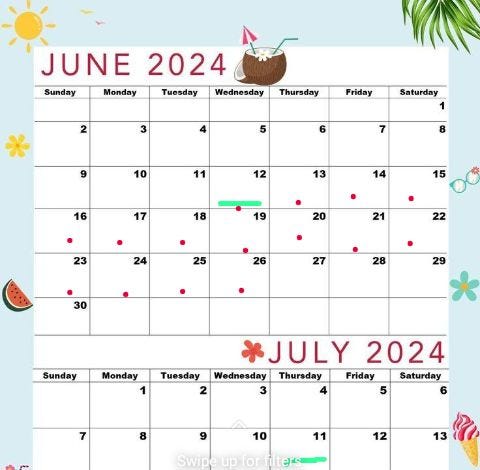
The day you see your menses ( green). So, to get your day 16 out of your 30 days cycle, count from 12thof June ( your day 1) till you reach day 16, this gives 26th of June.
Now do not forget that it is predicted. So, we extend our prediction by saying, 14±2. That’s we Subtract 2 from 14 and add 2 to 14 ( simply put in other words, count 2 days backward from 26th of June and also 2 days forward). This gives day 12 and 16 of your Cycle respectively. This means, your fertile days is from the day 12 till the day 16 of your cycle, which gives 24th, 25th, 26th, 27th and 28th of June.
Every other day aside from the five days we calculated would have been safe. But….
Unlike the egg, which can only survive 2 days at most. Sperm can survive 3-5 days in the body of a woman. Even a stronger sperm can survive 7 days.
This means, sex 5, 4 , 3, or 2 days before your ovulation can still lead to pregnancy.
How can we escape this?
Count 5 days back from your first fertile day, which is 24th of June ( according to our calculation up there). This is the 19th of June. . Your fertile days start on the 19th of June and extend till 26th.

The fertile days.
Every other day aside from these days are your Safe days.
However, this is for those with a constant cycle.
For those with a Varying Cycle. You need to.
- Track your cycle for at least 6 months.
- After doing this, fish out the longest and the shortest cycle.
- Subtract 18 from the shortest cycle. This gives your first fertile day.
- Subtract 11 from the longest cycle. This gives your last fertile day.

메타데이터
- post_id
- f48ca2c3f3c2
- slug
- understanding-your-cycle-2-f48ca2c3f3c2
- url
- https://medium.com/@adeoyeubaidah1/understanding-your-cycle-2-f48ca2c3f3c2
- canonical_url
- https://medium.com/@adeoyeubaidah1/understanding-your-cycle-2-f48ca2c3f3c2
- author_url
- https://medium.com/@adeoyeubaidah1
- status
- ok
- fetched_at
- 2026-06-09 15:37:30


