Stop Guessing in Suno AI. These 50 Prompt Techniques Will Get You to a 90% Satisfaction Rate.
Most creators treat Suno like a search engine. Here’s why that’s costing you credits — and what to do instead.
Stop Guessing in Suno AI. These 50 Prompt Techniques Will Get You to a 90% Satisfaction Rate.
Most creators treat Suno like a search engine. Here’s why that’s costing you credits — and what to do instead.
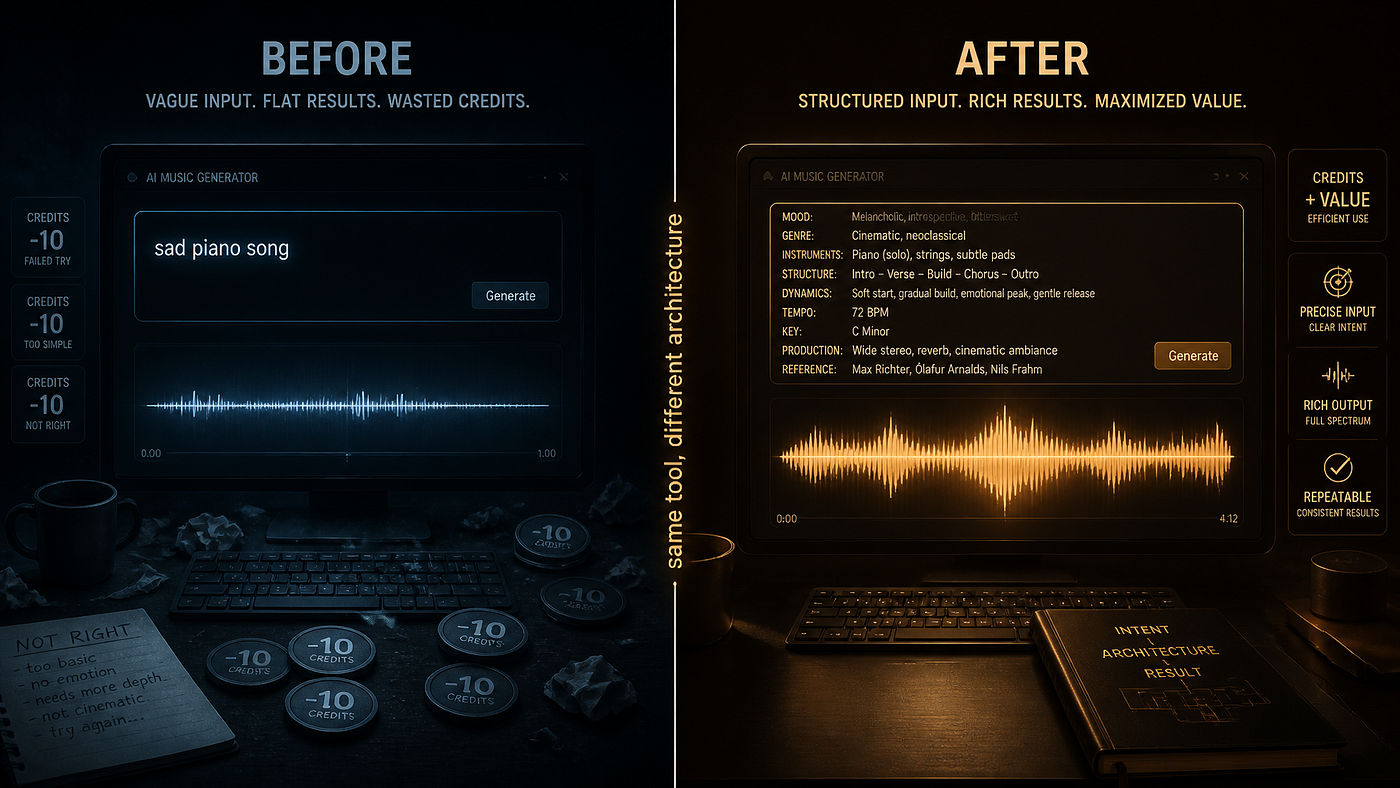
I’ve burned through hundreds of Suno credits on tracks that sounded almost right.
You know the feeling. The vibe is 70% there. The structure collapses after 30 seconds. The vocals sound like a GPS unit having an emotion. You hit regenerate. Same result.
The problem isn’t Suno. The problem is prompt architecture.
After months of testing, documenting failures, and reverse-engineering tracks that actually worked, I found a consistent pattern. The prompts that produced professional, emotionally resonant outputs shared one thing: specificity across multiple dimensions, not just genre.
Most tutorials tell you to write “lo-fi hip hop, relaxing.” That’s one dimension. The tracks that perform use five or six.
Here are 50 techniques organized by dimension. Use one and your output improves. Use three in combination and you’re building something that sounds intentional.
If you found this useful, I’ve compiled these techniques along with 300 additional tested prompts organized by genre, mood, and use case into a complete prompt pack. Details below.
Dimension 1: Genre — Go One Level Deeper
The biggest mistake I see: macro-genre tags. “Pop.” “Electronic.” “Rock.”
These give Suno a continent to work in. You want a city.
When you drop to the micro-genre level, the model has a much smaller sonic universe to draw from. The output gets specific. The output gets consistent.
1. Don’t say pop — say bedroom pop Activates: lo-fi texture, intimate mic placement, compressed warmth, DIY aesthetic. The track sounds like it was recorded in someone’s apartment at 2am. That’s the point.
2. Don’t say electronic — say downtempo electronica Activates: slower BPM range (75–95), spacious arrangement, late-night mood. “Electronic” gets you anything from EDM to ambient. Downtempo locks the tempo character immediately.
3. Don’t say rock — say post-rock Activates: dynamic structure (quiet to loud), instrumental focus, extended build sections. This is one of the most reliable micro-genres in Suno v4 for emotional arc.
4. Don’t say jazz — say lo-fi jazz hip-hop Activates: vinyl crackle, muted Rhodes or piano, relaxed drum pattern, compressed warmth. Extremely consistent in Suno. One of its strongest trained genres. Works for study playlists, content background, sleep-adjacent moods.
5. Don’t say classical — say modern classical Activates: minimalist arrangement, space between notes, ambient texture, piano or string focus. “Classical” gets you Beethoven energy. “Modern classical” gets you Nils Frahm.
Dimension 2: Emotion — Precision Over Approximation
“Sad.” “Happy.” “Angry.”
These are categories, not instructions. Suno’s interpretation of “sad” and your interpretation of “sad” might be separated by an entire sonic universe.
The fix: use secondary emotion words. They’re more specific, and they activate different sonic behaviors in the model.
6. Don’t say sad — say melancholic or wistful Melancholic carries weight without collapse. Wistful adds a looking-backward quality. Both produce more nuanced outputs than the blunt instrument of “sad.”
7. Don’t say happy — say euphoric or carefree Euphoric activates energy and lift. Carefree activates lightness without intensity. Different tracks entirely.
8. Don’t say angry — say tense or brooding Tense produces controlled aggression, useful for thriller backgrounds. Brooding gives you slow-burn darkness with restraint.
9. Don’t say calm — say serene or contemplative Serene is still and spacious. Contemplative adds movement, a mind working quietly. The difference is in how much the track breathes.
10. Don’t say romantic — say intimate and tender This two-word combination activates proximity — close mic’d vocals, soft dynamics, personal rather than cinematic scale.
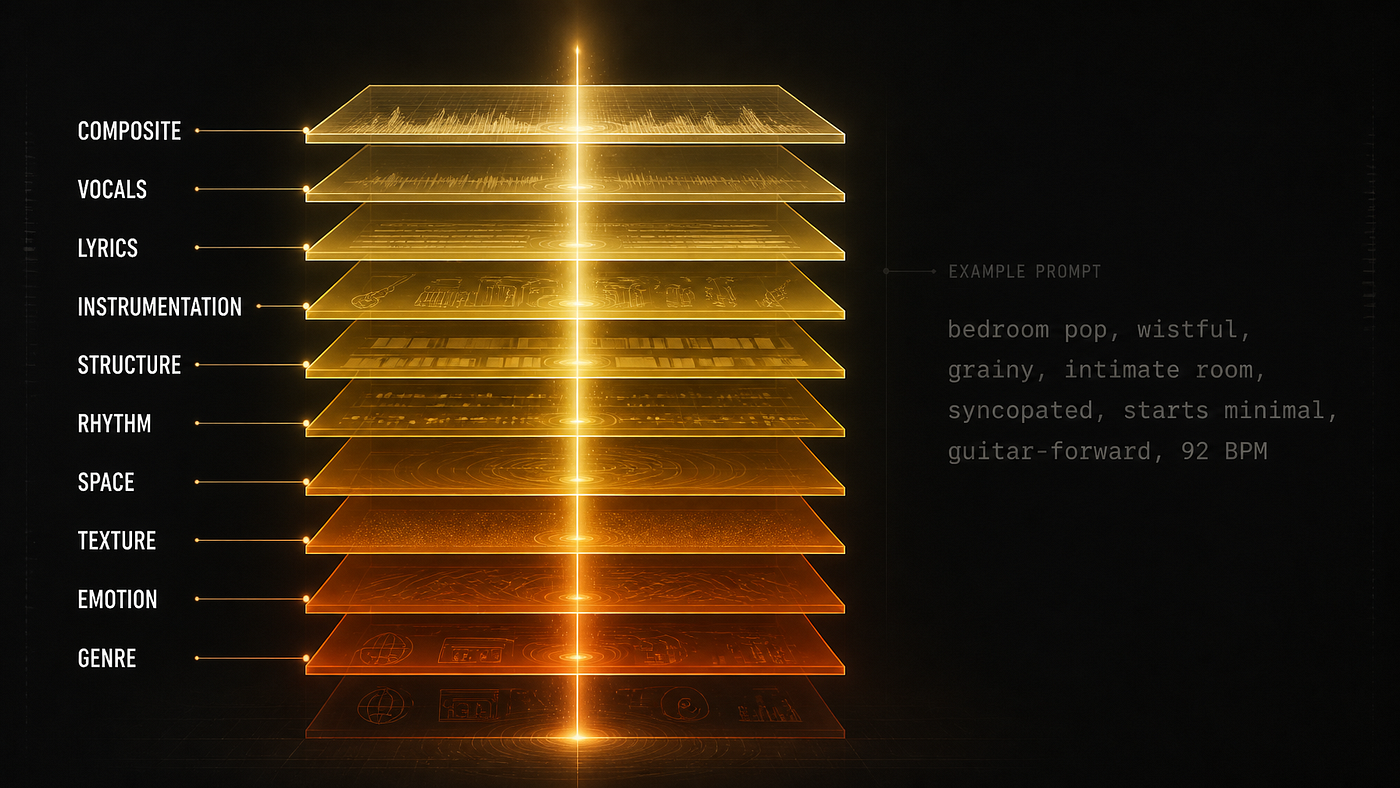
Dimension 3: Texture — The Anti-Plastic Layer
This is where most AI music fails. The output sounds technically correct but emotionally inert. Plasticky. Generated.
The reason: no texture instruction. Suno defaults to clean, which often means lifeless.
These five words solve that problem:
11. warm — rolls off high-frequency harshness, makes the track feel analog and human. Add this to almost any prompt and the output improves.
12. grainy — introduces texture noise, slight imperfection. Like an old photograph has grain. The imperfection is the character.
13. lush — signals layered arrangement, harmonic richness, nothing thin. Opposite of sparse.
14. crystalline — clean and transparent, but with a specific kind of brightness. Think: high-resolution acoustic. Not harsh, not warm. Clear.
15. muffled — like listening through a wall or from another room. Creates distance, intimacy of a different kind, a sense of memory rather than presence.
Dimension 4: Space — From Flat to Three-Dimensional
Without spatial instructions, Suno places every element on the same plane. Everything hits your ears at the same distance. The result is flat — technically fine, perceptually fatiguing.
Add spatial tags and the track gets depth. Elements exist at different distances. The mix has a front and a back.
16. cathedral reverb — long decay, large space, sense of distance and ceremony. Works for cinematic, orchestral, sacred.
17. intimate room — short reverb, small space, close proximity. The vocalist is in the room with you. Extremely effective for emotional tracks.
18. wide stereo field — instrumentation spreads across the full left-right range. Creates openness, space to breathe.
19. in the distance — pushes a specific element to the back of the mix. “Guitar in the distance” creates atmosphere without dominance.
20. close-mic’d — a specific element right in front of you. “Close-mic’d vocal” activates intimacy and detail.
Dimension 5: Rhythm — Personality, Not Just Tempo
“Fast.” “Slow.” These are speeds. What you want is rhythmic character — how the beat moves, where it leans, what kind of body it has.
21. swung — the beat leans slightly, like a real drummer rather than a metronome. Human feel. Essential for jazz-adjacent genres.
22. syncopated — accents land in unexpected places. Creates rhythmic interest, unpredictability. Good for R&B, soul, neo-soul, funk.
23. half-time feel — the groove moves at half the implied tempo. Same BPM, twice as heavy and slow-feeling. Effective for trap, hip-hop, dramatic builds.
24. driving — relentless forward momentum. The beat pushes. Nothing relaxes. Good for action, chase sequences, high-energy electronic.
25. laid-back behind the beat — the groove intentionally drags slightly. Lazy, relaxed, confident. Classic soul and R&B character.
Dimension 6: Structure — From Loop to Arc
Suno’s default behavior: generate a strong 30-second passage and repeat it with minor variation. The result sounds like a loop, not a song.
Give it structural instructions and it builds a narrative.
26. starts minimal, builds gradually — the track earns its complexity over time. Space at the beginning, density at the end.
27. quiet verse, explosive chorus — classic pop architecture. The contrast is the point.
28. sudden breakdown, then full return — strip everything out mid-track, then bring it all back. Creates a release that feels earned.
29. slow-burn buildup to a massive climax — longer arc. The track is building toward something from the first note.
30. fades out slowly, like disappearing into fog — the ending is the statement. Nothing cuts. Everything dissolves.
Dimension 7: Instrumentation — One Thing Forward, Everything Else Back
The most common mixing mistake in AI music: trying to feature everything. When everything is prominent, nothing is.
Pick one or two instruments to lead. The rest serve.
31. piano-led — the piano carries the melodic and emotional center. Other elements support.
32. string-driven — the emotional weight lives in the strings. Everything else is texture.
33. guitar-forward — the guitar is in front, the defining voice of the track.
34. voice-centered — the vocal is the track. Instrumentation exists to frame it.
35. synth-heavy — the synthesizer is the primary sonic identity. Works for electronic, synthwave, retrowave.
Dimension 8: Lyrics — Specificity Over Abstraction
AI lyrics default to abstraction. Dreams. Stars. Distant skies. The feeling you get when you don’t give instructions.
The fix: give it objects. Give it scenes. Specific things anchor emotion more effectively than abstract statements.
36. Instead of “I miss you” — write “your toothbrush is still in the same cup” The object is the emotion. No explanation needed.
37. Instead of “I’m lonely” — write “delivery note: extra pair of chopsticks” Scene-setting through a single detail. Loneliness in one line.
38. Instead of “time moves fast” — write “the text on that movie ticket is too faded to read now” Time as physical decay. More resonant than any abstraction.
39. Instead of “I have regrets” — write “what if I’d turned around that day” A conditional moment, not a statement. Opens something instead of closing it.
40. Instead of “chasing big dreams” — write “resignation letter folded under the bottom drawer” The dream is in the gesture. The object tells the story.
Dimension 9: Vocals — Making the Voice Sound Human
AI vocals fail in a specific way. They sound like synthesized speech performing emotion rather than a person feeling it. The texture is wrong.
These five descriptors change the texture:
41. breathy vocal — air in the voice, intimacy and vulnerability. Works for bedroom pop, indie folk, acoustic.
42. raspy and tired — worn, lived-in quality. A voice that has been somewhere. Essential for blues, soul, late-night character.
43. whispered delivery — extreme proximity. The voice is almost not there, which makes it impossible to ignore.
44. belting with emotion — power and feeling simultaneous. Chorus vocals that earn their volume.
45. soft falsetto — upper register with restraint. A delicate upper note that floats above the mix.
Dimension 10: Composite Templates — Copy, Modify, Generate
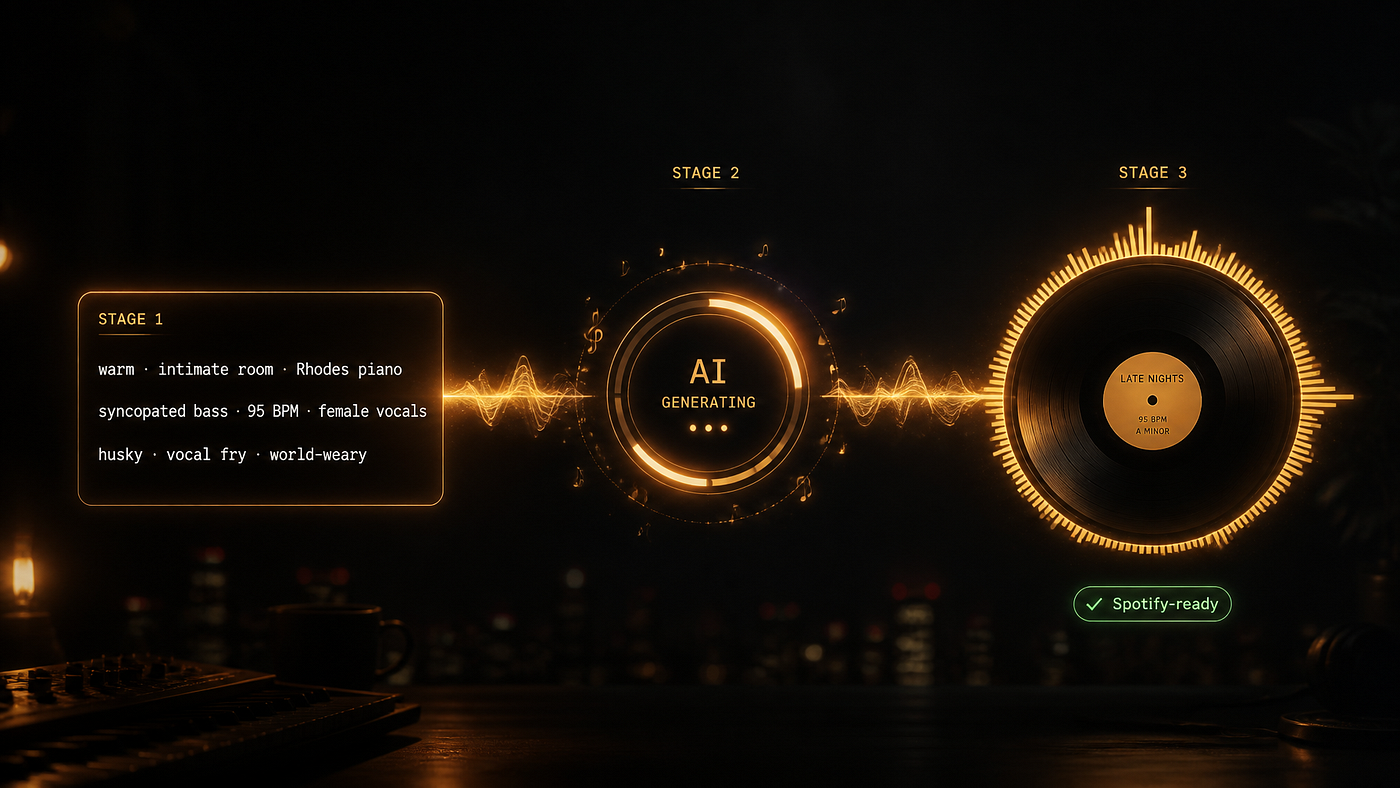
Once you understand the dimensions individually, the real leverage comes from combining them into full prompt architectures.
These five templates are copy-paste ready. Change the theme, keep the structure.
46. Healing Piano Template A warm, intimate piano piece in a small room. Soft pedal resonance, gentle mechanical noises from the keys. Melancholic but hopeful. Like afternoon sunlight coming through dusty windows.
47. Epic Trailer Template Hybrid orchestral, starts with low string pulse. Brass enters gradually, massive percussion at key moments. Builds from whisper to roar, ends abruptly with sub-bass rumble.
48. Ambient Electronic Template Downtempo electronica, grainy analog synths, airy vocal chops. Spacious reverb, like floating in a dark ocean. Breathes slowly. No rush. No climax.
49. Folk Narrative Template Guitar-forward folk, intimate male vocal. A story about a small town and a missed opportunity. Loose, unsyncopated rhythm. Warm and honest. Nothing shiny.
50. Chinese Orchestral Template Chinese orchestral, dizi flute carries the melody. Guzheng with light harmonics like water ripples. Erhu enters in the distance. Pentatonic base with occasional color notes. Leave space between phrases, like ink painting.
The Core Principle
Suno doesn’t read your prompt the way you read a sentence. It reads it as a weighted list. The first words carry the most influence. Each subsequent word carries slightly less.
This means:
- Word order matters. Put the most important dimension first.
- More tags is not more control. Past 9–10 tags, attention dilutes. You think you’re being precise. You’re actually giving the model too many conflicting instructions.
- One strong dimension beats five weak ones. A single well-chosen texture word does more than five generic mood words.
Use these 50 techniques as a menu, not a checklist. Pick the dimensions that matter for your specific track. Build a prompt that says exactly one thing, clearly, across multiple layers.
That’s the difference between a track that almost works and one you’d actually publish.
Follow for more on AI music production, prompt engineering, and building a catalog that actually sounds like something.
메타데이터
- post_id
- f496151b277c
- slug
- stop-guessing-in-suno-ai-these-50-prompt-techniques-will-get-you-to-a-90-satisfaction-rate-f496151b277c
- url
- https://medium.com/@deng197715/stop-guessing-in-suno-ai-these-50-prompt-techniques-will-get-you-to-a-90-satisfaction-rate-f496151b277c
- canonical_url
- https://medium.com/@deng197715/stop-guessing-in-suno-ai-these-50-prompt-techniques-will-get-you-to-a-90-satisfaction-rate-f496151b277c
- author_url
- https://medium.com/@deng197715
- status
- ok
- fetched_at
- 2026-06-21 15:33:18