Ukraine Update — June 9, 2026
Russia issues a nuclear weapon threat to NATO.
Ukraine Update — June 9, 2026
Russia issues a nuclear weapon threat to NATO.

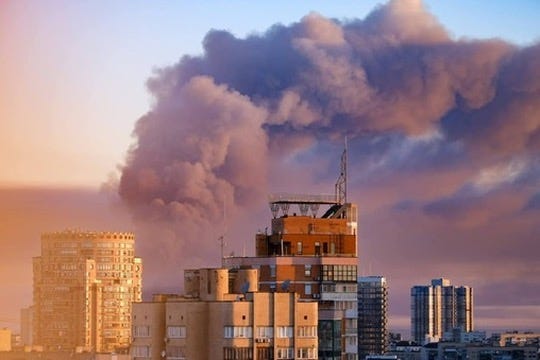
mage created by the author.
Something unusual happened in May 2026. Russia didn’t just talk about nuclear weapons — it performed the entire orchestra.
Within the space of eleven days, Moscow tested its most powerful intercontinental ballistic missile ever built; announced a snap nuclear exercise involving 64,000 soldiers, eight nuclear submarines, and hundreds of aircraft; and then had its deputy foreign minister walk up to a podium and warn NATO of a “direct clash between nuclear powers". Three separate nuclear signals in under two weeks.
That is not routine military planning. That is a country trying to send a message. The question worth asking is, 'What exactly happened on the battlefield that rattled the Kremlin so badly?'
Battlefield Reality
To understand why Russia is rattling its nuclear saber, you have to understand what has been going wrong for Moscow on the ground — and lately, quite a lot has.
May 2026 was a humiliating month for the Kremlin. Russia’s annual Victory Day parade on May 9 — that sacred celebration of Soviet triumph over Nazi Germany, the one Putin uses as a stage to project strength — had to be stripped of its military vehicles for the first time in decades. The reason was simple and embarrassing: Ukrainian drone strikes had become so credible a threat to Moscow that Russian authorities couldn’t risk rolling tanks and missile launchers through Red Square. Think about what that means. The parade that is supposed to show the world Russia’s military might was hollowed out because Ukraine’s drones had gotten good enough to threaten the Russian capital itself.
It got worse. On May 17, a massive Ukrainian drone strike on the Moscow area killed at least four people including three near the capital, with debris falling near Russia’s largest airport. Ukraine reportedly sent hundreds of drones in what May 2026 data showed as the highest monthly total of Ukrainian drones ever reported by Russia’s own Defense Ministry — 9,418 craft claimed shot down in a single month. Even accounting for Russian exaggeration in those numbers, the scale is staggering.
Here is why this matters beyond the symbolism. Ukraine is no longer just fighting a defensive war on its own territory. It has systematically extended the war into Russia’s interior, targeting logistics, refineries, airfields, and now the psychological heart of Putin’s regime — Moscow itself. Every drone that breaches the capital’s layered air defenses is a statement: your war is not contained, your people are not safe, and your military cannot protect you.
Russia’s response on the battlefield has not been a triumphant counter-surge. The Institute for the Study of War assessed that Russian forces failed to secure meaningful gains in their spring-summer 2026 offensive, with Ukrainian defense units contesting the tactical initiative across multiple front-line sectors while landing increasingly painful strikes on Russian rear-area logistics and infrastructure.
That is a polite way of saying Russia’s big offensive push has stalled. After four years of grinding warfare, after throwing hundreds of thousands of men into eastern Ukraine, Moscow has very little new territory to show for the bloodshed of 2026.
Ukraine is meanwhile targeting what military analysts call “deep logistics” — the supply lines, fuel depots, and command infrastructure that keep Russian forces fed and armed. Russian forces struck Ukrainian railway infrastructure and rolling stock 541 times in just the first quarter of 2026, causing roughly $178 million in losses, which shows both sides understand that the war is now as much about disrupting supply chains as it is about taking villages.
The strategic picture heading into summer 2026: Ukraine cannot dramatically advance but is making Russia’s occupation increasingly painful and expensive. Russia cannot break through but is refusing to acknowledge that reality publicly. Both sides are exhausted. But only one side is reaching for the nuclear alarm button.
Russia’s Economic Pressure
While the military situation frustrates Moscow, the economic picture behind it is quietly becoming a slow-motion disaster.
Russia sharply downgraded its economic growth forecast for 2026 to just 0.4 percent — down from a previous forecast of 1.3 percent — while the economy actually contracted 0.3 percent in the first quarter. That is not a war economy running hot. That is a war economy running out of steam.
The budget situation is particularly revealing. Russia’s Ministry of Finance admitted that the budget deficit reached 4.58 trillion rubles in just the first three months of 2026 — already exceeding the planned deficit of 3.79 trillion rubles for the entire year. In plain terms: Russia blew through its entire planned annual deficit in 90 days. And Putin has shown no appetite to cut military spending to fix it.
Real income growth for Russians is forecast to slow to just 1.6 percent this year, down from 7.7 percent last year, while consumer spending is expected to ease sharply. This is the quiet social contract breaking down. The Russian public tolerated the war partly because the wartime economy was — paradoxically — putting money in people’s pockets through military wages and defense production. That cushion is thinning.
Oil and gas revenues have fallen more than 25 percent due to sanctions and the appreciation of the ruble, continuing to constrain the budget’s revenue base in 2026. Ukraine’s drone strikes on Russian refineries have contributed to this, reducing domestic fuel production and disrupting the internal logistics that Russia’s military depends on.
Here is the connection that gets underreported: Russia’s economic strain is not separate from the nuclear bluster — it is partly the cause of it. A country confident in its economic and military position does not need to remind the world twice a month that it has nuclear weapons. A country feeling cornered does.
Propaganda and Information War
Moscow’s nuclear signaling campaign is not just military. It is a carefully orchestrated information operation designed to achieve three things simultaneously.
First, it wants to frighten Western governments into restricting what weapons they send Ukraine. Every time Russia waves the nuclear flag, European capitals hold a quiet internal debate about whether they have gone “too far.” That hesitation is the entire point.
Second, it wants to reassure the Russian domestic audience. State media presented the Sarmat missile test and the nuclear exercises as proof that Russia is strong, unbeatable, and not to be crossed. Putin appeared on state television to declare the Sarmat “the most powerful missile in the world,” claiming its warhead yield was more than four times greater than any Western equivalent. For a domestic audience fed on a diet of military triumphalism while their economy quietly tightens, this kind of performance matters enormously.
Third, Russia’s propaganda machine has been pushing a specific narrative at international forums. At Russia’s St. Petersburg International Economic Forum, Kremlin-affiliated figures presented future scenarios that framed the nuclear option as near-inevitable if the war continued its current trajectory, framing it not as a choice but as an almost mechanical outcome of Western aggression. This is sophisticated messaging — it removes moral agency from Moscow and casts nuclear use as something that happens to Russia rather than something Russia decides to do.
Ukraine’s information strategy has been sharper and, frankly, more creative. Zelensky’s response to Putin’s Victory Day antics was a masterpiece of political theater. In a tongue-in-cheek statement, Zelensky “decreed” permission for the parade to be held in Moscow — essentially mocking Putin by acting as though he controlled whether the Russian president could celebrate in his own capital. It was simultaneously funny, defiant, and devastating to the Kremlin’s image of strength.
The information war matters because it shapes what Western publics are willing to support. Russia wants people to believe the war is approaching a nuclear cliff edge and the only sane choice is to back off Ukraine. Ukraine wants people to believe Russia is a paper tiger rattling empty threats while losing on the battlefield. Both cannot be entirely right. But one of them is much closer to the truth.
Politics and Global Reactions
The nuclear theater is playing out against a complicated diplomatic backdrop that involves multiple moving parts — and a U.S. administration that is, to put it charitably, unpredictable.
The New START treaty — the last major arms control agreement between the United States and Russia — formally expired in February 2026 with no replacement in sight. With no discussions in place to extend or replace it, concerns are mounting that an unrestricted global nuclear arms race has begun for the first time in decades. Both the U.S. and Russia tested ICBMs within days of each other in May 2026. The diplomatic environment has deteriorated to the point where missile tests have become normal background noise.
On May 20, the U.S. Air Force launched its own unarmed Minuteman III ICBM — a system that has been in service since 1970 and may need to operate through 2050 because its next-generation replacement, the Sentinel ICBM, is running years behind schedule and billions over budget. There is something grimly poetic about America’s nuclear deterrent being held together with institutional duct tape while Russia shows off its shiny new Satan II.
The Trump administration’s approach to the war continues to be a source of deep anxiety for European allies. Trump had been pushing for a 30-day unconditional ceasefire, which Ukraine accepted and Russia effectively rebuffed. German Chancellor Friedrich Merz backed Trump’s ceasefire proposal but warned of further sanctions if Russia refused to cooperate, saying European states including Germany, France, Poland, and the United Kingdom were willing to support the initiative with a joint declaration. That coalition represents a rare moment of European unity — but it is unity built on a foundation of mutual anxiety rather than a coherent strategy.
The deeper problem is that NATO officials have suspended internal discussions about recalibrating their long-term strategy on Russia, largely because Washington’s partners simply do not know what the United States actually wants to achieve in these negotiations. An alliance that cannot agree on its strategic objective is not an alliance prepared to respond decisively to nuclear coercion.
The German Council on Foreign Relations made a pointed assessment in early June: the correlation between developments in the war that were detrimental to Russia and the Kremlin’s nuclear messaging implies that Moscow will likely take similar steps again if it suffers further setbacks in Ukraine. Translation: every time Ukraine humiliates Russia, expect more nuclear noise. Europe needs to start treating that pattern as policy, not provocation.
Russia’s Deputy Foreign Minister Sergei Ryabkov put it in the starkest terms available. He stated that Russia allows the use of nuclear weapons in the event of a threat to its territorial integrity, describing these as extreme conditions and “worst-case scenarios” when a country responds to an attempt on its territory. Note the framing carefully. Russia has claimed the four Ukrainian oblasts it partially occupies as its own territory. Any Ukrainian military operation to retake those regions could, under this framing, constitute a “threat to Russian territory.” That is not a narrow red line. That is a very wide one.
Strange, Ironic, and Darkly Funny Moment
Amidst all this geopolitical darkness, spare a thought for the awkward position of Russian state television anchors in May 2026. Their job, day after day, was to explain to the Russian public why the Victory Day parade — the great annual pageant of military power — could not feature actual military hardware because Ukraine’s drones might blow it up. The solution the Kremlin landed on was to hold the parade anyway, without the tanks, and declare it a success. Russian state media dutifully reported this as a triumph of organization and safety-conscious planning. Kremlin-affiliated presenters kept straight faces while effectively announcing: “Our military is so powerful that we cannot safely display our military.” No one on Russian television appeared to notice the contradiction. Or perhaps more accurately: everyone noticed, and no one was allowed to say so.
What Happens Next?
The biggest risk right now is not that Russia will actually launch a nuclear weapon. The U.S. Defense Intelligence Agency assessed in 2025 that Russia is “very unlikely” to use nuclear weapons unless leadership judged it faced an existential threat to the regime — and losing tanks in Donetsk does not rise to that level. The real risk is the slow normalization of nuclear rhetoric. When nuclear threats become a regular feature of Russian diplomatic communication, the world starts to tune them out. And that is precisely when a miscalculation becomes possible. A Russia that has cried wolf enough times may one day find that no one takes the warning seriously at the moment it is actually serious.
The biggest opportunity belongs to Ukraine and its allies. Russia’s pattern is now established and readable: military setbacks produce nuclear theater, not nuclear action. That means Ukraine’s drone campaign against Russian territory is working exactly as intended — it is imposing costs, disrupting logistics, and stripping the regime of its symbolic dignity. Continuing and expanding that campaign while keeping diplomatic channels open for an eventual settlement is the path forward.
Watch for two things in the coming weeks. First, whether the collapsed ceasefire process is revived with any genuine Russian engagement, or whether Moscow continues to use negotiations as a stalling tactic while its military regroups. Second, whether Germany and France follow through on the promised additional sanctions. Their credibility — and the West’s ability to influence Russian behavior — depends on whether “severe consequences” means something.
The question that should be keeping European leaders awake at night: if Russia’s nuclear threats are performative and NATO knows it — why is NATO still moderating its support for Ukraine based on those threats? That gap between knowledge and action is where the real danger lives.
Independent geopolitical analysis. All assessments are the author’s own interpretation of open-source information.
메타데이터
- post_id
- f4a3e3cab78b
- slug
- ukraine-update-june-9-2026-f4a3e3cab78b
- url
- https://medium.com/the-observers-pen/ukraine-update-june-9-2026-f4a3e3cab78b
- canonical_url
- https://medium.com/the-observers-pen/ukraine-update-june-9-2026-f4a3e3cab78b
- author_url
- https://medium.com/@shivjadon1234
- status
- ok
- fetched_at
- 2026-06-14 11:28:49