BRCA Mutations: Beyond Angelina Jolie’s Story
What if a gene test could rewrite your future?
BRCA Mutations: Beyond Angelina Jolie’s Story
What if a gene test could rewrite your future?
BRCA Mutations: Beyond Angelina Jolie’s Story
Emma’s Wake-Up Call
Emma was 32, planning her first pregnancy, when she sat in a genetic counselor’s office. Her mother had been diagnosed with breast cancer at 45. An aunt had died of ovarian cancer before 50. Emma had always carried this quiet unease, but when her test results came back positive for a BRCA1 mutation, the unease became real. Suddenly, the decisions ahead were no longer abstract: Should she pursue early screenings? Should she consider preventive surgery? Could she still safely try for a baby?
Emma’s story is becoming more common, because awareness of BRCA mutations has grown in the last decade. Much of that is thanks to the “Angelina Jolie effect,” after the actress publicly shared her preventive double mastectomy in 2013. But behind the headlines is a scientific story about DNA repair, risk, and, importantly, options.
This article unpacks what BRCA mutations really mean, why testing matters, and how they’ve become not only a way to predict cancer risk but also a biomarker guiding modern treatment.

Emma learns her BRCA status: one gene, many generations at stake.
The DNA Repair Crew
What Are BRCA1 and BRCA2?
BRCA1 and BRCA2 are not “cancer genes.” In fact, they’re protective genes, part of your body’s natural DNA repair system. Think of them as a pair of quality-control inspectors on a factory floor. Every day, your DNA accumulates damage from cell division, environmental stress, and even normal metabolism. BRCA1 and BRCA2 help spot those mistakes and fix them.
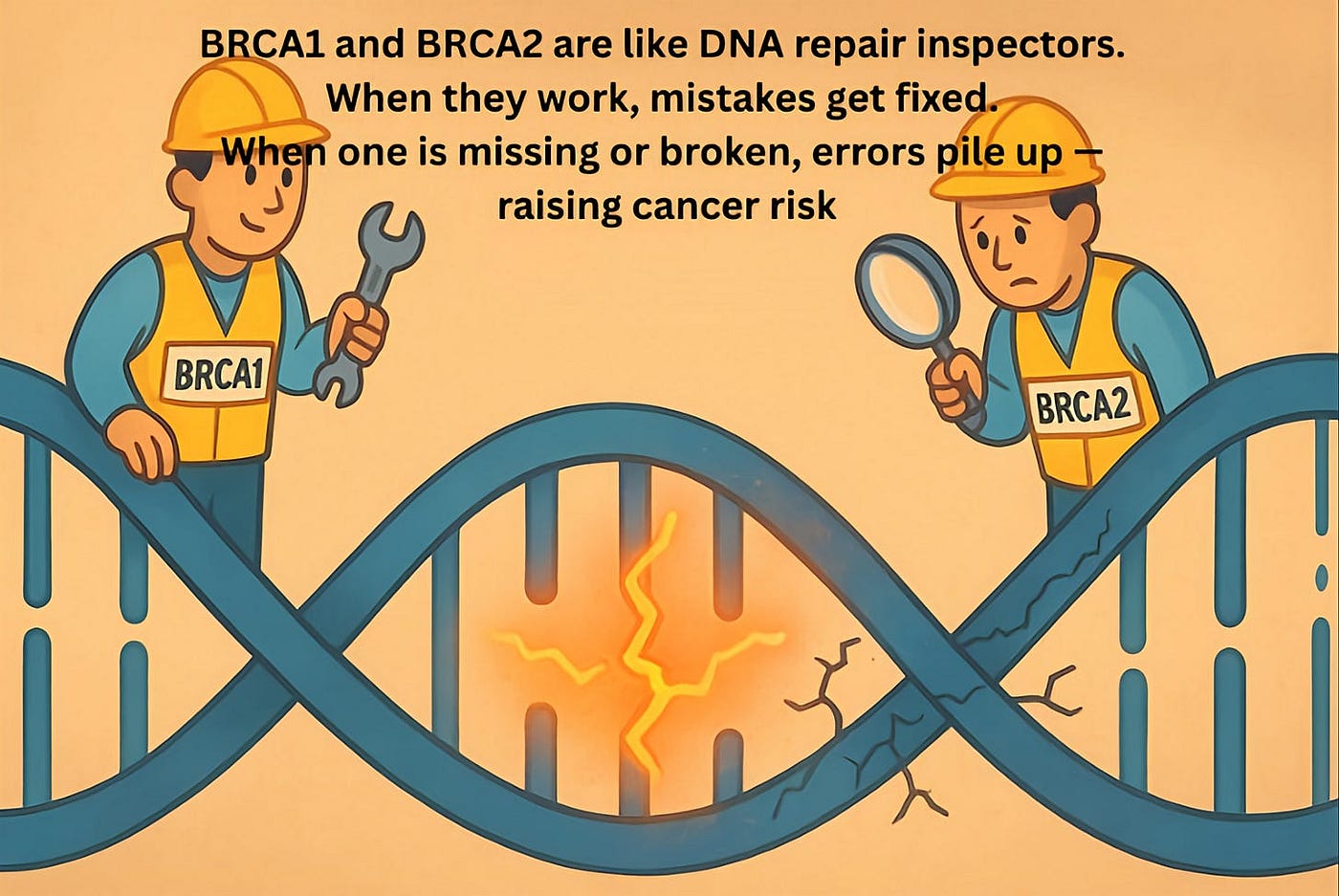
BRCA1 and BRCA2 are like DNA repair inspectors. When they work, mistakes get fixed. When one is missing or broken, errors pile up, raising cancer risk.
When one of these genes carries a harmful mutation, the inspectors can’t do their job well. Over time, errors pile up, and the chance of cancer rises.
It’s also important to know that BRCA mutations can be passed down from either parent, not just mothers. Fathers can unknowingly carry and pass them on to sons or daughters.
The Risk Rundown
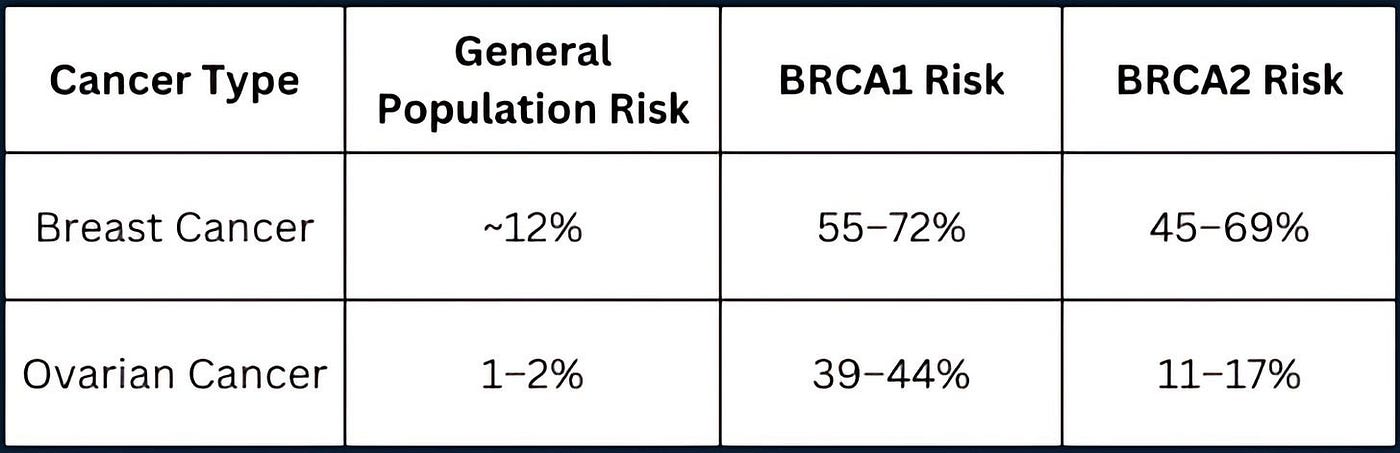
For women with a BRCA1 or BRCA2 mutation, the risks are significantly higher than in the general population:
For men, BRCA mutations also matter. BRCA2, in particular, raises the risk of prostate cancer, pancreatic cancer, and even male breast cancer. These cancers may not be as well-known in the BRCA conversation, but screening and awareness are just as important.
These numbers don’t mean cancer is inevitable. They mean the odds are higher, which is why proactive screening, preventive strategies, and personalized care matter.
Why Testing Opens Doors
For people like Emma, learning about a BRCA mutation can feel overwhelming at first. But knowledge opens doors:
- Early detection: High-risk women may start breast MRI screening as early as age 25. Ovarian screening strategies are less reliable, but knowing risk helps guide decisions.
- Preventive Moves: Some opt for mastectomy or ovary removal post-kids. Big steps, but risk drops 90%.
- Tailored Care: Drugs like tamoxifen or lifestyle shifts (exercise, no smoking) fit the risk profile.
Testing’s a family affair too. When Emma’s brother tested positive, it alerted his daughter. If your relatives had breast, ovarian, pancreatic, or prostate cancer, especially before 50, your odds tick up. Ashkenazi Jews face higher rates, but anyone can carry it. My neighbor’s dad, a quiet guy, carried BRCA2; his prostate screening saved him at 55.
Real Lives, Real Choices

BRCA isn’t one-size-fits-all. What BRCA provides is information that empowers choice. For many, the hardest part isn’t the science, it’s making decisions about identity, fertility, and family.
BRCA isn’t one-size-fits-all, Not everyone approaches BRCA results the same way:
- Rosa, a 28-year-old nurse, chose intensive screening over surgery while she finished her medical training. “I needed time, but I also needed vigilance.”
- David, a 45-year-old father, discovered he carried BRCA2 after his sister’s diagnosis. He now gets regular prostate screening. “Men often don’t think these genes apply to them, but they do.”
- Amira, a 40-year-old mother of three, opted for preventive surgery after finishing her family. “It wasn’t about fear, it was about control.”
- Emma? She froze eggs, took a pill, and delayed surgery, balancing baby dreams with risk. These stories show BRCA gives power, not panic. The hard part? Wrestling with identity, fertility, and family expectations. I’ve seen friends cry over it, then rally with a plan.
These stories show there is no single “right” response. What BRCA provides is information that empowers choice. For many, the hardest part isn’t the science, it’s making decisions about identity, fertility, and family.
BRCA as a Treatment Guidepost
When BRCA first entered the public conversation, it was mostly about prevention. But today, it’s also a critical biomarker in cancer treatment.
A biomarker is a biological signal, something doctors can test for to help guide care. For people already diagnosed with cancer, knowing BRCA status can:
- Help determine whether a PARP inhibitor (a type of targeted drug) may be effective. These drugs exploit the weakness in DNA repair to selectively kill cancer cells.
- Inform eligibility for certain clinical trials.
- Refine treatment planning, especially for breast, ovarian, pancreatic, and prostate cancers.
In other words: BRCA mutations don’t just predict who might get cancer, they also influence how cancer is treated once it appears.
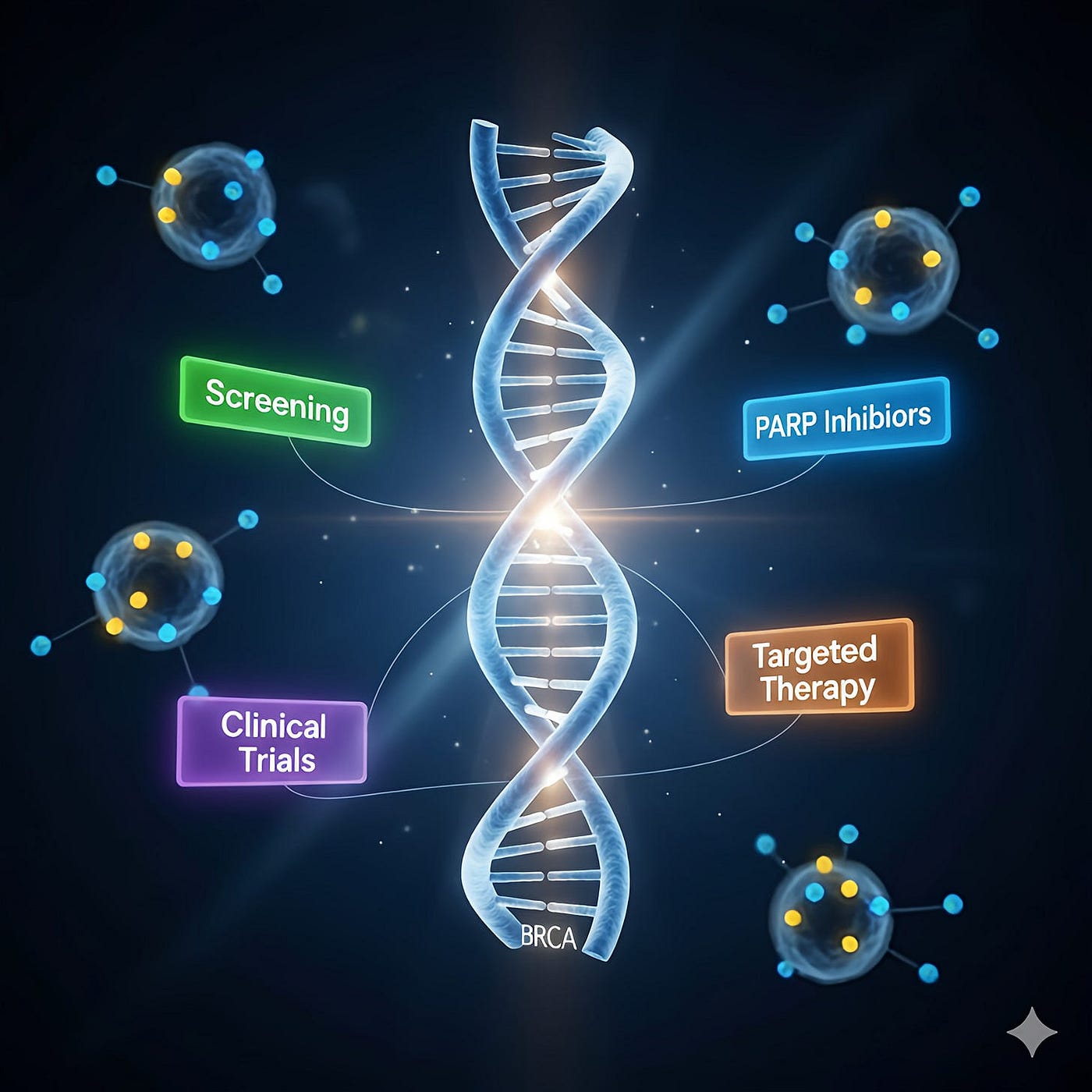
A BRCA test result can feel overwhelming, but it’s also a guidepost. It helps families navigate decisions about prevention, informs treatment if cancer appears, and opens doors to new therapies, a reminder that DNA carries not just risk, but direction.
Tiny FAQ
- What are BRCA genes? BRCA1 and BRCA2 are DNA repair genes. Mutations in them increase the risk of certain cancers, especially breast and ovarian.
- Who’s at risk? Anyone can carry BRCA mutations, but risk is higher with strong family histories of breast, ovarian, pancreatic, or prostate cancer, or in certain groups like Ashkenazi Jews.
- What’s the “Jolie effect”? After Angelina Jolie shared her preventive mastectomy in 2013, referrals for genetic testing increased worldwide, raising awareness and access.
Your Next Step
If you’re concerned about BRCA, whether because of family history or personal worry, here’s a first step:
✅ Review your family cancer history with your doctor. Write down any diagnoses, ages at diagnosis, and types of cancer among relatives. This helps determine whether genetic testing makes sense for you.
Lifestyle factors like regular exercise, limiting alcohol, not smoking, and maintaining a healthy weight can also support overall cancer prevention. They don’t erase BRCA risk, but they help reduce the background risk everyone carries.
The Bottom Line
BRCA mutations can sound intimidating, but they’re not a life sentence. They’re a source of knowledge. And knowledge means options: earlier screenings, preventive choices, personalized treatments, and family awareness.
Like Emma, Rosa, David, and Amira, each person with BRCA faces their own decisions. But thanks to advances in science and awareness, those decisions can now be made with clarity rather than fear.
📌 Up next in this series: Part 2 — Understanding Your Test Results: Pathogenic, VUS, and What To Do.
References
- Kuchenbaecker KB, et al. Risks of Breast, Ovarian, and Contralateral Breast Cancer for BRCA1 and BRCA2 Mutation Carriers. JAMA. 2017 Jun 20;317(23):2402–2416. doi: 10.1001/jama.2017.7112. PMID: 28632866.
- Antoniou A, Pharoah PD, Narod S, Risch HA, Eyfjord JE, Hopper JL, et al. Average risks of breast and ovarian cancer associated with BRCA1 or BRCA2 mutations detected in case Series unselected for family history: a combined analysis of 22 studies. Am J Hum Genet. 2003 May;72(5):1117–30. doi: 10.1086/375033. Epub 2003 Apr 3. PMID: 12677558.
- Evans DG, Barwell J, Eccles DM, Collins A, Izatt L, Jacobs C, et al. The Angelina Jolie effect: how high celebrity profile can have a major impact on provision of cancer related services. Breast Cancer Res. 2014;16(5):442. doi: 10.1186/s13058–014–0442–6. PMID: 25510853.
- Cheng HH, Schwartz J, Castro E, Couch FJ, D’Andrea AD, Eeles R, Giri VN, Halabi S, Kauff ND, Lin DW, Lynch SL, McNamara MA, Offit K, Paller CJ, Penson DF, Stadler ZK, Van Allen EM, Kantoff BW, Mucci LA. BRCA1, BRCA2, and associated cancer risks and management for male patients: a review. JAMA Oncol. 2024 Sep 1;10(9):1272–1281. doi: 10.1001/jamaoncol.2024.2185. PMID: 39052257.
- Morganti S, D’Andrea E, Viale G, et al. PARP inhibitors for breast cancer treatment: a review. JAMA Oncol. 2024;10(5):658–670. doi: 10.1001/jamaoncol.2023.7322. PMID: 38512229.
- Kunwor R. PARP Inhibitors for the Treatment of BRCA1/2-Mutated Metastatic Breast Cancer: A Systematic Review and Meta-analysis. Hematol Oncol Stem Cell Ther. 2023;16(3):186–196. doi: 10.56875/2589–0646.1033. PMID: 37023220.
메타데이터
- post_id
- f4b87487104a
- slug
- brca-mutations-beyond-angelina-jolies-story-f4b87487104a
- url
- https://medium.com/illumination/brca-mutations-beyond-angelina-jolies-story-f4b87487104a
- canonical_url
- https://medium.com/illumination/brca-mutations-beyond-angelina-jolies-story-f4b87487104a
- author_url
- https://medium.com/@neuroscope
- status
- ok
- fetched_at
- 2026-06-09 14:34:10