I Built My Own Pricing Tool Because I Couldn’t Ask for Help
The origin
I Built My Own Pricing Tool Because I Couldn’t Ask for Help
The origin
Kayapa comes from a Venezuelan indigenous word meaning collaborative work for the community. When we created Kayapa Creative Studio, the concept felt right: collaboration, collective effort, community.
But I have a problem: I struggle to ask for help. I’m too aware of other people’s time. Those moments of disconnection I value so much — I don’t like interrupting them for anyone. Every time I need something, I think twice: “Is this worth bothering someone over?”
Funnily enough, it doesn’t bother me when others ask me for help. The problem is mine, not theirs.
AI gave me an elegant way out: I can solve without interrupting, learn without depending, move forward without making anyone uncomfortable. Not because I don’t want human help, but because it lets me keep going without that constant feeling of asking for favours.
The moment everything changed
One night I tried ChatGPT and asked it to write a full plan for an art exhibition. I’ve been organising exhibitions for over a decade, so I knew exactly what to ask for.
Five seconds later: curatorial structure, budget, logistics, marketing, timelines, comms, and post-mortem. Everything.
What I already knew merged with what I had no clue about. Since that day, these tools help me plan projects, write grants, and structure ideas in ways that used to depend on someone else having free time.
English and confidence
For years I believed my English was “good, but not enough.” I still think that sometimes. On top of not expressing myself very well in Spanish, converting it simultaneously to English makes things worse.
Until I started writing to these models in imperfect English and they responded as if it had been perfect. They didn’t correct me. They understood me.
Today I accept that my English is better than my ears let me hear. And that helps me keep pace here in Sydney. Now I feel comfortable writing emails, statements, projects, grants. I no longer need to ask anyone to proofread them.
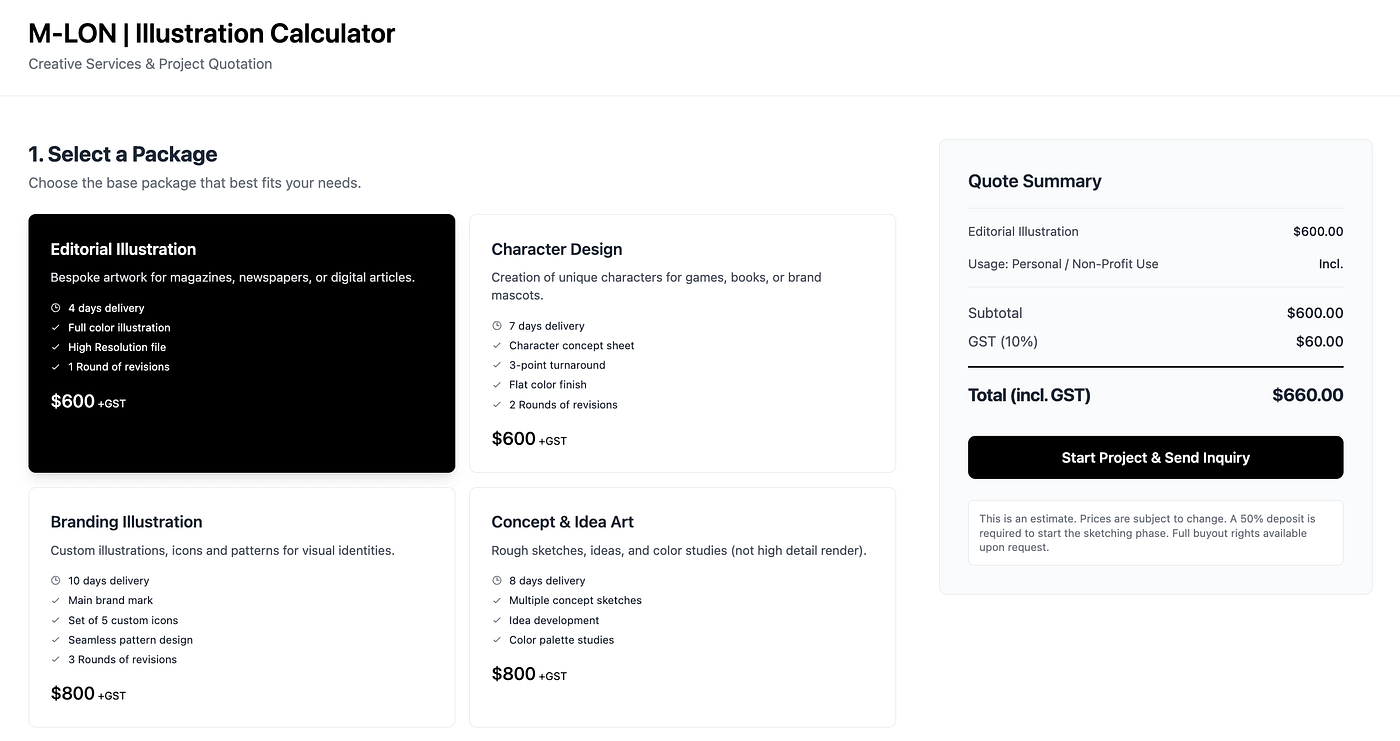
Screenshot of M-LON | Illustration Calculator — Prices are only samples
From frustration to tool
I started building tools inspired by my ten years running La Crème and six years with BAD, hearing the same problems over and over — mine and other creatives’. I built them for myself first. If they help another creative, even better.
- An Illustration Pricing Calculator (editorial, character design, branding, covers, animation). Scaling to other disciplines within the art and creative industry.
- Easy access to laws and rights for creatives.
- A Grant Scout, a Creative Precinct Directory, and an Event Scout (already in use for BAD’s directory and calendar).
- A series of admin micro-apps that simplify repetitive processes.
All born from the same principle: if something annoys me enough, I turn it into a tool — or something like that.
My goal is for these not to be just for me. I want them to become part of a Creative Precinct OS: an accessible set of resources for creative precincts, their residents, and the general public. Independent micro-apps, with purchase, membership, or subscription models depending on the need. The beginning is taking shape through modules I’m building in Notion.
How the calculator works (and why I think in Lego)
The calculator is designed like a Lego set. It’s not a monolithic piece trying to solve everything at once. They’re modules that connect.
The base is the package: six options depending on the project type — Editorial Illustration, Character Design, Branding Illustration, Concept & Idea Art, Book or Album Cover, Frame-by-Frame Animation. Each one comes with what’s included, how long it takes, and how many revisions are covered. That’s your baseplate. The floor you build on.
Then come the context pieces: how many illustrations you need and how the work will be used. Personal use or non-profit. After that come the optional blocks: buyout, source files, rush delivery, extra revisions, loops, or spot art. You add them only if they apply.
The summary calculates everything: package → licence → add-ons → subtotal → GST. Zero manual maths — but more importantly, it helps me cut the time and have a solid base when making decisions that affect the budget.
Seriously, I went from spending 2 to 4 hours (or more) just calculating and deciding how much to charge per project — to minutes deciding, quoting, and sending. Hours that, by the way, I got to spend on my paintings and other projects.
The M-LON | Illustration Calculator wasn’t born as a product. It was born because quoting was draining me: time and energy.
And if that can help another illustrator, even better.
If you work in any creative field and this happens to you too, tell me: how have you dealt with it? Need help? I can share the google project so you can remix it and adapt it to your practise, needs and rates.
Try it at the link below and let me know what you think — the amounts shown are referential and not my official rates.
메타데이터
- post_id
- f4cc17f4ada7
- slug
- i-built-my-own-pricing-tool-because-i-couldnt-ask-for-help-f4cc17f4ada7
- url
- https://medium.com/@art.mlon/i-built-my-own-pricing-tool-because-i-couldnt-ask-for-help-f4cc17f4ada7
- canonical_url
- https://medium.com/@art.mlon/i-built-my-own-pricing-tool-because-i-couldnt-ask-for-help-f4cc17f4ada7
- author_url
- https://medium.com/@art.mlon
- status
- ok
- fetched_at
- 2026-06-17 08:27:05






