A Close Reading of The Swing’s Thematic Paradox: Innocence and Experience
Once, Kahlil Gibran wrote, “When love beckons to you, follow him, though his ways are hard and steep. And when his wings enfold you, yield…
A Close Reading of The Swing’s Thematic Paradox: Innocence and Experience
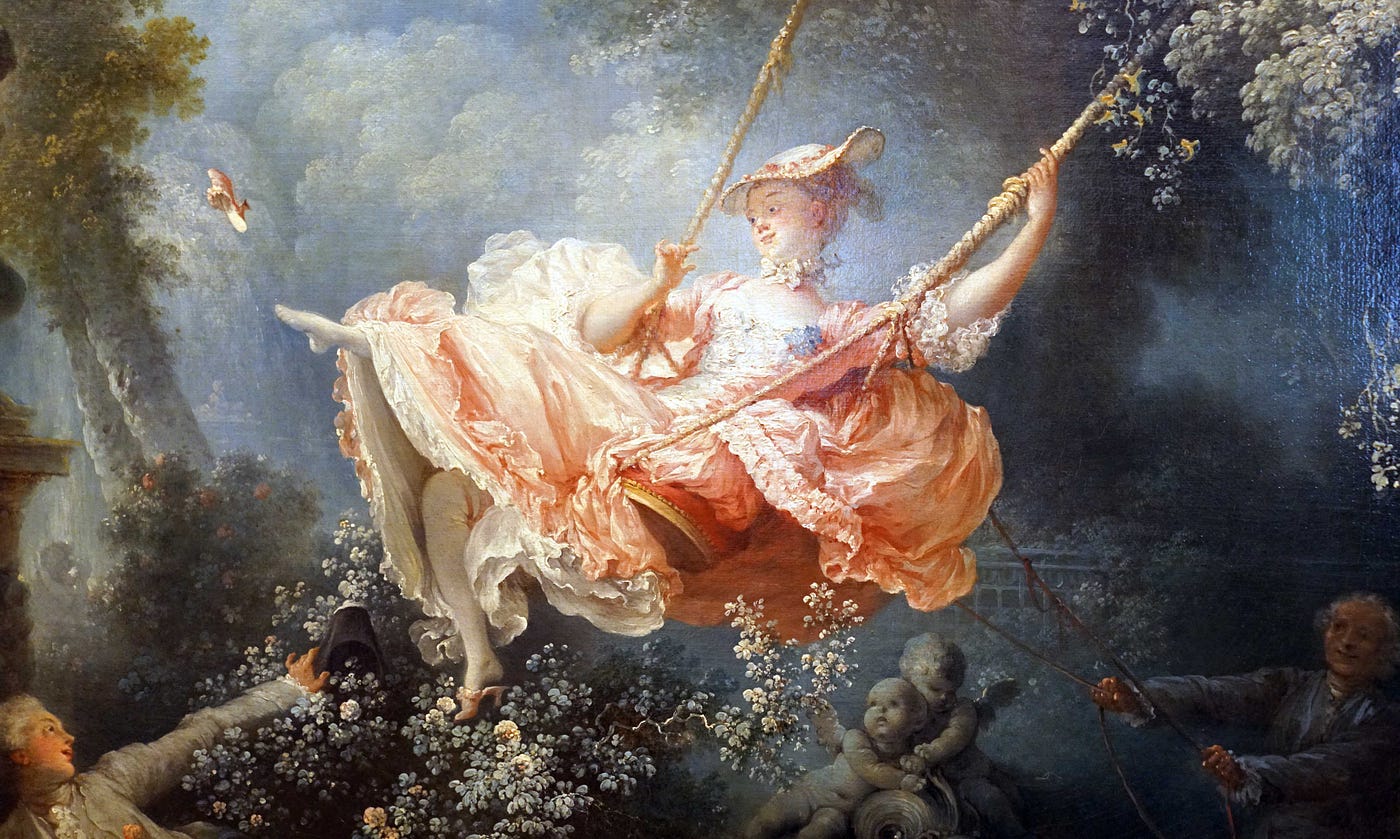
Fragonard, Jean-Honoré. The Swing (Les hasards heureux de l’escarpolette). 1767, oil on canvas, The Wallace Collection, London.
Once, Kahlil Gibran wrote, “**When love beckons to you, follow him, though his ways are hard and steep. And when his wings enfold you, yield to him, though the sword hidden among his pinions may wound you” *(Gibran 11). Gibran emphasized the pure beauty of love alongside its unexpected challenges. This metaphorical depiction reveals a paradox between romanticized and idealized love and the potential for pain and sacrifice. The innocence of yielding to love’s call contrasts sharply with the reality of the wounds it may inflict, an image that Jean-Honoré Fragonard brilliantly captures in his Rococo masterpiece, The Swing (1767). With a style rooted in the Baroque, Fragonard’s painting exudes energy and movement, reflecting the complexities of love during 18th-century French collectivistic society. It jettisons traditional values, instead embracing themes of pleasure and libertine . The portrait, richly detailed with symbolic elements, embodies a nuanced portrayal of love’s paradox. Hence, this reading explores the historical background of The Swing, its emblematic themes of love intersecting with Greek mythology, the contradiction between social norms and personal pleasure, and the analogy of innocence and experience: a theme that finds parallels in Henry James’s novel, Daisy Miller*.
The Swing by Fragonard is a New Classicism masterpiece created in the 18th century. The societal movements that France experienced during this time contributed to the hierarchical system between social classes. The existence of The Swing is a depiction of France’s elite through their way of life. Additionally, the painting is a private commission by an anonymous aristocratic patron seeking a lighthearted and flirtatious work, setting himself in a fanciful and overgrown garden. As seen in the painting’s concealed romantic subtext, an admirer hidden in the bushes gazes up at the Lady on the Swing. Therefore, the painting serves as an artifact that captures the state of French nobility, who reveled in opulence. It is a historical snapshot of a society engrossed in pleasure, detached from shared interests, privacy, and societal development.
The Rococo style of The Swing examines a shift from the grandeur of Baroque to an aesthetic that prioritizes intimacy. This artistic movement portrays the hedonistic tendencies of the French aristocratic families before the revolution. The symbolism of Fragonard in the painting details diverse components : the fabulous pink silk dress of the Lady, lined with lace, her bodice, décolletage, breasts, and her choker exudes sensuality, while her tiny pink slipper playfully flips up into the air, off of her foot. She is set on a red velvet with gilded molding at the bottom. Her lover in the lower left, who leans back on his right elbow and lifts his right hand, of cultivated, aristocratic gardens with fertile, overgrown nature, symbolizes the tension between human artifice and romanticized emotion.The symboles capture the rebellion deportment of the lady against relationship restraint. Also, The scene portrays the easy-going life, the extreme pleasure of the upper classes, and their societal point in a perfect expression of frivolity, luxury, and indulgence.
Within the style, Fragonard employs Greek mythology in The Swing, referencing Maenads and cupids. The woman swinging symbolizes the free spirit and the innocence, contrasted with the voyeuristic admirer in the bushes below her. This dynamic analogically recalls purity and experience, often seen in Greek mythology, Especially the story of Artemis, the goddess of the hunt and purity , and Actaeon, the moral hunter. Artemis transforms Actaeon into a stag, and his hunting dogs ultimately tear him apart. The dog in the painting symbolizes fidelity, and his barking results from the couple’s unorthodox situation. The woman swinging embodies the playful freedom and innocence akin to Artemis’ untouched purity, and the admirer hidden in the bushes mirrors Actaeon’s voyeuristic gaze, capturing the tension between pure satisfaction and the experience of being observed (Ovid Book III). In addition, Fragonard’s contemporaries, like Falconet, explored the hidden side of love through sculptures such as Menacing Love, where playful cupids riding dolphins symbolize the duality of love’s joys and dangers. The mythological reference that Fragnard examines adds a mortal sense of depiction of the lovers and the couple, with the Lady being interested in paradoxical subjective love.
The composition of The Swing effectively captures the contradiction between social norms and personal pleasure. On the right side of the painting , symbols of fidelity and restraint are represented by the fluffy white dog barking loudly. The dog strives to uphold the moral code of the aristocratic family . On the right side of the painting, the lover’s overt passion, as he leans back on his elbow with a longing gaze, represents libertine ideals. The figure pushing the swing, often interpreted as a bishop or an unsuspecting husband, who pushes the Swing further complicates the narrative, symbolizing the attachment and reservedness of societal norms. This analogous tension between control and indulgence extends to set a broader social dynamic of 18th-century France, where appearances often blur desires.
Fragonard’s implementation of innocence versus experience in the painting aligns with literary themes explored in Henry James’s novel Daisy Miller. In both contexts, the female protagonists navigate to balance social expectations and personal freedom; they both come from high-class families. The Lady on the Swing, like Daisy, in the story Daisy embodies the complexity of innocence to Winterbourne; while she is in a playful relationship with Mr. Giovanelli, her free-spirited actions set a more profound tension about her true intention. Similarly, the Lady on the Swing is entirely in a state of in-betweenness, giving an ambiguous viewpoint to the viewers, questioning her true intention regarding the pushes that encourage her to betray her husband. This complexity allows us to understand the personalized state of the aristocratic relationship, lost in the dilemma of pleasure and libertine.
In fact, The Swing is one of the perfect Rococo paintings. Blended with the Rococo art style, the ultimate details, the dynamic composition, and the theme of love and innocence the painting efficiently portrays the complexity of society and the Lady’s internalized intentions. The blending of mythology, culture symbolization, and the human condition allows Fragonard to create an iconic work visited daily in the Wallace Collection in London.
References :
Fragonard, Jean-Honoré. The Swing (Les hasards heureux de l’escarpolette). 1767, oil on canvas, The Wallace Collection, London.
Gibran, Kahlil. The Prophet. Alfred A. Knopf, 1923.
Falconet, Étienne-Maurice. Menacing Love (L’Amour menaçant). 1757, marble sculpture, Musée du Louvre, Paris.
James, Henry. Daisy Miller. Cornhill Magazine, 1878.
Ovid. Metamorphoses. Oxford University Press, 2008.
메타데이터
- post_id
- f4dcf42d2fed
- slug
- a-close-reading-of-the-swings-thematic-paradox-innocence-and-experience-f4dcf42d2fed
- url
- https://medium.com/@redouane.ouazzi/a-close-reading-of-the-swings-thematic-paradox-innocence-and-experience-f4dcf42d2fed
- canonical_url
- https://medium.com/@redouane.ouazzi/a-close-reading-of-the-swings-thematic-paradox-innocence-and-experience-f4dcf42d2fed
- author_url
- https://medium.com/@redouane.ouazzi
- status
- ok
- fetched_at
- 2026-07-13 15:30:25