Covert Narcissism and the Meteorology of Mood Manipulation
They don’t shout. They change the weather. And by the time you notice the storm, you’re already apologizing for the rain.
Covert Narcissism and the Meteorology of Mood Manipulation
They don’t shout. They change the weather. And by the time you notice the storm, you’re already apologizing for the rain.

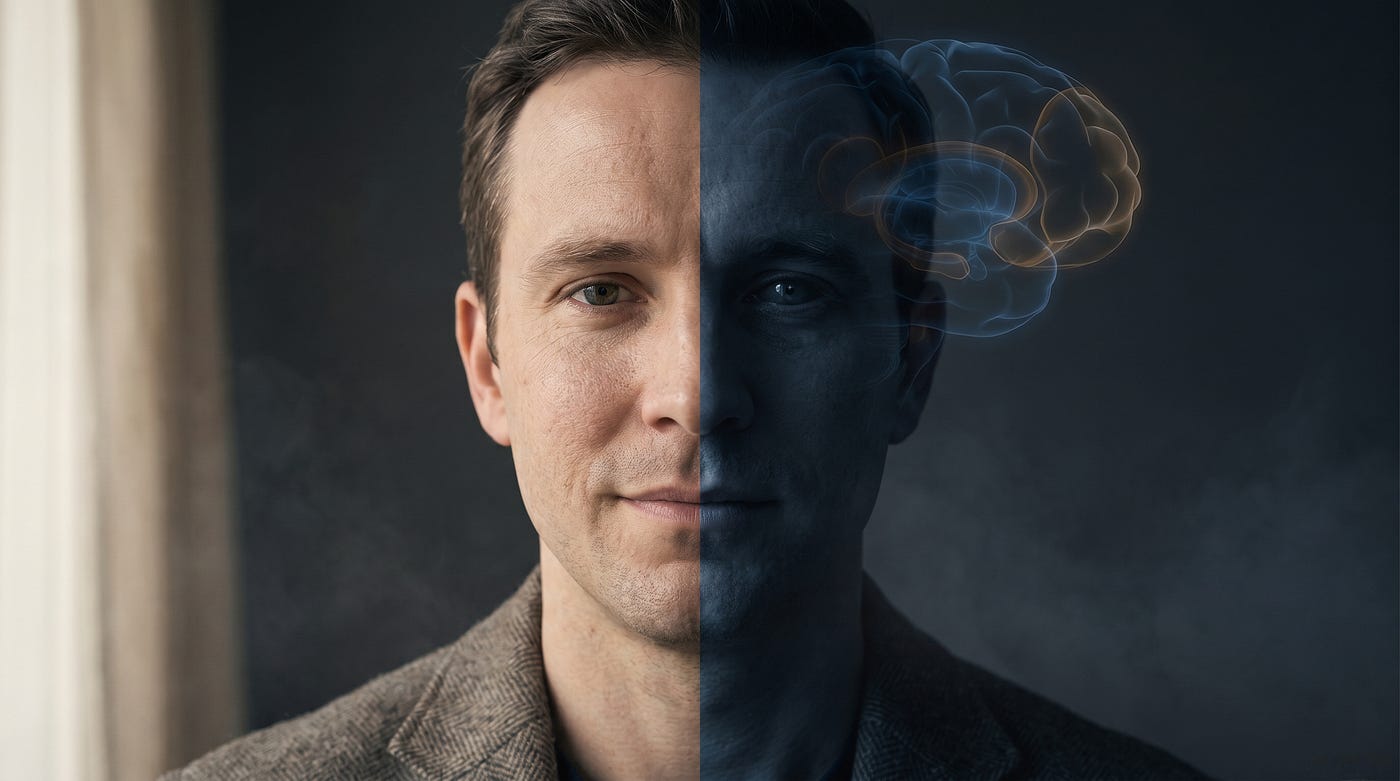
Image is generated via Nano Banana Pro.
The Barometer in Your Chest
There is a moment — and if you have lived with a covert narcissist, you know exactly the moment I mean — when you walk into a room and the air changes.
Nothing has been said. No door has slammed. No voice has been raised. And yet, somewhere between the threshold and the kitchen counter, you feel it: a subtle drop in pressure, a thickening of the atmosphere, a static charge that makes the hair on your arms stand up. You look at the person you love. Their face is a mask of calm. Their mouth is even smiling, faintly. But the barometer in your chest has already fallen twenty points, and your body — which learned this weather before your mind did — is already bracing for the storm.
You will spend the next six hours, or six days, or six years trying to figure out what you did wrong.
This is the phenomenon I want to talk about. Not narcissism as most people describe it — the loud, chest-thumping, obviously arrogant caricature that shows up on personality-disorder listicles. That kind of narcissism is easy. You see it coming. You can name it, dodge it, leave it.
I want to talk about the other kind. The quiet kind. The kind that never raises its voice because it doesn’t have to. The kind that has mastered something far more insidious than manipulation: the manipulation of atmosphere itself. The covert narcissist does not attack you. They do not command you. They simply change the weather in the room until you cannot breathe, and then, when you gasp, they look at you with wounded surprise and ask, gently, why you always have to be so difficult.
I have come to think of this as the meteorology of mood manipulation — because that is genuinely what it is. A private climate system, invisible to outsiders, in which one person controls the pressure, the temperature, the humidity, and the visibility, while the other person is left forever checking the sky, forever reading omens in clouds, forever apologizing for the rain they did not cause.
This article is a long look at that climate. It is going to take some time. If you are here because you have felt this weather in your own home, in your own family, in your own marriage — settle in. What you have been experiencing has a name, a shape, a mechanism, and, most importantly, a way out.
Part One: The Two Faces of Narcissism (and Why You Were Never Meant to Recognize the Second One)
When people picture a narcissist, they picture the wrong person.
They picture the grandiose executive who interrupts everyone in the meeting. The influencer who cannot stop talking about their own beauty. The politician whose voice fills every room like an inflatable raft expanding to touch every wall. Loud. Obvious. Almost cartoonish.
That is overt narcissism, and while it can be exhausting to be around, it has one saving grace: it is visible. When it hurts you, other people can see it happening. Your friends notice. Your family notices. Your coworkers roll their eyes at the same person you do. You get external validation that something is wrong. You are not alone in your perception.
Covert narcissism does not offer you this mercy.
Covert narcissism — also called vulnerable narcissism in the academic literature — is the version that hides behind sensitivity, martyrdom, quiet suffering, and a beautifully constructed public image. Where the overt narcissist demands admiration through display, the covert narcissist extracts it through pity, guilt, invisible pressure, and an ambient sense that you owe them something you cannot name. The 2022 review in the Journal of Personality Disorders by Weinberg and colleagues traces this distinction back through decades of clinical observation, noting that vulnerable narcissism is prospectively predicted by childhood impulsivity and unstable self-esteem, and that it is far more comorbid with depression, anxiety, and interpersonal hypersensitivity than its grandiose cousin.
In other words: the covert narcissist looks nothing like the stereotype. They may present as:
- The self-effacing partner who says “I’m fine” in a tone that will destroy your entire afternoon.
- The devoted mother whose sacrifices are recited like a rosary and weaponized like a scalpel.
- The gentle intellectual who never yells but somehow leaves every conversation with you feeling small.
- The wounded artist who is always misunderstood, always the tragic hero of every story.
- The quietly religious relative whose disappointment falls on you like a slow, cold rain.
- The soft-spoken friend who mysteriously undermines every good thing that happens to you.
None of them are shouting. None of them are punching walls. None of them fit the checklist you found on the internet at 2 a.m. And that is precisely why they are so dangerous. Because the culture has trained you to look for lightning, while the covert narcissist works through humidity.
The Two Key Differences That Change Everything
There are two essential distinctions between overt and covert narcissism that everyone should understand before we go further.
First: reactivity. Research on vulnerable narcissism — including Loeffler et al.’s 2020 findings in Frontiers in Psychiatry — has repeatedly shown that people high in covert-narcissistic traits experience larger and more volatile emotional spikes than the general population, particularly in response to perceived criticism, slights, or being ignored. They feel more, not less. But they have almost no ability to regulate what they feel, so they externalize it — usually by silently rearranging the emotional furniture of everyone around them until the room reflects their inner state.
Second: shame. Overt narcissists generally experience shame as an intolerable intrusion they must attack. Covert narcissists experience shame as a permanent climate they must escape by projecting it onto someone else. That someone else is usually you.
When you understand these two things — high reactivity and chronic shame — every strange, atmospheric, seemingly-inexplicable behavior you have witnessed suddenly clicks into place. The sudden sulks. The mysterious withdrawals. The way a compliment to someone else in the room detonates a three-day cold front. The way an innocent question — “did you remember to call the plumber?” — becomes evidence of your cruelty.
You are not crazy. You are living inside a weather system.
Part Two: What I Mean by “Meteorology”
The word matters. Let me explain it properly.
Meteorology is the study of the atmosphere — of pressure, temperature, moisture, and motion. Weather is not caused by any single object. You cannot point to the thing that made it rain. Rain is the emergent result of thousands of small variables interacting invisibly until, at last, something falls from the sky.
This is exactly how a covert narcissist controls a household.
An overt abuser hits you, and there is a bruise. You can photograph the bruise. You can show it to a judge. You have evidence.
A covert narcissist changes the pressure in the room. They shift the temperature by three degrees. They introduce a low humming humidity of disapproval into an ordinary Tuesday. And when you finally break down and ask what’s wrong, they look at you with soft, injured eyes and say, “Nothing. I’m just tired.” And now you are the person who has made “nothing” into a fight.
You have no bruise. You have no evidence. You have only a feeling. And that feeling — the feeling of the weather — is precisely what they will later use to convince you, and everyone else, that you are the unstable one.
I call this meteorology, then, for a very specific reason: because it operates below the level of language. It does not communicate through what is said. It communicates through what is felt in the room when nothing is said. And because it is atmospheric, it is almost impossible to describe to anyone who was not standing in it.
The tragedy of covert narcissistic abuse is not that it is invisible to the victim. The victim feels it acutely, sometimes at a cellular level. The tragedy is that it is invisible to everyone else. You cannot photograph a pressure drop. You cannot record a silence that has weight. You cannot describe, to a friend at brunch, the specific quality of the air in your kitchen when your partner is “not mad, just disappointed.” And so you begin, slowly, to doubt your own instruments.
That doubt is the first climate the covert narcissist creates. It is called the fog.
Part Three: The Fog — Fear, Obligation, Guilt
There is a term in the recovery community that names this fog exactly: FOG. It stands for Fear, Obligation, and Guilt, and it was popularized by therapists Susan Forward and Donna Frazier. It describes the three atmospheric conditions that a covert narcissist maintains around you at all times, like a private microclimate, in order to keep you emotionally captive without ever needing to lift a hand.
Let me describe each one, because the vocabulary matters.
Fear
Not fear of violence. Not the kind of fear you would ever report. The covert narcissist rarely creates that kind. What they create instead is anticipatory fear — a low, humming dread that lives in your ribcage every time you walk into your own home. Fear of the mood you’ll find waiting. Fear of the sigh at the dinner table. Fear of the sentence that will begin with “I just think it’s interesting that…” and end with three weeks of icy politeness. Fear of doing the wrong thing when you have not been told what the right thing is, and cannot ask, because asking is itself part of the wrong thing.
This kind of fear activates what neuroscientists call the hypervigilance response. Research on chronic relational stress, including Bruce McEwen’s foundational work on allostatic load and more recent studies at institutions like Rockefeller and Yale, has shown that living in a state of anticipatory threat produces sustained elevations in cortisol, alterations in amygdala reactivity, and, over time, measurable atrophy in regions of the prefrontal cortex responsible for executive function. In plain terms: living with a covert narcissist literally reshapes your brain to be worse at recognizing what your brain is being reshaped by. You become slower, foggier, more forgetful, and more easily overwhelmed — and then you are blamed, of course, for being slow, foggy, forgetful, and easily overwhelmed.
Obligation
Obligation is fear’s better-dressed cousin. It arrives in the form of unsolicited sacrifices you did not ask for and now cannot refuse without becoming a monster. The covert narcissist is a master of the invisible ledger. They will do things for you — sometimes generous things — but the moment you display any autonomy, any preference of your own, any deviation from the emotional script they have written, the ledger appears. After everything I’ve done for you. After all I’ve given up. I never ask for anything.
The last sentence is particularly clever, because it is technically true. They never ask for anything. They simply arrange the atmosphere so that anything less than total compliance becomes a form of ingratitude. You are not being blackmailed. You are being climatized.
Guilt
Guilt is the finest of the three instruments, because it does not need to be introduced. It is already inside you. The covert narcissist merely finds it and tunes it — often to a frequency you cannot consciously hear but which vibrates through every choice you make. The wrong purchase. The wrong friend. The wrong tone. The wrong career move. The wrong hobby. The wrong feeling. Nothing you do is quite right, because if it were quite right, they would have no fog with which to disorient you.
Guilt, in a covert-narcissistic system, is not a response to wrongdoing. It is the default emotional temperature — a low, damp seventy-two degrees of ambient self-blame in which you live year-round.
FOG is not, in the end, three separate emotions. It is a single unified climate that surrounds the covert narcissist like a private atmosphere they carry into every room. Step into their weather and you begin, without knowing it, to breathe it.
Part Four: The Fronts — Idealize, Devalue, Discard, Hoover
If FOG is the ambient climate, then the abuse cycle is the front system — the moving weather patterns that sweep across the covert-narcissistic relationship in a rhythm so predictable that, once you learn to see it, you will never unsee it.
Almost every serious clinician working in this field describes the same four phases. They go by slightly different names — Sam Vaknin calls one part “shared fantasy,” others call it “love bombing” — but the shape is universal.
Phase One: The Idealize (High Pressure, Blue Sky)
At the beginning, the weather is spectacular.
Not overtly grandiose the way it might be with an overt narcissist — no showy displays, no expensive gifts, no love-bombing in the theatrical sense. Covert love-bombing is quieter and, in many ways, more seductive. It is the sensation of being seen. Of being understood in a way you have never been understood before. Of finally, finally, meeting the one person who gets it — who gets you.
The covert narcissist is often extraordinarily perceptive. Because their inner world is dominated by shame and hypersensitivity, they have developed, over a lifetime, an almost supernatural attunement to the emotional cues of other people. They read you like weather. They know within minutes what you long for, what you fear, what you have never quite gotten from your parents or your previous partners. And they position themselves, very quietly, as the fulfillment of all of it.
They mirror you. Not by copying your interests, but by reflecting your inner self back to you at a higher resolution than you have ever seen it. It is intoxicating. You feel, for the first time, that you exist.
This phase can last months. It can last years. But it is not permanent. It cannot be. Because the covert narcissist is not really loving you — they are loving the mirror-image of themselves that they have constructed by watching you. And sooner or later, you will do something that breaks the mirror. Something small. Something ordinary. You will disagree with them. You will succeed at something on your own. You will laugh at a joke they did not make. You will be tired one night when they wanted attention.
And the front will move in.
Phase Two: The Devalue (Falling Pressure, Cold Front)
You will not know it is happening at first. That is the terrible genius of the covert version.
An overt narcissist devalues you loudly. They insult you, criticize you, embarrass you in front of others. You can name what is happening as it happens. A covert narcissist devalues you atmospherically. Small comments, dropped like pebbles into still water. A sigh at your outfit. A silence when you tell them good news. A subtle rewriting of shared history in which you were always slightly less than you remember being. A friend they used to like whom they now find “a bit much.” A hobby of yours they used to encourage that they now describe, with a tender smile, as “cute.”
The temperature drops so slowly you do not notice you are cold. You just find yourself, one morning, wearing three sweaters in your own life.
The devalue phase is where the meteorology becomes most vicious, because it is here that the covert narcissist begins to farm the negative emotions they are creating in you. Every time you react — hurt, confused, defensive — they file it away as evidence of your instability. See how emotional you are. See how you overreact. See how difficult you have become. You are being provoked, and then blamed for being provoked, in a loop so tight it becomes indistinguishable from your own personality.
Somewhere in this phase, if you are paying attention, you will notice that you no longer know who you are without them. You have become a barometer. Your entire self has been reorganized around reading their weather. You have forgotten what you used to like, what you used to want, what you used to think about when you were alone. This is not accidental. It is the whole point.
Phase Three: The Discard (The Storm, or the Sudden Silence)
The discard is where covert and overt narcissists diverge most sharply.
An overt narcissist discards with drama. There is a fight, or an affair, or an announcement. The end is loud and undeniable. A covert narcissist discards with disappearance. They may not leave physically. They may still sit across from you at dinner. But something has gone out of the room, and it will not come back, and no direct question you can ask will elicit an answer.
Sometimes the covert discard takes the form of the infamous silent treatment — days, weeks, occasionally months of icy, minimal communication in which every attempt on your part to repair the situation is met with a small, sad smile and the words “I just need some space.” Sometimes it takes the form of emotional emigration: they are still there, but they have quietly begun to construct their next life somewhere else, with someone else, and you are being slowly written out of the story you thought you were the co-author of.
You will feel, during this phase, that you are being punished for something you cannot identify. You will replay every conversation of the last month, trying to find the crime. You will apologize preemptively for things you did not do, hoping this will summon back the person you fell in love with. It will not. That person, as you now begin to suspect, may never have existed.
Phase Four: The Hoover (The Sudden Clearing, the Trick of the Sun)
Just when you have accepted that it is over — just when you have started sleeping through the night again, laughing with a friend, remembering what your own voice sounds like — the weather changes back.
It is the most disorienting climate of all. The sun comes out. The person you fell in love with reappears, as if from a long trip, as if nothing has happened. They are tender again. They remember your birthday. They send you a song you loved in the first year of the relationship. They tell you they have been thinking a lot, that they realize they were struggling, that they see you clearly again.
This is hoovering, named for the vacuum cleaner: the act of sucking a discarded partner back into the system. And it works. God, does it work. Because after months of drought, even a few drops of rain feel like salvation. You forget, in that moment, that this same person put you through hell. You forget because your nervous system, starved of positive input for so long, will accept any dose of it to end the suffering.
And then the cycle begins again, tighter this time, faster, with the loving phase shorter than before and the cold front closer to the surface.
This is the machinery of trauma bonding, and it is not, contrary to what your friends may say, a sign that you are stupid or weak.
Part Five: Why You Cannot Just Leave — The Neuroscience of Intermittent Reinforcement
If you are reading this and someone in your life is asking, exasperated, why don’t you just leave, I need you to understand something. Something biological. Something that will hopefully take a great weight off your chest.
You are not staying because you are foolish. You are staying because your brain has been trained, through one of the most reliable behavioral mechanisms ever discovered, to be unable to leave.
The mechanism is called intermittent reinforcement, and it was discovered by the psychologist B.F. Skinner in the middle of the twentieth century. Skinner found that if you reward a rat every time it presses a lever, and then stop, the rat will quickly give up. But if you reward the rat unpredictably — sometimes yes, sometimes no, with no pattern the rat can detect — the rat will press the lever forever. Even when the rewards become extremely rare. Even when the punishments outnumber the rewards ten to one. The unpredictability itself becomes the drug.
Slot machines are built on this principle. So are trauma bonds.
When you are in a covert narcissistic relationship, you are the rat and the affection is the pellet. During the idealize phase, the pellets fall in abundance. During the devalue phase, they stop entirely. During the hoover, they resume in a sudden, thrilling burst. Your brain — specifically, your dopaminergic reward system — has now been trained to associate this specific person with the largest, most unpredictable pleasure spikes it has ever experienced. And it will not, cannot, easily stop pressing the lever.
Neuroscientific research, including work at institutions like the National Institute on Drug Abuse, has shown that intermittent reinforcement schedules activate the same brain circuits as addictive substances — the mesolimbic dopamine pathway, particularly the ventral tegmental area and nucleus accumbens. This is not a metaphor. When you feel like you are addicted to your partner, you are, at a neurochemical level, describing something real.
Add to this the effects of chronic cortisol elevation — the exhaustion, the impaired memory, the shrinking of your emotional bandwidth — and you have a body that is physically less capable of leaving than it was on the day the relationship began.
You are not weak. You are chemically bonded. There is a difference. And the first step in dissolving the bond is understanding that it exists.
Part Six: The Specific Weather Patterns — A Field Guide
Let me now describe the specific atmospheric events you may recognize from your own life. Think of this section as a birdwatcher’s guide, except for storms. Once you can name them, they lose some of their power.
The Sigh
The single most efficient weapon in the covert narcissistic arsenal. It costs nothing. It leaves no evidence. It cannot be repeated back to them in an argument. And it can, deployed correctly, reorganize the emotional geometry of an entire evening.
You are chopping onions. They walk into the kitchen. They sigh. They walk out. You spend the next four hours trying to figure out what you did. When you finally ask, they say, “Nothing. I just had a long day. Why are you being so sensitive?”
The sigh is not communication. The sigh is the weather report of a storm they will not admit is coming.
The Long Pause
You have said something. Anything. Something completely ordinary. And instead of responding, they pause. Two seconds. Five seconds. Ten. Just long enough for you to hear your own words hanging in the air and, in the sudden silence, discover new and terrible interpretations of them.
Then they respond, softly, with a version of, “Okay.” Or “If that’s what you think.” Or “Sure.”
You now have no idea what just happened. But you know something happened, and you know it was your fault.
The Wounded Reference
They mention, out of nowhere, in a mild and passing tone, something you did months ago. Something you had thought was resolved. They do not accuse. They simply include it in a sentence, as if it were a well-known fact, alongside things that are actually well-known facts.
“Well, ever since that thing you said to my mother at Thanksgiving, I’ve just been trying to be more careful about what I share.”
You are now defending yourself against a charge that has been quietly stitched into the fabric of your shared history. You cannot object without confirming your guilt. You cannot agree without accepting a version of events you do not remember agreeing to. You are trapped inside a story someone else is writing about you.
The Compliment Sandwich (Except There’s No Bread)
A backhanded compliment, so lightly delivered that objecting to it would make you seem paranoid. “You look really rested today.” (Meaning: you usually don’t.) “That’s such a brave choice.” (Meaning: it looks bad.) “I’m just so glad you’re finally being confident.” (Meaning: your confidence is childish and I am indulging it.)
The covert narcissist is a poet of the disguised insult. You will spend the drive home trying to explain to yourself why an obviously kind sentence made you want to cry.
The Public Face vs. The Private Face
At the dinner party, they are marvelous. Warm, funny, self-deprecating, kind. Your friends will tell you, later, how lucky you are. In the car on the way home, the temperature will drop forty degrees for a reason you cannot identify. By the time you reach your door, you will be walking three feet behind them in the cold. Inside, they will go to bed without a word. In the morning, they will not remember any of it, or will remember it as your strange mood.
This split — the difference between what everyone else sees and what you experience — is one of the most crazy-making features of covert narcissistic abuse. Because when you try to describe it to friends, they will not believe you. They will say, “But they seem so nice.” And that is exactly the point. That is the whole architecture. The mask is not for you. The mask is for your witnesses.
DARVO
An acronym coined by psychologist Jennifer Freyd of the University of Oregon: Deny, Attack, Reverse Victim and Offender. Peer-reviewed research by Freyd, Harsey, and colleagues has documented DARVO as one of the most reliable patterns exhibited by perpetrators when confronted with their behavior.
You bring up something they did. They deny it happened. When you produce evidence, they attack you for producing it — for keeping receipts, for being obsessive, for holding grudges. And then, in the most breathtaking rhetorical move in the human catalog, they position themselves as the victim of your confrontation. Suddenly, you are the aggressor. You are cruel. You are relentless. You are the reason they cannot open up.
You came into the conversation with a legitimate grievance. You leave it apologizing. This is DARVO, and once you can see it in real time, it becomes almost comical — although the tragedy is that seeing it does not always stop it from working on you.
Triangulation
They mention someone else — an ex, a coworker, a friend, a family member — in a way carefully calibrated to make you feel less-than. “You know, when I was with X, they used to…” “My friend was just saying the other day…” You are now competing with a ghost. You do not know who the ghost is or what the ghost said, but you know you are losing.
Triangulation may also involve pitting two people in your life against each other — telling each of you different, unflattering versions of the other — until you find yourselves fighting instead of comparing notes. Because if you compared notes, the whole illusion would collapse. Family systems poisoned by a covert narcissist often display exactly this pattern: siblings estranged for reasons neither can quite reconstruct, spouses distrustful of in-laws they have never really spoken to.
The Emotional Weather Forecast
You wake up and, before opening your eyes, you check the weather. Not outside. Inside. You listen for the sound of their breathing. You gauge the tempo of their movement in the next room. You calculate — with a precision you were not trained for and cannot turn off — the mood of the person you live with.
This is called hypervigilance, and it is one of the most durable neurological legacies of covert narcissistic abuse. Long after the relationship ends, you may find yourself doing this with everyone. Your boss. Your friends. Your new partner. The barista. Your body has learned that survival depends on reading the atmosphere before it is spoken. And unlearning that is one of the great and quiet works of recovery.
Part Seven: The Body Keeps the Weather
I want to spend a moment on something that recovery communities sometimes underemphasize, which is that all of this — all of this atmospheric, invisible, unprovable manipulation — is not just happening to your mind. It is happening to your body.
Bessel van der Kolk’s now-canonical The Body Keeps the Score was not written specifically about covert narcissistic abuse, but it might as well have been. His central thesis — that trauma is stored in the body, that it lives in the nervous system, that it emerges as somatic symptoms long before it can be verbalized — describes with almost eerie accuracy what happens to people who spend years inside a covert narcissistic weather system.
You will not, at first, know that you have been hurt. You will simply notice that you are always tired. That your stomach hurts. That your shoulders live somewhere near your ears. That you catch every cold that goes around. That you cannot remember the last time you slept without gritting your teeth. That your hair is falling out in the shower. That you cry, sometimes, for no reason, in your car in parking lots, and then wipe your face and go into the grocery store.
Chronic stress research — including foundational work by McEwen, Sapolsky, and more recent longitudinal studies on adverse childhood experiences (ACEs) — has firmly established that sustained psychosocial stress, particularly stress you cannot escape or control, produces measurable physiological damage: elevated inflammation markers, immune suppression, cardiovascular strain, altered gut microbiome, disrupted sleep architecture, and, over long enough exposure, increased risk of autoimmune conditions, metabolic disorders, and neurodegeneration.
This is what walking on eggshells does to a body. Not metaphorically. Literally.
If you have been living inside a covert narcissistic climate for months or years, one of the first things you may notice when you finally leave — sometimes weeks after leaving — is that your body seems to be exhaling for the first time in living memory. Symptoms you had assumed were just how you were built begin to lift. You sleep. Your digestion returns. Your skin clears. Your shoulders come down.
This is your body telling you the truth that your mind, still tangled in cognitive dissonance, may not yet be ready to accept: you were not imagining the weather. You were living in a storm.
Part Eight: Cognitive Dissonance — The Two-Photograph Problem
There is a particular form of suffering that covert narcissistic abuse produces which I want to name specifically, because it is one of the hardest things to explain to someone who has not lived it. It is called cognitive dissonance, and in this context it takes a very specific and cruel shape.
Imagine that you have two photographs of the same person. In one, they are radiant, tender, generous, the love of your life, the one who saw you when no one else did. In the other, they are cold, cruel, dismissive, contemptuous, punishing you for a crime you cannot name. Both photographs are of the same person. Both photographs are real. You took both of them yourself.
Your mind cannot hold both photographs at the same time. It is not built to. And so, in an act of self-preservation that will slowly destroy you, it begins to alternate. When you are with the cold photograph, you cling to the warm one — this is not who they really are, this is just a phase, they were struggling, they’ll come back. When you are with the warm photograph, you edit the cold one — maybe I misremembered, maybe I overreacted, maybe I made too much of it.
This oscillation is exhausting. It is not, as you may think, a sign that you are indecisive or weak. It is the predictable neurological consequence of being in a relationship with a person whose behavior does not add up to a single coherent human being.
Research on cognitive dissonance following Leon Festinger’s original 1957 formulation has shown that the mind, faced with two irreconcilable truths about someone it loves, will typically resolve the tension in one of two ways: by rejecting one of the truths, or by inventing a third explanation that harmonizes them. In covert narcissistic relationships, the third explanation is almost always “it must be my fault.” Because if it is your fault, then the person you love is still good, still real, still salvageable. It is easier to be the villain of your own life than to accept that the person you love may not exist.
This is why leaving a covert narcissist is so much harder than leaving a merely bad partner. You are not leaving a person. You are leaving an entire cosmology — a story about who you are, who they are, and what love means. And the price of leaving is agreeing to grieve, all at once, both the person you loved and the person you thought you were when you were loved by them.
Part Nine: The Covert Narcissist Beyond the Bedroom
I have written most of this article, so far, as if the covert narcissist is a romantic partner, because that is the most common site of this abuse. But I would be doing you a disservice if I did not name the other places you may find them.
The Covert Narcissist Parent
Perhaps the most devastating version of all, because you did not walk into this weather — you were born inside it, and you took it, for the first two decades of your life, as simply the climate, the way the sky was, the temperature of being alive.
The covert narcissist parent is often praised by outsiders. They may be religious, self-sacrificing, community-oriented, softly spoken. In private, they are running a family through the machinery of guilt, obligation, and the endless subtle comparison of children — one favored, one scapegoated, one invisible, all three trapped in different corners of the same weather system.
If you grew up inside this, you may not recognize what happened to you until adulthood, when you suddenly notice that all of your relationships have the same shape as your childhood, and you cannot understand why.
The Covert Narcissist Colleague
The one who never openly attacks you but somehow gets you excluded from the meeting. The one who takes credit for your ideas in a tone so gentle no one can call it what it is. The one whose sighs, in the presence of your boss, are more devastating than any criticism.
The Covert Narcissist Friend
The one who congratulates you on your promotion in a voice that makes you want to apologize for it. The one who is always in crisis, always needing more, always subtly disappointed that you were not, this time, exactly enough. The one who mysteriously drifts away every time your life gets better.
The Covert Narcissist in Religious or Spiritual Communities
A specific and particularly toxic subspecies. The one who leverages holy language — humility, forgiveness, sacrifice — as instruments of control. Who describes their manipulation as discernment. Who describes your reasonable boundaries as spiritual immaturity. Who is uniformly beloved by the community precisely because their entire personality is a performance of virtue calibrated to extract exactly this beloved status.
The pattern is the same in all of these venues. It is only the costume that changes.
Part Ten: Why Naming It Matters — And Why It Is Not Enough
Here is the strange truth about covert narcissistic abuse.
Naming it changes everything.
And naming it changes almost nothing.
When you first learn the language — love bombing, devaluation, hoovering, DARVO, FOG, trauma bonding, narcissistic supply — there is a moment of catastrophic recognition, an almost religious clarity, in which every strange, unnameable, impossible-to-articulate thing you have felt for years suddenly has words. You will read articles like this one and you will weep, not because they contain new information but because they contain permission to trust your own perceptions. That is a gift no article can quite prepare you for.
But I would be lying if I told you that naming was the end. It is only the first door. Behind it are many more.
Because the covert narcissist has not just injured you externally. They have installed themselves internally — in your voice, in your judgments about yourself, in the reflexive apology that leaves your mouth before you have decided to speak it, in the way you scan every room you enter for signs of atmospheric disturbance. And you cannot simply learn your way out of that. You have to live your way out.
That takes time. Longer than you want. Longer than seems reasonable. Longer than most support groups will tell you. And it takes, in most cases, some kind of skilled help — a therapist who understands narcissistic abuse specifically, ideally one trained in trauma modalities like EMDR, somatic experiencing, or Internal Family Systems.
But it is possible. That is the thing I want to end this section on. It is fully, gloriously, unambiguously possible. Not to become who you were before — that person is gone, and grieving them is part of the work — but to become someone new. Someone whose barometer no longer swings wildly at the mood of every person in the room. Someone who can, finally, feel the weather without becoming it.
Part Eleven: How the Weather Ends — Practical Meteorology for Escape
Let me now try to be practical. Because atmospheric metaphors are lovely, but you may be reading this from inside the storm, and what you need is not another beautiful description of the storm. You need to know how to get out.
I will not pretend to give you a full protocol here — that is what therapists and support groups are for — but I want to offer some principles that have helped me and others.
Principle One: The Weather Is Not Yours
The single most transformative realization of my recovery was that I did not have to fix the weather. I did not have to explain myself into a place of safety. I did not have to earn back the warmth. The weather was not a response to anything I was doing. The weather was who they were.
Once you understand this — really understand it, not as an idea but as a felt bodily truth — an enormous burden lifts. You stop trying to solve a puzzle that was never a puzzle. You stop trying to be good enough to summon the sun. You realize the storm is simply the atmosphere they carry with them everywhere, and the only variable you control is whether you are standing under it.
Principle Two: The Gray Rock
For situations in which you cannot go no-contact — a co-parent, a boss, a family member you cannot yet cut off — there is a technique called the gray rock method, developed in the recovery community. The principle is to make yourself as boring as possible. To offer no emotional reaction. To respond in flat, unmemorable ways. To become, essentially, a gray rock: something the narcissist can pick up, examine, and put back down with no reward for their effort.
The gray rock works because the covert narcissist is not actually feeding on you as a person. They are feeding on your reactions — your fear, your explanations, your defensiveness, your tears, your love, your rage, all of it. Deprived of these reactions, they lose interest. They will still try, of course. But over time, they will drift toward richer sources of supply, and you will have bought yourself the space to plan a fuller exit.
Principle Three: The Documentation
If you are still inside the relationship, particularly if there are shared children or shared finances, begin keeping records. Not obsessively. Not with anger. Simply factually. Date. Time. Event. What was said. What was done.
This is not paranoia. It is a corrective to the specific epistemic damage covert narcissism inflicts. Because one of their most powerful tools is the ongoing rewriting of history — the quiet insistence that events did not happen the way you remember them. A written record, external to your own memory, is a life raft. It reminds you, on the days you doubt yourself most, that your perceptions were real.
Principle Four: The Witnesses
Find one person who believes you. One. That is all you need to begin. It does not have to be a therapist, though a therapist helps. It does not have to be your best friend or your family. It only has to be one human being who, when you describe the weather, does not tell you it must be your fault.
The covert narcissist has spent years working to make sure you have no witnesses — isolating you, undermining your friendships, making sure that everyone who might have believed you now believes a version of you that is unstable, dramatic, difficult, unfair. Finding a single person who will meet the real you is the beginning of undoing that isolation.
Principle Five: Go No-Contact If You Can
I know how loaded this is. I know how many complications real life puts in the way. But if it is at all possible — logistically, financially, safely — the single most healing act you can perform is total no-contact. Not because it is petty. Not because it is dramatic. But because covert narcissists cannot be reasoned with, cannot be reformed by your love, and cannot be present in your life without slowly rebuilding the weather system you are trying so hard to escape.
No-contact is not revenge. No-contact is the greenhouse in which the tender green shoots of your new self can, finally, grow.
Principle Six: Grieve the Person Who Never Was
This one is the hardest. Because when you leave a covert narcissist, you are not just leaving a person. You are leaving the version of them you loved, which turns out to have been a projection you constructed out of your own hope and their willingness to reflect it back to you. That person — the good one, the tender one, the one who saw you — was never fully real. And you have to mourn them anyway.
This grief is disorienting because it is grief for someone who is still alive. You are grieving a ghost that walks around, drives to work, posts on Instagram, and, worst of all, may be actively repeating the entire cycle with someone new who thinks — the way you once thought — that they have finally been seen.
Let yourself grieve them. Do not skip this part. The person you loved was, in the end, a beautiful and terrible fiction. But your love for them was real, and real love, even for a fiction, deserves a proper funeral.
Part Twelve: The Sky After
I want to end this article somewhere hopeful, because if I have done my job at all, I have taken you through some very dark weather, and you deserve a glimpse of the sky on the other side.
Here is what I can tell you, from my own experience and from the experiences of many people I have known who have come through this.
There is a season, after you leave, when the sky becomes strange in the opposite direction. Everything feels too still. You wake up in the morning and the room is not full of pressure. You walk into your kitchen and no one is sighing at you. You come home from work and the atmosphere is neither warm nor cold — it is neutral, which is a temperature your nervous system may not remember and may, at first, find frightening.
You will feel, for weeks or months, that something must be wrong, because nothing is wrong. Your hypervigilance will keep scanning. You will find yourself flinching at ordinary things — a partner’s genuine bad mood, a friend’s off day, a coworker’s brusque email — because your nervous system has not yet learned that these are just weather, that they are not directed at you, that they do not mean the storm is coming.
Give yourself time. Give yourself much more time than you think reasonable.
Because there is a further season, beyond this strange stillness, and this is the one I most want you to know is real. It is the season in which you begin to have your own weather again. Your own moods, un-borrowed from the atmosphere of someone else. Your own opinions, expressed without a preemptive apology. Your own preferences — for food, for music, for how you spend a Saturday — that do not need to be checked against another person’s approval before being allowed to exist.
You will find, in this season, that you begin to remember things you had forgotten. Songs you loved before you met them. Foods you liked. Ideas you used to have. Friendships you let atrophy. Ambitions you set down. All of these things come back, not all at once, but in a slow returning tide, and one day you will look up and realize that you are, once again, a person with a life of your own.
The sky, after covert narcissistic abuse, is not always sunny. That is not the point. The point is that it is yours again. The weather is your own weather. The atmosphere is your own atmosphere. And when a storm comes — as storms will come, because they are part of any real life — you get to feel it as your storm, and pass through it as your self, without having to first negotiate its meaning with someone who does not have your good in mind.
That is the destination. That is what recovery looks like. That is what is waiting on the other side of the fog, past the fronts, beyond the meteorology.
Not a life without weather. A life in which the weather is finally, at last, your own.
A Note to the Person Still Inside
If you are reading this, and the person I have described is sitting on the couch in the next room, and the air in your house is heavy right now, and you are not sure whether to laugh or cry or shut this article and pretend you never read it — I want to say one last thing to you.
You are not crazy.
You have never been crazy.
The weather is real. You have always been reading it correctly. Your instruments are not broken. You are not too sensitive. You are not too much. You are not the reason it is raining.
And there is a sky above this storm. There has always been a sky above this storm. And whether you leave today or in a year or in a decade, whether you leave with a therapist or with a suitcase or simply with the slow, private knowledge that this is not love and never was — the sky is still there. The sky is still waiting. The sky is still yours.
Go find it. Go find it when you can. And in the meantime, know that you are not alone in the weather. There are many of us. We have felt what you feel. We can see, from the other side, that you will get here too.
The storm is not the end of the story.
The storm was never the story.
You are.
메타데이터
- post_id
- f4edd3195e41
- slug
- covert-narcissism-and-the-meteorology-of-mood-manipulation-f4edd3195e41
- url
- https://medium.com/psyche-pedia/covert-narcissism-and-the-meteorology-of-mood-manipulation-f4edd3195e41
- canonical_url
- https://medium.com/psyche-pedia/covert-narcissism-and-the-meteorology-of-mood-manipulation-f4edd3195e41
- author_url
- https://medium.com/@waheedahmedofficial
- status
- ok
- fetched_at
- 2026-07-18 08:02:56