A Living Language Has to Be Sung Somewhere New
Why I’m using Anishinaabemowin inside noir song, requiem, pop, food, and contemporary creative work instead of treating it like a relic.
A Living Language Has to Be Sung Somewhere New
Why I’m using Anishinaabemowin inside noir song, requiem, pop, food, and contemporary creative work instead of treating it like a relic.

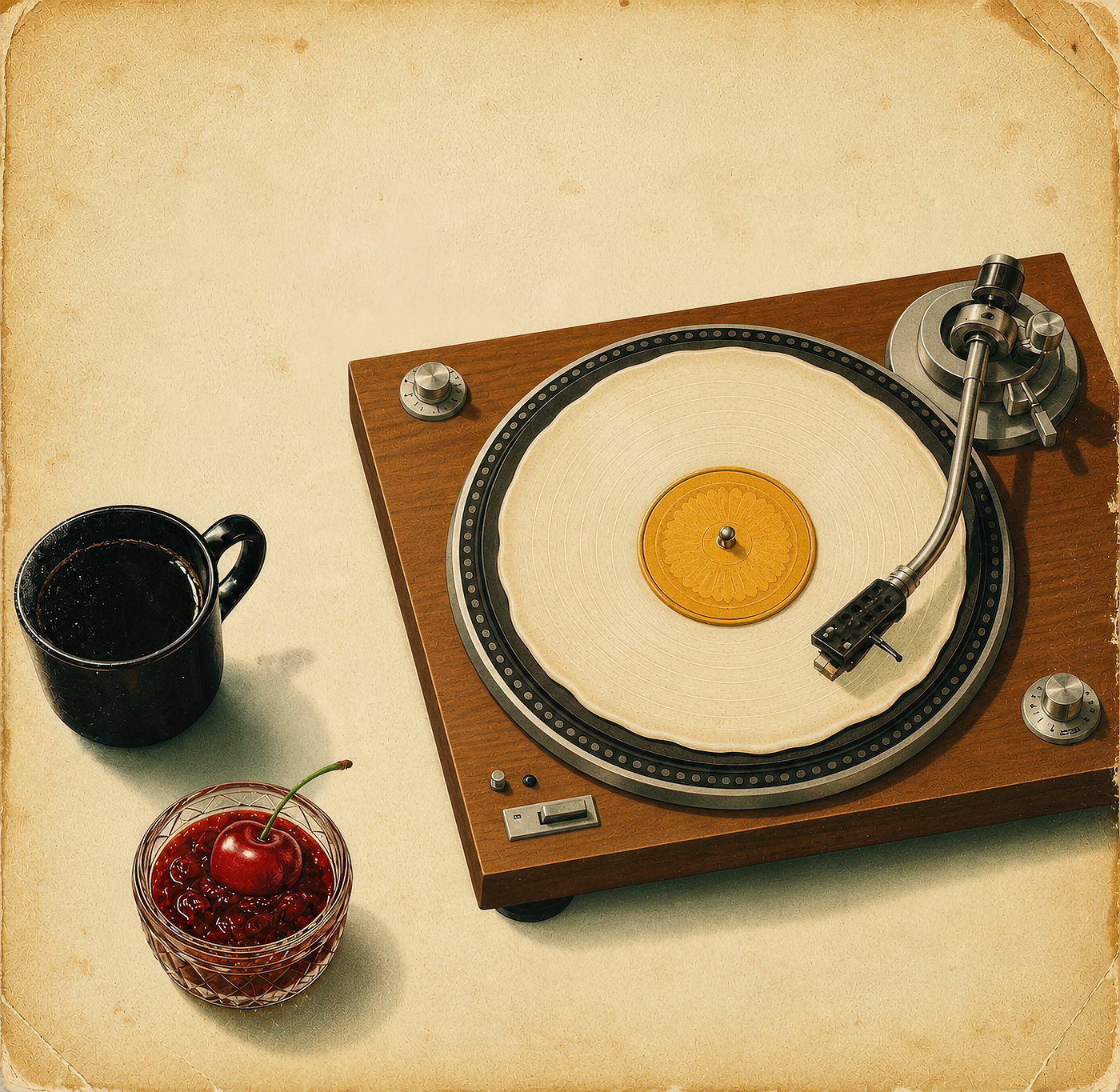
Conceptual image of place, language, and music converging. AI-generated by Robert Meyers-Lussier with OpenAI image tools, 2026.
Before this became music, it began with place: Crow Wing, central Minnesota, and the Anishinaabe history beneath the landscape where I was born. That history gives the work ground. The music is where the question became audible.
A language does not live by being placed behind glass. It lives by being used.
That sounds simple until the language in question is endangered, Indigenous, sacred to a people, wounded by history, or surrounded by the understandable fear that outsiders will turn it into costume, branding, mood lighting, or spiritual decoration. That fear is real, and I have to take it seriously. But there is another danger too, quieter and harder to name: reverence can become so absolute that it begins to resemble silencing. A language can be praised, protected, archived, studied, and mourned, yet still be kept away from the places where living languages breathe. It can be treated as too precious for ordinary use, too sacred for experiment, too vulnerable for play, too culturally charged for new forms.
Eventually, respect starts to resemble a glass case. I am not interested in glass cases. I am interested in song.
What I Am Not Claiming
Let me say this clearly. I am not Ojibwe. I am not claiming to represent Ojibwe people. I am not claiming authority over Anishinaabe tradition, ceremonial music, sacred language, or cultural practice. I am not presenting my work as traditional Indigenous music, nor am I pretending that artistic use is the same as cultural belonging.
Those boundaries matter because the work asks for a harder position than either permission-by-admiration or silence-by-fear. I am using Anishinaabemowin as sung language inside my own authored creative systems. The work is contemporary, hybrid, and mine in its artistic construction, while the language is not mine in any possessive sense. That distinction is the frame, not a footnote.
What I do have, and what I cannot ignore, is a relationship to place. I was born in Brainerd, Minnesota, in a landscape shaped by Anishinaabe language, memory, naming, displacement, and survival. That is closeness of place, not kinship. It gives the work ground without granting ownership. It explains why the question is not abstract to me and why the music has to be made with care rather than appetite. History is not the subject replacing music. It is the ground that makes the musical question impossible to treat casually.
That also means my work is not the center of the language’s survival. Anishinaabemowin lives first through Anishinaabe communities, families, teachers, speakers, learners, immersion programs, language tables, songs, ceremonies, classrooms, kitchens, and everyday acts of return. My work belongs beside that reality, not in place of it. It is not language revitalization by itself. It is one artistic argument for expanded life, expanded rooms, expanded use.
The Problem With Glass-Case Reverence
When people talk about Indigenous languages, the tone often changes. The air gets heavy. The language is no longer treated like a living system of verbs, jokes, tenderness, anger, hunger, flirtation, grief, rhythm, contradiction, and ordinary human mess. It becomes an artifact, something to be admired and approached only with lowered eyes.
There is a reason for that. Languages such as Ojibwe, also called Anishinaabemowin, carry histories of survival against direct attempts to erase them. They carry people, land, family, ceremony, memory, and a world of relationships that English cannot simply absorb. Anyone who treats that lightly has already failed before the first note is sung. But reverence can become its own problem when it tells a language, “You may be honored, but not used.”
A living language has to move. It has to enter forms that did not exist when the old songs were first sung. It has to sit inside headphones, choruses, refrains, kitchen songs, strange hybrids, private grief, public art, pop hooks, and work that does not ask permission from nostalgia before it begins. If a language is alive, it cannot belong only to the museum, the archive, the classroom, the ceremony, or the past. I believe it has to be sung somewhere new.
A language can be honored by protection. It can also be honored by being trusted with new work.
What Living Language Actually Means
Living language is not only about correct grammar. It is use, risk, breath, return. It is the moment a word leaves the safe page and enters a human mouth. Languages do not survive because they are never touched. They survive because people keep finding reasons to need them. They carry lullabies and arguments, recipes and weather, jokes that do not translate, and songs whose meanings may be partly understood, partly felt, partly learned over time.
They carry the sacred. They also carry the daily. That matters to me because I work in forms where language is not only information. It is sound, color, pressure, rhythm, placement, and recurrence. A word in a song does not behave exactly like a word in an essay. A refrain can become a hinge, a response, an ache, a witness, a room the listener enters before fully understanding it.
That is not a lesser form of language. It is one of language’s oldest homes.
Where This Began
This did not begin with the Requiem. It began with a song.
Before I started building a 19-movement choral work, before I began thinking about Anishinaabemowin in the structural role Latin often occupies in Western sacred music, I wrote a dark jazz noir piece in Anishinaabemowin. The musical world was not ceremonial, archival, or ethnographic. It was Detroit noir: spoken-word vocals, brushed drums, muted trumpet, fretless bass, vibraphone, Rhodes chords, tape saturation, rain-slick atmosphere, intimate verses, and a broad nocturnal chorus.
That song mattered because it did not treat language as a symbol superimposed on the music. It let the language determine the music’s interior weather. The lyric moved through transformation, walking, exile, inner life, fear, anger, sadness, return, and the stubborn presence of the self within the self. It was not narrative-clear in the ordinary pop sense, but it was emotionally clear. It moved by recurrence, pressure, image, and return.
That was the first real artistic test: whether Anishinaabemowin could sit inside a modern noir song without becoming decoration, whether it could carry drift, fear, return, and self-recognition, whether it could move through brushed drums and muted trumpet, through a chorus built not as a translation exercise but as emotional recurrence. The answer, for me, was yes.
The song proved that Anishinaabemowin did not have to enter my work as a quotation, homage, or ornament. It could enter as structure. It could shape pacing, emotional distance, and the way a piece moved between exposure and self-recognition. It could make the difference between a song about transformation and one that feels as if it is transforming as you hear it.
That discovery changed the question. I was no longer asking whether Anishinaabemowin could be placed into contemporary music as a respectful element. I was asking what contemporary music became when Anishinaabemowin was allowed to organize its emotional logic from within. The Requiem grew out of that discovery, not the other way around.
The song proved that Anishinaabemowin did not have to enter my work as quotation, homage, or ornament. It could enter as structure.
The Requiem and the Question of Latin
In the Requiem, Anishinaabemowin occupies the structural role Latin has often occupied in Western sacred music. That parallel has to be named precisely because it carries weight that a careless reader could misread. Latin became the architectural language of Western sacred music partly because it carried the authority of the empire and the church. It created ritual distance. It turned private sorrow into ritual sound across centuries of mass and choral form. Its presence in mourning is as much the residue of power as of devotion.
Anishinaabemowin sits in the opposite historical position. Asking an endangered, historically suppressed Indigenous language to take the structural role a colonizing language held in another tradition is not symmetry. It is a different gesture entirely. The unease is part of the point. That difference is not a problem to be solved. It is a fact to work inside.
The Requiem is not borrowing sacred authority. It is asking whether the architecture of Western mourning, which has spent centuries holding grief in a language of empire, can hold grief in a language of survival without flattening either tradition. I do not know whether the answer is fully yes. I know the question is honest. I know the work has to be made before the question can be answered. And I know that the historical weight beneath the language is precisely why the music cannot treat the language as atmosphere.
The first noir song showed me that Anishinaabemowin could organize emotional logic from within. The Requiem asks whether that same principle can hold under greater formal pressure: choral architecture, mourning, ritual distance, grief, recurrence, and scale.
Food Songs, Pop Structures, and Ordinary Creative Life
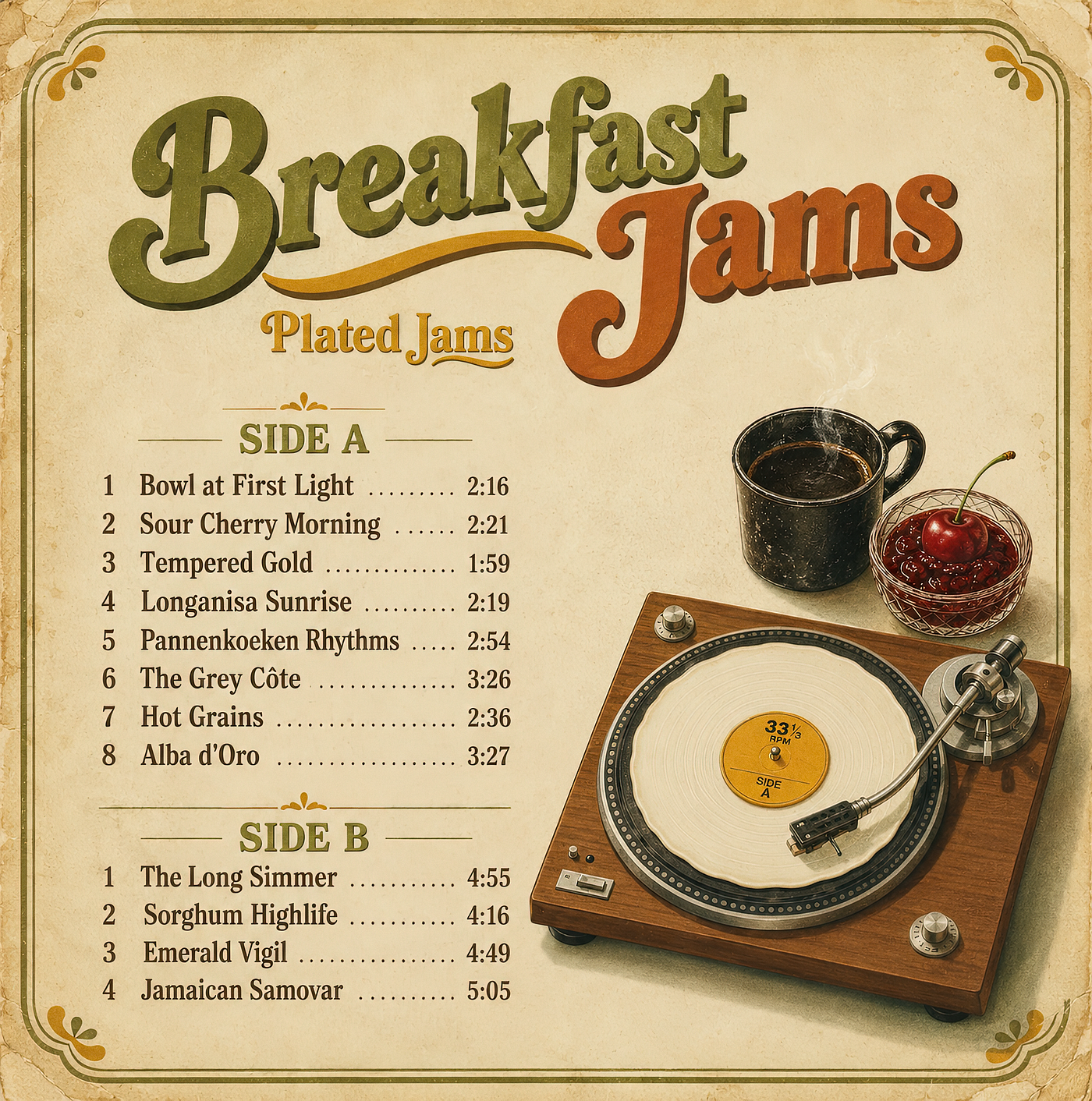
The Requiem is only one form of the question. In another body of work, Plated Jams and CogniCuisine Records songs move through food, place, memory, and cultural imagination. English can carry narrative clarity when needed. Other languages can carry flavor, refrain, pulse, and emotional center. In that setting, Anishinaabemowin words can function as response, color, inner truth, hook, and anchor.
That matters because the argument for living language cannot stop at solemn forms. Community-led revitalization rightly begins where language life is most rooted: homes, schools, ceremonies, families, classrooms, and everyday use. But art has rooms too. If Anishinaabemowin can enter a requiem but not a food song, not a chorus, not a hook, not a strange little contemporary track about appetite or memory or weather or longing, then the glass case has only been moved to a more beautiful room.
If Anishinaabemowin can enter a requiem but not a food song, then the glass case has only been moved to a more beautiful room.
A living language should not have to remain solemn in order to be respected. It should not have to sound ancient to be taken seriously. It should not have to perform sacredness every time it appears. Songs have always taught us words by making us need to sing them. A refrain can be a doorway. A repeated phrase can become a place where curiosity begins. A hook can carry more than melody. It can carry attention.
The Creative Principle
A language is not honored only by being protected from use. Sometimes it is honored by being trusted with new work. That does not mean every use is good. It does not mean intention is enough. It does not mean outsiders get to declare themselves absolved because they “mean well.” Art does not become ethical simply because the artist can explain the ethics. But refusing all new use is not the same thing as respect.
There is a difference between extraction and encounter, between decoration and structure, between using a language as a costume and asking it to do real artistic work. When I use Anishinaabemowin in a noir song, I am not asking it to decorate the rain. I am asking it to be the rain, the streetlight, the voice under the voice, the interior pulse of someone walking between the outside world and the self that still remains within.
When I use Anishinaabemowin in a requiem, I am asking it to bear weight: to shape form, enter repetition, carry mourning, sound through choral architecture, and become part of how the piece thinks. When I use it in a food song or a pop structure, I am not making it safely ornamental. I want it to behave the way language behaves in music: returning, opening, intensifying, withholding, revealing. The line is not ownership. It is trust.
Relationship Is the Difference
This is where principle has to meet practice. A practice like this cannot be ethical in isolation. It depends on ongoing relationships with translators, teachers, and speakers whose knowledge shapes the language as it lives. Pronunciation, idiom, register, what a word actually carries, what it refuses to carry, the difference between a phrase that lands and a phrase that misfires: these come from people, not from dictionaries.
The relationship is not only musical. I have also been publishing open-source investigative historical work on the Anishinaabe people of central Minnesota, the place where I was born. That work gives the music foundation, not a second subject. It keeps the creative work answerable to place, history, naming, and erasure without asking the history to replace the song.
Naming those relationships in detail, with credit and compensation, belongs inside the work itself: in liner notes, song credits, published acknowledgments, and the way the work is introduced when it enters the world. In an essay like this, that naming can too easily become a shield. What belongs here is the standard.
An ongoing relationship is the difference between encounter and extraction. An outsider artist who does not build that relationship has not earned the trust required to use the language well. Reverence at a distance is not enough. Silence is not enough. Use without relationship is worse than either. This is not a position that absolves anyone in advance. It is a position that says the work has to be answerable, by name, to the people whose language it is borrowing breath from.
Risk, Responsibility, and Correction
There is risk here. There should be. If there were no risk, the language would probably have been reduced to texture: a pretty sound, a surface, a harmless aesthetic object. Real language pushes back. It corrects you. It exposes what you do not know. It asks more of you than admiration. That is part of living use.
Mistakes are not proof that use should never happen. Mistakes are proof that one must remain accountable. Pronunciation can be corrected. Translation can be improved. Context can be clarified. Choices can be reconsidered. Better sources can be found. The answer to the possibility of error is not silence. The answer is humility with motion: learn, correct, revise, sing better.
A language that can only be approached by those who already know everything is a language we have made impossible to enter. No living language survives by being impossible to enter.
Against the Past Tense
One thing I strongly resist is the way Indigenous languages are often treated as if they belong primarily to the past. I know why that matters to me. The place where my own life began carries a longer story of Anishinaabe presence, language, naming, displacement, and survival than the English name on the map can hold. That history does not make the language mine. It makes the act of using it musically more serious. It tells me that every new artistic room I bring it into has to be entered with memory, not just imagination.
Even praise can lean backward. Beautiful ancient language. Sacred old words. Vanishing tongue. The phrases may be affectionate, but they frame survival as elegy. They make the language sound like something already half-gone, something whose highest dignity is to be mourned properly.
A living language is not only a memorial. It is an instrument. It can stand in a requiem without becoming dead. It can enter noir without becoming imitation. It can enter pop without becoming trivial. It can sit beside food without becoming a gimmick. It can carry grief without becoming museum glass. It can carry play without losing dignity. The past matters. Deeply. But the past cannot be the only room a language is allowed to occupy.
The Work Ahead
This position will make some people uneasy. I know that, and I am prepared to be challenged on it. I am not asking for exemption from criticism, and I am not offering an apology for the central conviction of the work. Unease is not always a sign that something is wrong. Sometimes it is a sign that old categories are being asked to make room. I would rather work in that tension, honestly, than pretend there is a perfectly safe way to make art with living languages, living histories, and living wounds. There is not. There is only more care, more learning, more listening, more correction, more relationship, more serious work.
What I reject is the idea that the only respectful posture for an outsider is distance. Distance can be respectful. It can also be convenient. It can leave the language untouched, unheard, and safely praised from across the room. I am choosing a harder path: not claiming what is not mine, not pretending permission is automatic, not dressing experiment up as tradition, not treating relationship as optional, not accepting that reverence requires silence.
A language does not live by being placed behind glass. It lives by being used. It lives when it is spoken by children, taught by elders, carried by families, defended by communities, studied by learners, corrected by speakers, and yes, sometimes sung by artists into forms nobody expected.
The goal is not to make Ojibwe mine. The goal is to refuse the idea that it belongs only to the past.
A living language has to be sung somewhere new.
© 2026 Robert Arthur Meyers Jr. All rights reserved.
메타데이터
- post_id
- f4fc7eaf3e47
- slug
- a-living-language-has-to-be-sung-somewhere-new-f4fc7eaf3e47
- url
- https://medium.com/cognicuisine/a-living-language-has-to-be-sung-somewhere-new-f4fc7eaf3e47
- canonical_url
- https://medium.com/cognicuisine/a-living-language-has-to-be-sung-somewhere-new-f4fc7eaf3e47
- author_url
- https://medium.com/@robertmeyerslussier
- status
- ok
- fetched_at
- 2026-06-11 15:16:29