The Extermination of a Megacity: How a Tactical Deception Erased the Oldest Chauhan Capital
The Second Battle of Kasahrada (1197 AD) and the Tragic Fall of Nadol.
The Extermination of a Megacity: How a Tactical Deception Erased the Oldest Chauhan Capital
The Second Battle of Kasahrada (1197 AD) and the Tragic Fall of Nadol.
Written by: Dr. Govind Malviya (Founder, REAL HI STORY) Read Time: ~7 mins
Whenever we read the history of medieval India and the early Turkish invasions, the entire historical discourse centers tightly around the Battles of Tarain (1191 & 1192 AD). We are traditionally taught that with the tragic defeat of Prithviraj Chauhan, the Rajput resistance in northern India fell completely silent.
But that is a highly incomplete narrative.
Just five years after Tarain, in 1197 AD, a monumental conflict took place in the shadows of the Aravalli hills — a war that completely redefined military strategy in the subcontinent. This is the dark, forgotten story of the Second Battle of Kasahrada, and the absolute obliteration of a thriving medieval metropolis that was once famously known as the “City of 12 Kos” — Nadol.
The Architecture of a Megacity: The Forgotten Opulence of Nadol
Today, Nadol is a small, peaceful village in the Pali district of Rajasthan. However, between the 10th and 12th centuries, it stood as one of the most prosperous and heavily fortified capitals in northwestern India.
Founded around 960 AD by Rao Lakshman (Lakhan Si), a prince of the Imperial Shakambhari line, the Nadol branch was the oldest offshoot of the Chauhans. According to contemporary Jain texts and local bardic chronicles (Khyats), Nadol was an expansive urban sprawl spreading across an area of 12 Kos (approximately 36 to 38 kilometers).
Strategically anchored on the lucrative trade highway connecting the Silk Road and Central India to the wealthy ports of Gujarat, Nadol was a booming commercial center. It boasted magnificent multi-tiered Jain temples, lavishly carved Hindu shrines, and massive palaces. Unfortunately, its boundless wealth eventually turned it into a prime target for foreign conquerors.
Kasahrada (Kayadra): Where Destiny Flipped the Coin Twice
Nestled at the foothills of Mount Abu, the valley of Kasahrada (modern-day Kayadra) was a highly strategic, narrow mountain pass. Following the conquest of Delhi and Ajmer, Qutb-ud-din Aibak, the supreme commander of the Ghurid Turks, set his sights on plundering the immense wealth of the Chaulukya (Solanki) Empire of Gujarat. However, the gateway to Gujarat could not be breached without crossing the sovereign borders of Abu and Nadol.
History selected this precise mountain pass as the stage for two monumental clashes:
- The First Battle of Kasahrada (1178 AD): When Muhammad Ghori marched toward Gujarat, a formidable ‘Triple Alliance’ comprising the Chaulukyas (under Rajmata Nayika Devi), Dharavarsha Paramara of Abu, and King Kelhan Si of Nadol completely ambushed Ghori within this narrow pass. The Rajput coalition routed the Turkish forces so brutally that a severely wounded Ghori barely escaped back to Ghazni and abandoned this route for the next 13 years.
By 1197 AD, nineteen years after that humiliating defeat, the geopolitical landscape had fundamentally shifted. King Kelhan had passed away, leaving the throne to his son, Jaisingh (Jayantasingha). In Delhi, Qutb-ud-din Aibak was mobilizing a massive, modernized Turkish army to avenge his master’s historical disgrace.
The Tactical Blunder: ‘Feigned Retreat’ and Martial Hubris
Qutb-ud-din Aibak was a brilliant and ruthless military tactician. Upon reaching the mouth of the Kasahrada pass, he halted. Seeing the combined Rajput army heavily entrenched on the high, secure ridges of the mountains, he immediately realized that a frontal assault through the narrow valley would mean instant annihilation for his cavalry.
Aibak chose to exploit the psychological overconfidence of his enemy. He deployed the classic nomadic steppe warfare tactic: the Feigned Retreat (faking a chaotic withdrawal).
The Psychological Trap
One morning, the Turkish forces deliberately abandoned their front-line outposts, leaving behind their tents, provisions, and baggage, retreating in apparent panic. They successfully simulated the behavior of a terrified army fleeing the battlefield.
Blinded by the legacy of the 1178 victory and fueled by extreme martial pride, the Rajput commanders completely misjudged the maneuver. King Jaisingh of Nadol and his generals assumed the enemy was routed and believed it was the golden opportunity to hunt down a fleeing foe. This was the exact moment the scales of history tipped. Enticed by the prospect of an easy victory, the Rajput army abandoned their invincible, elevated defensive positions and poured down into the wide, flat, open plains.
The Circle of Death and the Carnage
The moment the heavily armored Rajput warriors — laden with heavy shields and weapons optimized for close-quarter combat — poured into the flat plains of Kasahrada, the faked retreat ended instantly. The Turkish cavalry wheeled around with lethal precision.
- The Mobile Horse Archers: Aibak’s highly agile horse archers swarmed the Rajput forces, creating a fast-moving perimeter. They rained a continuous storm of arrows from a distance, giving the Rajput swordsmen no room to engage in hand-to-hand combat.
- The Chaos of Trampling Elephants: Turkish archers deliberately targeted the eyes of the Rajput war elephants. Wounded and blinded, the massive beasts panicked, turned back in frenzy, and began ruthlessly trampling their own infantry.
The Last Stand of Jaisingh
King Jaisingh realized they had been lured into a catastrophic tactical trap. But true to his Chauhan lineage, he refused to retreat. Gathering his elite guard, Jaisingh launched a final, ferocious counter-attack directly into the core of the Turkish lines. Contemporary chronicles state that Jaisingh fought valiantly, slaying numerous enemy warriors before being completely surrounded. Pierced by countless arrows, he fell on the blood-soaked soil of Kasahrada, wiping out the entire military elite of Nadol.
The Sack of Nadol: Erasing a Metropolis from the Map
The contemporary Persian chronicler Hasan Nizami, in his seminal work ‘Taj-ul-Masir’, provides a chilling description of the aftermath:
“The soldiers washed the earth with the blood of the infidels, turning the plain into a crimson sea. More than 50,000 infidels were sent to hell, and pyramids were raised from the severed heads of the fallen.”
Following this absolute victory, Aibak’s triumphant forces marched directly onto the capital city of Nadol. With its entire defensive army wiped out at Kasahrada, the city of Nadol stood completely defenseless.
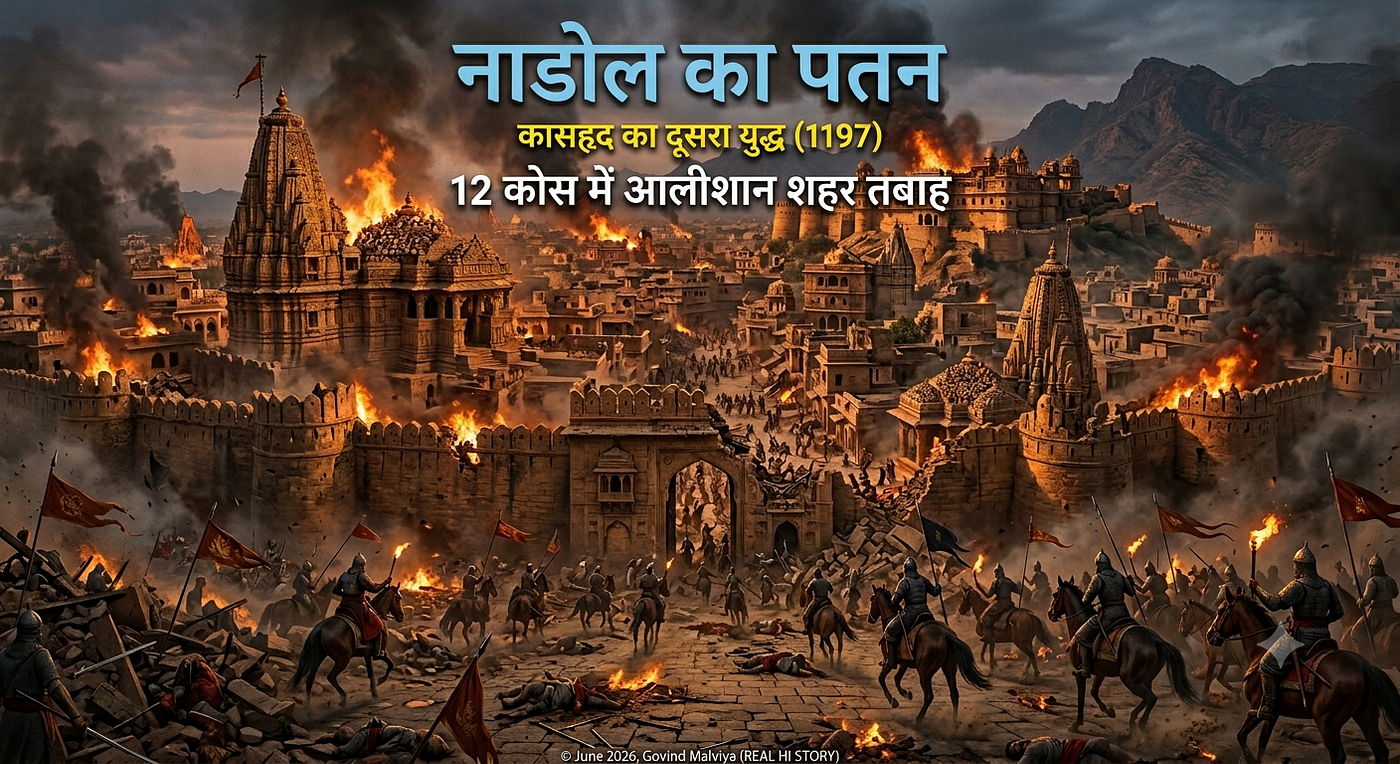
The subsequent sack of the city was absolute and total. The grand palaces of the 12-Kos metropolis were systematically torched. The ancient, world-renowned Jain and Hindu temples were reduced to mounds of rubble, their exquisite idols shattered to pieces. The city was thoroughly plundered, and its remaining citizens were either massacred or enslaved.
The oldest capital of the Chauhans was broken so thoroughly that it could never recover. The magnificent 12-Kos trading hub vanished into history, shrinking over the centuries into a small, forgotten village. The surviving political legacy of the clan shifted permanently to Jalore under the Songara Chauhan branch (founded by Kirtipal, Jaisingh’s uncle), which later produced the legendary hero Kanhadadev Songara.
Academic References & Sources:
- Taj-ul-Masir by Hasan Nizami (Contemporary Persian Chronicle) — Elliot and Dowson, Vol. II, pp. 229–231.
- The Early Chauhan Dynasties by Dr. Dasharatha Sharma — pp. 74–78.
- History of Rajputana (History of Jodhpur State, Vol. 1) by Dr. G.H. Ojha — pp. 170–175 (Archaeological insights on Juna Kheda).
Disclaimer:
This article is based on rigorous historical research and authentic academic sources. The sole purpose of this content is historical awareness and education; it does not intend to hurt the sentiments of any caste, religion, or community.
© June 2026, Govind Malviya (REAL HI STORY).
mail me- drmalviya0@gmail.com
12 कोस की वो महा-तबाही: जब एक मनोवैज्ञानिक चाल ने मिटा दिया चौहानों का सबसे समृद्ध महानगर
The Fall of Nadol (1197 AD): इतिहास की वो आत्मघाती भूल, जिसके बारे में हमारी टेक्स्टबुक्स ने कभी बात नहीं की।
लेखक: डॉ. गोविंद मालविय (Founder, REAL HI STORY)
जब भी हम मध्यकालीन भारत या तुर्क आक्रमणों का इतिहास पढ़ते हैं, तो हमारा पूरा नैरेटिव तराइन के युद्ध (1191 और 1192 ई.) के इर्द-गिर्द सिमट कर रह जाता है। हमें सिखाया जाता है कि पृथ्वीराज चौहान की हार के साथ ही उत्तर-पश्चिम भारत में राजपूत प्रतिरोध थम गया था।
लेकिन यह अधूरा सच है।
तराइन के ठीक 5 साल बाद, सन 1197 ई. में, अरावली की पहाड़ियों की छांव में एक ऐसा विनाशकारी युद्ध लड़ा गया, जिसने सैन्य रणनीति (Military Strategy) के मायने बदल दिए। यह कहानी है ‘कासह्रद के दूसरे युद्ध’ की, और एक ऐसे ऐतिहासिक ‘महानगर’ के रातों-रात इतिहास से गायब होने की, जिसे कभी ‘बारह कोस की नगरी’ कहा जाता था — नाडोल (Nadol)।
द आर्किटेक्चर ऑफ अ मेगासिटी: नाडोल का प्राचीन वैभव
आज का नाडोल राजस्थान के पाली जिले का एक छोटा, शांत गाँव हो सकता है, लेकिन 10वीं से 12वीं शताब्दी के बीच यह राजपूताना के सबसे शक्तिशाली साम्राज्यों में से एक था।
लगभग 960 ई. में शाकम्भरी के चौहान राजा वाक्पतिराज के पुत्र राव लक्ष्मण (लाखण सी) ने नाडोल के चौहान वंश की स्थापना की थी। स्थानीय ख्यातों (Bardic Chronicles) और पुरातात्विक साक्ष्यों के अनुसार, नाडोल केवल एक गढ़ या किला नहीं था; यह ‘बारह कोस’ (लगभग 36 से 38 किलोमीटर) के दायरे में फैला एक आलीशान, योजनाबद्ध और समृद्ध महानगर था।
यह शहर सिल्क रूट और मध्य भारत को गुजरात के बंदरगाहों से जोड़ने वाले मुख्य ट्रेड रूट पर स्थित था। यहाँ के भव्य जैन मंदिर, नक्काशीदार हिंदू देवालय और आलीशान महल इसकी आर्थिक संपन्नता की गवाही देते थे। लेकिन यही बेहिसाब दौलत तुर्कों की आँखों में खटक रही थी।
कासह्रद (कयादरा): जहाँ नियति ने दो बार पासा पलटा
माउंट आबू की तलहटी में स्थित कासह्रद (आधुनिक कयादरा), सामरिक रूप से एक बेहद संवेदनशील पहाड़ी दर्रा (Mountain Pass) था। दिल्ली और अजमेर पर कब्जा करने के बाद, मुहम्मद गौरी के सिपहसालार कुतुबुद्दीन ऐबक की नजर गुजरात की अकूत संपत्ति पर थी। लेकिन गुजरात में घुसने का रास्ता नाडोल और आबू की सीमाओं को पार किए बिना मुमकिन नहीं था।
इतिहास ने इस मैदान में दो बार अपनी क्रूरता दिखाई:
- कासह्रद का प्रथम युद्ध (1178 ई.): जब मुहम्मद गौरी ने गुजरात पर आक्रमण किया, तब गुजरात की राजमाता नायकी देवी, आबू के धारावर्ष परमार और नाडोल के राजा केलहण चौहान के ‘महा-गठबंधन’ ने गौरी को इसी संकरी पहाड़ी घाटी में घेरकर इतनी बेरहमी से काटा था कि गौरी लहूलुहान होकर गजनी भाग गया था। उसने अगले 13 साल तक इस रास्ते आने की हिम्मत नहीं की।
लेकिन सन 1197 में स्थितियां बदल चुकी थीं। नाडोल की गद्दी पर केलहण के पुत्र जयसिंह (जयंतसिंह) बैठे थे और दिल्ली से कुतुबुद्दीन ऐबक एक विशाल, आधुनिक तुर्क सेना लेकर अपनी पुरानी हार का बदला लेने आगे बढ़ रहा था।
द टैक्टिकल मिस्टेक: ‘फीन्ड रिट्रीट’ और राजपूतों का अति-उत्साह
कुतुबुद्दीन ऐबक एक बेहद शातिर मिलिट्री कमांडर था। जब वह कासह्रद के मुहाने पर पहुँचा, तो पहाड़ी ऊँचाइयों पर संयुक्त राजपूत सेना (चालुक्य, परमार और नाडोल के चौहान) को अभेद्य मोर्चेबंदी किए देखकर वह ठिठक गया। वह समझ गया कि इस संकरी घाटी के भीतर घुसना सीधे मौत को दावत देना है।
तभी उसने खानाबदोश स्टेपी वारियर्स की सबसे घातक युद्ध नीति अपनाई, जिसे सैन्य इतिहास में ‘Feigned Retreat’ (पीछे हटने का ढोंग करना) कहा जाता है।
मनोवैज्ञानिक जाल
एक सुबह, तुर्क सेना ने अचानक अपनी चौकियां छोड़ दीं और इस तरह पीछे भागने लगी जैसे वे राजपूतों के डर से मैदान छोड़कर भाग रहे हों। उन्होंने रास्ते में अपने तंबू और कुछ रसद भी छोड़ दी ताकि यह नाटक बिल्कुल असली लगे।
1178 ई. की ऐतिहासिक जीत के गौरव और अति-आत्मविश्वास से भरे राजपूत सेनापति इस चाल को समझ नहीं पाए। नाडोल के राजा जयसिंह और अन्य योद्धाओं को लगा कि भागते हुए दुश्मन को खत्म करने का यह सबसे सही मौका है। यही वह क्षण था जब एक रणनीतिक भूल ने पूरे युद्ध का फैसला कर दिया। राजपूत सेना अपनी सबसे सुरक्षित पहाड़ी पोजिशन को छोड़कर खुले, सपाट मैदान में तुर्कों का पीछा करने उतर आई।
द डेथ सर्कल (Circle of Death) और कत्लेआम
जैसे ही भारी कवच (Heavy Armor) पहने राजपूत योद्धा कासह्रद के खुले मैदान में आए, भागते हुए तुर्क घुड़सवार अचानक मुड़ गए। ऐबक का जाल पूरी तरह से काम कर चुका था।
- गतिमान तीरंदाज (Horse Archers): तुर्कों के पास बेहद फुर्तीले घुड़सवार तीरंदाज थे जो दौड़ते घोड़ों से अचूक निशाना लगाने में माहिर थे। खुले मैदान में उन्होंने राजपूतों को चारों तरफ से घेरकर एक ‘डेथ सर्कल’ बना लिया और तीरों की भयंकर बौछार शुरू कर दी।
- रफ़्तार बनाम भारी कवच: राजपूत आमने-सामने की तलवारबाजी (Close Combat) में अजेय थे, लेकिन दूरी से चलने वाले हजारों तीरों के सामने उनकी गति धीमी पड़ गई।
- हाथियों का भड़कना: तुर्क तीरंदाजों ने राजपूतों के हाथियों की आँखों को निशाना बनाया। घायल होकर भड़के हाथियों ने पीछे मुड़कर अपनी ही पैदल सेना को कुचलना शुरू कर दिया।
जयसिंह का ‘लास्ट स्टैंड’
राजा जयसिंह को समझ आ चुका था कि वे एक भयानक धोखे का शिकार हो चुके हैं, लेकिन चौहान रक्त पीछे हटना नहीं जानता था। उन्होंने अपने चुनिंदा राजपूत वीरों के साथ तुर्क सेना के केंद्र पर एक आत्मघाती हमला बोला। जयसिंह ने अंत तक अदम्य साहस का परिचय दिया, लेकिन चारों तरफ से घिर जाने और अनगिनत तीरों से छलनी होने के कारण वे उसी मैदान में वीरगति को प्राप्त हुए।
नाडोल का संपूर्ण विनाश: ‘द सिंड्रोम ऑफ ओब्लिवियन’
समकालीन तुर्क इतिहासकार हसन निज़ामी ने अपनी पुस्तक ‘ताज-उल-मासिर’ (Taj-ul-Masir) में इस युद्ध के बाद के मंज़र का रूह कंपा देने वाला विवरण दिया है:
“सैनिकों ने काफिरों के खून से मैदान को समंदर बना दिया। 50,000 से अधिक काफिरों को मौत के घाट उतारा गया और उनके कटे हुए सिरों के पहाड़ों जैसे ऊंचे ढेर लगा दिए गए।”
कासह्रद के मैदान में जीत के बाद कुतुबुद्दीन ऐबक की क्रूर सेना सीधे नाडोल की तरफ बढ़ी। नाडोल की रक्षा करने के लिए अब कोई पुरुष या सेना बची ही नहीं थी, क्योंकि सारे मुख्य योद्धा आबू की तलहटी में वीरगति पा चुके थे।
ऐबक ने नाडोल में प्रवेश करते ही बर्बरता की सारी हदें पार कर दीं। 12 कोस में फैले इस वैभवशाली शहर के आलीशान महलों को आग लगा दी गई। यहाँ के विश्वप्रसिद्ध प्राचीन जैन और हिंदू मंदिरों को मलबे के ढेर में तब्दील कर दिया गया, मूर्तियों को खंडित कर दिया गया। शहर की धन-दौलत को पूरी तरह लूट लिया गया और बची हुई आबादी को या तो मार दिया गया या दास बना लिया गया।
चौहानों की यह सबसे पुरानी और ताकतवर राजधानी इस कदर बेरहमी से तोड़ी गई कि वह फिर कभी उठ नहीं सकी। 12 कोस का वह समृद्ध महानगर हमेशा के लिए खंडहरों में दफन हो गया। नाडोल के इस खूनी अंत के बाद बची-कुची राजनैतिक सत्ता जालोर के सोनगरा चौहानों (कीर्तिपाल के वंशजों) के हाथ में चली गई।
ऐतिहासिक संदर्भ (Academic References):
- Taj-ul-Masir by Hasan Nizami (Contemporary Persian Source) — Elliot and Dowson, Vol. II, pp. 229–231.
- The Early Chauhan Dynasties by Dr. Dasharatha Sharma — pp. 74–78.
- राजपूताना का इतिहास (जोधपुर राज्य, भाग-1) बाय डॉ. गौरीशंकर हीराचंद ओझा — pp. 170–175 (जूना खेड़ा पुरातात्विक साक्ष्य).
메타데이터
- post_id
- f515c8a5fa60
- slug
- the-extermination-of-a-megacity-how-a-tactical-deception-erased-the-oldest-chauhan-capital-f515c8a5fa60
- url
- https://medium.com/@drmalviya0/the-extermination-of-a-megacity-how-a-tactical-deception-erased-the-oldest-chauhan-capital-f515c8a5fa60
- canonical_url
- https://medium.com/@drmalviya0/the-extermination-of-a-megacity-how-a-tactical-deception-erased-the-oldest-chauhan-capital-f515c8a5fa60
- author_url
- https://medium.com/@drmalviya0
- status
- ok
- fetched_at
- 2026-06-24 11:06:28