YouTube’s New Monetization Warning Has Creators Panicking — But Here’s What the Update Actually…
YouTube has clarified its monetization policy around AI-generated and repetitive content. Learn what “Unsatisfying or Off-Putting Content”…
YouTube’s New Monetization Warning Has Creators Panicking — But Here’s What the Update Actually Means
YouTube has clarified its monetization policy around AI-generated and repetitive content. Learn what “Unsatisfying or Off-Putting Content” means, which channels are most at risk, and how creators can stay monetized in 2026.
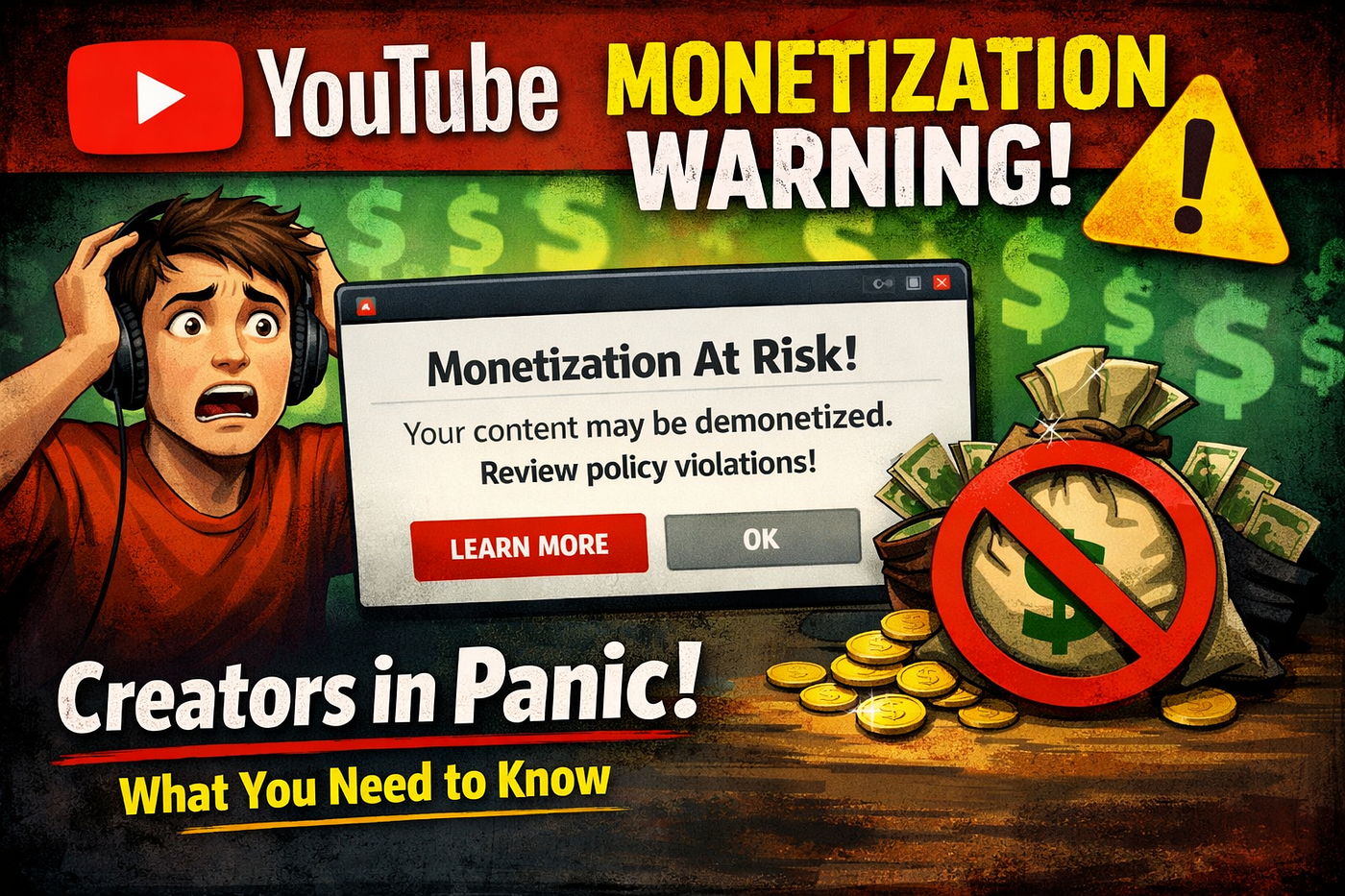
YouTube’s New Monetization Warning Has Creators Panicking — But Here’s What the Update Actually Means cover image by author
The July 2026 clarification on “Unsatisfying or Off-Putting Content” isn’t a ban on AI. It’s YouTube drawing a clear line between creators who add value and those who mass-produce content.
One Morning, Thousands of Creators Woke Up Worried
The headlines spread quickly.
“YouTube is demonetizing AI channels.”
“Mass AI content is dead.”
“New monetization rules are coming.”
Within hours, creator communities across Reddit, Discord, X, and YouTube were filled with the same question:
“Is my channel still safe?”
The fear was understandable.
Many creators have spent months — or even years — building channels powered by AI-assisted workflows. Scripts generated with AI, synthetic voiceovers, AI images, automated editing… these tools have become part of modern content creation.
So when YouTube updated its monetization guidance in mid-July 2026, people assumed the platform had declared war on AI.
But that’s not what happened.
The real story is much more interesting — and far more important for every creator trying to build a long-term business on YouTube.
The Real Update: YouTube Isn’t Fighting AI — It’s Fighting Low-Effort Content
Let’s clear up the biggest misconception first.
The July 2026 update is not a brand-new monetization policy.
Instead, YouTube expanded and clarified its existing Inauthentic Content guidance by giving creators clearer examples of what reviewers consider low-value content.
The platform’s message is surprisingly simple:
Using AI isn’t the problem. Publishing videos that feel empty, repetitive, manipulative, or interchangeable is.
That’s a major distinction.
Creators who use AI as a productivity tool have very little to worry about.
Creators who rely on copy-and-paste templates without adding meaningful value may have much bigger concerns.
Why YouTube Is Making This Change Now
This update didn’t appear out of nowhere.
Over the past two years, generative AI has transformed YouTube.
Anyone can now create dozens — or even hundreds — of videos every week with almost no manual effort.
We’ve all seen them:
- Endless Reddit story channels
- AI-generated motivational videos
- Celebrity gossip narrated by robotic voices
- Animal rescue videos using identical emotional formulas
- Movie clips stitched together with dramatic AI narration
- Fake news thumbnails promising shocking revelations
Many of these videos perform well in the algorithm.
But many viewers don’t enjoy watching them.
And advertisers definitely don’t enjoy paying to appear beside them.
From YouTube’s perspective, that’s a problem worth solving.
The Three Types of Content YouTube Is Watching More Closely
The updated guidance groups problematic content into three categories.
Understanding these categories could be the difference between growing your channel — or losing monetization.
1. Generic or Repetitive Content
Imagine visiting a channel where every upload feels like the previous one.
Same editing.
Same script structure.
Same AI voice.
Same thumbnail.
Same ending.
Even if the topic changes, the experience doesn’t.
That’s exactly what YouTube wants creators to avoid.
Examples include:
- AI-generated videos using identical templates
- Image slideshows with little narration
- Educational videos that repeat surface-level facts
- Stories following the same predictable structure
- Characters repeating identical scenarios across videos
None of these are automatically disallowed.
The issue is whether viewers feel they’re watching something new — or just another version of yesterday’s upload.
2. “Unsatisfying or Off-Putting Content” — The Phrase Everyone Is Talking About
This new label has attracted the most attention.
Why?
Because it describes something creators have struggled to define for years.
We’ve all watched videos that leave us feeling…
“Why did I waste my time?”
That’s exactly the experience YouTube wants to reduce.
According to the updated guidance, examples include:
Emotion Without Meaning
Videos that repeatedly rely on:
- Violence
- Tragedy
- Animal suffering
- Constant danger
- Emotional distress
without offering a meaningful story or educational purpose.
Shock for the Sake of Shock
Another example is stitching unrelated AI clips together simply to surprise viewers.
The visuals may look dramatic.
But there’s no narrative connecting them.
Just endless attempts to trigger curiosity.
Manipulative Clickbait
This includes:
- Fake celebrity deaths
- False disaster reports
- Misleading thumbnails
- Invented breaking news
These tactics may generate clicks.
But they often destroy viewer trust.
And trust is becoming one of YouTube’s most valuable currencies.
3. Fake AI Experts on Sensitive Topics
This is perhaps the most serious category.
AI presenters are becoming increasingly realistic.
That’s exciting — but also risky.
YouTube is drawing a line when AI characters present themselves as genuine experts in areas like:
- Medicine
- Finance
- Politics
- Legal advice
The concern isn’t that AI exists.
It’s that viewers may mistake generated content for professional advice.
If creators use AI in these areas, transparency and genuine expertise matter more than ever.
Here’s What YouTube Really Wants
Reading the update closely reveals a broader philosophy.
YouTube isn’t asking creators to stop using technology.
It’s asking them to stop outsourcing creativity.
Those aren’t the same thing.
The platform wants videos that feel like someone actually cared about making them.
That means:
- Original thinking
- Personal insight
- Clear storytelling
- Strong editing
- Authentic personality
- Meaningful viewer value
Technology can help create all of those things.
It just can’t replace them.
The Rise — and Fall — of “AI Slop”
One phrase keeps appearing in creator discussions:
AI slop.
It refers to mass-produced content created primarily for algorithms instead of humans.
Characteristics often include:
- Generic narration
- Endless automation
- Little research
- Recycled scripts
- Predictable thumbnails
- Zero creator identity
The internet has become flooded with these videos.
And YouTube appears determined to reward creators who rise above them.
Ironically, Small Creators May Benefit the Most
This update could actually level the playing field.
For years, creators with automated production pipelines overwhelmed search results through sheer volume.
But if originality becomes a stronger ranking signal, quality may begin outperforming quantity.
That creates opportunities for creators who:
- Research deeply
- Tell compelling stories
- Build recognizable brands
- Develop unique voices
- Earn loyal audiences instead of chasing clicks
In other words…
Being memorable may become more valuable than being prolific.
A Simple Test: Would Someone Miss Your Channel If It Disappeared?
This may be the most important question every creator should ask.
If your channel vanished tomorrow…
Would viewers notice?
Or could they replace it with fifty nearly identical channels?
If the answer is the second one, YouTube’s new guidance is worth taking seriously.
Because the safest channels aren’t necessarily the biggest.
They’re the ones that offer something nobody else does.
Five Ways to Future-Proof Your YouTube Channel
Instead of worrying about every policy update, focus on habits that make your content difficult to imitate.
Develop a recognizable identity
Let viewers remember you, not just your topic.
Add genuine commentary
Explain why something matters instead of simply describing it.
Tell complete stories
Give viewers a beginning, middle, and satisfying conclusion.
Use AI as an assistant
Let AI speed up production — but make sure your judgment shapes the final product.
Build beyond ad revenue
Diversify with:
- Newsletters
- Courses
- Digital products
- Memberships
- Community spaces
- Merchandise
A sustainable creator business is rarely built on ads alone.
The Bigger Picture: This Isn’t About AI at All
Every major technological shift changes creative industries.
Photography didn’t eliminate painters.
Streaming didn’t eliminate filmmakers.
AI won’t eliminate creators.
But it will make originality more valuable than ever.
That’s exactly what this update reflects.
YouTube is sending a clear signal:
The future belongs to creators who combine AI with authentic human creativity — not those who replace creativity altogether.
Final Thoughts
If your content teaches, entertains, informs, or inspires in a way that’s unmistakably yours, this update shouldn’t feel like a threat.
It should feel like an opportunity.
The creators who win over the next decade won’t necessarily be the ones publishing the most videos.
They’ll be the ones creating videos viewers genuinely remember.
And in a platform increasingly crowded with automation, being unforgettable may become YouTube’s most valuable algorithm.
FAQ Section
Is YouTube banning AI-generated content?
No. YouTube allows creators to use AI tools. The platform is targeting repetitive, low-effort, misleading, or manipulative content — not AI itself.
What is Unsatisfying or Off-Putting Content?
It refers to videos that rely on repetitive emotional manipulation, deceptive storytelling, shocking imagery, or generic templates without meaningful value.
Can AI voiceovers still be monetized?
Yes. AI voiceovers can qualify for monetization if the overall video provides original commentary, education, entertainment, or other transformative value.
Which channels are most at risk?
Channels built around repetitive templates, AI story farms, misleading clickbait, bodycam compilations with minimal commentary, or mass-produced content may face a higher risk of limited monetization.
How can creators stay monetized?
Focus on originality, strong storytelling, authentic commentary, research, and creating videos that provide genuine value to viewers.
메타데이터
- post_id
- f52313a33fe5
- slug
- youtubes-new-monetization-warning-has-creators-panicking-but-here-s-what-the-update-actually-f52313a33fe5
- url
- https://medium.com/no-time/youtubes-new-monetization-warning-has-creators-panicking-but-here-s-what-the-update-actually-f52313a33fe5
- canonical_url
- https://medium.com/no-time/youtubes-new-monetization-warning-has-creators-panicking-but-here-s-what-the-update-actually-f52313a33fe5
- author_url
- https://medium.com/@tamzidulhaque
- status
- ok
- fetched_at
- 2026-07-17 13:23:26