How Schema Mark-up Became the Secret Weapon of AI Search Visibility
Structured data was always important. But in the era of LLM-powered answer engines, it has quietly become the single most decisive…
How Schema Mark-up Became the Secret Weapon of AI Search Visibility
Structured data was always important. But in the era of LLM-powered answer engines, it has quietly become the single most decisive technical factor separating brands that get cited from brands that get ignored.
In 2015, schema markup was a nice-to-have. In 2020, it was a competitive advantage in rich results. In 2026, it is infrastructure as foundational to your AI search presence as your domain was to your organic search presence a decade ago. The difference is that most technical teams have not made this mental shift yet, and the performance gap between those who have and those who haven’t is becoming measurable and severe.
This piece is a technical walkthrough. We will cover what schema mark-up actually communicates to AI retrieval systems, which schema types matter most right now, how to implement them correctly, and the common implementation mistakes that are silently killing your AI visibility even when you think you have schema deployed.

Why AI Systems Care About Schema Mark-up
To understand why schema matters to AI answer engines, you need to understand how those engines retrieve and evaluate content. The dominant pattern in 2026 is Retrieval-Augmented Generation (RAG): the model doesn’t rely solely on baked-in training data. Instead, it queries an index, retrieves candidate documents, scores them for relevance and authority, and synthesises a response from the highest-scoring candidates.
The scoring mechanisms used in RAG pipelines weight several signals. One of the most reliable and machine-readable signals available is structured data. Here’s why:
1. Disambiguation at the Entity Level
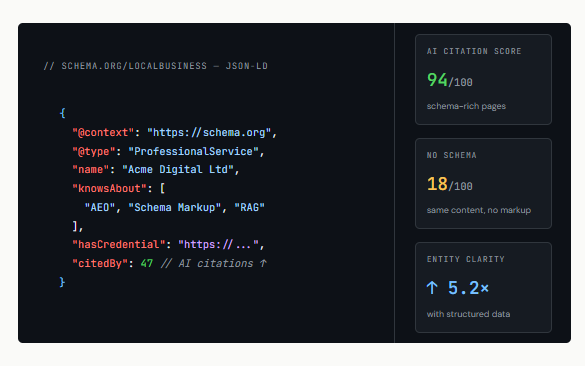
AI language models think in entities named objects, people, organisations, places, concepts and the relationships between them. A page of prose about “our digital marketing services” is ambiguous to a retrieval system. A page with a correctly typed ProfessionalService schema, a defined knowsAbout array, and a linked Organization entity with a verifiable sameAs reference to a Wikidata or Companies House URI is unambiguous. The AI knows exactly what this entity is, what it does, and how it connects to other entities in its graph.

2. Claim Verifiability
Modern AI answer engines are trained to be epistemically cautious. They prefer to cite content whose claims are verifiable i.e., content that presents facts as facts, not as marketing assertions. Schema mark-up provides a structured claim layer: when your Product schema includes a review array with ratingValue and reviewCount, or your FAQPage schema contains a factual acceptedAnswer, those claims are structurally separated from your promotional prose. This makes them easier for retrieval systems to extract and evaluate.
3. Reduced Parsing Ambiguity
This is the most underappreciated benefit. When a RAG pipeline ingests a web page, it does not read it the way a human does. It tokenises and embeds it, often losing the semantic hierarchy your CSS and visual design implied. Schema mark-up exists entirely outside the rendering pipeline it tells the machine directly: this block of content is a HowTo, these are its steps, this is the totalTime. You are removing guesswork that the model would otherwise have to do, and guesswork costs you relevance score.

The Schema Types That Matter Most for AI Visibility in 2026
Not all schema types are equal in their impact on AI retrieval performance. Based on testing across multiple verticals throughout 2025 and early 2026, the following types show the strongest correlation with citation rate improvements.

Implementation Deep-Dive: Building AI-Ready Schema
Let’s go beyond the basics. Most schema guides show you the minimum viable implementation. What follows is what production-grade, AI-optimised schema actually looks like.
FAQPage The Highest-Impact Implementation
FAQPage schema is the closest structural analogue to how AI answer engines retrieve information. A conversational query is essentially a question; your acceptedAnswer is the structured response. When your FAQ schema answers the same question a user is asking an AI assistant, the retrieval pipeline has a strong signal to surface your content.


Article Schema Signalling Author Authority
AI systems, particularly those applying E-E-A-T principles to retrieval scoring, weight author expertise heavily. An Article schema with a properly defined author object including the author's knowsAbout array, their sameAs links to their LinkedIn, Google Scholar profile, or industry associations tells the retrieval system this content was written by a credentialed expert, not an anonymous content farm.

The Seven Schema Mistakes Destroying Your AI Visibility
Having audited hundreds of schema implementations in 2025 and 2026, the following errors appear so consistently that they deserve direct enumeration. Each one is actively harming your citation rate right now.
Mismatched @type specificity. Using Organization when you should use ProfessionalService, MedicalOrganization, or LegalService. More specific types give retrieval systems stronger categorical signals. Default to the most specific applicable type.
Missing @id anchors. Without a canonical @id URI for your core entities, different schema blocks across your site cannot be linked into a coherent graph. The AI sees disconnected fragments rather than a unified entity. Use fragment identifiers like #organisation and #person-alex-chen consistently.
Empty or generic knowsAbout arrays. Listing "Marketing" and "SEO" is nearly useless. List specific, verifiable topics at the level of granularity that matches your actual content: "Retrieval-Augmented Generation", "JSON-LD implementation", "AI citation optimisation". Vague entries provide no disambiguation signal.
No sameAs corroboration. This is the most common critical omission. Without external corroboration links, your entity claim is unverifiable. Even one or two strong sameAs references LinkedIn, Companies House, a Wikipedia or Wikidata entry dramatically increase entity confidence scores in retrieval systems.
FAQPage answers that are too brief. AI systems extract value from the semantic density of your acceptedAnswer text. One-sentence answers do not provide enough signal. Aim for 60–120 words per answer, written in the same register as a factual, authoritative response not a teaser pointing to the full article.
Deploying schema that doesn’t match page content. Schema lying about page content adding a Review aggregate that doesn't appear on the page, or a HowTo with steps not present in the body is flagged as spam by Google and likely penalised in AI retrieval too. Schema must describe what is actually on the page.
Ignoring validation errors. Deploying schema with validation errors is worse than deploying none at all malformed structured data can cause parsing failures that corrupt the entire page’s representation in the index. Always run through Google’s Rich Results Test and Schema.org validator before deployment.
Testing, Monitoring, and Iterating Your Schema Performance
Schema is not a one-time implementation. The landscape of AI retrieval systems is evolving rapidly, and the schema types and properties that maximise citation rate in one quarter may shift as the underlying models and retrieval architectures are updated. You need a monitoring cadence.
Validation Tools (Use All Three)
Google’s Rich Results Test (search.google.com/test/rich-results)validates against Google's current schema parser and shows which rich result features your implementation qualifies for. Run this for every page with schema before and after changes.
Schema.org Validator (validator.schema.org)tests against the full schema.org specification, catching errors that Google's tool might not surface. Particularly useful for less common schema types.
Google Search Console → Enhancements monitors schema errors and warnings at scale across your entire site. Set up alerts for new errors; a CMS update silently breaking your schema template is a common and damaging failure mode.
AI Citation Monitoring
The output metric that matters is citation rate in AI-generated answers not rich result impressions. This requires a different monitoring approach. Teams that are serious about AEO are now running weekly query panels: structured sets of target queries run against ChatGPT, Perplexity, and Google AI Overviews, with results logged for brand citations and competitor citations. This is the feedback loop that tells you whether your schema investments are translating into actual AI visibility.
A note on scope: Schema mark-up is one pillar of a comprehensive AEO programme a critical one, but not sufficient alone. Entity authority, content structure, and third-party citation signals all interact with your schema layer. Technical teams implementing schema in isolation, without the broader strategic context of a full AEO approach, will see partial gains. The organisations achieving the largest AI visibility improvements are treating schema as part of an integrated system. If you’re looking to understand the full stack, the team at Gorilla360’s AEO practice publishes some of the most technically rigorous methodology on this their structured data audit process in particular is worth reviewing before you scope your own implementation.
What the Next 12 Months Looks Like for Schema and AI
The direction of travel is clear: AI retrieval systems will become more schema-dependent, not less, as they are asked to answer increasingly specific and verifiable queries. Several developments in the near-term pipeline will make current schema investments compound:
Semantic graph expansion. The major AI labs are investing heavily in knowledge graph infrastructure. Brands with well-defined, externally corroborated entity graphs will slot cleanly into these structures; brands without them will remain ambiguous noise in a higher-signal environment.
Temporal schema signals. Expect AI retrieval to weight dateModified and temporal specificity more aggressively as users demand answers about current states, not historical ones. Schema that includes precise temporal metadata will outperform static implementations.
Credentialing and claims schemas. The hasCredential and hasCertification schema properties, currently underused, are positioned to become more significant as AI systems try to apply E-E-A-T signals at retrieval time. Implementers who deploy these now will have a seasoning advantage.
The technical foundation you build today is not just about current AI search performance. It is about positioning your entity correctly in the AI-mediated information layer that is, increasingly, where discovery begin and where brand trust is established before a user ever visits your website.
Get the schema right. The rest of the AEO stack builds on it.
메타데이터
- post_id
- f52bfa47dbe9
- slug
- how-schema-mark-up-became-the-secret-weapon-of-ai-search-visibility-f52bfa47dbe9
- url
- https://medium.com/@fizza.q1399/how-schema-mark-up-became-the-secret-weapon-of-ai-search-visibility-f52bfa47dbe9
- canonical_url
- https://medium.com/@fizza.q1399/how-schema-mark-up-became-the-secret-weapon-of-ai-search-visibility-f52bfa47dbe9
- author_url
- https://medium.com/@fizza.q1399
- status
- ok
- fetched_at
- 2026-06-09 15:37:30