Silapathikaram and Migration of People at Sangam Age.
Silapathikaram is a famous book written by a Prince turned Jain monk Ilango Adigal.
Silapathikaram and Migration of People at Sangam Age.
Silapathikaram is a famous book written by a Prince turned Jain monk Ilango Adigal.
He was the younger brother of Cheran Senguttuvan. There is a story that goes like this:
An astrologer is said to have predicted that Ilango would succeed his father, named Imayavaramban Neduncheralathan, to the throne.
In the Tamil region, three famous Tamil clans ruled different parts of Tamil Nadu.
Cheras ruled the western coast, which is what is presently called Kerala, and also parts of Tamil Nadu like Coimbatore, and Ooty called as Udhagamandalam. The capital city of Cheras was Vanchi. We don’t know where that city is today. Many call that Vizhinjam is what Vanchi was known as previously
Cholas ruled the areas around Tanjore and they had several capitals like Uraiyur, Gangaikonda Cholapuram, Pazhaiyaarai, Tanjore, Poompugar, etc.
Pandiyas ruled from their capital city of Madurai.
All these three Kingdoms are considered to be pure Tamil Kingdoms.
Pallavas later became prominent and they ruled from the city of Kanchipuram.
Now, coming to the question of migration of people between these different regions one wonders whether there was any restriction in their movements.
Silapathikaram, written by Ilango Adigal, is divided into three parts. They are Pugar Kandam, Madurai Kangam, and Vanchi Kandam.
During the time of the happening of this epic, the capital city of Cholas was Poompugar also called Pugar. This was a harbor and was situated at the mouth of the river Kaveri, where it joins the sea.
In ancient times ports were situated at the mouth of some major river where it joins the sea. Sometimes the loading and the unloading happened in the mid-sea and sometimes if the port was deep, the ships would come very near to the shore, where any laborer could load and unload the goods.
Pugar was one such port where the ships could come very near the lands inside.
The King who ruled the Chola Kingdom during this time was Karikal Peruvalathaan also called Thirumavalavan.
The story revolves around two merchant families. Two merchant families decide to unite their children in wedlock. Kovalan was the bridegroom and Kannagi was the bride.
Both their families were of equal stature in business and wealth. The marriage was celebrated with much pomp and beautiful young girls were hired to go around the city of Pugar to announce the marriage of Kovalan and Kannagi and invited all the citizens of the city to attend the marriage and bless the young couples.
After the marriage is celebrated with much pomp the bride’s mother sets up a house for their living together and for some time they live happily there.
At the time of their marriage, Kovalan was sixteen years of age and Kannagi was twelve years of age.
After some time of their marriage, a dancing girl by the name of Madhavi invites one and all of the city’s VIPs to attend her first stage performance, in the presence of King Thirumavalavan aka Karikal Cholan.
Kovalan was of such stature that he was also invited to that dance performance.
At the time of her stage performance, Madhavi was twelve years age.
After the dance performance went off well, the King presented the dancing girl with a precious gift and left the place.
Then Kovalan approaches the foster mother of Madhavi and persuades her to start a live-in relationship with Madhavi.
Things were going on like this. He neglected his wedded wife Kannagi and was always living in the quarters of Madhavi. He lavishes all his wealth on her and soon becomes a pauper.
At that time he felt ashamed of himself. He could have at that time approached his parents but fearing their admonishing he never went to them. He could have gone to his in-laws and sought their help to overcome the financial burden, but his ego prevented him from going to them.
Then both Kovalan and Kannagi decide to start a new chapter in their life. They decided to migrate to Madurai which was the capital city of Pandiyas.
They go to Madurai and Kannagi gives him her anklet worn on her feet. Since that jewel is worn on the feet, it comes in pairs.
She gave one of them to her husband and asked him to sell that in the market and using that as the principal she urged him to engage in business once again.
Kovalan went to the places where jewels are made or traded and he asked one of the jewelers to help him sell his wife’s anklet.
The jeweler upon seeing the anklet felt that it was fit to be worn by the Queens and he mistook Kovalan for having stolen that precious and costly jewel.
The Pandiyan King decides in haste and punishes Kovalan with the death penalty without a proper trial.
When the news of his death reached her, Kannagi was crestfallen. She didn’t anticipate this fate to her husband.
Furthermore, she was infuriated at the fact that her husband was branded a thief.
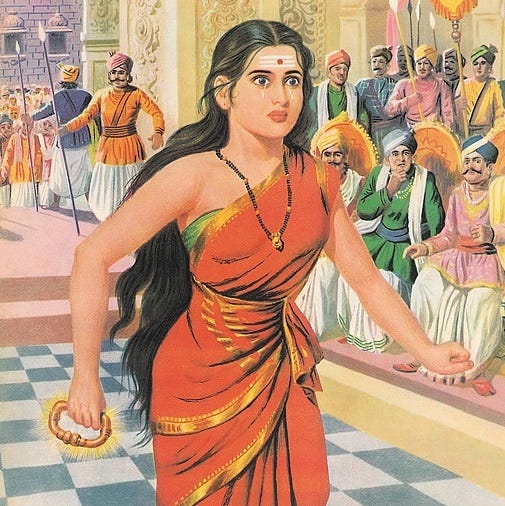
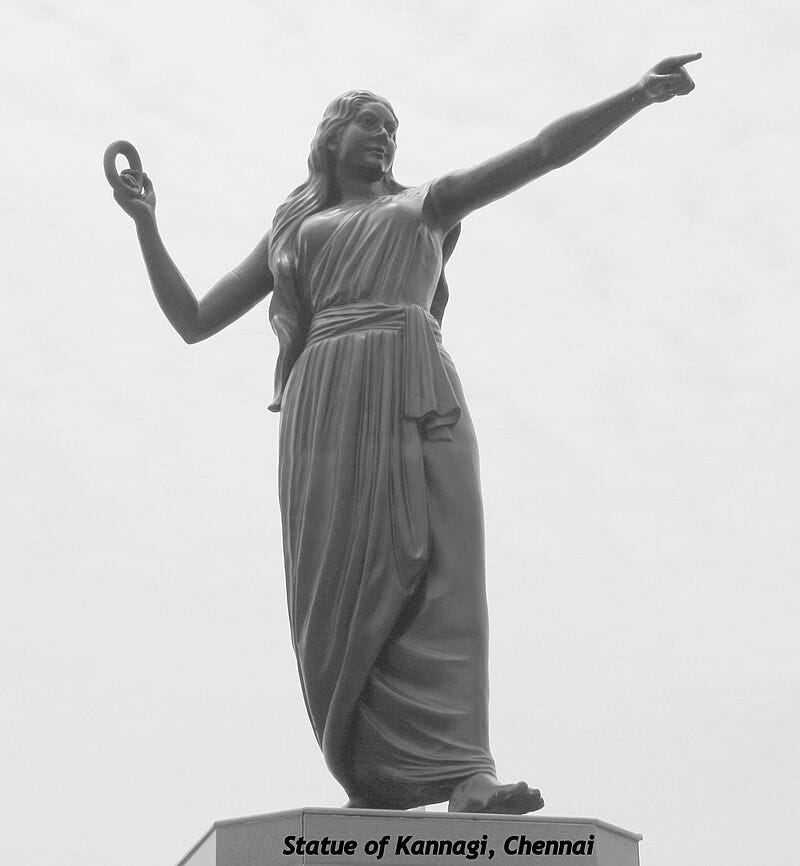
Immediately she set forth to the Palace to see the King and seek justice. She came to the entrance of the Palace with the other anklet that she was wearing and confronted the King.
She announced herself as the daughter of a wealthy business family of Pugar. She said that her husband was also from a wealthy business family of Pugar and she requested the reason for the capital punishment meted out to him.
The King said to her, that it was the duty of a King to punish the culprits and since he was found to have the anklet of the Queen he was beheaded.
Then Kannagi demanded to show her the anklets of his queen. And the King showed her the same.
In the anklet, there was the practice of putting some precious stones inside the hollow space of the anklet.
She then asked what was the inlaid stone in the queen's anklet and the King replied that the inlaid stones of her anklet were diamonds.
To prove her point she threw the anklet in the ground and the diamonds scattered all around the Palace.
Seeing this fact, the King was crestfallen for giving capital punishment to an innocent person like Kovalan.
He regretted it and out of shock he immediately died there on the throne. His queen and consort also died out of this sudden shock.
Even after the death of these two people who had caused the death of her husband, Kannagi’s anger was not pacified. She then plucked one of her breasts and threw it at the city and commanded the fire god to burn the entire Madurai barring those who recite Vedas, cows, good and honest people, women, children, and old people.
Fire God obeyed her words and burnt Madurai's bad people.
While coming into Madurai city she had come from the eastern gate along with her husband and now when she went away from Madurai, she went away from the western gate, without her husband.
She walked for days together and reached the Kingdom of Cheras. Here starts the Vanchi Kandam.
She walks for about fourteen days and meets some tribals there in the mountains of the western ghats. She has some interactions with the tribals who enquired about her with genuine love and affection.
She explained everything to them and then suddenly in a heavenly chariot Kovalan came and took her with him to the high heavens.
This is the gist of the story of Silapathikaram.
Let us from this analyze the movement of men from one part of the land to another.
As said earlier the Silapathikaram, happens in three different Kingdoms. There must have been a defined border between the Kingdoms.
Guards could also be stationed there, but it seems that no ordinary man was ever stopped from moving around the Kingdoms. Kovalan was engaged in a flourishing business in Pugar. His family was still there.
But he one day chooses to leave Pugar and go to Madurai and turn a new leaf in his life.
There was no one who was there to stop him in the borders between the Chola and the Pandiya Kingdoms.
Again both Kovalan and Kannagi enter the capital city of Pandiyas Madurai. There were guards stationed there, as mentioned by the author of Silapathikaram, but again nobody stopped him there.
After the tragic death of her husband, Kannagi leaves Madurai and goes to the Chera Kingdom. Here also she is not stopped in the borders of the Kingdom.
This means, that the border was porous and no one stopped people from moving from one Kingdom to another. People were free to choose their place of business. So, there were no restrictions for the internal migration of people.
For the goods, of course, there would have been some screening and levying of taxes, but the common man had no such restrictions.
This shows the cultural unity of the land, even if it was ruled by three different Kings.
This must have been the case all over India, and that was the reason people were able to on Kashi Yatra or any temple situated in any part of the land.
메타데이터
- post_id
- f52c2f681dcb
- slug
- silapathikaram-and-migration-of-people-at-sangam-age-f52c2f681dcb
- url
- https://medium.com/@tnmaheshlic/silapathikaram-and-migration-of-people-at-sangam-age-f52c2f681dcb
- canonical_url
- https://medium.com/@tnmaheshlic/silapathikaram-and-migration-of-people-at-sangam-age-f52c2f681dcb
- author_url
- https://medium.com/@tnmaheshlic
- status
- ok
- fetched_at
- 2026-07-23 05:00:24