What Does the Design of the Federal Highway System Have to do with Misinformation?
A handful of people in Silicon Valley should not be left in charge of designing how we live our increasingly digital lives. — from the…
What Does the Design of the Federal Highway System Have to do with Misinformation?
A handful of people in Silicon Valley should not be left in charge of designing how we live our increasingly digital lives. — from the book: Building Back Truth in an Age of Misinformation, by Leslie Stebbins with a forward by Ethan Zuckerman
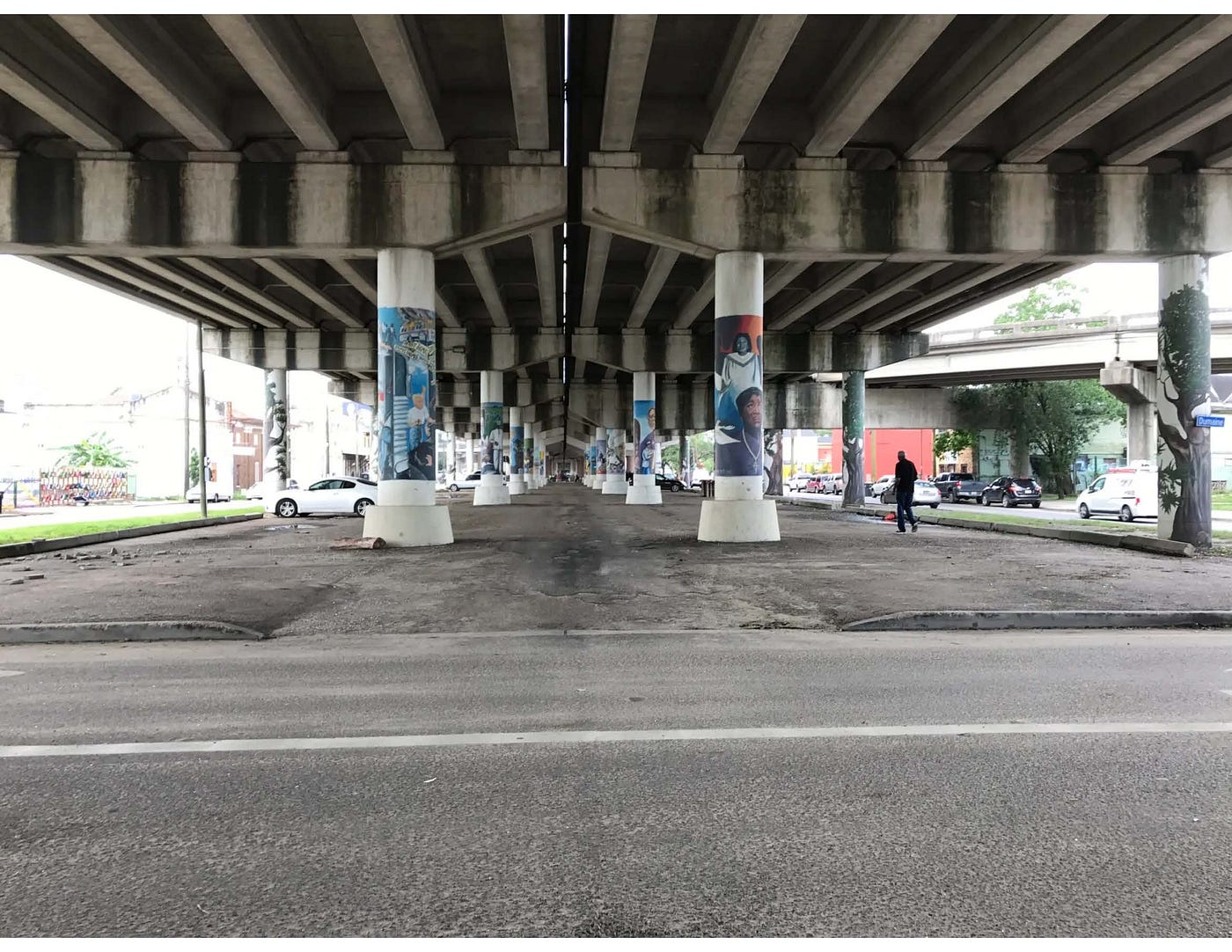
Treme Neighborhood, New Orleans Photo Credit: Amy Stelly
The federal highway system transformed two million miles of poorly constructed and disconnected roads into a networked system of four million miles of paved roads. Moving away from a system that linked farms to markets, the federal system included limited-access expressways that connected city to city across the country. No other public policy shaped our physical environment more. Despite the vast efficiencies created, many urban planners today view the system as causing more harm than good. We are still working on repairing some of the damage.[1]
The infrastructure devised by engineers created winners and losers: some towns literally were “put on the map” due to their connection to an off-ramp and the rapid increase in the number of visitors that drove into town. The losers were those that were either left off the map or saw residents uprooted from their homes as the highway cut communities in half or dismantled them altogether. The negative impact on the environment, public health, communities of color, and low-income neighborhoods was substantial.[2]
Half a century later, urban planners are working to redress some of the damage done by the creation of the interstate. One project is investigating ways to repair some of the destruction caused by Interstate 10, which plowed through the historic Tremé district in New Orleans, a thriving Black community known as the “Main Street of New Orleans.[3] A highway deck was built in 1968 that ran over the town center, disrupting neighborhoods and local businesses, uprooting trees, and altering the quality of life for those living there. The planners are devising tools to help them collect community input on how best to remove a crumbling highway deck without causing further harm.
How were decisions made to roll out this highway system over the course of a handful of decades? The central players were a group of federal engineers who were viewed as neutral experts. They were seen as the best choice for becoming the arbiters of not just the technical decision-making, but also the political and social decisions that needed to be made over the course of sixty years. In hindsight, we can see that this heavy reliance on engineers, rather than finding a healthy balance between democratic and community values and technical expertise, was an enormous mistake.
So what does all this have to do with misinformation?
Four years ago, I started looking into the problem of online misinformation. As a research librarian, my professional life has focused on connecting college students and faculty to reliable information. I have been stunned to watch as the rise in digital information that had initially held so much promise in providing people with abundant, diverse, and trustworthy content had instead spiraled into vast wastelands of clickbait, scams, advertising, false information, and toxic content, while at the same time reliable information was often buried or behind a paywall.
Comedian Bo Burnham points out that “if you want to say a swear on television, you have to go in front of Congress, but if you want to change the neurochemistry of an entire generation, it can be, you know, nine people in Silicon Valley.”[4] We have left the design of our online worlds, like the design of the federal highway system, in the hands of technical experts. And like the federal highway system the internet has provided us with benefits for businesses, government, and citizens that were unthinkable a few decades ago. But just as the highway engineers overfocused on efficiencies, platform companies have focused too much on growth at all costs. A handful of people in Silicon Valley should not be left in charge of designing how we live our increasingly digital lives.
It’s been said that Google “defines what we think” and Facebook “defines who we are.”[5] Social media platforms and Google search did not set out with a business plan to spew misinformation out to users. Misinformation was an unintended by-product of their way of doing business.[6] Google’s original purpose was to “organize all the world’s information and make it available,” and Facebook’s early mission was to “help you connect and share with the people in your life.”[7] But in their early days, tech companies were living hand to mouth, often in danger of going under. Companies such as Google were initially reluctant to embrace advertising, knowing that it would ultimately impact their mission. Once they started down that road what followed was a transition from the goal of technology in service to people to technology in service to profit.[8]
Facebook and Google alone have scarfed up over half of all digital advertising throughout the world — 70 billion and 135 billion dollars respectively — gutting the news industry that provided us with reliable information.[9] Their parent companies, Meta and Alphabet, control eight of the top ten sites online and are in the top five largest corporations in the world.[10] Google often points us to useful information and Facebook supports lots of positive social interactions, but these platforms are not optimized for these purposes.
Social media platforms, and Google search, have caused significant damage because they are optimized for making money over providing value and serving the public. Platforms collect our behavioral data and sell it to advertisers who can then create hyperpersonalized ads that are wrapped in engaging content to persuade us to spend more time and money online. In the quest to drive engagement, misinformation is incentivized and promoted because it is more exciting and keeps us online longer. And so it goes. For Google, the icing on the cake is that roughly half of its first-page search results push people toward companies that Google owns.[11]
We have made a grave error in who we put in charge of our digital worlds and our democracy is in danger as a result. Access to reliable news is a cornerstone of democracy. As funding models for the news collapse and information gatekeeping is in the hands of a few large tech platforms this infringes on our right to accurate information that helps inform the choices we make and the leaders we elect. We have failed to apply moral standards to new technologies and instead have embraced innovation at all costs. We measure new tools by their efficiencies and growth potential and not by the degree to which they enhance our humanity.
When I started on my travels through the land of misinformation research, I came across Claire Wardle’s work. Wardle, co-founder and co-director of the Information Futures Lab, developed a useful metaphor for how misinformation was being studied and understood:
“It’s as though we are all home for the holidays and someone pulls out a 50,000 piece jigsaw puzzle. Everyone has gathered round, but our crazy uncle has lost the box cover. So far, we’ve identified a few of the most striking pieces, but we still haven’t even found the four corner pieces, let alone the edges. No individual, no one conference, no one platform, no one research center, think tank, or non-profit, no one government or company can be responsible for ‘solving’ this complex and very wicked problem.”[12]
I was intrigued. Wicked problem is a term that researchers use for hard-to-solve problems of indeterminate scope and scale. Wicked problems can’t always be solved, but actions can be taken to mitigate their harmful effects. With generous support from the Alfred P. Sloan foundation I was able to spend several years wading into the different streams of research to see if I could help piece them together — to find the corner pieces and connect some edge pieces. Wardle was right: there are so many studies and reports out there from so many academic fields that one of the biggest challenges is to wrap our brains around all of it and figure out what is important. As I read, I focused on proposed strategies and solutions: Where were people seeing the most hope? Which solutions were showing the strongest evidence of potential impact? Was misinformation a problem of technology that had technological solutions? Was it a matter of education — that we just needed to learn more skills to avoid falling for misinformation? Or perhaps it was a legal problem: Could regulations fix it? Or were there deeper, less obvious solutions we needed to pursue?
The oft-cited parable of the blind men and the elephant illustrates the diversity of approaches by the many researchers working on this wicked problem. Like the blind men, each has a different view of what constitutes an “elephant” because each man is touching a different parts of it — the “trunk,” the “tail,” and the “foot.” Computer scientists are looking at technical solutions, psychologists and behavioral economists are investigating people’s vulnerabilities, educators are moving beyond skills-based media literacy programs to address student agency and ethicists and legal scholars are looking into questions of morality and regulatory solutions. The list goes on.
As I read across the disciplines, I also dove into the work of a rising group of activists– often disillusioned former Google, Facebook and more recently Twitter workers — who are now working on new approaches to technology development more aligned with values-driven goals. In-house programs, such as the Civic Integrity program at Facebook, paid lip service to curbing harmful misinformation and preventing election interference, but when push came to shove revenue was prioritized over ethical action. Former Facebook engineer turned whistleblower Frances Haugen testified to Congress about a meeting where European political leaders told Facebook staff: “We’ve noticed now with the change in your algorithm … that if we don’t have incendiary content, it gets no distribution. So you’re forcing us to be more incendiary, to prey on people’s fears and anger.”[13]
The Hewlett Foundation sponsored a study that concluded that multidisciplinarity brings a richness to our understandings of the challenges of misinformation but that more work needs to be done to overcome siloed approaches and make stronger connections between different fields of study. Most importantly we need to translate research findings into practical recommendations for use by policymakers, tech executives, activists and citizens.[14] An Aspen Institute report stated that possibly the biggest lie being told about misinformation is that the misinformation crisis is uncontainable. It is not.[15]
My new book Building Back Truth in an Age of Misinformation is about making strong links between the different academic disciplines working on the problem of misinformation. It is about translating these potential solutions into a practical and realistic plan of attack. It’s about understanding the mechanisms that create and incentivize misinformation and containing and addressing them.
Building Back Truth is a book about hope.
The strength of my book is in explaining what we know about our current information disorder and what it will take to repair our broken digital spaces. We will never eradicate misinformation — it has been around since the beginning of time — but we can repair existing platforms and build better ones that are designed to strengthen community ties and promote access to reliable content. And we can stop incentivizing and promoting harmful information.
While the focus of Building Back Truth is on the United States, it is important to note that more widespread harms are being caused outside of the United States. Misinformation is threatening democracy, public health and general well-being around the globe. Facebook, for example, spends 87 percent of its global content moderation budget on trying to address misinformation impacting the United States, with only 13 percent left to address problems in the rest of the world, despite 90 percent of Facebook users living outside of the United States. The company has been found directly responsible for offline violence in India, Ethiopia, and Myanmar. In Myanmar, more than half the country relies on Facebook for news and the platform was easily weaponized to spread political misinformation. UN human rights investigators concluded that Facebook was complicit in the Rohingya genocide in Myanmar.[16] In some countries, Facebook provides no content moderation staff who are fluent in the languages used by those countries, such as in India.[17]
Building Back Truth seeks to shift our approach from a sole focus on going after misinformation from the top down –by picking it off piecemeal using AI and stronger content moderation — to attacking the problem from the bottom up. We need to go after the root causes of misinformation by requiring platforms to be redesigned to better serve the public interest. The core structures of social media platforms are built on a business model that prioritizes engagement over accuracy. We also need to support the creation and promotion of reliable content that is grounded in fact — the truth as we best know it — and to present a diversity of views to help us better understand our worlds. Our very democracy is at stake.
It’s a big leap, but we need to change our mindset and start thinking of our digital spaces as more similar to public parks and libraries and less like shopping malls or roller derbies. We need to build an internet designed to help us be better citizens rather than better consumers. When creating the U.S. National Park system the goal was never to try to figure out how to get as many people as possible to visit and how to make as much money as possible. The planners focused on how to promote interactions and behaviors that would help people better understand and appreciate natural areas, treat the environment and each other with respect, be safe, not litter and so on. Intentional value-based design — whether offline or online — can promote healthier interactions and boost well-being.
Each national park has had its own local challenges, and what works for the least visited park, the Gates of the Arctic in Alaska, is not what works for Yellowstone. Yellowstone has had to make intentional design changes by piloting low-speed shuttles to reduce crowding, limiting parking and visitors and creating best practices around wildlife jams to encourage safe interactions. The park engineers are focused on the visitor experience and safety while also balancing finite resources and the impact on stakeholders including nearby communities. What would Yellowstone look like if the planners decided instead that they just wanted to make a lot of money? The same thinking — emphasizing public values over growth, can be applied to our digital spaces.
The mission of online public spaces needs to change course and start prioritizing technology in service to people rather than technology in service to profits. We need to build back truth online. Truth can be defined as beliefs that are in line with, and are supported by, the best available current evidence.[18] This is tricky: evidence shifts as our knowledge advances, which means our beliefs need to shift in response.
At the same time, we need to guard against bad actors that are now bending the truth for their own benefit. There have always been people seeking power who have spread lies to shape public opinion in service to their own goals. But we now have people who have been provided with megaphones who are not only bending the truth, but also questioning whether such a notion as truth actually exists, whether science and empirical evidence matter and whether the fourth estate — our independent news media — has value.[19]
A handful of social media platforms — “nine people in Silicon Valley” — now have enormous power over what information people see and what information is censored or buried. They are, despite their denials, the new “arbiters of truth.”[20] Their business model has created a crisis in information that needs to be curtailed. Understanding what is happening and knowing that there are solutions — that the challenges of misinformation are not insurmountable — are the first steps we can take toward improving our digital public square.
The Road Ahead…
The creation of new technologies is frequently followed by a combination of enthusiasm, concern, and the appearance of unintended consequences. When cars were first introduced into American life the ability to travel and the freedom of the open road had a profound and permanent impact on society. But as the number of cars on the road increased, accidents and fatalities soon followed. Before the development of stop signs, seat belts, traffic lights, yellow lines dividing streets, rules and regulations on driving safety and driver education and licensing tests, there was a free-for-all on city streets that resulted in tens of thousands of accidents and deaths.
As fatalities rose, competing interests argued over solutions. The auto industry, in an effort to avoid being regulated or held accountable, stated that cars themselves did not cause accidents if driven properly and that the focus should be on driver education.[21] Engineers pushed for technological solutions such as seat belts and consumer groups argued that stronger driving laws would improve safety.
These disagreements over personal responsibility, technological solutions and regulations played out over five decades with little progress made.[22] Seat belts, a technological solution, were introduced in the 1940s, but by the 1950s they were offered only as an accessory in some cars for an added cost. By 1967, laws were passed requiring seat belts in all cars, but this strategy failed. Few people chose to wear their seat belts.
Education campaigns followed but were scattered and had little impact. The National Highway Traffic Safety Board saw little hope in education, stating that these strategies created “unrealistic expectations of the American public.”[23] New technological solutions were developed. The airbag and passive automatic belts, requiring no action on the part of the individual, made little traction because manufacturers were wary about cost and because providing these safety features implied liability. Battles raged in courts and legislatures, with little accomplished. Seat belt wearing in the 1970s ranged from 3 to 10 percent.
Common ground was finally found when a third path was envisioned. Rather than pitting sides against each other, an integrated approach was created and huge strides were made for improving safety. Airbags were rebranded as “supplemental systems” that needed to be used in combination with seat belts that required individual agency, addressing the fear companies had of taking sole responsibility for safety. This was combined with an accelerated effort in educating the public and with the passing of mandatory seatbelt-use-laws. Seat belt use went from 14 percent in 1984 to over 90 percent today.[24] Seat belts have saved tens of thousands of lives in the past decade alone.[25]
The rise of social media platforms seems to be following a similar trajectory with powerful companies prioritizing profits over safety, unrealistic expectations about educating users and stalled legislation that will be difficult to move forward. The business philosophy that has pervaded Silicon Valley and spread to many tech companies is epitomized in PayPal’s business plan: “Raise a boatload of money, expand quickly, and present lawmakers with a fait accompli. Here is the future, deal with it.”[26] This needs to be called out, not celebrated.
[Extra space]
Building Back Truth provides six paths forward to create digital spaces that prioritize the public good. Drawing on many different fields, the book presents a comprehensive and connected strategy of how we can reduce misinformation online and build back truth. New, experimental models that are ethically designed to build community and promote trustworthy content are having some early successes. We know that human social networks — online and off — magnify whatever they are seeded with. They are not neutral. We also know that to repair our systems we need to repair their design. We are being joined in the fight against misinformation by some of the best and brightest minds of the current generation as they flee big tech companies in search of vocations that value integrity and public values. The problem of misinformation is not insurmountable. We can fix this.
This article was adapted from the Introduction to the book Building Back Truth in an Age of Misinformation, with permission from Rowman & Littlefield. Funded by the Alfred P. Sloan Foundation. The book is available for purchase here.

Cover of Building Back Truth in an Age of Misinformation
[1] Christina Passanese, “Their Assignment? Design a More Equitable Future,” Harvard Gazette, February 17, 2022, https://news.harvard.edu/gazette/story/2022/02/harvard-design-students-reimagine-u-s-interstate-highway-system/?utm_source=SilverpopMailing&utm_medium=email&utm_campaign=Daily%20Gazette%2020220218%20(1)&spMailingID=34125902&spUserID=MjM1MTMzMTMwNDQ3S0&spJobID=2123962944&spReportId=MjEyMzk2Mjk0NAS2.
[2] Passanese, “Design a More Equitable Future.”
[3] Passanese, “Design a More Equitable Future.”
[4] Michael Schulman, “Bo Burnham’s Age of Anxiety,” New Yorker, June 25, 2018, https://www.newyorker.com/magazine/2018/07/02/bo-burnhams-age-of-anxiety.
[5] Marc Rotenberg, “Regulating Privacy,” New York Times, May 6, 2018, https://www.nytimes.com/2018/05/06/opinion/letters/regulating-privacy.html.
[6] Dipayan Ghosh, “It’s All in the Business Model: The Internet’s Economic Logic and the Instigation of Disinformation, Hate, and Discrimination,” Georgetown Journal of International Affairs 21 (Fall 2020): 129–35, https://doi.org/10.1353/gia.2020.0012
[7] Gillian Reagan, “The Evolution of Facebook’s Mission Statement,” Observer, July 13, 2009, https://observer.com/2009/07/the-evolution-of-facebooks-mission-statement/.
[8] Shoshna Zuboff, The Age of Surveillance Capitalism (New York: Public Affairs, 2019).
[9] Jason A. Gallo and Clare Y. Cho, Social Media: Misinformation and Content Moderation Issues for Congress. (Congressional Research Service, 2021), https://crsreports.congress.gov/product/pdf/R/R46662.
[10] Marc Rotenberg, “Regulating Privacy,” New York Times, May 6, 2018, https://www.nytimes.com/2018/05/06/opinion/letters/regulating-privacy.html.
[11] Adrianne Jeffries and Leon Yin, “Google’s Top Search Result? Surprise, It’s Google,” MarkUp, July 28, 2020, https://themarkup.org/google-the-giant/2020/07/28/google-search-results-prioritize-google-products-over-competitors.
[12] Heidi Legg and Joe Kerwin, “The Fight Against Disinformation in the U.S.: A Landscape Analysis,” The Shorenstein Center on Media, Politics and Public Policy, (November, 2018), https://shorensteincenter.org/the-fight-against-disinformation-in-the-u-s-a-landscape-analysis/. Quoted with permission under a Creative Commons Attribution-NoDerivs 3.0 Unported License.
[13] Julia Angwin, “The Challenge of Regulating Algorithms,” Revue, October 23, 2021, https://www.getrevue.co/profile/themarkup/issues/the-challenge-of-regulating-algorithms-813783.
[14] Amy O’Hara and Jodi Nelson, “Combatting Digital Disinformation: An Evaluation of the William and Flora Hewlett Foundation’s Disinformation Strategy,” Hewlett Foundation, (October 2020), https://hewlett.org/wp-content/uploads/2020/10/Final-Hewlett-evaluation-report-on-disinformation-.pdf.
[15] Aspen Institute, “Experts Weigh in on Scope of Commission on Information Disorder,” Commission on Information Disorder, April 20, 2021, https://www.aspeninstitute.org/blog-posts/experts-weigh-in-on-scope-of-commission-on-information-disorder/.
[16] Tom Miles, “U.N. Investigators Cite Facebook Role in Myanmar Crisis,” Reuters: Technology News, March 12, 2018, https://www.reuters.com/article/us-myanmar-rohingya-facebook-idUKKCN1GO2PN.
17 Nik Popli, “The 5 Most Important Revelations From the ‘Facebook Papers’,” Time Magazine, October 26, 2021, https://time.com/6110234/facebook-papers-testimony-explained/.
[18] O’Connor, Cailin and James Owen Weatherall (2019) The Misinformation Age: How False Beliefs Spread. Yale University Press, 2019.
[19] R. Kelly Garrett, “The ‘Echo Chamber’ Distraction: Disinformation Campaigns are the Problem, Not Audience Fragmentation,” Journal of Applied Research in Memory and Cognition, 6, no. 4 (2017): 370–76. https://doi.org/10.1016/j.jarmac.2017.09.011.
[20] K. Sabeel Rahman, “The New Utilities: Private Power, Social Infrastructure, and the Revival of the Public Utility Concept,” Cardoza Law Review 39, no. 5 (2018): 1621–89; Alexis Wichowski, “The U.S. can’t Regulate Big Tech Companies When They Act Like Nations,” Washington Post, October 20, 2020,
[21] Jameson M. Wetmore, “Implementing Restraint: Automobile Safety and the US Debate over Technological and Social Fixes,” in Car troubles: Critical Studies of Automobility and Auto-Mobility, eds. Jim Conley and Arlene Tigar McLaren (London: Ashgate, 2009), 111–26.
[22] Jameson, “Implementing Restraint,” 111–26.
[23] Jameson, “Implementing Restraint,” 111–26.
[24] National Highway Traffic Safety Administration, “Seat Belt Use in 2016: Use Rates in the States and Territories,” U.S. Department of Transportation, May 2017, https://crashstats.nhtsa.dot.gov/Api/Public/ViewPublication/812417; Wetmore, “Implementing Restraint,” 111–26.
[25] “Seat Belts,” National Highway Traffic Safety Administration, U.S. Department of Transportation, n.d., https://www.nhtsa.gov/risky-driving/seat-belts#:~:text=Your%20seat%20belt%20is%20crucial,saved%20an%20estimated%20374%2C276%20lives.
[26] Tom Slee, What’s Yours is Mine: Against the Sharing Economy (New York and London: OR Books, 2017): 167.
메타데이터
- post_id
- f549b96f5e41
- slug
- what-does-the-design-of-the-federal-highway-system-have-to-do-with-misinformation-f549b96f5e41
- url
- https://medium.com/@lesliestebbins/what-does-the-design-of-the-federal-highway-system-have-to-do-with-misinformation-f549b96f5e41
- canonical_url
- https://medium.com/@lesliestebbins/what-does-the-design-of-the-federal-highway-system-have-to-do-with-misinformation-f549b96f5e41
- author_url
- https://medium.com/@lesliestebbins
- status
- ok
- fetched_at
- 2026-07-13 06:23:13