Anxiety Is Not a Policy: An Evening with Jensen Huang, Fei-Fei Li, and Rice at the Stanford HAI…
Inside Stanford HAI’s 2026 Congressional Boot Camp: Jensen Huang and Fei-Fei Li on Open Source AI, the US-China AI Race, and What…
Anxiety Is Not a Policy: An Evening with Jensen Huang, Fei-Fei Li, and Rice at the Stanford HAI Congressional Boot Camp
Inside Stanford HAI’s 2026 Congressional Boot Camp: Jensen Huang and Fei-Fei Li on Open Source AI, the US-China AI Race, and What Washington Gets Wrong About AI Policy
TL;DR: At the keynote dinner of Stanford HAI’s 2026 Congressional Boot Camp on AI, Jensen Huang, Fei-Fei Li, and Condi Rice gave congressional staffers a masterclass in productive disagreement about American AI leadership. Huang argued that the AI race is won through diffusion, when Walmart and Safeway become AI companies, and that Washington’s fixation on frontier labs is myopic; his companion claim, that closed models are a business model choice while open models are essential human infrastructure, ran through the history of Linux and the observation that a black box is the most unsafe thing. Li warned that fear-fueled doomerism is crowding scientific understanding out of policy rooms, and named education and blue-sky research funding, including the stalled CREATE AI Act, as the most underresourced fronts of the competition. Rice supplied the governance framework, translating three failures of September 11th into an AI agenda of early warning, internal visibility, and consequence management, while cautioning that export controls buy time at best and function as a security blanket at worst. The sharpest exchange compressed the entire open-weights debate into two sentences: Huang’s “our response to someone getting good grades is getting better grades, not taking their textbook away,” met by Rice’s reply that taking their textbook doesn’t make you any smarter. The closing irony belongs to the room itself: after ninety minutes of world-class argument, the hardest job walked out with the bipartisan staffers who must turn it all into law, armed with Rice’s reminder that anxiety is not a policy, and my addendum that enthusiasm isn’t one either.
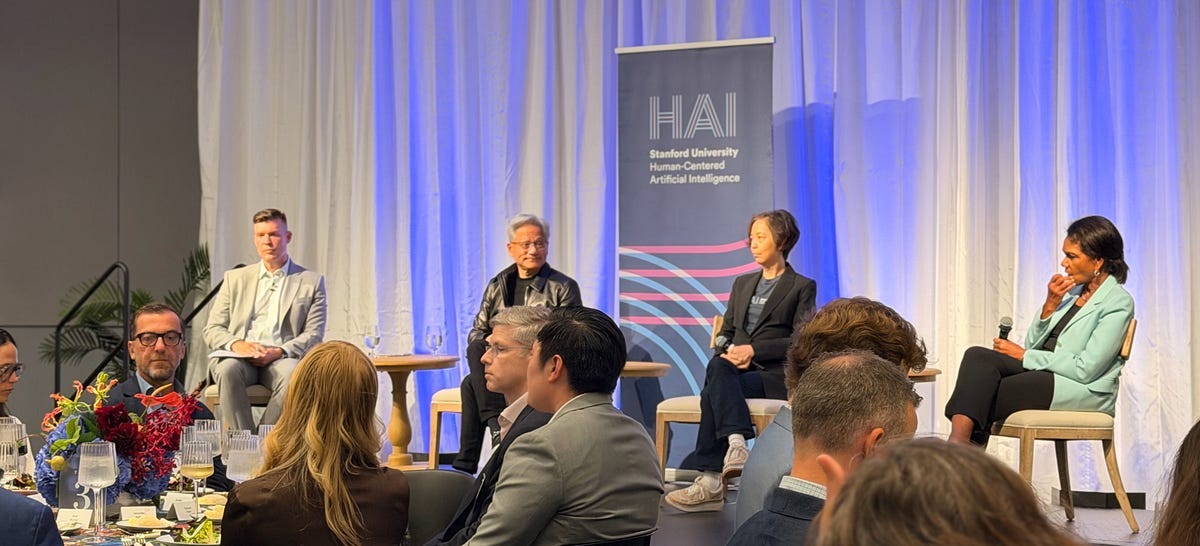
Last night I sat in a dining room at Stanford with dozens of congressional staffers, faculty, and assorted AI practitioners for the keynote dinner of the 2026 Congressional Boot Camp on AI, hosted by the Stanford Institute for Human-Centered Artificial Intelligence (HAI) [1], [2]. The panel put Jensen Huang, Fei-Fei Li, and Condi Rice at one table, with HAI executive director Russell Wald moderating. James Landay, HAI’s Denning Director, opened the evening by noting that Professor Amy Zegart conceived this program thirteen years ago on a simple premise: bring the people who write our nation’s laws into the same room as the people who build the frontier, and let them argue in good faith [1].
Landay also marked an institutional milestone. In May, Stanford folded Stanford Data Science into HAI under the HAI name, positioning the combined institute as the university’s front door for AI and data science [3]. His framing question for the night set the terms of everything that followed: what will US leadership in AI look like in the years to come, and how much does it matter that the stack is American-made?
What followed was ninety minutes of the most candid disagreement I have seen on a public stage this year. I took notes the whole way through. Here is what I heard, and what I think it means.
The Race Nobody Defined
Wald opened by asking Huang what Washington most misunderstands about the AI race. Huang’s answer began by refusing the premise. What is the race, he asked, and what are you racing for?
His diagnosis: the current view of AI in Washington is myopic in two dimensions. First, AI is an industrial transformation, a full stack of energy, chips, infrastructure, cloud, models, and applications. He was explicit that models means far more than language models; physics models, biology models, and robotics models all count. Second, the policy conversation has narrowed around frontier AI labs, a very specific slice of that stack, and he sees real risk in that fixation.
His definition of winning was the line I have been repeating to clients ever since: America wins the AI race when AI diffuses so deeply into society and industry that the United States remains the world’s economic, technology, and military leader. Winning happens when Walmart is an AI company, Blackstone is an AI company, JP Morgan Chase is an AI company, even Safeway is an AI company. He reached back to the last industrial revolution for precedent. Most of the scientists who invented its fundamental technologies had names that were not American, and the technologies were largely created across the ocean, yet the United States exploited them better and diffusion here outran diffusion everywhere else.
For those of us who spend our days on enterprise adoption rather than pretraining runs, this framing lands squarely. Diffusion is the contest. The lab leaderboard is an input.

Doomerism as a Policy Failure
Li picked up the thread from the scientist’s chair. She agreed with Huang on the stack, from energy to compute to infra to model to data to application, and argued that education about that full stack is still lacking in policy circles. Her sharper point concerned rhetoric. She called the extreme, fear-fueled doomerism in policy discussions very dangerous, arguing that sci-fi talk has overfilled the rooms where decisions get made and crowded out a scientific, rational understanding of what this civilizational technology can do for jobs, scientific discovery, education, and healthcare.
Coming from the founder of AI4ALL and the person who put “human-centered” into the institutional vocabulary of this field, that criticism carries weight [4]. She was careful to demand understanding of what the technology does and what it does not, which is a two-sided obligation the boosters in the room needed to hear as much as the doomers.
Rice’s Three Failures
Rice handled the governance question, and to her credit the framework she offered is usable, which is more than can be said for most conference-stage frameworks. Washington, she argued, is going through a crisis of confidence about its role, because a transformational, civilizational technology is emerging from the private sector rather than from government. The reaction has oscillated between two extremes: control it, predict it, guardrail it on one end; let a thousand flowers bloom and out-innovate China on the other. Both, in her view, are false places to be.
Her template came from September 11th, when she served as National Security Advisor, and she extracted three failures from it. First, we didn’t know what we were looking for; nobody was looking for airplanes flying into buildings. Left unmentioned was the sequel, in which Washington knew precisely what it was looking for in Iraq and found certainty considerably faster than evidence. In her telling, threat assessment only ever fails in the quiet direction. Second, we had gaps in knowledge about what was happening inside the country because our focus pointed outward. Third, we had no consequence management whatsoever. She told the story of asking Deputy Attorney General Larry Thompson to run a critical infrastructure pod the day after the attacks, and Thompson confessing years later that he knew nothing about critical infrastructure. Nobody did. That was the point.
The translation to AI policy was straightforward enough. Where will early warning come from? It will have to come from the private sector, because only the labs know what the models are doing. How will we keep tabs on China? It will look like no intelligence operation ever run before, and she stated flatly that our intelligence agencies are not ready for the task. And what is the consequence management plan? What do you tell the banks, the water supply, the energy grid?
She closed with the sentence that titles this post. She sees the anxiety in Congress, in the executive branch, in the intelligence agencies. But anxiety is not a policy. On that much, she and I agree.
The Open Weights Fight
Wald then steered into what he called the thorniest question: open models and open-weight models.
Li answered first, as the panel’s scientist, and situated the debate historically. The spectrum from open to closed science predates AI by centuries. Even nuclear technology, seemingly the most closed of sciences, rested on physics papers that were very much open; the controls sat on materials and system diagrams. She invoked the Human Genome Project, where public scientists and a private company raced to the same milestone and the result was both open and commercially productive [5]. Her conclusion: every technology lives in an ecosystem, and a healthy ecosystem for something this profound needs tolerance for both open and closed systems. Android and iOS both thrived.
Rice, asked how a national security mind handles openness gone wrong, rejected the word mitigation outright. Things are moving too fast; her job was always to worry about surprise. One should never bet against human beings taking the best of something and turning it to malign use, she said, and nuclear weapons came out of the same physics that turns on the lights. Her prescription mirrored her earlier framework: early warning and consequence management, systems that respond when something goes wrong, because something will.
Then she briefly hijacked the moderator’s chair and asked Li directly: is the Chinese lead in open-source models a problem for us? Li’s answer was the most quotable sentence of her evening. It is a problem if the only open models are Chinese, or if the only leading open models come from one country whose values we do not share.
That set up Huang, who delivered the argument he first made in his inaugural post on X: closed models is a business model choice; open models is essential for human infrastructure [6]. His logic ran through Linux. You cannot build infrastructure for the world on top of closed software. Absent Linux, how would AWS, Azure, and Google Cloud exist as forks? Would the world file bugs and wait? He pushed back hard on the safety framing too: a black box is the most unsafe thing, while openness gives everyone the capacity for self-defense, which is exactly why software responds to cybersecurity threats as quickly as it does. He noted, gesturing at the room, that something is being attacked somewhere right now, and the reason everyone was still enjoying their salads is that some open, collective response was happening at the same moment.
His closing questions were rhetorical and pointed. Do you really care who cures cancer? For what reason would America want to block knowledge from coming in while only letting knowledge go out?
Rice took the microphone back for the sharpest exchange of the night. She agreed on taking knowledge from everywhere, and students from everywhere, a position she defended explicitly. Her objection was structural. In a democracy, when something goes wrong, you get investigative reporting, congressional hearings, an open accounting. In an authoritarian regime, you get what she called the Wuhan response: lie, obfuscate, deny access to information. She trusts openness; she does not trust that failures inside an authoritarian system will ever surface.
Huang’s rejoinder was operational rather than ideological. Our intelligence is not connected to their cloud; we fork it, we change it, we guardrail it. He pointed out that China contributes more to open-source software in totality than any country including the United States, that NVIDIA contributes more open models than any company, and that removing NVIDIA from the ledger would leave America contributing almost nothing. Recruit their best minds, learn from their advances, reduce dependency on frankly everybody. He believes we can do both at once.

Export Controls, or the Security Blanket Problem
The first congressional staffer question asked for guiding principles on sharing technology with adversaries. Huang reframed it as a single question: what outcome do you want to avoid? His cautionary tale was Huawei and 5G, where policy choices helped a competitor lay telecommunications infrastructure across much of the world while the United States, once a telecom monopoly, ended up without a domestic supplier [7]. He walked through the arithmetic of the China chip restrictions: a domestic Chinese industry that has grown tremendously, and roughly a hundred billion dollars of market the American technology industry left behind. Absolute policies, he argued, reliably generate unintended consequences. Then he offered the staffers a compliment disguised as a condolence: your job is policy, and it is not called algebra. Algebra is easier.
Rice, who described herself as a national security person who loves export controls because sometimes it is all we know how to do, laid down two constraints from experience running COCOM against the Soviet Union [8]. First, the most controls can do is buy time, and frameworks built on them systematically underestimate indigenous capability. Second, controls carry a psychological hazard: you believe you have solved a problem you have not. The Soviet Union was self-isolating; China is fully integrated into the international system, which makes the instrument far blunter. Export controls, she concluded, can become a security blanket, and we should be careful not to overuse them.
Huang got the last laugh on this one. We do not want American technology going to China, and it turns out China does not want American technology going to China either. Whoever wrote those policies, he observed, agrees with Huawei.
Science, Singularities, and Salads
A second staffer asked about AI for scientific discovery, referencing the Genesis Mission. Li’s answer was a resourcing argument. Open data policy matters; she cited HAI’s long push for the National AI Research Resource, since renamed the CREATE AI Act and still hanging in Congress [9]. Curiosity-driven, blue-sky research takes decades to pay off, and everything in today’s AI blossom traces back to academic work from long ago. Her most interesting move was to name education as the competition we underappreciate most: rethinking education as social science and as policy for the AI era, which she ranked above the race rhetoric everyone else uses.
Huang called the current narrative around AI-driven discovery overrated while remaining, in his words, very optimistic. A large language model fundamentally does not understand biology, because vast aspects of biology remain unknown to us; representing English is one thing, representing a cell or a protein properly is another. Deep science is hard, and the further you dig, the more you discover there is more to dig. His optimism rests on acceleration: digital lab assistants and digital research assistants will compress the pace of discovery even where fundamental knowledge is missing.
He then dispatched three popular claims in a single breath: we are not racing toward the singularity at an exponentially faster pace, there is no twenty percent chance this ends civilization, and it is not true that half of young Stanford graduates will fail to find jobs [10]. Delivered to a room of policy staff, that catalog of negations was itself a policy argument.
The NIMBY Question and the Sentiment Gap
Tim Persons, formerly chief scientist at GAO, raised the compute dimension: data center resistance in the Loudoun County corridor and whether American NIMBYism is an anti-competitive posture relative to China.
Rice went first with the survey data. A recent OECD study of developed countries found Americans the most sour and skeptical about AI of any population measured, largely because they have been told it will take their jobs and run up their electricity bills [11]. Her populism point was the most quotable of the segment: Steve Bannon on the right and Bernie Sanders on the left are saying the same thing, which is stop this thing. She catalogued the energy failures honestly, old and dispersed grids, the nuclear build-out we should have done decades ago while France draws roughly eighty percent of its power from nuclear, and she guaranteed that the next presidential debate on this issue will be alarmist and uninformed.
Li added the data point from her own shop: HAI’s 2026 AI Index found American sentiment toward AI dramatically more negative than in China and much of Asia [12]. As someone deep in the technology, she said she would be deeply concerned if the country fails to embrace compute in the fullest way, because compute is foundational to the entire economy.
Huang’s response was the closest thing to a sermon the evening produced. Society once manufactured intelligence at scale through schools and universities, and a wiser, more productive society proved a safer one; we are now about to augment that with manufactured intelligence, and the fact that a room discussing intelligence manufacturing is this somber struck him as mind-blowing. He then made the reindustrialization case: trillions of dollars into chip plants, computer plants, AI factories, power grids, and generators; millions of high-quality jobs; a once-in-a-generation chance to upgrade the grid through market dynamics; and the plain equation that no energy means no growth, no growth means no thriving economy, and no thriving economy means no thriving military. Mid-argument he mentioned he was hungry and barely had the energy to produce his own intelligence, which is the kind of joke that works better when a CEO of his market cap tells it.
His closing image on the question stayed with me. In China, he said, grandparents are learning to build with Open Claw, everyone raising their own AI agents, which people there affectionately call lobsters. Grandparents raising lobsters, parents raising lobsters, a population embracing the technology the way America embraced the last industrial revolution while others argued about jobs and horses.
The Textbook
The final audience question crystallized the whole evening: if the centralized-versus-decentralized framing matters geopolitically, shouldn’t we care whether a centralized state wins?
Huang opened with credentials rather than diplomacy. You are looking at potentially the most competitive person in the world, he said, and nobody invests more, financially and technically, in open models than NVIDIA, so acknowledge that before starting the question. He still learns from the Chinese, and he will learn from anybody; if Iran discovered a cure for cancer tomorrow, he would be grateful. Scientific knowledge is scientific knowledge, and he does not care where algebra came from.
The questioner, he argued, had misread him. Saying we should not lose sleep over strong Chinese open models is an entirely different claim from saying America should not build better ones. Then came the line of the night: our response to someone getting good grades is getting better grades, not taking their textbook away.
Rice cut in with six words that earned the biggest reaction of the evening: taking their textbook doesn’t make you any smarter.
Huang agreed, and turned it into his summation. Take their models, figure out what they figured out, cure cancer faster if it helps. If America wants the best national open source, resource the scientists; do not ask Stanford researchers to compete with frontier labs on ramen budgets, give them infrastructure. Open source, he added, will decentralize the technology the way open protocols decentralized the internet: Linux, PyTorch, Hugging Face, a stack of openness thicker than most policymakers realize, models of every size running on your own device with no cloud required. Centralized systems that filter what people see, he noted, describe exactly China’s problem, and decentralization makes narratives hard to control. His parting shot to the room, and to the country: just get out there and compete. Stop whining and compete.
Wald closed the evening by asking the bipartisan congressional staff to stand for recognition, a small gesture that framed the whole event correctly. These are the professionals who will translate ninety minutes of argument into legislative language, and the panel gave them a genuinely hard synthesis to perform.

What I Took Home
Three threads deserve attention from anyone building or governing enterprise AI.
First, the diffusion thesis is now the consensus of the most credible voices on that stage, and it matches what I see in the field every week. The gap between frontier capability and enterprise absorption is the largest arbitrage in the economy, and Huang’s Walmart-to-Safeway list is a reasonable roadmap of where it closes.
Second, the governance triad that surfaced in the national security discussion, early warning, internal visibility, and consequence management, ports directly to enterprise AI. Most organizations deploying agents today have none of the three. That is fixable, and it is precisely the work our industry should be doing before an incident forces the question. I will note, that the evening’s chief advocate for accurate threat prediction is the same official who once assured the country that the smoking gun would arrive as a mushroom cloud. Good frameworks occasionally outlive their authors’ forecasting records, and this one deserves to.
Third, the openness debate has matured past slogans. Li’s ecosystem framing, Rice’s authoritarian-transparency objection, and Huang’s infrastructure argument are all correct within their scopes, and the policy synthesis will have to hold all three simultaneously. The textbook exchange between Huang and Rice compressed that tension into two sentences, and I suspect both of them are right.
Anxiety is not a policy. Neither, for that matter, is enthusiasm. The staffers who stood for applause at the end have the harder job, and after this dinner, at least they cannot say the arguments were hidden from them.
References and Further Readings
[1] J. Huang, F.-F. Li, C. Rice, R. Wald (moderator), and J. Landay (welcome remarks), “The New American Industrial Era: Charting a New Age of U.S.-Led Innovation,” Keynote Dinner, 2026 Congressional Boot Camp on AI, Stanford Institute for Human-Centered Artificial Intelligence, Stanford, CA, USA, Aug. 2026.
[2] Stanford Institute for Human-Centered Artificial Intelligence (HAI). [Online]. Available: https://hai.stanford.edu
[3] Stanford University, announcement of the integration of Stanford HAI and Stanford Data Science as one institute under the HAI name, May 2026, as described in J. Landay’s welcome remarks [1].
[4] AI4ALL, nonprofit founded by F.-F. Li et al. to broaden participation in AI. [Online]. Available: https://ai-4-all.org
[5] National Human Genome Research Institute, “June 2000 White House Event: Completion of a Working Draft of the Human Genome Sequence.” [Online]. Available: https://www.genome.gov
[6] J. Huang, post on X regarding open-source and open models (“Closed models is a business model choice; open models is essential…”), 2026, as discussed by the panel [1].
[7] U.S. Federal Communications Commission, designation of Huawei Technologies Company as a national security threat to the integrity of communications networks, Jun. 2020. [Online]. Available: https://www.fcc.gov
[8] M. Mastanduno, Economic Containment: CoCom and the Politics of East-West Trade. Ithaca, NY, USA: Cornell Univ. Press, 1992.
[9] Creating Resources for Every American To Experiment with Artificial Intelligence Act (CREATE AI Act), U.S. Congress, legislation to establish the National Artificial Intelligence Research Resource (NAIRR). [Online]. Available: https://www.congress.gov
[10] D. Amodei, remarks predicting significant entry-level white-collar job displacement from AI, Axios interview, May 2025 (the class of claims disputed by J. Huang in [1]). [Online]. Available: https://www.axios.com
[11] Organisation for Economic Co-operation and Development, cross-national survey data on public attitudes toward artificial intelligence, OECD.AI Policy Observatory. [Online]. Available: https://oecd.ai
[12] Stanford HAI, Artificial Intelligence Index Report 2026, incl. cross-national AI sentiment findings. [Online]. Available: https://hai.stanford.edu/ai-index
[13] Stanford Emerging Technology Review, Hoover Institution and Stanford School of Engineering (C. Rice, co-director). [Online]. Available: https://setr.stanford.edu
[14] A. Zegart, on the origins of the Stanford Congressional Boot Camp connecting congressional staff with Stanford experts, as recounted in J. Landay’s welcome remarks [1].
메타데이터
- post_id
- f54d64345849
- slug
- anxiety-is-not-a-policy-an-evening-with-jensen-huang-fei-fei-li-and-rice-at-the-stanford-hai-f54d64345849
- url
- https://medium.com/@adnanmasood/anxiety-is-not-a-policy-an-evening-with-jensen-huang-fei-fei-li-and-rice-at-the-stanford-hai-f54d64345849
- canonical_url
- https://medium.com/@adnanmasood/anxiety-is-not-a-policy-an-evening-with-jensen-huang-fei-fei-li-and-rice-at-the-stanford-hai-f54d64345849
- author_url
- https://medium.com/@adnanmasood
- status
- ok
- fetched_at
- 2026-08-15 05:26:37