Lymphatic Drainage: The Detox Method Nobody Talks About
I spent years trying every detox trend — juice cleanses, charcoal lemonade, fancy supplements. Some worked a little. Most didn’t. Then I…
Lymphatic Drainage: The Detox Method Nobody Talks About

I spent years trying every detox trend — juice cleanses, charcoal lemonade, fancy supplements. Some worked a little. Most didn’t. Then I learned about the lymphatic system, and everything changed.
Your body already has an incredible lymphatic drainage detox network — it removes waste products, toxins, and excess fluid from your tissues. But unlike blood (which has the heart pumping it), your lymphatic system has no central pump. It relies entirely on your movement, breathing, and manual techniques. If you’re sedentary, stressed, or dehydrated — your lymph is basically stagnant.
Key Takeaways
- The lymphatic system is your body’s sewage network — no central pump, relies on movement and breathing [1]
- Dry brushing (5 min/day) stimulates superficial lymph capillaries and reduces morning puffiness
- Rebounding (mini trampoline) is 68% more efficient than jogging for lymphatic flow — NASA studied it
- Self-lymphatic massage uses extremely light pressure (weight of a nickel) directed toward lymph node clusters [4]
- Lymph is 95% water — dehydration renders all other techniques less effective
- Contrast showers (hot/cold alternation) reduced sick days by 29% in an RCT [2]
What Does the Lymphatic System Actually Do?
Your lymphatic system collects cellular waste, transports immune cells, filters pathogens through lymph nodes, returns excess fluid to the bloodstream, and absorbs dietary fats [1]. When sluggish, you notice puffiness, frequent illness, brain fog, and that “blah” feeling no amount of coffee fixes.
A 2018 review in Annual Review of Fluid Mechanics confirmed that lymphatic circulation depends almost entirely on external forces — skeletal muscle contractions, respiratory movements, and manual manipulation [1].
Does Dry Brushing Actually Work?

Yes — using a natural bristle brush on dry skin before showering stimulates lymph capillaries sitting just below the skin surface. Sweep toward your heart, starting at extremities.
The technique:
- Start at feet, brush up legs
- Hands, brush up arms
- Gentle clockwise circles on abdomen
- Chest — from sternum outward toward armpits
- Neck — downward toward collarbones (major lymph drainage point)
Within the first week of daily dry brushing, I noticed less morning puffiness and noticeably smoother skin. A decent brush costs $10.
Why Is Rebounding So Effective for Lymphatic Flow?
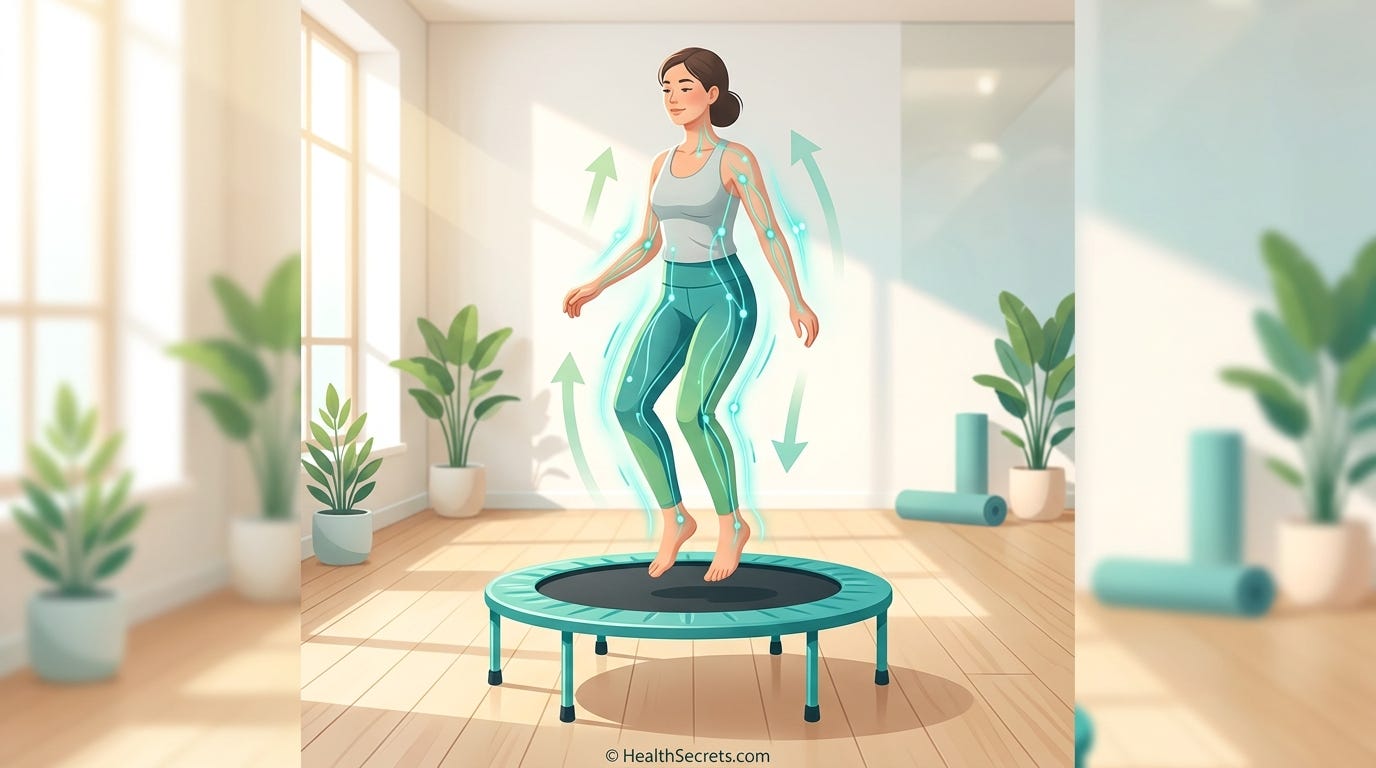
Gentle bouncing on a mini trampoline creates vertical acceleration/deceleration that opens and closes one-way valves in lymph vessels — NASA found it 68% more efficient than jogging for cardiovascular conditioning.
You don’t need to jump high. A gentle bounce where feet barely leave the surface is enough. 5–15 minutes daily.
How Do You Do Self-Lymphatic Massage?
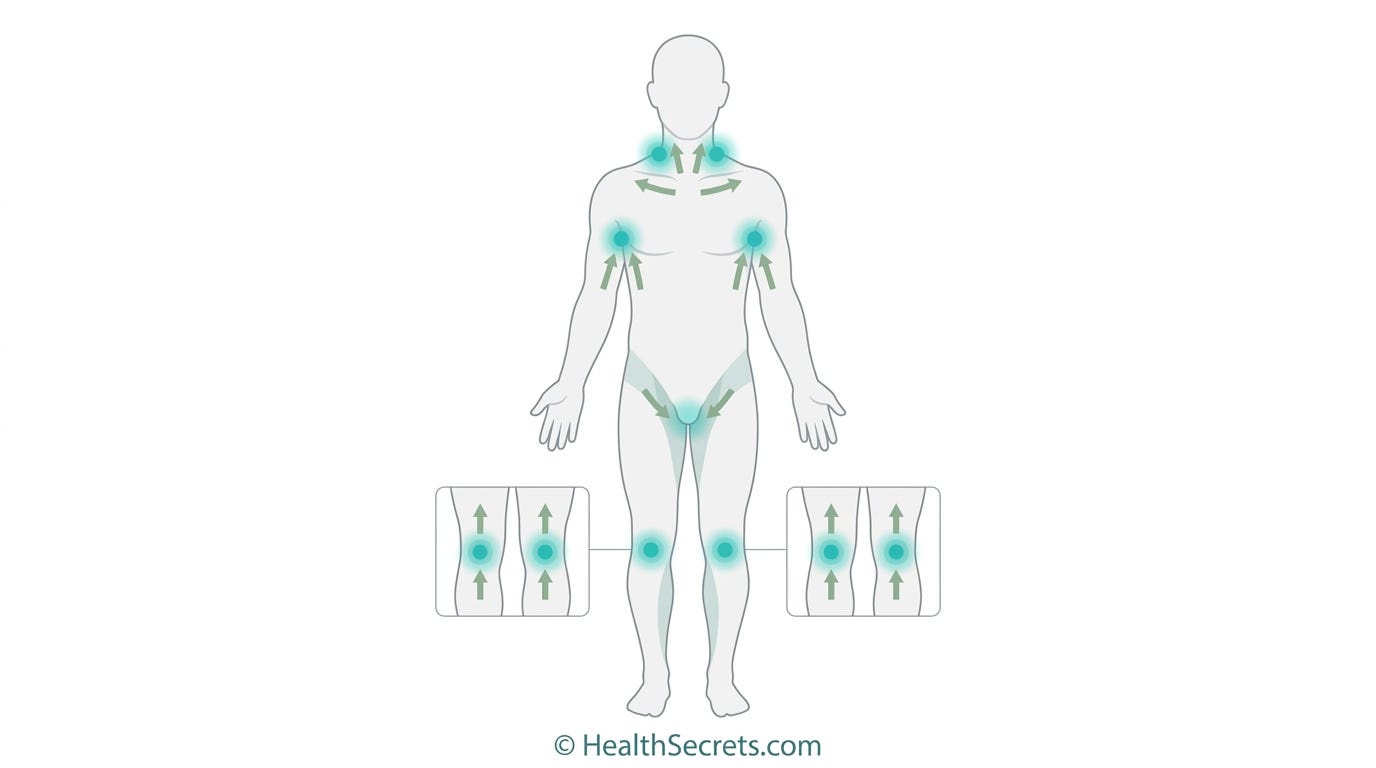
Using extremely light pressure — the weight of a nickel — stroke skin in the direction of the nearest lymph node cluster [4]. Lymph vessels are extremely superficial.
Key areas:
- Collarbones — gentle circles (where lymph re-enters bloodstream)
- Neck — stroke from jaw down to collarbones
- Armpits — gentle pumping (major node cluster)
- Groin — gentle pumping (inguinal nodes)
- Legs and arms — long strokes toward nearest node cluster
10 minutes in the evening. This is the most relaxing part of the routine.
Do Contrast Showers and Deep Breathing Help?
A 2016 RCT found daily cold showers reduced sick days by 29% [2]. Alternating hot and cold creates a vascular pumping effect that moves lymph fluid. Protocol: 2 minutes warm, 30 seconds cold, repeat 2–3 times, always end cold.
Deep diaphragmatic breathing pumps the thoracic duct — your largest lymph vessel — which runs through your diaphragm. 5 minutes of 4–7–8 breathing (inhale 4, hold 7, exhale 8) activates the vagus nerve and pumps lymph simultaneously.
Why Is Hydration Non-Negotiable?
Lymph is 95% water. If you’re dehydrated, all the dry brushing and rebounding in the world won’t help much [3]. Aim for half your bodyweight in ounces of water daily, plus herbal teas like ginger and dandelion root that support lymphatic function.
What Changed After 30 Days?

- Less morning puffiness — face noticeably less swollen
- Fewer colds — made it through a whole season without getting sick
- Better energy — afternoon slump became less intense
- Clearer skin — fewer breakouts, more even complexion
Start with dry brushing and hydration. Add contrast showers after a week. Build from there.
For the complete daily routine with step-by-step protocols, visit the full lymphatic drainage techniques guide on Health Secrets.
For the complete lymphatic drainage protocol, visit the full guide on Health Secrets.com.
You might also enjoy
- What “Detox” Actually Means (Hint: It’s Not Juice Cleanses) — The science behind real detoxification
More from Health Secrets
Lymphatic Drainage Routine Checklist — Interactive step-by-step morning and evening guide
Lymphatic Drainage Guide — Curated protocols and evidence summaries
Frequently Asked Questions
How often should you do lymphatic drainage?
Daily for best results. Dry brushing (5 min before shower) and deep breathing (5 min) are easy daily habits. Rebounding (5–15 min) and self-massage (10 min) can be done 3–5 times per week.
Can you do lymphatic drainage wrong?
The main mistake is pressing too hard during self-massage. Lymph vessels are extremely superficial — use the weight of a nickel. Always stroke toward the nearest lymph node cluster, and start by opening the drainage points (collarbones first) before working outward [4].
Does dry brushing really help with cellulite?
Dry brushing may temporarily reduce the appearance of cellulite by improving circulation and reducing fluid retention. However, it doesn’t address the structural causes of cellulite. The primary benefit is lymphatic stimulation, not cosmetic.
Who should avoid lymphatic drainage techniques?
People with active infections, blood clots, congestive heart failure, or active cancer should consult a doctor first. If you have lymphedema, work with a certified lymphedema therapist rather than self-treating.
Can rebounding replace regular exercise?
Rebounding is excellent for lymphatic flow but shouldn’t replace a full exercise routine. It’s best used as a complement — 5–15 minutes daily alongside your regular strength and cardio training.
How long until you see results from lymphatic drainage?
Most people notice reduced puffiness within 1–2 weeks of daily practice. Energy and immune improvements typically emerge over 2–4 weeks. Skin improvements may take 4–6 weeks.
References
- Moore, J.E. & Bertram, C.D. “Lymphatic System Flows.” Annu Rev Fluid Mech, 2018. https://doi.org/10.1146/annurev-fluid-122316-045259
-
- Buijze, G.A. et al. “The Effect of Cold Showering on Health and Work.” PLoS One, 2016. https://doi.org/10.1371/journal.pone.0161749
-
- Olszewski, W.L. “The lymphatic system in body homeostasis.” Lymphat Res Biol, 2003. https://doi.org/10.1089/153968503321642606
-
- Boesler, D. et al. “Efficacy of manual lymphatic drainage.” Arch Phys Med Rehabil, 2014. https://doi.org/10.1016/j.apmr.2014.06.006
- This article is for informational purposes only and doesn’t replace professional medical advice.
메타데이터
- post_id
- f55212a70b7f
- slug
- lymphatic-drainage-the-detox-method-nobody-talks-about-f55212a70b7f
- url
- https://medium.com/healthsecrets/lymphatic-drainage-the-detox-method-nobody-talks-about-f55212a70b7f
- canonical_url
- https://medium.com/healthsecrets/lymphatic-drainage-the-detox-method-nobody-talks-about-f55212a70b7f
- author_url
- https://medium.com/@healthsecrets
- status
- ok
- fetched_at
- 2026-06-12 07:40:50