Cooper Lutkenhaus vs. Quincy Wilson: The Gap
Quincy Wilson has the brighter Olympic story. Cooper Lutkenhaus has the stronger individual résumé and deeper senior-level proof.
Cooper Lutkenhaus vs. Quincy Wilson: The Gap
Quincy Wilson has the brighter Olympic story. Cooper Lutkenhaus has the stronger individual résumé and deeper senior-level proof.
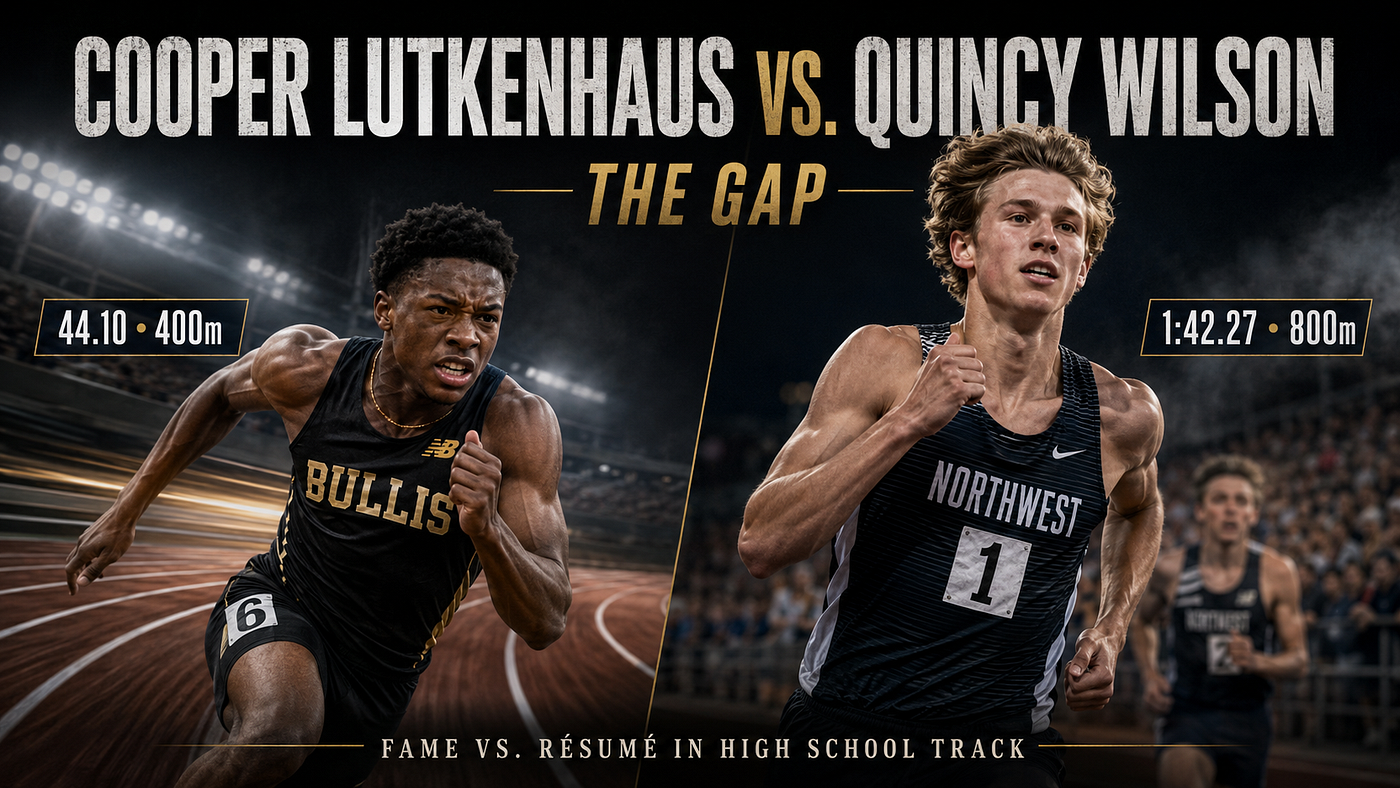
A parent scrolling track videos can be forgiven for thinking Quincy Wilson is the clear king of high school boys’ track. The Olympic relay tag is powerful. The 400 meters is easy to understand. A 16-year-old in a Team USA kit feels like a once-in-a-generation story. But when the comparison shifts from attention to accomplishment, Cooper Lutkenhaus has built the better case. Not by a little. By the standards that matter most in senior track: individual marks, individual championships, and head-to-head proof against grown professionals.
The Result Ledger Does Not Match the Hype
Wilson is not a media creation. He is a historic long sprinter.
His 44.10 in the 400 meters is listed by World Athletics as a world U18 best and American U18 best. World Athletics also placed that race as the joint fourth-fastest 400 in the world at that point of the 2025 season.
That is elite. No coach should wave it away.
But Lutkenhaus’ résumé already reaches a different shelf. At the 2025 USATF Outdoor Championships, he ran 1:42.27 for second in the 800 meters, behind Donavan Brazier’s 1:42.16. That performance broke the world U18 best, broke the American U20 record, moved him to №4 on the all-time U.S. performer list, and came with a 12.48 final 100 meters.
Then came the senior global title. At the 2026 World Indoor Championships, Lutkenhaus won the men’s 800 meters in 1:44.24, with Eliott Crestan second in 1:44.38.
That is the separation point. Wilson has a brilliant age-group 400 and an Olympic relay gold. Lutkenhaus has a senior individual world title.
What Wilson Has Actually Done
Wilson’s best individual argument starts with the clock.
World Athletics lists his 400-meter best at 44.10, scored at 1243 points, with world U18 and American U18 best labels attached. His profile also lists him as an Olympic champion because of his 4x400 relay role in Paris.
The Olympic relay piece matters. Wilson ran the opening leg for Team USA in the Paris 2024 4x400 heat. The group of Wilson, Vernon Norwood, Bryce Deadmon, and Christopher Bailey ran 2:59.15 and advanced automatically.
The final team changed. Christopher Bailey, Vernon Norwood, Bryce Deadmon, and Rai Benjamin won gold in 2:54.43, an Olympic record.
That still gives Wilson a real Olympic achievement. He was trusted in a high-pressure Olympic round at 16. He helped the relay pool get to the final. That is not small.
But relay status and individual dominance are different categories.
Wilson’s 44.10 sits tied 38th on the World Athletics all-time senior outdoor 400-meter list. That is remarkable for a teenager, but it is not the same kind of senior résumé as winning a world title in an individual event.
What Lutkenhaus Has Actually Done
Lutkenhaus has the stronger record book case.
World Athletics lists his 800-meter best at 1:42.27, with world U18 best, American U20 record, American U18 best, and national U20 record labels. The same profile gives that mark a 1258 score, higher than Wilson’s 44.10 score of 1243.
That number alone does not settle the debate, but it supports what the race results already show.
At USATF Outdoors, Lutkenhaus did not just run fast in a protected high school race. He beat Bryce Hoppel, Josh Hoey, Brandon Miller, and nearly everyone else in one of the deepest American 800 finals ever. USATF’s own race summary put Hoppel at 1:42.49, Hoey at 1:43.04, and Miller at 1:43.14 behind him.
Then he added World Indoor gold. Then, on June 7, 2026, he won the Stockholm Diamond League 800 in 1:42.70, ahead of Marco Arop and Slimane Moula.
That is no longer just “high school phenom” territory. That is senior professional territory.
[Parent Power Move] When your athlete compares stars, ask one question: “Are we talking about fame, medals, records, or who beat the best adults?” The answer changes the ranking fast.
Why the 800 Proof Is Heavier
The 800 meters is a cruel event. It punishes the incomplete athlete.
A great 400 runner needs speed, rhythm, special endurance, and the nerve to keep form through the final 80 meters. Wilson has those qualities. His 44.10 proves that.
But the 800 asks for more layers. It requires sprint speed, aerobic strength, anaerobic tolerance, positioning, patience, and timing. A young runner cannot just blast the first lap and hope the field disappears. The pros cover moves. They lean on you. They force decisions.
Lutkenhaus already makes those decisions like a senior runner.
The final 100 meters at USATF tells the story. A 12.48 close after a national-championship 800 is not just fitness. It is posture, timing, relaxation, and a mind that did not panic when the race turned violent.
Research on track running energy systems helps explain why this matters. The 800 has a heavy aerobic and anaerobic blend, often modeled around 60% aerobic and 40% anaerobic for male track athletes, depending on method.
That mix is what makes Lutkenhaus so unusual. He has enough 400 speed to stay dangerous and enough middle-distance strength to keep attacking when most teenagers would be tying up.
[Biomechanics Insight] Watch the last 120 meters of an elite 800. The best runners do not look fresh. They look organized. Hips stay tall, arms stay compact, and foot strikes stay under the body. Lutkenhaus’ late-race strength is a mechanics story as much as a fitness story.
Why Wilson Gets the Attention
Wilson gets attention because his story is easier to sell.
“Teen Olympic gold medalist” fits in a headline. “World U18 400-meter best” fits in a social post. The 400 meters also sits close to the sprint spotlight. Fans understand lanes, speed, and a single lap.
Lutkenhaus requires more context. A casual fan may not know what 1:42.27 means. They may not know that 1:43 is already world-class. They may not understand why beating Hoppel, Hoey, Miller, Arop, and other senior pros carries more weight than crushing high school fields.
That is not Lutkenhaus’ fault. It is how track coverage works.
The Olympic machine also matters. Paris gave Wilson a global stage before most fans had learned his pacing pattern, relay split, or senior championship record. Once a young athlete gets attached to the Olympic brand, the story travels on its own.
Lutkenhaus had to earn a more technical kind of respect. He had to make people look up the all-time list.
The Relay Medal Problem
Wilson’s Olympic gold is real. It belongs on his résumé.
But it should not be treated as stronger evidence than Lutkenhaus’ individual world title.
A relay pool medal says an athlete was part of a national-team effort. In Wilson’s case, he ran in the heat, and Team USA advanced. The final was won by a different quartet.
That is still historic. It is just not the same as stepping into an 800-meter final and beating every man in the race.
This is where the comparison becomes unfair to Wilson if people overstate the relay medal. He was 16. He did his job in a brutal spotlight. He should not have to carry a bigger claim than the result actually supports.
But if the question is individual accomplishment, Lutkenhaus is ahead.
The Senior-Test Difference
High school greatness can hide behind age-group dominance.
Senior greatness cannot.
Lutkenhaus has already shown he can survive professional race pressure. At USATF, the race was not built for him. The field did not wait for him. He had to solve the traffic, absorb the pace, and still close faster than established stars.
World Indoors made the case cleaner. No relay math. No “future potential.” No age-group curve. Just a senior global final and a gold medal.
Then Stockholm added another layer. A Diamond League win over Marco Arop at 17 tells the rest of the world that the indoor title was not a one-off.
Wilson may get there. He may become a senior global medalist. He may run 43 seconds. His ceiling is still enormous.
But the comparison is about what has happened, not what might happen.
The Coaching View
Wilson looks like a rare long sprinter. His gift is speed endurance. He can carry sprint rhythm deep into a race, and that is hard to teach.
Lutkenhaus looks like a rare complete half-miler. His World Athletics profile lists 46.30 for 400, 1:14.15 for 600, 1:44.03 short track for 800, and 1:42.27 outdoors.
That range is the coach’s clue.
The 46.30 says he has real speed. The 600 tells you he can hold high velocity under stress. The 800 results show he can convert both into championship racing.
That is why his résumé feels heavier. It is not one magic race. It is a profile that keeps matching itself.
[Training Load Check] The danger for both athletes is not lack of talent. It is expectation. Teen stars need honest rest, patient season planning, strength that supports mechanics, and adults who do not turn every race into a referendum on their future.
The Parent Lesson
Attention is not the same as accomplishment.
Wilson is famous for understandable reasons. He is a historic teenager in a glamour event with an Olympic medal attached to his name. That story will always travel.
Lutkenhaus is the better answer if the question is harder: who has accomplished more as an individual senior-level athlete?
He owns the stronger individual record. He has the better senior championship result. He has the individual world title. He has now beaten a Diamond League field outdoors. Wilson’s Olympic relay role is meaningful, but it does not outweigh those pieces.
That is the honest split.
Wilson has the cleaner headline.
Lutkenhaus has the stronger résumé.
Key Takeaways
- Quincy Wilson is a historic high school 400-meter runner, and his Olympic relay gold is a real achievement.
- Cooper Lutkenhaus has the stronger individual senior résumé: 1:42.27, USATF runner-up, World Indoor gold, and a Diamond League 800 win.
- Wilson’s best mark ranks tied 38th on the all-time senior 400 list, while Lutkenhaus’ 800 profile carries higher World Athletics scoring.
- Relay medals and individual global titles should not be treated as the same kind of proof.
- The attention gap says more about media packaging than the actual competitive résumé.
References
Reuters. (2026, June 7). Duplantis suffers shock defeat at Stockholm Diamond League.
World Athletics. (2026). Men’s 800 metres final results, World Athletics Indoor Championships Kujawy Pomorze 26.
Reuters. (2026, March 23). US teen Lutkenhaus becomes youngest man to win title at world indoors.
World Athletics. (2026). Cooper Lutkenhaus athlete profile.
World Athletics. (2026). Quincy Wilson athlete profile.
USA Track & Field. (2025, August 4). Historic 800 tops final day of Toyota USATF Outdoor Championships.
World Athletics. (2025, July 13). Wilson sets world U18 400m best, McCallum runs 200m world lead in Memphis.
World Athletics. (2024). Paris 2024 men’s 4x400 metres relay heats results.
World Athletics. (2024). Paris 2024 men’s 4x400 metres relay final results.
Duffield, R., Dawson, B., & Goodman, C. (2005). Energy system contribution to 400-metre and 800-metre track running. Journal of Sports Sciences, 23(3), 299–307.
메타데이터
- post_id
- f55e285b8ab3
- slug
- cooper-lutkenhaus-vs-quincy-wilson-the-gap-f55e285b8ab3
- url
- https://medium.com/@sarahb57/cooper-lutkenhaus-vs-quincy-wilson-the-gap-f55e285b8ab3
- canonical_url
- https://medium.com/@sarahb57/cooper-lutkenhaus-vs-quincy-wilson-the-gap-f55e285b8ab3
- author_url
- https://medium.com/@sarahb57
- status
- ok
- fetched_at
- 2026-06-28 04:42:08