Maximize Uptime And Improve TCO: RAS And Telemetry In HBM4 For Data Centers
As AI workloads scale and data center operations become increasingly complex, it is critical to keep the infrastructure up and running…
Maximize Uptime And Improve TCO: RAS And Telemetry In HBM4 For Data Centers
As AI workloads scale and data center operations become increasingly complex, it is critical to keep the infrastructure up and running. Total Cost of Ownership (TCO) is a key metric that includes not only the upfront cost of hardware but also the ongoing expenses of power, cooling, maintenance, and most importantly, downtime. A single memory failure in a hyperscale AI cluster can cascade into hours of lost compute time, missed Service-Level Agreements (SLA), and costly reruns of training jobs. This is where Reliability, Availability, and Serviceability (RAS) and Telemetry features step in, not as optional add-ons, but as strategic enablers of cost-efficient, resilient infrastructure.
Why TCO is vulnerable to memory failures
As process nodes shrink and advanced packaging techniques are adopted to meet the constraints of emerging workloads, the risks of silent data corruption, thermal stress, and electromigration increase dramatically. These failures are often invisible until they cause system crashes or incorrect results, particularly detrimental in AI inference and training environments. Traditional software-based RAS mechanisms tend to be reactive, identifying faults only after damage has occurred. This approach inflates TCO through increased downtime, reduced hardware lifespan, and the need for overprovisioning.
By integrating RAS features across the hardware-software stack down to the chip level, data center operators can proactively mitigate risks, extend system longevity, and reduce operational costs.
RAS: The first line of defense
RAS features a suite of technologies designed to detect, correct, and prevent hardware faults before they impact system performance.
For HBM, RAS typically comprises:
- Error Correction Code (ECC): Detects and corrects bit-level errors in memory.
- Error Check & Scrubbing (ECS): Periodically scans memory to correct latent errors.
- Failure Recovery Mechanisms: E.g., interrupts to host processors, selective recovery from failing read or write transactions.
- Parity Protection: Ensures data integrity across internal buses and registers.
- Telemetry Integration: Monitors system health in real time.
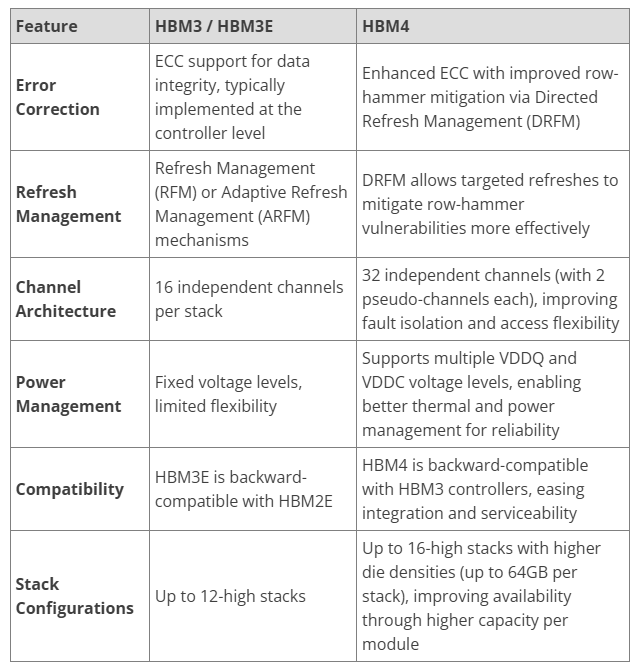
These features work in tandem to reduce the frequency and severity of failures, enabling systems to recover gracefully — or avoid failure altogether. The RAS features in HBM4 represent a notable evolution over HBM3/3E:
RAS features comparison: HBM3/3E vs. HBM4
Why these RAS enhancements matter:
- Reliability: DRFM in HBM4 directly addresses row-hammer issues, a growing concern in dense memory systems. By providing better visibility into memory health, it reduces the risk of silent data corruption or thermal runaway.
- Availability: More channels and higher capacity per stack reduce the risk of bottlenecks and improve system uptime.
- Serviceability: Backward compatibility and flexible power options simplify integration and maintenance in existing systems. By leveraging these features, it’s easier to isolate faults to specific channels or dies, reducing mean time to repair (MTTR).
Telemetry: Turning data into uptime
Telemetry in HBM4 is not just about logging — it’s about real-time diagnostics and predictive maintenance. Rambus offers telemetry features that help identify link utilization bottlenecks, thermal effect tracking, and measures the efficacy of the memory controller:
- Bank Access Monitoring: Identifies addressing hotspots and improves memory access efficiency.
- Queue Occupancy Tracking: Helps tune reordering logic and avoid bottlenecks.
- PHY Interface Monitoring: Detects misconfigurations and stalls at the physical interface.
- Error Counters: Tracks correctable and uncorrectable errors to flag failing components early.
Similar to the evolution of RAS features from HBM3/3E to HBM4, the telemetry features have evolved too, as evident from this comparison here:

These capabilities empower system integrators to fine-tune configurations, prevent failures, and optimize performance per watt, directly reducing TCO by providing enhanced visibility into system-level performance in runtime environments, which can further be leveraged for performance tuning and correcting inefficient configurations.
Telemetry is a key enabler for lifecycle management, event logging, and failure prediction in HBM4 deployments, and helps bring up silicon faster and manage reliability throughout the product lifecycle.
This shift from reactive to proactive reliability management highlights the fact that RAS and telemetry are no longer optional but they are foundational to building sustainable, scalable AI infrastructure. By embedding intelligence into the memory subsystem, HBM4 transforms RAS and telemetry from a reactive safety net into a proactive strategy for improving TCO. Furthermore, the RAS & telemetry enhancements for HBM4 make it particularly well-suited for AI accelerators, data center GPUs, and mission-critical HPC systems, where memory integrity is paramount.
메타데이터
- post_id
- f56101fa944a
- slug
- maximize-uptime-and-improve-tco-ras-and-telemetry-in-hbm4-for-data-centers-f56101fa944a
- url
- https://medium.com/@techreigns/maximize-uptime-and-improve-tco-ras-and-telemetry-in-hbm4-for-data-centers-f56101fa944a
- canonical_url
- https://medium.com/@techreigns/maximize-uptime-and-improve-tco-ras-and-telemetry-in-hbm4-for-data-centers-f56101fa944a
- author_url
- https://medium.com/@techreigns
- status
- ok
- fetched_at
- 2026-06-11 10:13:20