Beyond the Vehicle: Exploring Car Culture Through Design Research Methods
Introduction
Beyond the Vehicle: Exploring Car Culture Through Design Research Methods
Introduction
The overarching theme of this module was Car Culture. Rather than focusing on automobiles as technical products, the course encouraged us to investigate the broader cultural systems that emerge around vehicles and their role in society. Throughout the lecture, different design research methods were introduced to explore specific aspects of this evolving automotive landscape. Within this framework, each student was free to identify personal areas of interest and use them as entry points for investigation.
As a designer, I was particularly interested in understanding how cars generate meaning beyond their functional purpose. While vehicles are often discussed in terms of performance, innovation, or aesthetics, I became increasingly curious about the relationships they create with people, places, rituals, and collective memory. Through the application of In-Field Observation, Visual Inquiry, and Heritage Mapping, I explored different manifestations of car culture, ranging from museum experiences and rally communities to historical racing traditions.
Rather than seeking solutions to predefined design problems, the objective of this research was exploratory. Each method provided a different perspective on the broader question posed by the course: how can we redefine the relationship between people and vehicles within an evolving automotive landscape while respecting the diversity of car cultures? Through this process, I discovered that research methods do not simply generate information. They shape the questions we ask, the patterns we notice, and ultimately the way we understand culture as designers.
In-Field Observation: Comparing Heritage Narratives at the Alfa Romeo Museum
The first method explored during the module was In-Field Observation. For this exercise, we visited the Alfa Romeo Museum in Milan, including both the public museum exhibition and the vehicle deposit archive that is accessible through a guided tour.
Initially, both spaces appeared equally valuable from a cultural and historical perspective. The museum and the deposit contain extensive information about Alfa Romeo’s heritage, including its influence on everyday mobility, luxury automobiles, motorsport, technological innovation, and Italian identity. However, through observation and comparison, a significant difference emerged between the two experiences.
The museum had clearly been designed as a visitor experience. Multiple formats were used to communicate stories and engage audiences. Historical vehicles were accompanied by contextual information, images, interactive displays, videos, and cinematic installations. Visitors could engage with the brand’s history through different sensory and narrative channels. The museum transformed information into an experience.
The archive, on the other hand, contained equally fascinating stories but lacked the design interventions necessary to make them accessible and engaging. The space relied heavily on the presence of a guide to communicate its significance. Without this mediation, many of the narratives embedded within the vehicles, objects, and documents remained invisible to visitors.
What I found particularly interesting was that the archive contained stories that were fundamentally different from those presented in the museum. While the museum focused primarily on iconic achievements and celebrated milestones, the archive revealed processes, experimentation, failures, design iterations, and moments of uncertainty. These narratives exposed the complexity behind the construction of a brand’s heritage and identity.
This observation led me to reflect on the role of design in shaping heritage experiences. The value of cultural artifacts does not lie solely in their existence but also in how they are communicated. The same collection of objects can generate entirely different experiences depending on the narrative structures, interactions, and forms of accessibility that surround them.
As a designer, this exercise demonstrated that heritage is not simply preserved through storage. It is activated through experience design. Observation allowed me to move beyond the physical objects and understand how narrative, interaction, and accessibility influence the way cultural meaning is constructed and shared.

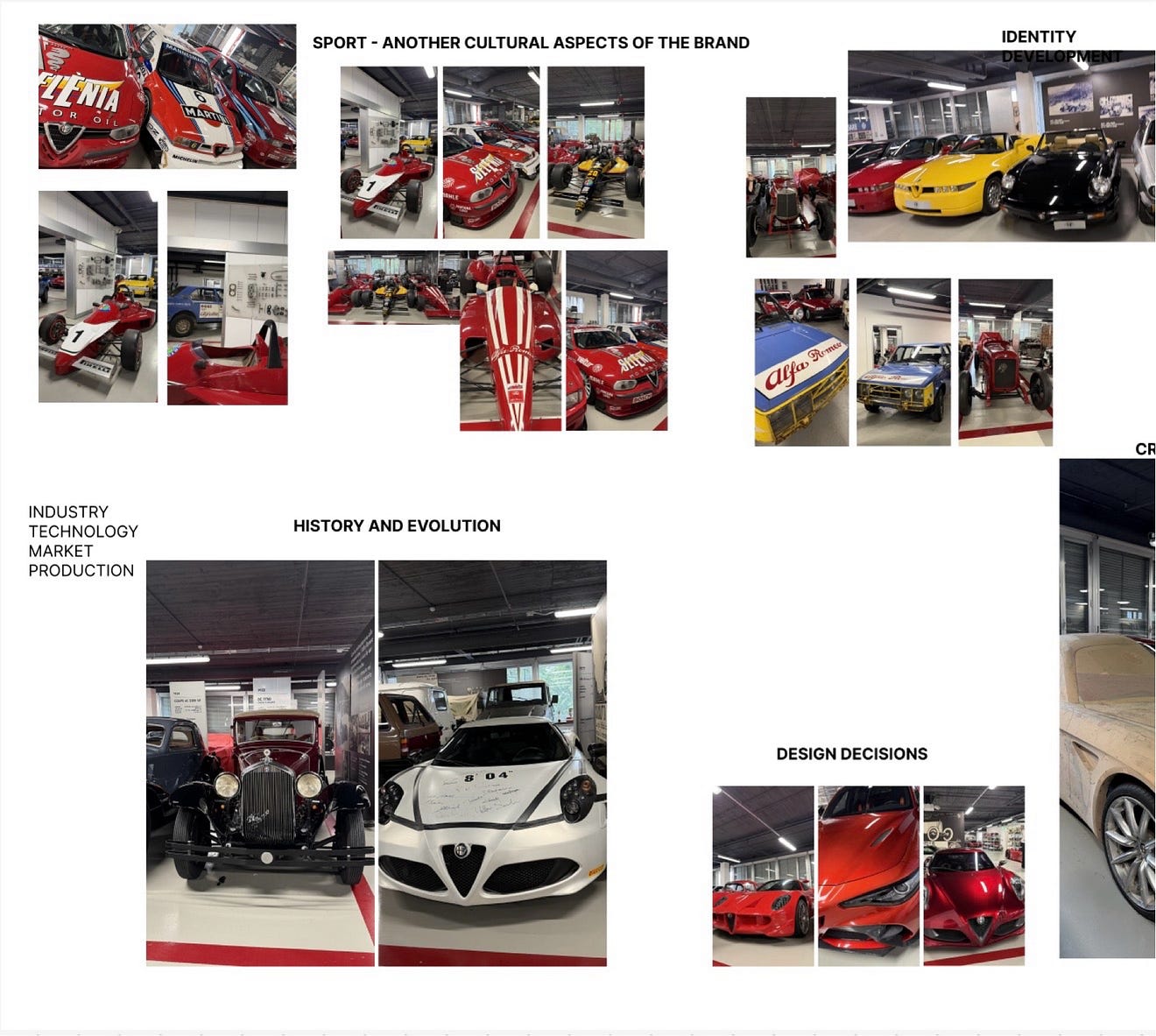

Field Observation- Pictures and notes taken during the visit to the Alfa Romeo Museum
Visual Inquiry: Argentine Rally Culture and the Landscape as Social Infrastructure
For the Visual Inquiry exercise, I chose to investigate Argentine rally culture, focusing specifically on rally events in the province of Córdoba. Unlike circuit racing, rally competitions take place within natural environments, transforming existing roads, mountains, rivers, and rural landscapes into racing infrastructure.
Through the collection and organization of visual references, I sought to explore the relationship between people, vehicles, and landscape. Initially, my interest was directed toward the visual spectacle of rally racing. However, as I analysed the imagery, a more complex cultural phenomenon emerged.
The first theme identified was Landscape as Infrastructure. Images of mountain roads, dirt tracks, river crossings, and remote routes revealed that the landscape itself functions as the racetrack. Unlike purpose-built circuits, rally events depend entirely on environmental conditions. The geography determines visibility, accessibility, speed, and risk. In this context, the territory becomes an active participant in the event rather than a passive backdrop.
A second theme focused on Spectators Occupying the Landscape. The visual material consistently showed spectators camping, climbing hills, gathering around strategic viewpoints, and spending entire days waiting for vehicles to pass. These activities extend beyond spectating. They involve social rituals such as preparing asado, drinking mate, sharing fernet, and spending time collectively within remote environments.
What became particularly interesting was the realization that spectators temporarily transform the landscape into social infrastructure. Informal gathering spaces, observation points, temporary camps, and social networks emerge through collective behaviour. The event is not only about the vehicles but also about the communities that form around them.
Finally, a third theme emerged around Waiting as a Ritual. Images revealed that spectators often travel long distances, camp for days, and wait for hours in order to witness vehicles pass by for only a few seconds. This apparent contradiction became one of the most fascinating aspects of the investigation. The experience is not defined solely by the moment of viewing but by the rituals of anticipation, preparation, and collective participation that surround it.
Through this exercise, I developed a deeper understanding of how visual materials can reveal relationships that are not immediately obvious. The most significant insight was that rally culture transforms natural landscapes into temporary social infrastructures. Rather than focusing on the vehicle itself, the investigation revealed a complex network of interactions between territory, community, and mobility.
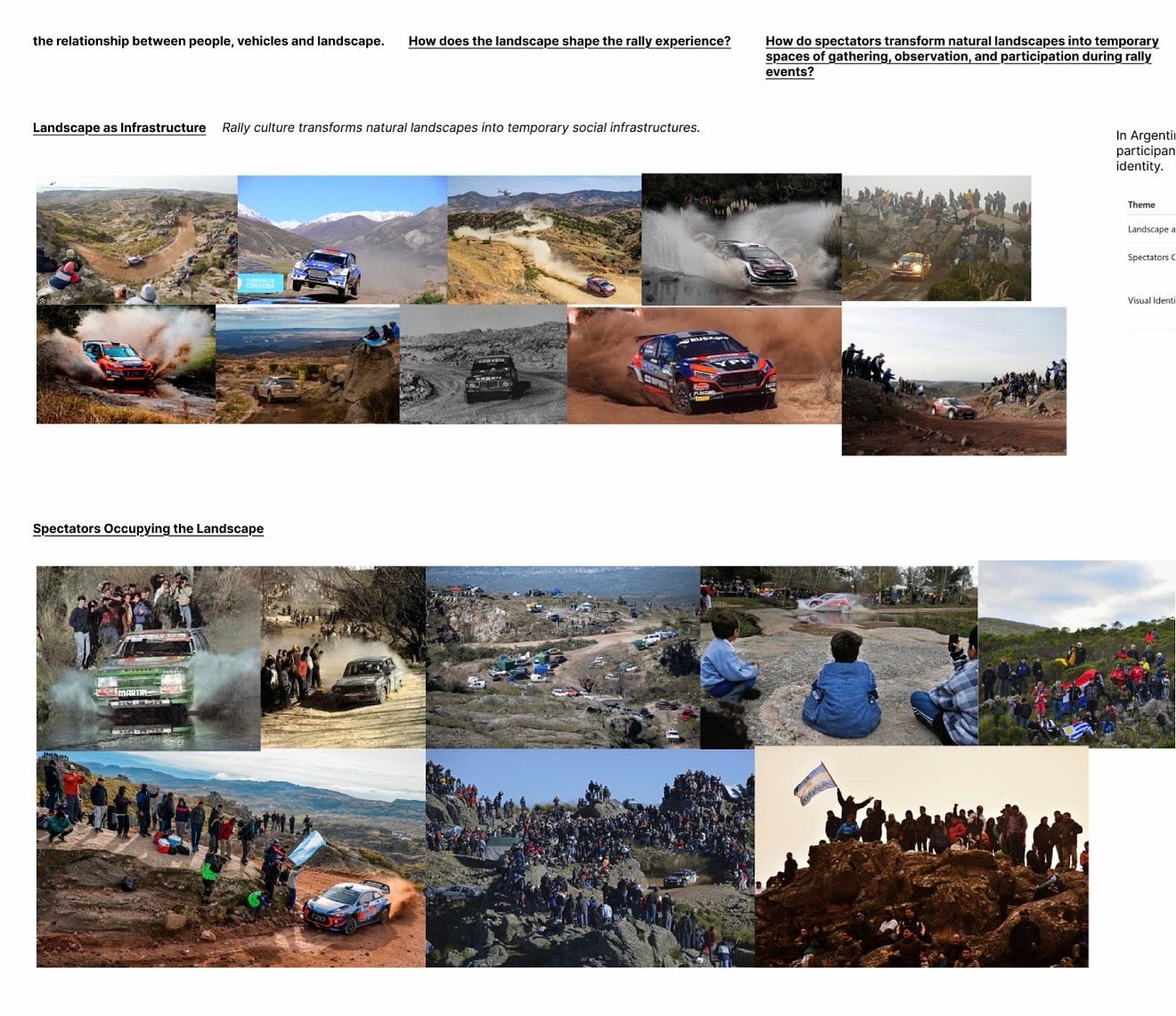
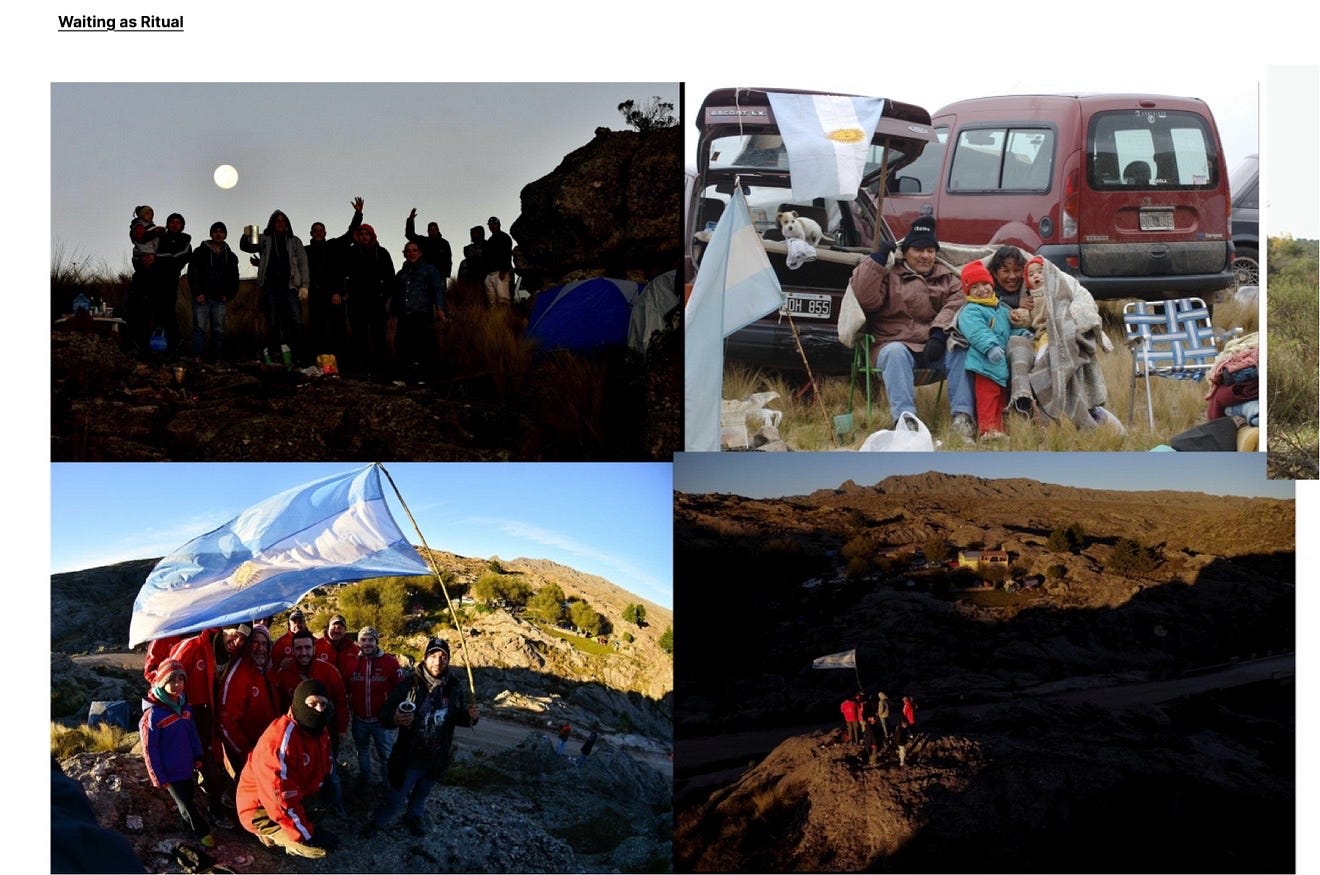

Fragments of the visual inquiry collage
Heritage Mapping: Historic Racing as Living Heritage
The final method explored during the module was Heritage Mapping. Within the broader topic of racing culture, I chose to focus on historical racing. More specifically, I explored three interconnected categories: Historic Formula Racing, Historic Endurance Racing, and Historic Rally. My objective was to understand how these activities contribute to the preservation of automotive heritage.
The research combined secondary visual sources with primary research. Through a personal opportunity, I was able to visit the home of a historic racing driver who actively participates in all three categories. During this visit, I documented historic Formula 1 and Formula 3 vehicles and conducted informal conversations about his experiences within the community.
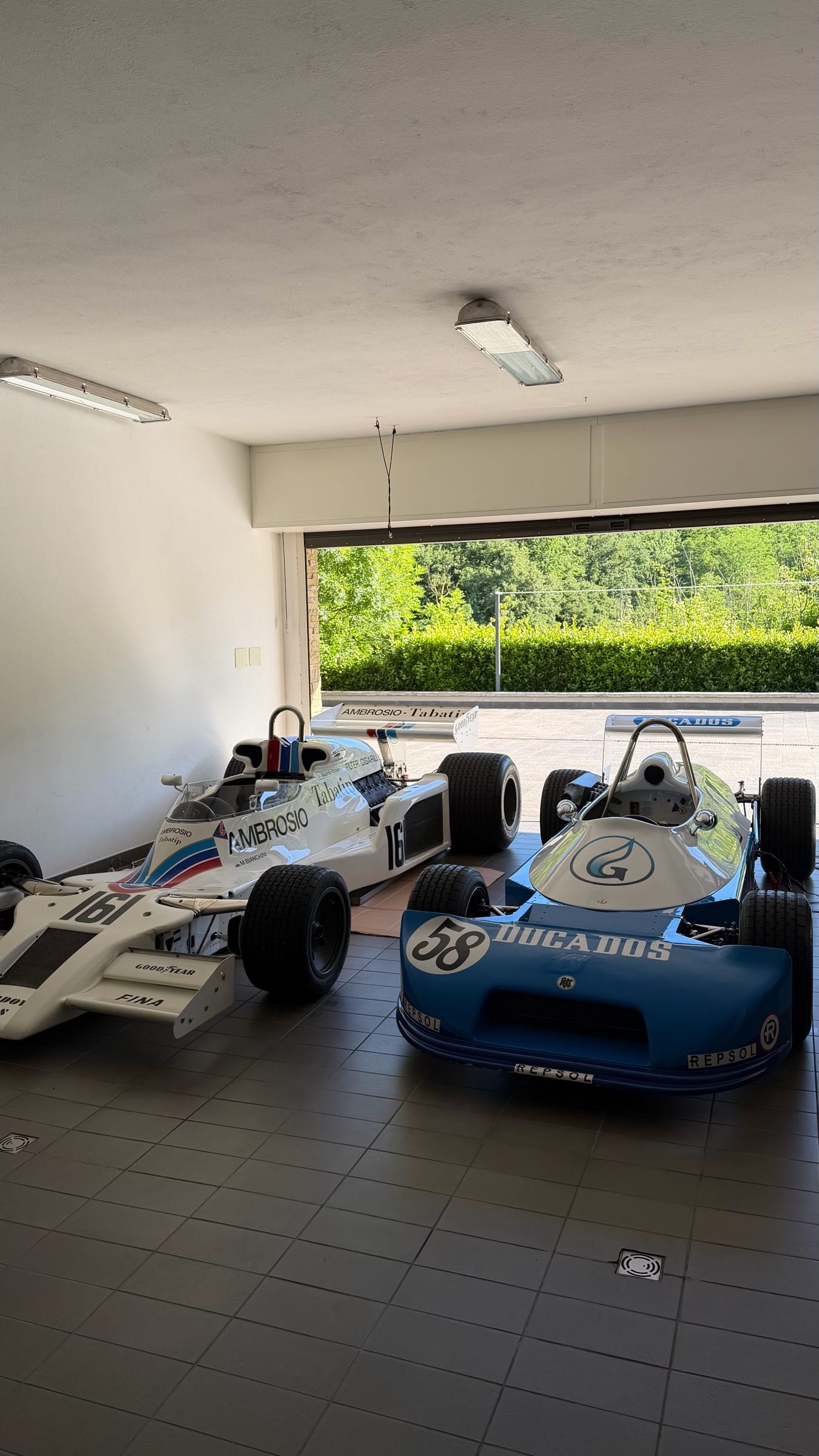

Historic Formula 1 and Historic Formula 3 racer Marco Bianchini with the historical cars.
Initially, I assumed that historic racing was primarily concerned with preserving old vehicles. However, the mapping process revealed a much broader cultural ecosystem. The cars themselves represent only one component of a larger network that includes drivers, mechanics, collectors, organizers, archives, technical knowledge, and personal memories.
Across all three categories, recurring themes emerged around authenticity, preservation, craftsmanship, and transmission of knowledge. The vehicles are maintained not simply as museum objects but as functioning artifacts that continue to be used and experienced. Through racing, communities actively preserve mechanical skills, driving techniques, and cultural traditions that might otherwise disappear.
The most important insight generated by the Heritage Map was that historic racing preserves more than vehicles. It preserves stories, relationships, identities, and forms of embodied knowledge. Unlike conventional heritage institutions that focus on conservation, historic racing keeps heritage alive through participation and practice.
As a designer, this exercise expanded my understanding of heritage beyond physical artifacts. Mapping cultural relationships allowed me to recognize how knowledge and identity circulate through communities. The method demonstrated that heritage is not static. It is continuously recreated through collective engagement.
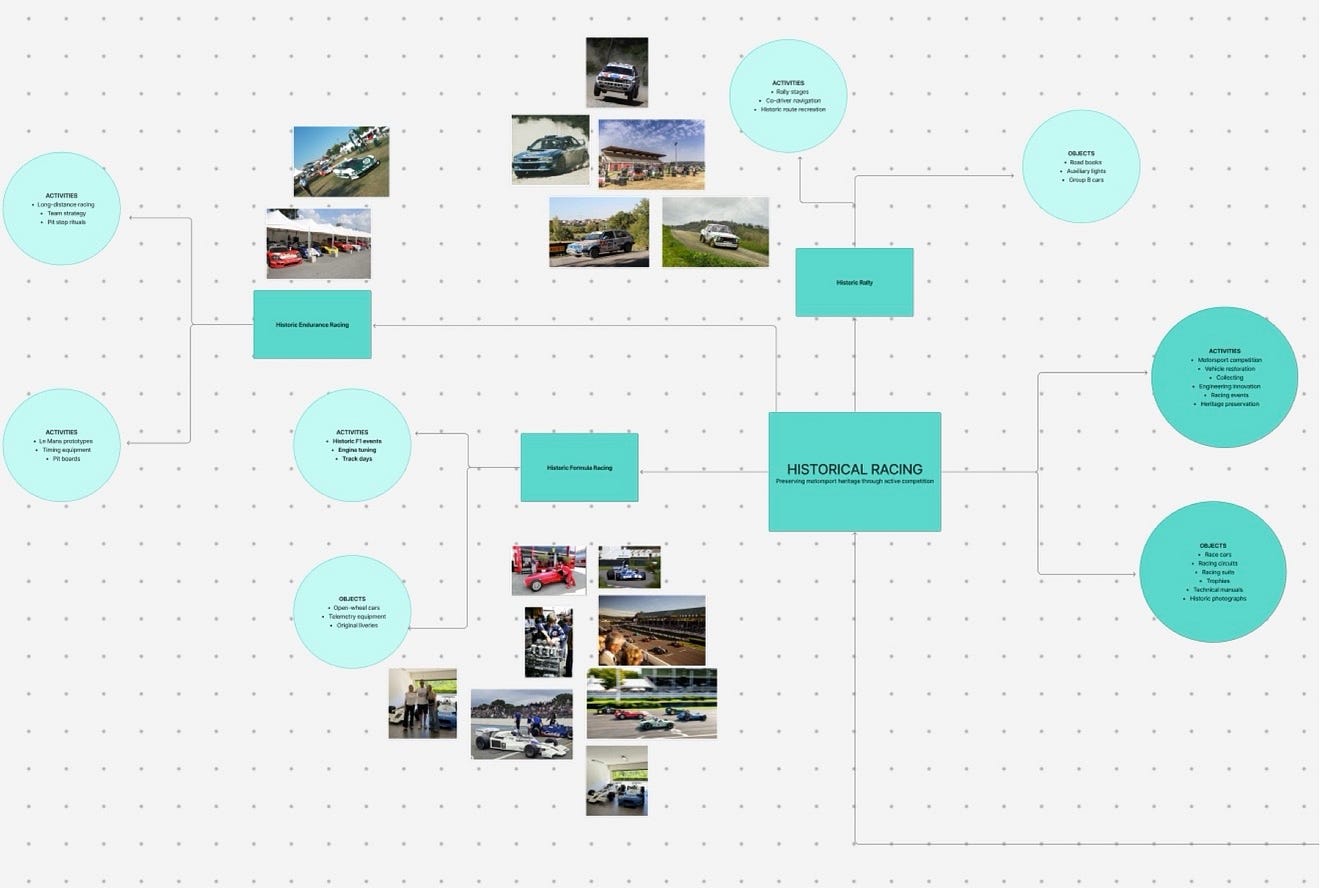
First draft of the Heritage map
What I Learned as a Designer
Looking back at the three methods explored throughout this module, I realized that the most valuable outcome was not the accumulation of information about cars. Instead, it was learning how different research methods reveal different dimensions of culture.
Observation taught me to look beyond objects and examine the experiences and narratives that surround them. Visual Inquiry showed me how images can uncover relationships between people, environments, and cultural practices. Heritage Mapping revealed the networks of memory, knowledge, and identity that sustain communities over time.
Across all three investigations, a common pattern emerged: cars rarely function as isolated objects. They operate as cultural artifacts embedded within broader systems of meaning. Whether in a museum, a mountain rally stage, or a historic racing event, vehicles become vehicles of storytelling, belonging, ritual, and heritage.
Most importantly, this module changed the way I understand design research. Rather than a process focused solely on identifying problems and generating solutions, research became a tool for exploration. It allowed me to uncover cultural dynamics that would have remained invisible through a purely design-oriented lens.
Through the exploration of car culture, I learned that design research methods are not only ways of collecting information. They are ways of seeing. By applying different methods to different manifestations of the same cultural phenomenon, I developed a richer understanding of how people create meaning around vehicles and how designers can engage with those meanings in more thoughtful and informed ways.
References
Alfa Romeo. (n.d.). Centro Documentazione Alfa Romeo. Museo Storico Alfa Romeo. Retrieved June 17, 2026, from https://www.museoalfaromeo.com/it-it/museo/Pages/CentroDocumentazione-Alfa-Romeo.aspx
Asociación Civil Rally Argentino (ACRA). (n.d.). Acerca de Rally Argentino. Rally Argentino. Retrieved June 17, 2026, from https://www.rallyargentino.com/acerca-de.php
Federation Internationale de l’Automobile (FIA). (n.d.). Historic motorsport. FIA. Retrieved June 17, 2026, from https://www.fia.com/historic
Federation Internationale de l’Automobile (FIA). (n.d.). FIA Historic Database. FIA. Retrieved June 17, 2026, from https://historicdb.fia.com/
Federation Internationale de l’Automobile (FIA). (n.d.). International Historical Commission: Securing the future of our motoring heritage. FIA. Retrieved June 17, 2026, from https://www.fia.com/international-historical-commission
Italia.it. (n.d.). Alfa Romeo Historical Museum. Italian National Tourism Board. Retrieved June 17, 2026, from https://www.italia.it/en/lombardy/milan/alfa-romeo-museum
Koskinen, I., & Tomitsch, M. (2024). How maps shape information in design research: A study of five method collections. Design Research Society. https://doi.org/10.21606/drs.2024.1226
Ministero della Cultura. (n.d.). Museo storico Alfa Romeo. Governo Italiano. Retrieved June 17, 2026, from https://cultura.gov.it/luogo/museo-storico-alfa-romeo
Meyer, M., & Dykes, J. (2019). Criteria for rigor in visualization design study. arXiv. https://arxiv.org/abs/1907.08495
메타데이터
- post_id
- f565a97dd09c
- slug
- beyond-the-vehicle-exploring-car-culture-through-design-research-methods-f565a97dd09c
- url
- https://medium.com/domus-academys-design-research-methods-and-tools/beyond-the-vehicle-exploring-car-culture-through-design-research-methods-f565a97dd09c
- canonical_url
- https://medium.com/domus-academys-design-research-methods-and-tools/beyond-the-vehicle-exploring-car-culture-through-design-research-methods-f565a97dd09c
- author_url
- https://medium.com/@lsanchezdsgn
- status
- ok
- fetched_at
- 2026-07-27 08:19:09





