Why AI Startups Should Stop Buying GPUs in 2026
The economics of artificial intelligence have shifted. Owning your own hardware is no longer the ultimate tech flex , it’s a runway killer.
Why AI Startups Should Stop Buying GPUs in 2026
The economics of artificial intelligence have shifted. Owning your own hardware is no longer the ultimate tech flex , it’s a runway killer.
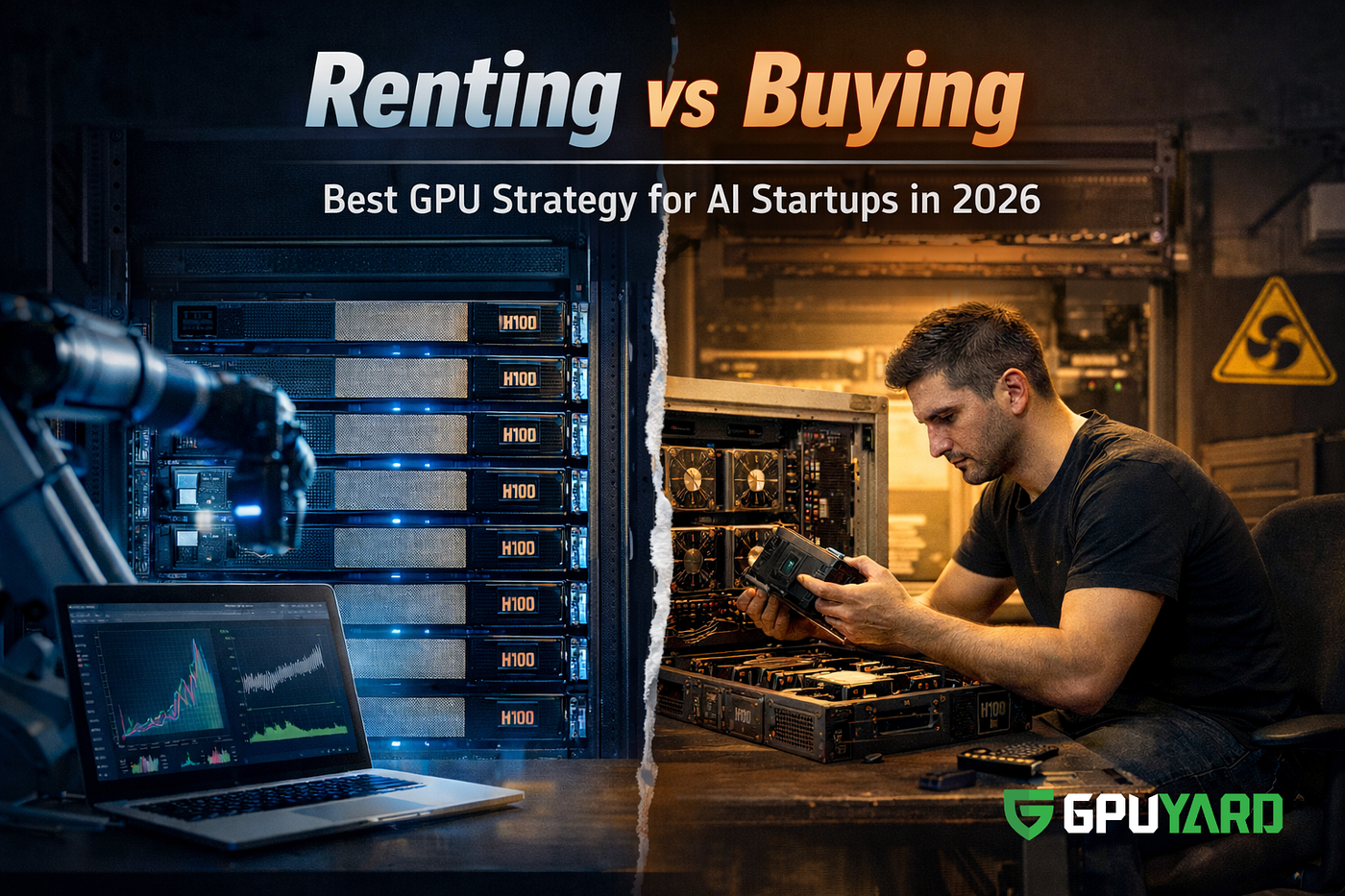
If you are an AI founder or CTO in 2026, you already know the golden rule of the current tech landscape: compute is king. The race to train larger foundational models and fine-tune localized LLMs has created an insatiable demand for raw GPU power.
Naturally, when a startup secures its seed or Series A funding, the first instinct is to build an in-house GPU cluster. Owning a stack of glossy NVIDIA H100s feels like you own the means of production.
But is it actually a smart business decision?
On a pure spreadsheet calculation, buying your own hardware sometimes looks cheaper over a 3-year horizon. However, that basic math ignores the brutal, hidden realities of running an AI infrastructure.
The 4 Hidden Costs Devouring Your Runway
If you choose to buy, you aren’t just buying metal. You are buying a logistical nightmare.
- The CapEx Drain: A complete 8-GPU H100 system easily costs between $250,000 and $400,000 upfront. Tying up half a million dollars in rapidly depreciating hardware means you have less cash for what actually matters: hiring top-tier ML engineers and acquiring high-quality datasets.
- The Power and Cooling Premium: Modern GPUs are power-hungry. An 8-GPU cluster requires 8 to 10 kilowatts (kW) of power. In 2026, high-density colocation space is at a premium, easily adding $5,000+ per month just to power and cool your rig.
- Rapid Hardware Depreciation: The AI hardware cycle moves at breakneck speed. By the time you rack your expensive H100s, newer architectures are already hitting the market. You are locked into that compute architecture for 3 to 5 years just to see an ROI.
- Idle Time is Wasted Money: AI workloads are notoriously “bursty.” You might need 16 GPUs to train a model, but only 2 for daily inference. If you buy, those extra GPUs sit idle, depreciating in value.
The Superpower of Agility (OpEx > CapEx)
In contrast to the heavy burden of ownership, renting dedicated GPU servers provides startups with ultimate agility.
Your compute costs shift to a predictable monthly operating expense (OpEx). You keep your venture capital in the bank. You get instant scalability to spin up 32 GPUs to beat a competitor to market, and you never have to play IT support when a motherboard shorts out.
But the most critical question remains: Which GPU architecture do you actually need? You don’t always need an enterprise-grade $30,000 chip. Depending on your pipeline, you might be able to cost-hack your way to success with high-end workstation GPUs like the RTX 6000 Ada or the RTX 4090.
Want the full hardware breakdown and cost comparison? I put together a comprehensive 2026 guide on how to match the exact right GPU to your startup’s specific machine learning workload, along with a quick-reference summary of Renting vs. Buying.
👉 Read the full guide and hardware breakdown on GPUYard here
메타데이터
- post_id
- f5788a40e8a1
- slug
- why-ai-startups-should-stop-buying-gpus-in-2026-f5788a40e8a1
- url
- https://medium.com/@gpuyard/why-ai-startups-should-stop-buying-gpus-in-2026-f5788a40e8a1
- canonical_url
- https://medium.com/@gpuyard/why-ai-startups-should-stop-buying-gpus-in-2026-f5788a40e8a1
- author_url
- https://medium.com/@gpuyard
- status
- ok
- fetched_at
- 2026-06-29 01:02:39