Lenny Susskind Describes How the Brain Receives Signals From Nonlocal Consciousness
Listen to this video in which Lenny Susskind describes how the brain receives signals from non-local consciousness:
Lenny Susskind Describes How the Brain Receives Signals From Nonlocal Consciousness
Listen to this video in which Lenny Susskind describes how the brain receives signals from non-local consciousness:
[embed]
Why Can’t Scientists Figure Out Where Thoughts Are Stored? Leonard Susskind
After decades of neuroscience research, we still cannot locate where a single thought or memory is physically stored in the brain. Neurons fire, synapses strengthen, but the actual content of our experiences remains mysteriously absent from brain tissue. What if the brain doesn’t store consciousness at all — but receives it?
In this video, I explore the profound mystery of consciousness and memory from a physicist’s perspective. We’ll examine Karl Lashley’s groundbreaking experiments, the puzzle of split-brain patients accessing the same memories, terminal lucidity in dementia patients, and quantum non-locality in biological systems.
Drawing from quantum mechanics, neuroscience, and the hard problem of consciousness, I present a radical hypothesis: the brain may function more like a television receiver than a hard drive — interfacing with a non-local field of consciousness rather than generating it from neural activity alone.
Topics covered: Why memories can’t be found in brain tissue • How synaptic molecules are replaced yet memories persist • Near-death experiences and terminal lucidity • Quantum effects in living systems • The measurement problem and consciousness • The placebo effect and mind-matter interaction • Implications for the nature of consciousness and reality
This isn’t mysticism — it’s following the evidence where materialism fails to explain the data. If everything else in physics is non-local and interconnected, why would consciousness be different?
Listen to this second video in which Lenny Susskind describes how the brain hallucinates reality:
[embed]
REALITY IS A CONTROLLED HALLUCINATION. LEONARD SUSSKIND
You’re not seeing the world right now — you’re hallucinating it. Your brain doesn’t passively receive reality; it actively constructs a simulation based on limited, noisy data and past predictions. From blind spots your mind fills in, to colors that don’t actually exist in the physical world, to the malleable flow of time itself — everything you experience is a controlled hallucination generated by your neural networks.
In this deep dive into neuroscience and perception, we explore how your brain is a prediction machine that creates a model of reality and only updates it when sensory evidence contradicts expectations. We’ll examine change blindness, the rubber hand illusion, predictive coding, and why evolution optimized your perception for survival — not truth.
The implications are profound: consciousness itself may be nothing more than the experience of your brain’s self-generated simulation. You’re living inside a virtual reality created by three pounds of tissue in your skull, and you can never step outside it. Welcome to the controlled hallucination you call reality.
Topics covered: Why your brain fills in blind spots and peripheral vision • How color is constructed, not perceived • Predictive coding and Bayesian inference in the brain • The rubber hand illusion and body perception • Why time perception is manipulated and edited • Dreams, psychedelics, and uncontrolled hallucination • Different species, different realities • Consciousness as simulation
Comment on the Holographic Nature of the Mind:
What we call the observable physical world is a mental construct, and the holographic principle is a construction mechanism. The observable physical world, which is really a mental world that is being displayed on a holographic or mental screen, is being constructed by consciousness. This construction process occurs as an observer, which is a presence of perceiving consciousness at the central point of view of its own holographic world, begins to undergo accelerated motion, which constructs the observer’s event horizon, which is a bounding surface of space. The observer’s event horizon becomes its holographic or mental screen when quantized bits of information are encoded on the horizon. Everything the observer can observe in its own holographic world, which is the same as everything it can observe in its own mind, is a form of information that can be reduced to quantized bits of information encoded on the observer’s holographic screen. The forms are projected like images from the observer’s holographic screen to its central point of view and are animated in the flow of energy that arises from the observer’s own accelerated motion.
The Observer’s Holographic Screen
The observer’s holographic world is just like the projected and animated images of a computer-generated virtual reality that is being displayed on a computer screen. The observer’s holographic screen, which is just like a computer screen, displays the images of that virtual reality, and is best understood as a mental screen that displays all the mental images of the mind. We only have the idea that we are perceiving external sensory perceptions of the world, like sight and sound, and internal sensory perceptions of the body and mind, like thoughts, memories and emotional body feelings, because we are arbitrarily dividing up those perceptions into external and internal based on the boundary of the body. This division into external and internal only occurs because the observer is emotionally identifying itself with its body, which in reality is only the central form of information that appears in its holographic world. The observer only emotionally identifies itself with the emotionally animated form of its body due to its perception of emotional body feelings that arise as the form of its body is emotionally animated relative to all other forms that appear in its holographic world, which creates feelings of emotional self-limitation to its body. In reality, the whole thing is being displayed on the observer’s own holographic screen, which is really a mental screen.
Holographic Principle
Holographic Entropy
Planck Length
The laws of physics, which include all the quantum field theories of particle physics, like quantum electrodynamics, as formulated in terms of Maxwell’s equations for the photon electromagnetic field and the Dirac equation for the spinor electron field, along with the law of gravity, as formulated in terms of Einstein’s field equations for the gravitational space-time metric, can all be understood in terms of holographic emergence. All these field theories can be understood to emerge from the thermodynamic entropy of the observer’s holographic world, which is given in terms of the number of quantized bits of information encoded on the surface of the observer’s holographic screen that arises as its event horizon due to its accelerated motion, and the expression of thermodynamic energy in that holographic world that is inherent in the temperature of the observer’s event horizon, which is given in terms of its accelerated motion.
Accelerating Observer’s Event Horizon
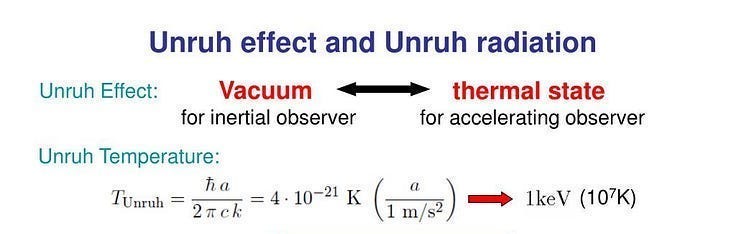
Unruh Temperature of an Accelerating Observer’s Event Horizon
A consensual reality shared by many observers, each at the central point of view of its own holographic world, becomes possible when the holographic screens of different observers overlap like a Venn diagram and share information, like the information sharing seen in a connected network of computer screens that are displaying an interactive virtual reality. This is possible since the observer’s holographic screen arises as its event horizon. Each holographic screen is observed by its own observer, but those screens can share information when they overlap like a Venn diagram.
Information Sharing Among Overlapping Holographic Screens
Understanding the observer’s holographic world as a virtual reality explains why there are so many puzzles in theoretical physics that do not seem to have definite answers. The problem is the whole thing is based on circular reasoning. For example, the whole concept of time is flawed. Relativity theory tells us there is no concept of absolute time in theoretical physics. The perception of time is always relative to the observer’s own motion, which is the basis for the idea of a dynamically curved space-time geometry that is understood as the nature of gravity. The principle of equivalence tells us the observed effect of gravity can always be traced back to the observer’s own accelerated motion.

Principle of Equivalence
The only valid definition of time is the observer’s own proper-time, which is how time is perceived by the observer in its own rest frame, but there is no explanation anywhere in theoretical physics for what gives rise to the observer’s proper-time. The only possible explanation is that the observer’s proper-time is somehow related to its own accelerated motion, but there is no explanation for where that accelerated motion comes from.

Proper-time for the Schwarzschild Metric
The observer’s proper-time is always constructed in terms of a gravitational space-time metric, and the observer’s accelerated motion is inherent in the gravitational space-time metric, but there is no explanation in theoretical physics for where that accelerated motion comes from. That accelerated motion gives rise to the observer’s event horizon that becomes its holographic screen when quantized bits of information are encoded on its horizon. That is the construction process that constructs the observer’s holographic world. The gravitational space-time metric is characteristic of that holographic world in terms of the curved space-time geometry of that world. There is also no explanation for where the information comes from that is encoded on the observer’s holographic screen. The accelerated motion of the observer and the encoding of information on its holographic screen have to be assumed before we can understand how the observer’s holographic world is constructed and how its proper-time is constructed.
At the root of the whole problem is that there is no explanation anywhere in theoretical physics or any other science for where the observer comes from. The observer can only be understood as a presence of consciousness at the central point of view of its own holographic world, but there is no explanation for where that consciousness comes from. The existence of consciousness itself has to be assumed before the observer’s holographic world can be constructed. The observer’s consciousness itself must have its own a priori existence before its holographic world can be constructed.
Comment on the Measurement Problem of Quantum Theory and the Hard Problem of Consciousness:
Quantum theory is inherently about the nature of observation in the sense of knowing about the properties of the quantum state of some system of interest. The very nature of the knower is the observer. The observer is always outside of the system that it knows about. The very nature of observation or measurement, as some property of the quantum state of a physical system is observed or measured, is always made by an observer outside the physical system that the observer knows about. A problem arises when we try to understand how an observer can know about the entire physical universe. How can the observer be outside the physical universe?
Physicists want to assume that consciousness is an emergent property of some complex physical system, like a brain. That brain is a part of the physical universe. How can the consciousness that arises from a brain inside the physical universe know about the entire physical universe if the knower has to be outside the physical universe?
The simple answer is that it cannot. There is an inherent logical contradiction in assuming that the consciousness of the knower that knows about the physical universe arises or somehow emerges from the complex behavior of some complex physical system like a brain inside the physical universe. The idea that consciousness is an emergent property of a complex physical system like a brain is logically impossible.
This logical impossibility of consciousness being an emergent property of a complex physical system like a brain is demonstrated by the Godel incompleteness theorems, which prove that no mathematical system can be both consistent and complete. Even complex physical systems, like a brain, have to obey the laws of physics, which are essentially computational rules that are always formulated in terms of mathematical theories or equations. The consciousness of the knower that knows about the consistency of any mathematical system can never be reduced to that mathematical system it knows about. The knower is always outside that mathematical system, just as the knower that knows about the properties of the quantum state of some physical system is always outside that physical system. Since the behavior of the entire physical universe is described by a mathematical system that we call the laws of physics, the knower of that behavior must be outside the physical universe.
The other big problem that physicists want to sweep under the rug is the qualia problem of perception. We simply do not perceive things in terms of numerical quantities, like the wavelength of light, but rather in terms of subjective qualities, like the color of light. There is no possible way to transform an objective numerical quantity into a subjectively perceived quality. The only possible solution to this problem is to understand that the observer’s own light of consciousness is projecting the images of its own holographic world as that world is illuminated. The subjective quality of things is inherent in how the light of consciousness is projecting the images.
All Seeing Eye
Closely related to the qualia problem of perception is the measurement problem of quantum theory. Remarkably, there is no general agreement among theoretical physicists for how measurement is defined. Theoretical physicists cannot agree on what a measurement actually is. This problem stems from the fact that the most general quantum state of any system of interest is a superposition of all possible observable states of that system, which is a state of potentiality. In the measurement of an actual observable state of the system, this superposition of all possible observable states has to be reduced to an actual observable state. This is called quantum state reduction or the collapse of the wavefunction. There are many proposed theories for how this quantum state reduction occurs, and even theories if it occurs at all, but there is no general agreement among theoretical physicists about which theory is correct. Each theory has its own problems and limitations. The general consensus is that the measurement problem of quantum theory remains unsolved, which is to say that theoretical physicists really do not know what a measurement actually is.
On its face, this statement that theoretical physicists don’t really know what a measurement actually is seems absurd. Just take out your ruler and see it and measure it. The problem that theoretical physicists don’t seem to be able to solve is: Who sees what?
The problem only gets worse with the holographic principle, where it only makes sense to talk about the quantum state of a holographic world. The quantum state of that holographic world is formulated in terms of quantized bits of information encoded on an observer’s holographic screen. The quantized bits of information have the property of quantum entanglement, and so the quantum state of that holographic world is an entangled superposition of all possible observable states of all the quantized bits of information encoded on the screen.
Qubit of Information Encoded on the Surface of a Planck Size Event Horizon
In any observation of that holographic world, this quantum state must become disentangled as the quantized bits of information take on actual values. It really doesn’t make sense to talk about the quantum state of any isolated system in that holographic world, but only the quantum state of that entire holographic world that has to be reduced in any measurement of that world, which is inherently a holistic and global phenomena.
The best way to understand a measurement or observation of that holographic world is with the idea of holographic projection. Everything observable in that holographic world is a form of information that can be reduced to quantized bits of information encoded on the observer’s holographic screen. With measurement, the entangled quantum state of that holographic world is disentangled as observed forms of information are projected like images from the observer’s holographic screen to the observer’s own point of view.
The Observer’s Holographic Screen
The problem is that there is no mechanism in physics that can explain holographic projection. That’s why the light of consciousness has to be invoked as the means by which holographic projection occurs. The light of consciousness, as it emanates from the observer’s point of view, is projecting images from the observer’s holographic screen back to the observer’s point of view. This is inherently a non-physical mechanism since consciousness is inherently non-physical, and so the act of measurement is non-physical in nature. That’s why theoretical physicists can’t figure out what measurement actually is. Measurement is non-physical.
The inherent problem with the measurement problem is that the physical world is being measured by non-physical consciousness. Non-physical consciousness is measuring the physical world, and so there is no physical solution to the measurement problem. Non-physical consciousness is the measure of all physical things. Non-physical consciousness is not itself any physical thing that it can measure.
The consciousness of the observer is what completes the physical universe, just as the consciousness of the observer completes all mathematical systems, which can be consistent, but can never be complete. There has to be an observer that knows about the behavior of the physical universe, just as there has to be an observer that knows about the consistency of all mathematical systems. That observer is always outside the physical universe just as the observer is outside any mathematical system.
The observer has to have its own a priori existence that is independent of whatever behavior it observes. The idea that the consciousness of the observer is an emergent property of the behavior of a complex physical system, like a brain, and somehow emerges from that complex behavior, is a logical impossibility. The consciousness of the observer of the physical universe is always outside the physical universe as the observer observes the behavior of the physical universe.
The holographic principle explains how this is possible. The behavior of the physical universe is being displayed on a holographic screen, and the observer is outside of that holographic screen. The observer can only be described as a point of animating, illuminating and perceiving consciousness at the center of its own holographic world. All the mathematical bits of information for that holographic world are encoded on the observer’s holographic screen, and the observer is always outside the screen.
Comment on the Nature of Quantum Gravity:
Theoretical physicists continue to be puzzled about why it seems to be so difficult to unify gravity with quantum theory, but their puzzlement only reflects their inability to understand the full implications of the holographic principle. They continue to search for a theory of everything, even though there is no such thing. What they refuse to do, which would end their puzzlement, is to take the idea of the observer seriously.
The holographic principle demonstrates that gravity can easily be unified with quantum theory if the idea of the observer is taken seriously. This fact is already inherent in the principle of equivalence, since the observed effect of gravity can be understood purely in terms of the accelerated motion of an observer. That accelerated motion gives rise to the observer’s event horizon, which becomes its holographic screen when quantized bits of information are encoded on the horizon. All of quantum theory, along with the law of gravity, can be deduced from this simple idea in terms of holographic emergence. All field theories, including those for gravity and the electromagnetic and nuclear fields, can be understood to emerge from the thermodynamic entropy of the observer’s holographic world, which is given in terms of the number of quantized bits of information encoded on the observer’s holographic screen that arises as its event horizon due to its accelerated motion, and the expression of thermodynamic energy in that holographic world that is inherent in the temperature of the observer’s event horizon, which is given in terms of its accelerated motion.
Einstein’s Field Equations for the Gravitational Space-time Metric
Only the observer, which is called the Self, really moves. When the observer moves relative to its motionless Source, which is an empty space of potentiality, an event horizon or surface of space arises in that empty space. That surface of space acts as a mental screen, which displays all the images of the movie-of-the-world. Motion appears in that movie, but that motion can always be traced back to the motion of the observer. The observer itself is only a point of view that arises in that empty space in relation to the surface of space of the mental screen that displays the movie-of-the-world. Everything perceivable in the observer’s holographic world is just a projected and animated image that appears in that movie. When something appears to move in that movie, it is really the observer itself that is moving. As images of the movie, things don’t really have objective existence. The motion of images is purely a result of the motion of the observer, which is the motion of the Self.
There is No Spoon
Do not try to bend the spoon. That is impossible. Instead, only try to realize the truth. What truth? There is no spoon. Then you’ll see that it is not the spoon that bends, but only yourself.
The light of consciousness is reflecting the images from the mental screen back to the observer. The light of consciousness emanates from the observer’s point of view, and reflects or projects all the images of the movie-of-the-world from the mental screen back to the observer as it illuminates the movie. The images of the movie are only animated due to the observer’s own motion.
In reality, what we call the physical universe is only a collection of holographic worlds, each of which is like a bubble in space that is defined by a bounding surface of space. Each bubble in space is centered around the point of view of an observer, and the surface of space that defines that bubble arises as the observer’s event horizon due to its own accelerated motion. That surface of space is the observer’s holographic screen that encodes quantized bits of information for everything the observer can observe in its own holographic world. Many observers can only share a consensual reality when their respective bubbles or holographic screens overlap like a Venn diagram and share information. There is really no such thing as a universe, only many bubbles in space, each centered around the point of view of its own observer, and which overlap and share information, thereby allowing many observers to share in a consensual reality.
In relativity theory, these bubbles in space can simply be understood as arising from the accelerated expansion of space that always expands relative to the central point of view of an observer. In theoretical physics, the accelerated expansion of space is attributed to dark energy or a cosmological constant. The farther the observer looks out into space, the faster space appears to expand away from the observer. Every observer is surrounded by its own cosmic horizon where space appears to expand away from the observer at the speed of light, which defines the observer’s own bubble in space. The observer is at the central point of view of its own bubble in space, and the observer’s cosmic horizon limits its observations in space. Each bubble in space is limited by the observer’s own cosmic horizon, where space appears to expand away from the observer at the speed of light, and so nothing is observable to the observer beyond the limit of its own cosmic horizon.
Cosmic Horizon in the Accelerated Expansion of Space
Accelerated Expansion of the Universe from the Big Bang
Nothingness
The only reason physicists reject this simple scenario is because they refuse to take the idea of the observer seriously. If they did so, they would have to understand perception in terms of holographic projection. Everything the observer can observe in its own holographic world is a form of information that is encoded on its own holographic screen and is projected like an image from the screen to its own point of view outside the screen. Even the animation of the images can be understood in terms of the energy of the observer’s own accelerated motion. The observer itself is only a focal point of perceiving consciousness at the center of its own holographic world. Even the projection of the images requires another concept about the nature of the observer, which is the idea of the light of consciousness projecting the images.
The problem physicists have is that this scenario implies that the observer is nothing more than a focal point of perceiving, animating and illuminating consciousness at the center of its own holographic world. The observer is not something that the observer can observe in that holographic world. In this sense, the observer must have its own a priori existence that is independent of whatever it observes in that holographic world.
This simple conclusion is what physicists refuse to consider when they try to understand how gravity can be unified with quantum theory. They refuse to take the idea of the observer seriously. They refuse to accept the simple idea that the observer has to have its own a priori existence that is independent of whatever behavior it observes. That refusal to accept such a simple idea is why they continue to be puzzled and confused.
Saadhana commented:
When you say a mental construct in the first line of this essay, is it the character’s mental construct you are referring to, or the knower’s mental construct?
My response:
Every observer or knower observes its own mind as displayed on its own mental screen, but that mind is characteristic of the character that appears in the movie-of-the-mind. The character, which is called a body, is only a form of information that is being displayed on the mental screen. That body had a brain, and in large part, the behaviors of the mind, as in the generation of thoughts and memories, are being generated by the brain in the sense that those behaviors are highly correlated with the neuronal activity of the brain, but all of this mental activity can be reduced to the information that is encoded on the mental screen. The character is only the central character of the movie-of-the-mind, or the central form of information that is being displayed on the mental screen, like the form of an avatar in a virtual reality movie being displayed on a computer screen.
The key thing to realize is that all of this mental activity is emotionally generated. The generation of thoughts and memories are emotionally generated, just as the behavior of the character is emotionally generated. The movie-of-the-mind that is being displayed on the mental screen is emotionally animated, both at the level of the emotional animation of the character in the movie and at the level of the emotional generation of thoughts and memories, which are characteristic of the character. All of this mental activity takes the form of forms of information that can be reduced to the information encoded on the mental screen, and all of this emotional animation of form is ultimately a result of the motion of the observer itself.
Let me repeat myself: We only have the idea that we are perceiving external sensory perceptions of the world, like sight and sound, and internal sensory perceptions of the body and mind, like thoughts, memories and emotional body feelings, because we are arbitrarily dividing up those perceptions into external and internal based on the boundary of the body. This division into external and internal only occurs because the observer is emotionally identifying itself with its body, which in reality is only the central form of information that appears in its own holographic world. The observer only emotionally identifies itself with the emotionally animated form of its body due to its perception of emotional body feelings that arise as the form of its body is emotionally animated relative to all other forms that appear in its holographic world, which creates feelings of emotional self-limitation to its body. In reality, the whole thing is being displayed on the observer’s own holographic screen, which is really a mental screen.
The key thing to realize is that the sense of being a personal self can only arise from the personal self-concept that is emotionally constructed in the mind. People become feisty when their sense of being a personal self is attacked or threatened. They become self-defensive. They want to fight and defend their sense of being a personal self. They defend their personal self-concept. That emotional self-defense is what keeps them emotionally self-identified with their concept of being a person. That emotional self-defense creates feelings of emotional self-limitation to their personal form as their personal form is emotionally animated by the expression of self-defensive emotions, which leads them to emotionally identify themselves with their personal form. That’s how the vicious cycle of personal self-defense and personal self-identification with a personal form is emotionally perpetuated. People are defending their sense of being a personal self as though their existence depends on it. In reality, the only thing that really exists is consciousness itself, the existence of which depends on nothing.
There are many people who won’t like this explanation for the obvious reason that it calls into question the very nature of what they call reality.
Continue Reading:
All Seeing Eye
Nothingness
Holographic Principle
메타데이터
- post_id
- f581c7709366
- slug
- lenny-susskind-describes-how-the-brain-receives-signals-from-nonlocal-consciousness-f581c7709366
- url
- https://medium.com/@jkowall031/lenny-susskind-describes-how-the-brain-receives-signals-from-nonlocal-consciousness-f581c7709366
- canonical_url
- https://medium.com/@jkowall031/lenny-susskind-describes-how-the-brain-receives-signals-from-nonlocal-consciousness-f581c7709366
- author_url
- https://medium.com/@jkowall031
- status
- ok
- fetched_at
- 2026-06-21 15:33:18