Adding a Filter to an HRV/ERV Is Not a Trivial Modification
In the ventilation world, I keep seeing a claim repeated casually:
Adding a Filter to an HRV/ERV Is Not a Trivial Modification
In the ventilation world, I keep seeing a claim repeated casually:
“You can just add a filter on the intake of an HRV/ERV.”
Recently I saw it again, stated even more strongly:
“Most energy recovery ventilators can have a HEPA filter inserted on the intake. This works better than an air purifier because the house is positively pressurized.”
This kind of statement is misleading for the public.
Most residential ERV systems are not positively pressurized. They are typically balanced systems, meaning supply airflow and exhaust airflow are designed to be roughly equal.
So the claim that “most ERVs pressurize the house positively” is simply incorrect.
Furthermore, adding a filter — especially a HEPA filter — is not a trivial modification.
It changes:
- airflow
- pressure balance
- noise levels
- overall system behavior.
I wrote about related issues previously in my article:
“Unclear Specs on Air Cleaners”
where I discuss how manufacturers sometimes provide incomplete airflow and filtration data.
Unfortunately, the misunderstanding continues to circulate.
Filters Are Not Neutral Components
A filter is not just something that “catches particles”.
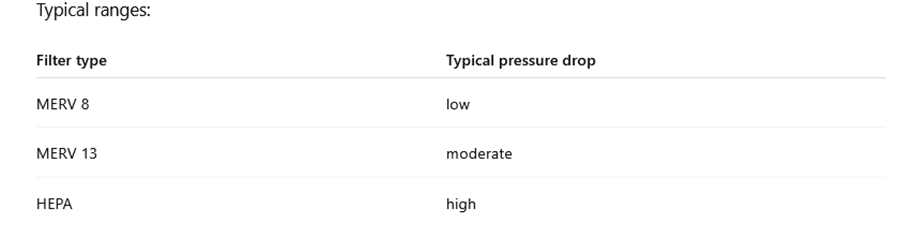
It also creates pressure drop.
The higher the filtration efficiency, the higher the resistance to airflow.
Residential ERV and HRV systems are typically designed for low pressure drops.
Their fans are optimized for:
- modest airflow
- low static pressure
When a high-resistance filter is added, the system changes.
Why HEPA Is Rare in Residential HRV/ERV Systems
Last year, out of curiosity, I spent a little time looking at central HRV/ERV units sold in Quebe
Among the models I reviewed, I found only one system with a HEPA filter.
That rarity is not accidental.
If integrating HEPA filtration were simple, it would be common.
Manufacturers generally avoid it because it requires:
- stronger fans
- larger filter surfaces
- careful airflow balancing
- higher energy consumption.
In other words, it requires a different system design.
What the Specifications Reveal
The model I found was the Venmar EVO5–700 HRV HEPA.
Looking at the technical data sheet reveals something interesting.
Even though it is not explicitly stated, the airflow data show:
- more air exhausted than supplied
In other words, the system operates with negative pressure.
This can be inferred from the published airflow ratios.

Technical sheet: https://broan-nutone.com/getmedia/2fd5efdb-b29c-40d8-927f-b926dcbefba6/Fiche_Technique_EVO5-700.pdf?ext=.pdf
This is already important.
But it becomes even more significant when we consider filter loading over time.
Filters Get Dirtier Over Time
All filters gradually accumulate dust and particles.
As they do:
- resistance increases
- airflow decreases.
If the HEPA filter is on the intake side, supply airflow will decrease further over time.
This means:
- even lower supply airflow
- potentially stronger negative pressure.
So the pressure balance may shift even more negative as the filter becomes loaded.
Most ERVs Are Designed to Be Balanced
Another false claim is that ERVs typically operate with positive pressure.
In reality, most residential ERVs are designed as balanced ventilation systems:
supply airflow ≈ exhaust airflow.
This balance is usually adjusted during installation.
But if you suddenly introduce a much higher pressure drop on the intake side — for example by replacing a MERV-8 or MERV-13 filter with a HEPA filter — the supply airflow may drop significantly.
At that point, the system can easily become negatively pressurized.
Exactly the opposite of what is being claimed.
When Better Filtration Can Backfire
There is another issue rarely mentioned when people casually recommend adding a HEPA filter to an ERV.
In some situations, it can actually increase indoor particle levels. This may sound counterintuitive, but it is a well-known effect in building airflow dynamics.
Here’s why.
If a HEPA filter significantly increases the pressure drop on the intake side, supply airflow may decrease while exhaust airflow remains similar.
The result can be a negatively pressurized house.
When a building is under negative pressure, outdoor air is pulled in through:
- cracks in the building envelope
- window and door gaps
- electrical penetrations
- attic bypasses
- foundation joints.
This air bypasses the ventilation system.
It also bypasses the HEPA filter.
Instead of entering through the filtered ventilation intake, outdoor air may enter through uncontrolled leakage paths.
If the house is leaky, the effect can be even stronger.
In that situation, adding a HEPA filter to the ERV could paradoxically lead to more outdoor particles entering the home, not less.
Why Portable HEPA Purifiers Can Sometimes Work Better
This is one reason portable HEPA air purifiers can be surprisingly effective.
Unlike ventilation systems, they do not depend on airflow from outdoors.
They simply:
- recirculate indoor air
- filter it repeatedly.
Even if outdoor particles enter the building through infiltration, a purifier can remove them from the indoor air over time.
In homes that are:
- leaky
- negatively pressurized
- difficult to balance mechanically
a portable HEPA purifier may sometimes be a more practical solution for reducing indoor particles than modifying the ventilation system.
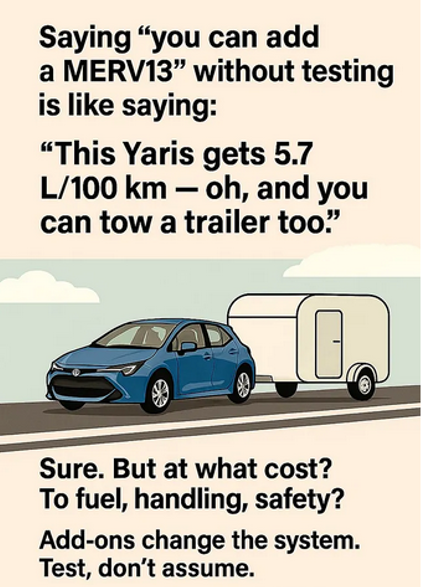
The Core Principle: Add-Ons Change the System
Adding components to a ventilation system is not neutral.
It is similar to saying:
“This small car gets excellent fuel economy… and you can tow a trailer too.”
Maybe.
But at what cost?
Fuel consumption, handling, and safety all change.
The same applies to ventilation systems.
When filtration is modified, we must consider:
- airflow
- fan curves
- pressure balance
- energy consumption
- long-term operation.
These systems should be tested and measured, not modified based on assumptions.
Transparency Matters
Ventilation, filtration, and indoor air quality are complex topics.
People deserve accurate information, especially when advice is presented as expert guidance.
Simplified statements like:
“Just add a HEPA filter to your ERV”
ignore the engineering realities behind these systems.
Add-ons change the system.
Assumptions should be replaced with measurements and transparent specifications.
메타데이터
- post_id
- f58306c8b7c8
- slug
- adding-a-filter-to-an-hrv-erv-is-not-a-trivial-modification-f58306c8b7c8
- url
- https://medium.com/@levangelistedelaventilation/adding-a-filter-to-an-hrv-erv-is-not-a-trivial-modification-f58306c8b7c8
- canonical_url
- https://medium.com/@levangelistedelaventilation/adding-a-filter-to-an-hrv-erv-is-not-a-trivial-modification-f58306c8b7c8
- author_url
- https://medium.com/@levangelistedelaventilation
- status
- ok
- fetched_at
- 2026-07-14 04:53:50