Development Costs for Food Delivery Platforms: Real Ranges Founders Should Expect (2025)
Ask three agencies how much it costs to build a food delivery platform and you will get three wildly different answers. One promises a lean…
Development Costs for Food Delivery Platforms: Real Ranges Founders Should Expect (2025)
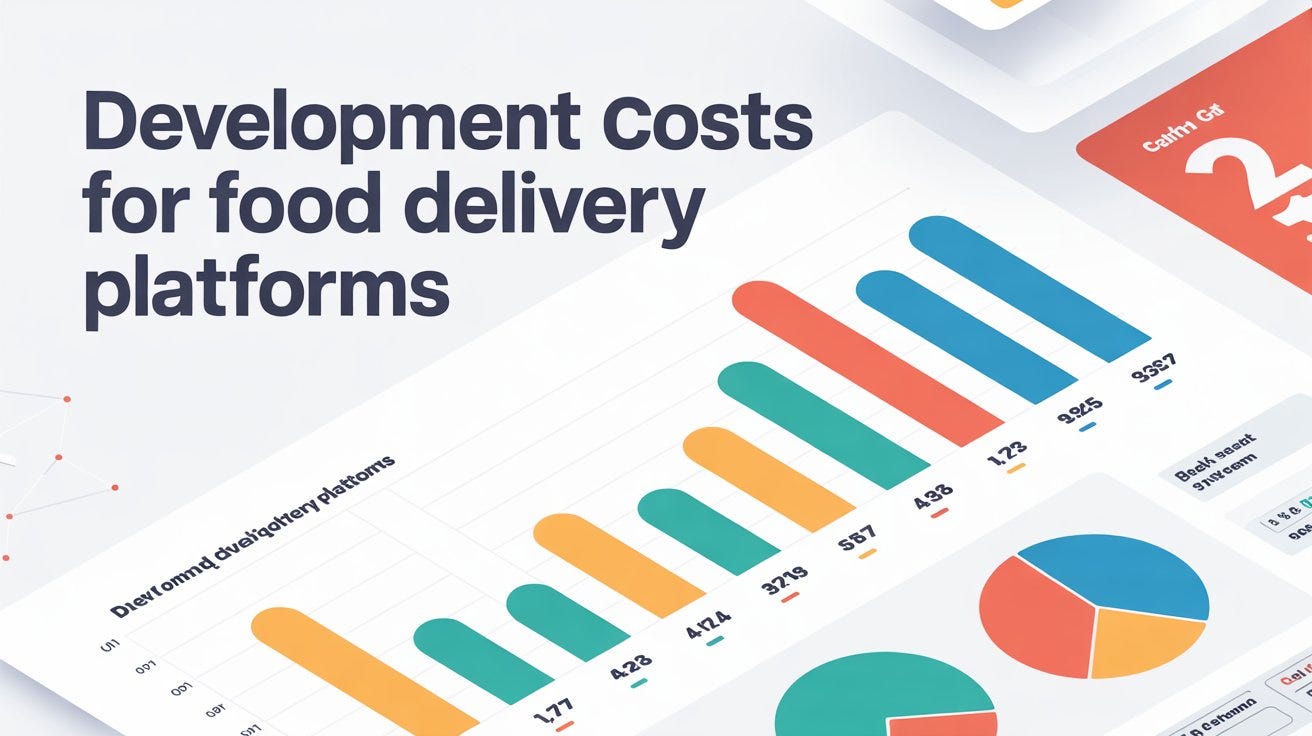
Ask three agencies how much it costs to build a food delivery platform and you will get three wildly different answers. One promises a lean MVP for a few thousand dollars. Another quotes six figures for what sounds like the same product. For founders, this gap creates confusion, hesitation, and often poor early decisions.
The problem is not dishonesty. It is a definition. “Food delivery app” can mean a single-city experiment with basic ordering or a multi-city platform with complex logistics, payments, and operations baked in. When the scope is unclear, cost estimates become meaningless.
This article cuts through that noise. Instead of generic price tags, it breaks down real development cost ranges based on what founders are actually trying to build and operate. The goal is not to sell a number, but to help founders budget with realism, avoid surprise expenses, and align development spend with business ambition.
What Founders Mean by “A Food Delivery Platform”

When founders say they want to build a food delivery platform, they are often describing very different products. For some, it means a single-city app to test demand. For others, it implies a multi-city marketplace with advanced logistics and admin control.
This distinction matters because cost is tied to ambition, not labels. A lightweight ordering app and a scalable delivery platform do not share the same architecture, complexity, or investment profile. Without defining the stage and intent, cost discussions become inaccurate from the start.
Clear definition of scope is the first and most important cost decision founders make.
MVP Cost Range and What You Actually Get
An MVP for a food delivery platform is designed to validate demand, not to scale. It typically includes basic user ordering, restaurant onboarding, simple delivery flow, and an admin panel to manage operations. Performance optimization, automation, and advanced analytics are intentionally limited.
In real terms, a functional MVP usually falls within a lower five-figure range, depending on region and team structure. What founders get is speed and learning, not long-term stability. The trade-off is clear. MVPs require refactoring or rebuilding once traction is proven.
An MVP should answer market questions quickly, not carry the business indefinitely.
Mid-Scale Platform Costs for Regional Growth

When a food delivery platform moves beyond validation, costs increase sharply. Supporting multiple cities, managing higher order volume, and introducing role-based admin tools require stronger architecture and more engineering effort.
At this stage, development typically enters the mid five-figure to low six-figure range. The platform must handle performance, reliability, and basic automation without constant manual intervention. This is where shortcuts taken during the MVP phase start to surface.
Regional growth does not add features slowly. It adds complexity quickly, and cost follows complexity.
Full-Scale Platform Costs and Why They Escalate
Full-scale food delivery platforms are built for reliability, not experimentation. Advanced dispatch logic, automation, integrations, security, and compliance become mandatory. Every failure now impacts revenue, not learning.
Development at this stage typically moves into the solid six-figure range and beyond. Costs rise because systems must handle peak loads, minimize downtime, and support ongoing customization. The platform is no longer a product. It is operational infrastructure.
Enterprise-scale delivery platforms pay for stability, scalability, and control, not just features.
Hidden Costs Founders Often Miss

Development budgets often exclude ongoing costs that surface after launch. Cloud infrastructure, third-party APIs, payment processing, and map services scale directly with usage. These expenses grow quietly as order volume increases.
Maintenance is another overlooked cost. Bug fixes, updates, performance tuning, and security patches are continuous, not one-time. Over time, these operational costs can rival initial development spend if not planned for.
Building the platform is only the starting cost. Running it is the long-term commitment.
Build vs Buy and Its Cost Implications
Buying a white-label or SaaS solution lowers upfront development costs and accelerates launch. However, recurring fees, limited customization, and transaction-based charges increase long-term spend as volume grows.
Building requires higher initial investment but reduces marginal cost over time and offers full control. The real cost difference appears after traction, not at launch.
Buying saves time early. Building saves money and flexibility later.
Cost Control Strategies Smart Founders Actually Use
Founders who manage development costs well focus less on cutting corners and more on controlling scope. They prioritize features that directly impact ordering, delivery reliability, and payments, while delaying everything else. This keeps early builds lean without breaking core workflows.
Another common pattern is phased development. Instead of funding a large build upfront, smart teams release in stages, validating assumptions before expanding functionality. Modular architecture also plays a role, allowing teams to upgrade specific components without rebuilding the entire platform.
Finally, choosing the right development partner matters as much as budgeting. Teams that understand food delivery operations reduce rework and prevent costly redesigns later.
Budget for the Platform You Want to Become
Development cost decisions should reflect where the platform is headed, not just where it starts. Many founders underbudget because they plan only for launch, then struggle when growth demands stability, automation, and scale-ready systems.
The right budget aligns with intent. If the goal is experimentation, keep the build lean. If the goal is regional or long-term platform play, invest early in architecture that will not need constant rebuilding. Underinvesting often leads to higher cumulative costs through rework, downtime, and missed opportunities.
Cost clarity is not about spending more. It is about spending deliberately, with a clear understanding of what each phase requires and unlocks.
메타데이터
- post_id
- f596c8e86664
- slug
- development-costs-for-food-delivery-platforms-real-ranges-founders-should-expect-2025-f596c8e86664
- url
- https://medium.com/@myoyelabs/development-costs-for-food-delivery-platforms-real-ranges-founders-should-expect-2025-f596c8e86664
- canonical_url
- https://medium.com/@myoyelabs/development-costs-for-food-delivery-platforms-real-ranges-founders-should-expect-2025-f596c8e86664
- author_url
- https://medium.com/@myoyelabs
- status
- ok
- fetched_at
- 2026-08-11 17:00:21