When the Plan Stops Fitting the Work: Responding to Change as a Leadership Practice
Here’s something most experienced project leaders will admit, but rarely say out loud: the plan was never going to survive contact with…
When the Plan Stops Fitting the Work: Responding to Change as a Leadership Practice
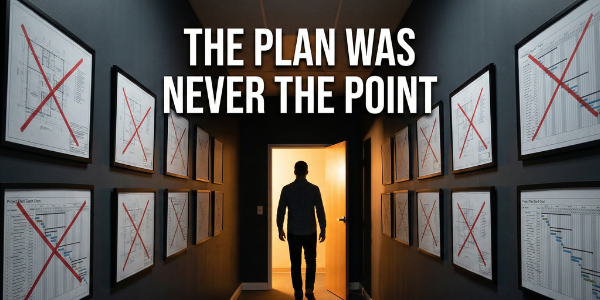
Here’s something most experienced project leaders will admit, but rarely say out loud: the plan was never going to survive contact with reality. Not fully. That’s not a failure of planning. That’s the nature of uncertain work.
This is Article 5 in a six-part series reframing the Agile Manifesto — not as a software methodology, but as a thinking framework for any project involving uncertainty. In the articles before this one, we covered how values clarify decisions under pressure, why human interaction outperforms process when things get complex, how working solutions teach you more than documentation can, and why real customer alignment requires ongoing conversation — not just a signed agreement.
This article takes on the fourth Agile value: Responding to Change Over Following a Plan. We’ll work through three concepts — and by the end, you’ll have a sharper way to think about what plans actually are, how to recognize when a project is quietly drifting off course, and why the ability to adapt isn’t a sign of weak planning. It’s the most reliable form of control available to you.
There are three concepts here, each with a practical example and a free AI prompt resource you can use immediately. If you know a project manager, team lead, or anyone who’s ever watched a solid plan slowly stop making sense — this one’s worth sharing. And scroll to the end for the infographic that pulls the whole article together.
Let’s get into it.
PLANS ARE HYPOTHESES
A plan is your best guess, made visible.
We treat plans like commitments. Once the Gantt chart is built and the milestones are set, there’s a kind of social contract around it — a shared agreement that this is what we’re doing. Deviating from it feels like failure. Asking to change it feels like admitting something went wrong.
But that framing creates a quiet trap.
A plan is built on assumptions. Assumptions about timelines, resource availability, stakeholder behavior, market conditions, technical complexity, and a dozen other variables that were estimated — not known — at the time the plan was made. Some of those assumptions will hold. Others won’t. And the ones that don’t are where the plan starts to break down.
The Agile Manifesto’s fourth value doesn’t say plans are useless. It says: don’t let the plan outrank reality. When new information arrives — and it always does — the question isn’t “how do we protect the plan?” It’s “what does the plan need to become?”
Researchers studying decision-making under uncertainty consistently point to this distinction. In Thinking in Bets (Annie Duke, 2018), the argument is straightforward: good decisions are made with incomplete information, and the goal is to hold your beliefs — including your plans — like a scientist holds a hypothesis. Willing to update when the evidence changes. Not willing to ignore evidence just because you built something around a different assumption.
When you treat a plan as a hypothesis, something shifts. You stop defending it and start testing it. You build in checkpoints not to confirm that the plan is on track, but to ask honestly whether the assumptions behind it still hold. That’s a fundamentally different kind of project meeting.
And it produces fundamentally different results.
WHAT IT LOOKS LIKE
When a competitor’s surprise launch sent the office into a tailspin, Diane had to convince her VP that the best way to move fast wasn’t to start over, but to pivot with precision….

HOW TO DO IT

✨ Concept Resources: *AI Prompt Guide: Assumption Audit*
A beginner-friendly set of prompts designed to help you surface the hidden assumptions inside any plan, test which ones are still holding, and identify where the plan needs to evolve. Useful before planning sessions, at milestone reviews, and any time the ground shifts. Full guide in the first comment.
DRIFT IS THE EARLY WARNING
By the time it’s obvious, it’s late.
Most projects don’t fail suddenly. They drift.
Drift is the gap between where the project is and where the plan said it would be — and it usually starts small. A deliverable slips by two days. A stakeholder stops showing up to reviews. The weekly update gets a little vaguer. The team starts hedging in status reports. None of it looks catastrophic on its own. But each small gap is a signal, and signals ignored tend to compound.
The reason drift is so dangerous is that it’s quiet. Unlike a crisis — which demands attention — drift just sits there, accumulating. And the organizational instinct is often to normalize it. “We’re a little behind, but we’ll catch up.” “The stakeholder is busy, but they’re still supportive.” “The team knows what they’re doing.”
Maybe. Or maybe the project has already moved off the rails and the evidence is right there, in the small things that stopped adding up.
Gary Klein’s research on naturalistic decision-making — described in Sources of Power (1998) — found that experienced practitioners in high-stakes fields routinely pick up on “weak signals”: subtle anomalies in the environment that don’t yet look like problems but indicate something is wrong. The skill isn’t dramatic. It’s noticing. Asking. Following the thread.
Drift detection is that skill, applied to project leadership. It’s not about micromanagement or distrust. It’s about staying close enough to the work to notice when something has quietly changed — and responding while the change is still small enough to correct.
The teams that catch drift early aren’t the ones with the most detailed reporting systems. They’re the ones with the most honest conversations.
WHAT IT LOOKS LIKE
When the status reports stayed green but the room went quiet, James realized that checking in with Rosa was the only way to uncover the “drift” before it derailed the entire project…

HOW TO DO IT

✨ Concept Resources: *AI Prompt Guide: Drift Detection Check-In*
A set of AI prompts built to help you surface early-warning signals in your project, structure honest team conversations, and distinguish noise from meaningful pattern shifts. Useful before weekly reviews, one-on-ones, and any time the project “feels off” but you can’t quite put your finger on why. Full guide in the first comment.
ADAPTATION IS CONTROL
The team that can change course is the team in control.
There’s a persistent belief in project management culture that changing the plan is a loss of control. That a well-run project is one where the original plan holds. That adaptation is what happens when something goes wrong.
This belief is exactly backwards.
In uncertain work, the ability to adapt is the control mechanism. Rigid adherence to a plan that no longer fits the situation isn’t discipline — it’s rigidity disguised as professionalism. And it produces the worst kind of project failure: one that could have been avoided, but wasn’t, because nobody wanted to be the person who said the plan needed to change.
The Agile Manifesto understood this. Responding to change isn’t a concession. It’s a capability — and one that needs to be built deliberately, because most organizations are not naturally set up for it. Reporting structures, approval chains, budget cycles, and performance metrics all tend to reward predictability over responsiveness. That’s not wrong, exactly, but it means the bias toward following the plan is structural. Overcoming it requires intentional design.
What does that design look like? It looks like teams with clear enough values to make fast decisions without escalating everything. It looks like planning horizons short enough to stay relevant. It looks like retrospectives that actually change how the team works, not just documents what happened. It looks like leaders who model adaptation as a sign of judgment, not weakness.
In Team of Teams (General Stanley McChrystal, 2015), the argument is made that modern operational environments — military and otherwise — demand “adaptable units” rather than compliant ones. The teams that performed best weren’t the ones that followed orders most precisely. They were the ones that understood the intent well enough to adapt their approach when conditions changed.
That’s adaptation as control. Not chaos. Not improvisation. Purposeful flexibility, grounded in clear values and clear goals.
WHAT IT LOOKS LIKE
When the evidence shifted but the contract remained fixed, Elena realized that a transparent conversation with her program officer was the only way to save the mission from a failing model…

HOW TO DO IT

✨ Concept Resource: *AI Prompt Guide: Adaptation Decision Support*
A beginner-friendly set of prompts to help you think through when and how to adapt a plan, how to communicate a course change to stakeholders, and how to evaluate whether an adaptation is working. Useful when facing a plan-versus-reality gap and not sure how to respond. Full guide in the first comment.
TYING IT TOGETHER
The goal is never to follow the plan. The goal is always to achieve the outcome.
The fourth Agile value — Responding to Change Over Following a Plan — is probably the most misread of the four. It sounds like permission to be disorganized, to skip the planning, to treat structure as optional. It’s not.
What it’s actually saying is this: plans are tools, not destinations. They encode your best thinking at a point in time. They make your assumptions visible and your intentions legible. They help teams coordinate and stakeholders stay oriented. All of that is real and valuable.
But plans don’t update themselves. And the longer you treat a plan as fixed when the underlying reality has shifted, the more work it takes to close the gap — and the more damage gets done while you’re pretending it isn’t there.
The three concepts in this article give you a practical path through that reality. Treat your plans as hypotheses — testable, updatable, and always subordinate to what you’re actually learning. Watch for drift not as a failure, but as early information that deserves a response while it’s still small. And build adaptation as a genuine capability: not improvisation, but disciplined responsiveness grounded in clear values and honest communication.
In the final article of this series, we’ll bring all four values together — and look at how to use the Agile Manifesto as a diagnostic tool when a project is struggling, a team is stuck, or the work has stopped making sense. If you’ve ever wanted a simple framework for reading what’s actually wrong with a project — not just the symptoms, but the structural cause — that article is the one.
If this connected with you, like it, share it, or drop a comment: what’s a moment when adapting the plan turned out to be the right call? I’d genuinely like to know.
Follow Idea Express for more in this series. And if you want to go deeper on these concepts in conversation, the Idea Express Deep Dive Podcast explores exactly this kind of thinking — check it out.
👇 Scroll down for the infographic.
Remember
Flexibility isn’t the opposite of control. In uncertain work, it’s how control is exercised.

Check out the Idea Express Deep Dive Podcast where we ‘dive deep’ into each article:

메타데이터
- post_id
- f5a1db23ce76
- slug
- when-the-plan-stops-fitting-the-work-responding-to-change-as-a-leadership-practice-f5a1db23ce76
- url
- https://medium.com/@kcbarr/when-the-plan-stops-fitting-the-work-responding-to-change-as-a-leadership-practice-f5a1db23ce76
- canonical_url
- https://medium.com/@kcbarr/when-the-plan-stops-fitting-the-work-responding-to-change-as-a-leadership-practice-f5a1db23ce76
- author_url
- https://medium.com/@kcbarr
- status
- ok
- fetched_at
- 2026-06-11 15:16:29