How Does Skinner’s Operant Conditioning Theory Apply to Microlearning?
Skinner’s Operant Conditioning: Engineering High-Retention Enterprise Training
How Does Skinner’s Operant Conditioning Theory Apply to Microlearning?
Operant Conditioning
Skinner’s Operant Conditioning: Engineering High-Retention Enterprise Training
Corporate training faces a persistent hurdle: knowledge decay. Traditional learning delivery methods often overwhelm employees with passive information, leading to poor retention and minimal behavior change. For enterprise leaders across high-stakes industries — such as banking, healthcare, pharma, energy, and retail — ensuring training translates directly into on-the-job performance is critical.
The solution lies in behavioral psychology. By integrating **B.F. Skinner’s Theory of Operant Conditioning** into modern workplace learning, organizations can create continuous reinforcement loops that reshape employee habits, ensure strict regulatory compliance, and boost operational performance.
What Is Skinner’s Operant Conditioning in Workplace Learning?
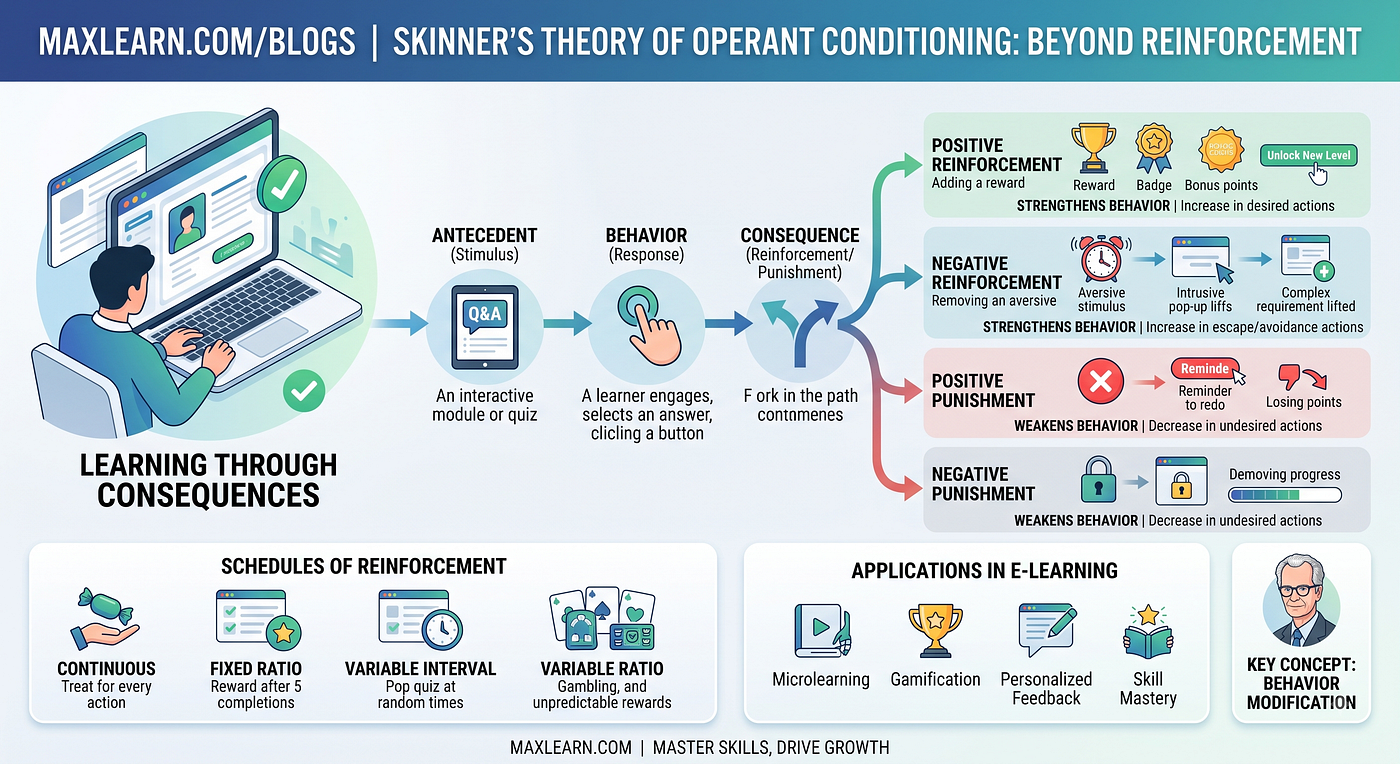
Skinner’s Operant Conditioning is a psychological framework where behavior is learned, modified, and sustained through consequences — specifically reinforcement and feedback. In enterprise learning, it replaces passive instruction with active recall and instantaneous reinforcement.
When applied to digital instruction, the behavioral sequence follows three stages:
- Antecedent (Stimulus): An employee receives a prompt, scenario, or micro-assessment.
- Behavior (Response): The employee makes an active decision or solves a problem.
- Consequence (Reinforcement): Immediate feedback, points, or remediation solidify the correct action.
By systematically applying positive reinforcement, organizations replace uncertainty with compliant, high-performing workplace habits.
The Core Mechanisms: Translating Theory into Digital Training
Modern learning management solutions leverage Skinner’s foundational principles to automate behavior modification across distributed teams.
1. Positive Reinforcement
Positive reinforcement introduces a rewarding stimulus immediately after a desired behavior occurs. Within an enterprise **microlearning platform**, this includes:
- Instant congratulatory feedback upon answering complex scenario questions.
- Digital badges, leaderboard recognition, and streak multipliers.
- Unlocking advanced operational simulation levels.
2. Immediate Feedback and Correction
Under operant conditioning, reinforcement loses its behavioral impact if delayed. Legacy learning frameworks often delay evaluation until quarterly or annual reviews. Modern systems provide micro-remediation within seconds, correcting errors before misinformation becomes ingrained behavior.
3. Reinforcement Schedules
Skinner demonstrated that behavior is most resilient when reinforced on strategic schedules:
- Fixed-Ratio: Providing recognition after completing specific milestone modules.
- Variable-Ratio: Delivering dynamic, unexpected micro-challenges that trigger dopamine-driven engagement and habit formation.
Industry Applications: Behavioral Impact Across Enterprise Verticals
Compliance, Banking, Finance & Insurance (BFSI)
Regulatory non-compliance risks severe financial penalties. Traditional annual compliance courses fail to change daily routines. Using a Microlearning LMS, BFSI organizations deliver daily 2-minute scenario checks on anti-money laundering (AML), insider trading, and data security, using immediate feedback to condition automated adherence.
Healthcare & Pharmaceuticals
In clinical environments and pharma manufacturing, precision prevents fatal errors and standard operating procedure (SOP) violations. Microlearning reinforcement conditions clinicians and laboratory personnel on safety protocols, hygiene standards, and regulatory documentation through rapid, continuous assessments.
Oil & Gas, Mining, and Heavy Industry
High-hazard workplaces demand instinctive safety adherence. Operant conditioning enables field workers to identify hazard risks, practice protocol responses via digital simulations, and receive positive recognition for zero-incident safety routines.
Retail, Sales, and Hospitality
Sales performance depends on rapid product recall, handling objections, and customer service excellence. Variable reinforcement through competitive gamification trains frontline staff to apply optimal customer engagement techniques instinctively.
Deploying Behavioral Learning with MaxLearn
Executing operant conditioning at enterprise scale requires an agile technology infrastructure. MaxLearn provides a specialized **Cloud Based Learning Management System and Learning Content Management System (LCMS)** engineered specifically for behavioral learning and knowledge retention.
┌────────────────────────────────────────────────────────┐
       │                      MaxLearn LCMS                     │
       │       (Rapid AI-Powered Micro-Course Authoring)        │
       └───────────────────────────┬────────────────────────────┘
                                   │
                                   ▼
       ┌────────────────────────────────────────────────────────┐
       │                      MaxLearn LMS                      │
       │  (Spaced Retrieval • Microlearning • Automated Loops)   │
       └───────────────────────────┬────────────────────────────┘
                                   │
                                   ▼
       ┌────────────────────────────────────────────────────────┐
       │                Measurable Behavior Change              │
       │   (Real-Time Analytics • Compliance • Field Mastery)   │
       └────────────────────────────────────────────────────────┘
1. Agile Content Authoring with MaxLearn LCMS
Building frequent micro-modules manually can strain L&D resources. The MaxLearn LCMS uses AI-powered authoring tools to transform complex operational manuals, compliance guidelines, and product documents into interactive micro-challenges within minutes.
2. Spaced Practice and Algorithmic Retrieval
The MaxLearn microlearning platform pairs operant conditioning with spaced repetition. The system tracks individual employee performance, identifying weak points and re-introducing targeted prompts at optimized intervals until full mastery is demonstrated.
3. Gamification and Social Reinforcement
Through the MaxLearn LMS, organizations deploy structured positive reinforcement mechanisms:
- Automated achievement badges for knowledge milestones.
- Peer and department leaderboards to foster healthy engagement.
- Real-time competency dashboards that give executives total visibility into organizational readiness.
Key Best Practices for L&D Executives
To implement Skinner’s operant conditioning successfully within enterprise training programs, L&D leaders should adopt the following approach:
- Deconstruct Monolithic Courses: Break 60-minute modules into focused, 3-to-5-minute learning nuggets.
- Prioritize Active Retrieval: Ensure every micro-module requires the learner to make an operational decision rather than passively watching video content.
- Automate Feedback Delivery: Leverage modern learning management software to give instant, context-rich explanations for both correct and incorrect selections.
- Track Behavioral Analytics: Measure success through applied competency metrics, reduction in compliance incidents, and frontline error rates rather than simple course completion numbers.
Conclusion
B.F. Skinner’s Operant Conditioning confirms that sustainable competence requires active practice, instant feedback, and continuous reinforcement. By combining proven behavioral psychology with an **Enterprise Learning Management system like MaxLearn**, L&D leaders can move beyond passive compliance checks to build a high-performance workforce driven by verifiable, repeatable skills.
메타데이터
- post_id
- f5b002e6d51a
- slug
- how-does-skinners-operant-conditioning-theory-apply-to-microlearning-f5b002e6d51a
- url
- https://medium.com/@maxlearn-microlearning/how-does-skinners-operant-conditioning-theory-apply-to-microlearning-f5b002e6d51a
- canonical_url
- https://medium.com/@maxlearn-microlearning/how-does-skinners-operant-conditioning-theory-apply-to-microlearning-f5b002e6d51a
- author_url
- https://medium.com/@maxlearn-microlearning
- status
- ok
- fetched_at
- 2026-08-19 19:16:50