DataHive AI vs Grass Network: Two DePINs Solving AI’s Data Hunger in Different Ways
The AI industry is starving for high-quality, real-world data. As models become more sophisticated, the demand for diverse, ethically…
DataHive AI vs Grass Network: Two DePINs Solving AI’s Data Hunger in Different Ways
The AI industry is starving for high-quality, real-world data. As models become more sophisticated, the demand for diverse, ethically sourced datasets continues to explode. Two prominent DePIN (Decentralized Physical Infrastructure Network) projects on Solana are tackling this challenge from slightly different angles: DataHive AI and Grass Network.
Both turn everyday user resources into contributions for AI training data, rewarding participants with points (and future tokens). Yet they approach the problem with distinct philosophies, mechanics, and user experiences. Here’s a clear head-to-head comparison.
The Core Idea: Decentralizing AI Data Collection
Traditional web scraping often relies on centralized data centers with easily blocked IPs, struggles with dynamic JavaScript-rendered content, and raises legal and ethical concerns. Both DataHive AI and Grass aim to fix this by distributing the workload across real residential devices worldwide.
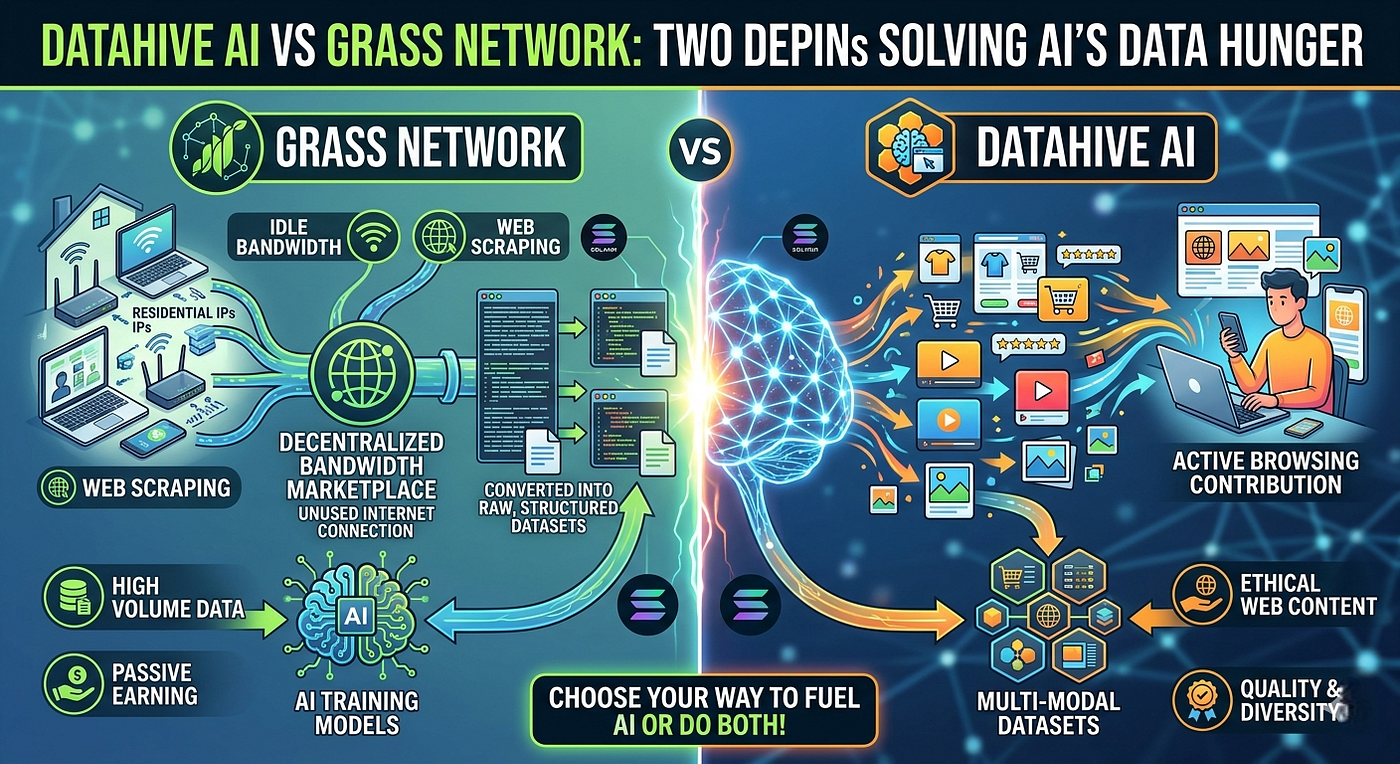
- Grass Network acts as a decentralized bandwidth marketplace. It uses users’ idle internet connection to power web scraping requests for public data, which is then structured into datasets for AI training. The network emphasizes transparency through on-chain proof of data origin (using zero-knowledge proofs) and has already grown to millions of users.
- DataHive AI focuses on crowdsourcing high-quality, ethically sourced web data directly through user devices. Participants contribute while browsing normally via a lightweight browser extension or mobile app, capturing dynamic content like e-commerce listings, reviews, images, videos, and more that traditional crawlers often miss.
In short: Grass rents out your unused bandwidth for scraping tasks, while DataHive turns your actual browsing sessions into data contribution opportunities.
Privacy Approach: Both Strong, But Different Emphases
Privacy is a top priority for both projects, and neither accesses your personal browsing history, passwords, or private information.
- Grass routes a small portion of idle bandwidth (often described as ~0.3%) through your device for public web requests. The app/extension operates separately from your personal session, and the team stresses that no private data is collected or viewed. Data is encrypted in transit, and provenance is recorded on-chain for transparency.
- DataHive AI is even more explicit about “privacy-first” design. Your device acts as a secure relay that collects only tiny fragments of publicly available web content (product pages, reviews, videos, etc.). The team repeatedly states that they never see or store personal information, credentials, or your individual activity. Everything is anonymized and encrypted at the device level.
Winner on transparency feel: DataHive positions itself as more “human-in-the-loop” and consent-driven, while Grass leans into technical guarantees (ZK proofs and audited security).
Data Quality and Type
This is where the approaches diverge most clearly.
- Grass excels at large-scale, distributed scraping of public web pages. It helps create structured datasets by pulling raw information from across the internet and processing it (with on-chain verification of origin). It’s particularly strong for broad, high-volume data needs.
- DataHive AI emphasizes higher-quality, domain-specific, and dynamic data. Because collection happens during real user browsing sessions, it naturally captures JavaScript-heavy pages, infinite-scroll content, real e-commerce interactions, multimedia (images, videos, audio), and culturally diverse examples. The project also offers labeled and cleaned datasets (e.g., e-commerce product listings with metadata, reviews for sentiment analysis, multilingual audio). Optional opt-in features may allow authenticated data collection for even richer datasets in the future.
If you want raw scale and verifiable provenance → Grass. If you prioritize diverse, real-world, dynamic, and ready-to-train data (especially for e-commerce or multimodal AI) → DataHive feels more targeted.
User Effort and Experience
Both are designed to be largely passive, which is the beauty of DePIN.
- Grass: Install the desktop app, browser extension, or mobile version, keep it running in the background, and earn based on uptime and actual bandwidth usage. It works even when you’re not actively browsing.
- DataHive AI: Install the Chrome extension and/or Android app, then simply browse the internet as you normally would. You earn Data Points for the quality/volume of data contributed during sessions and Hive Points for device uptime. You can run both tools simultaneously for multiplied earnings. The app is lightweight and claims not to slow down your device.
Edge: DataHive may feel more “active” in contribution (tied to your browsing), while Grass is truly set-it-and-forget-it bandwidth sharing. Many users run both projects at the same time without conflict.
Reward Mechanics
Both currently use points systems that are expected to convert into native tokens.
- Grass: Earns Uptime Points (for staying online) and Network Points (when your bandwidth is actively used for data requests). Referrals give bonuses (typically 20% of direct referrals’ points, with multi-level tiers). Grass has already completed major airdrops (e.g., Season 1 distributed 100M $GRASS tokens), making it more mature in token distribution. Points also factor in location, device type, and contribution quality.
- DataHive AI: Uses two tracks — Data Points (tied to actual data collection tasks) and Hive Points (for uptime). Additional boosts come from community missions, content creation, SOL staking (with 0% commission validator), and a multi-level referral program (up to 20% Level 1, 10% Level 2, etc.). All points are positioned to convert to the future $DATA token at TGE. Staking SOL also multiplies Hive Points.
Grass has a more established token and airdrop history. DataHive offers more ways to actively boost earnings (missions, staking, content tasks) and emphasizes community building (“Build your Hive”).
Which One Should You Choose?
- Choose Grass if you want maximum passivity, proven token distribution, and broad bandwidth-based contribution. It’s ideal for users with stable, high-speed internet who prefer a true “set and forget” model.
- Choose DataHive AI if you value ethical, dynamic, high-quality data collection tied to real browsing behavior, multimodal datasets, and extra earning opportunities through missions and SOL staking. It may appeal more to users interested in e-commerce AI or privacy-forward narratives.
- Best strategy for many: Run both. They use different resources (bandwidth vs. browsing sessions) and complement each other nicely for diversified DePIN farming.
The Bigger Picture
Both projects highlight a promising trend: turning ordinary users into active participants in the AI economy instead of letting Big Tech monopolize data collection. By leveraging residential IPs and real-user behavior, they help create more diverse, less biased, and harder-to-block datasets — all while rewarding contributors.
As the AI data shortage intensifies, these two DePINs represent complementary solutions rather than direct competitors. Grass provides scalable scraping infrastructure; DataHive delivers focused, high-fidelity, ethically emphasized data.
Ready to explore?
- Grass → grass.io
- DataHive AI → datahive.ai
Always do your own research (DYOR), understand the risks of early-stage crypto projects, and only participate with resources you can comfortably allocate. Points farming does not guarantee token rewards, and mechanics can evolve.
Which approach resonates more with you — pure bandwidth sharing or browsing-powered data contribution? Let me know in the comments, and feel free to share your experience if you’re already running one (or both)!
메타데이터
- post_id
- f5b78e90a74b
- slug
- datahive-ai-vs-grass-network-two-depins-solving-ais-data-hunger-in-different-ways-f5b78e90a74b
- url
- https://medium.com/@0xSych/datahive-ai-vs-grass-network-two-depins-solving-ais-data-hunger-in-different-ways-f5b78e90a74b
- canonical_url
- https://medium.com/@0xSych/datahive-ai-vs-grass-network-two-depins-solving-ais-data-hunger-in-different-ways-f5b78e90a74b
- author_url
- https://medium.com/@0xSych
- status
- ok
- fetched_at
- 2026-06-10 09:45:17