OWL (Web Ontology Language): A Practical Guide to Meaningful Data Modeling
In today’s world, where organizations generate more data than ever, understanding information is becoming far more valuable than merely…
OWL (Web Ontology Language): A Practical Guide to Meaningful Data Modeling
In today’s world, where organizations generate more data than ever, understanding information is becoming far more valuable than merely storing it. Businesses want smarter systems that interpret data, draw logical conclusions, and connect information across applications.
This is where OWL (Web Ontology Language) shines.
Originally developed to support the vision of the Semantic Web, OWL helps define rich relationships between entities so machines can “understand” data in a human-like way. From knowledge graphs to AI reasoning engines, OWL powers many modern intelligent systems.
OWL
What Is OWL?
OWL is a knowledge representation language used to create ontologies, structured frameworks that describe entities and how they relate to one another.
Unlike traditional data models, OWL focuses on meaning and logic, enabling systems to derive knowledge that isn’t explicitly stored.
Example:
Instead of saying, “This is a product” OWL lets you say:
- “A Product must have a Category”
- “A Book is a type of Product”
- “Every Author must write at least one Book”
Instead of saying, “A Tesla has an engine” OWL lets you say:
- “Every car has an engine”
- “A Tesla is a car”

Benefits of Using OWL
1. Rich Semantic Modeling
OWL lets you represent real-world concepts with depth, hierarchies, restrictions, rules, and relationships. This leads to smarter systems that understand not just “what” the data is but “how” it fits together.
2. Automated Reasoning
Through reasoners like Pellet, HermiT, and Fact++, OWL can:
- Detect inconsistencies
- Infer new relationships
- Validate constraints
- Highlight missing information
This boosts data quality and reduces human error.
3. Better Interoperability
OWL acts as a bridge between different systems. Whether one system uses “Customer” and another uses “Client,” OWL can map them to the same concept seamlessly.
4. Foundation for Knowledge Graphs
All major knowledge graph systems, Google Knowledge Graph, enterprise search engines, and recommendation engines leverage ontology-based structures.
OWL provides:
- Clear definitions
- Standardized relationships
- Domain rules
- Logical constraints
5. Scalability Across Domains
OWL is used in:
- Healthcare For defining medical terminologies like SNOMED CT and ensuring consistency across systems.
- Finance and risk modeling To unify risk data, compliance rules, and regulatory concepts.
- E-commerce catalogs To model products, categories, suppliers, user behaviour, and recommendations.
- Government datasets To standardise public data, enable interoperability, and ensure unified semantics across departments.
- AI assistants and bots To provide contextual understanding, improve intent recognition, and enable smarter conversational logic.
- Research and academic To model complex knowledge domains, support reasoning-based studies, and build reusable semantic frameworks.
Its adaptability makes it future-proof.
Pros of OWL (Why It’s Great)
- Highly expressive language OWL allows you to define complex relationships, constraints, and hierarchies beyond simple schemas. Example: You can define: “A PremiumCustomer is someone who has spent > ₹50,000 and made at least 5 purchases” — not just a table column.
- Supports logical inference OWL reasoners can automatically derive new facts from existing data without writing extra code. Example: If “All cardiologists are doctors” and “Dr. Mehta is a cardiologist” → OWL infers Dr. Mehta is a doctor.
- Standardized (W3C) OWL is defined by the World Wide Web Consortium, ensuring global consistency and long-term support. Example: Your ontology built today can work across tools like Protégé, GraphDB, or enterprise platforms without vendor lock-in.
- Compatible with RDF & SPARQL OWL builds on RDF and can be queried using SPARQL, making it powerful for graph-based data systems. Example: You can query: “Find all customers who bought electronics in the last 6 months” across multiple systems using SPARQL.
- Ideal for complex domains OWL is perfect for domains where relationships and rules are complex and deeply interconnected. Example: In healthcare, defining relationships between symptoms, diseases, treatments, and specialists requires more than simple tables.
- Improves data quality and meaning OWL enforces constraints and consistency, helping detect errors and incomplete data. Example: If a rule says “Every order must have a customer” → OWL can flag missing relationships automatically.
- Encourages domain-driven design OWL forces you to think in terms of real-world concepts and relationships rather than just tables and fields. Example: Instead of designing tbl_user and tbl_order, you model Customer, Order, Product, and their real relationships.
- Enhances AI models with context OWL adds semantic meaning, helping AI systems understand relationships rather than just raw data. Example: A recommendation engine can understand that “laptop” belongs to electronics and suggest related products intelligently.
Cons of OWL (Limitations You Should Know)
- Steep Learning Curve OWL requires understanding logic, semantics, and designing structured knowledge models, making it harder for beginners.
- Performance Overheads Reasoning can become slow with very large or complex ontologies.
- Not a Replacement for Databases OWL is not meant for data storage or high-volume transactional operations.
- Tooling Complexity Tools like Protégé are powerful but intimidating for first-time users.
- Requires Domain Expertise Building effective ontologies demands deep knowledge of the business domain.
Is OWL the Right Choice for You?
Use OWL if you need:
- Accurate and consistent domain modeling
- A knowledge graph or a smart data understanding system
- Interoperability across diverse data sources
- Systems that understand context
- Automated logic and inference
Avoid OWL if your goal is:
- High-speed transactional queries
- Simple relational models
- Large-scale ETL without semantic requirements
- Lightweight or prototype projects
Use Cases
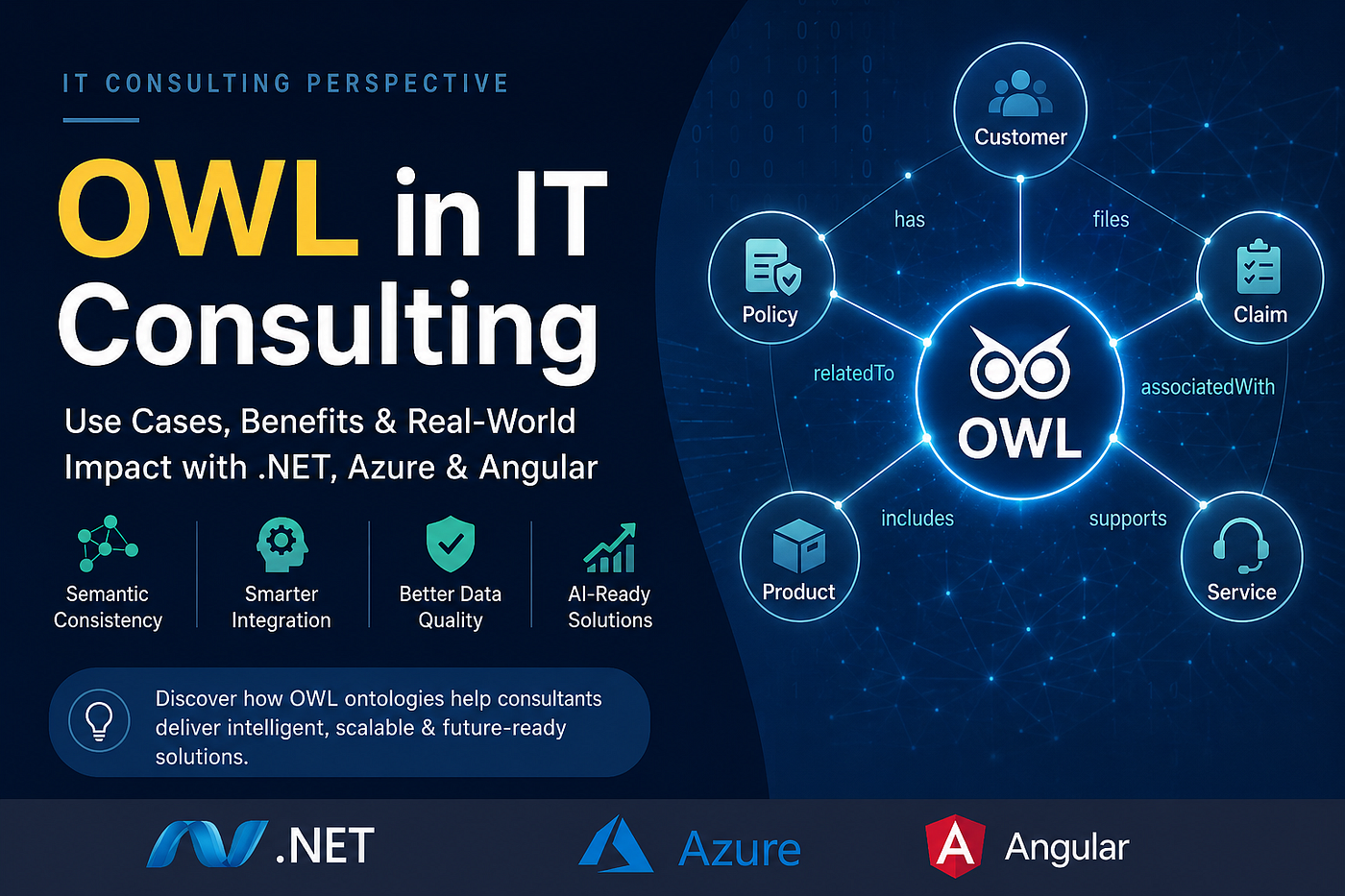
1. Multi-Tenant Insurance Platform (Dot Net + Azure + Angular) Problem: You’re building a multi-tenant insurance platform on Microsoft Azure where:
- Each tenant (carrier) has different rules
- Different naming conventions (PolicyHolder vs Customer)
- Different validation logic
Solution Using OWL Create a shared ontology layer:
- Define core concepts: Policy, Customer, Claim
- Map tenant-specific terms to the common ontology
- Add rules like: “Every Claim must be linked to a valid Policy” “High-risk claims require manual review”
Here,
- .NET APIs → handle CRUD operations
- Azure SQL / Cosmos DB → store transactional data
- OWL Ontology Layer → define relationships + rules
- Angular UI → consumes unified, consistent data
Benefits
- Eliminates data inconsistency across tenants
- Reduces custom logic per client
- Enables faster onboarding of new tenants
- Improves compliance and validation automatically
2. AI-Powered Support Assistant (Consulting Accelerator) Problem: Clients want AI bots, but:
- Data is scattered
- Context is missing
- Answers are inconsistent
Solution Using OWL Use OWL to build a domain knowledge base:
- Model entities: Issue, Service, Resolution
- Link historical tickets and solutions
- Feed this into AI assistant
Example User asks:
“Why is my payment failing?” OWL helps AI understand:
- Payment → Service
- Service → Known Issues
- Issue → Resolution
Benefits
- Improves AI response accuracy
- Reduces support ticket volume
- Creates reusable knowledge assets
- Differentiates your consulting offering
Conclusion
OWL is a powerful language that enables machines to interpret, reason, and connect information intelligently. While it comes with a learning curve and performance considerations, its benefits, especially in AI, enterprise knowledge graphs, and complex domains, are transformative.
As organizations move from “data storage” to “data intelligence,” OWL is becoming an essential tool for modern architects, AI engineers, knowledge graph designers, and researchers.
If your systems need deeper understanding, smarter relationships, and automated reasoning, OWL is worth your attention.
Centric Consulting is an international management consulting firm with unmatched in-house expertise in business transformation, hybrid workplace strategy, technology implementation and adoption. Founded in 1999 with a remote workforce, Centric has established a reputation for solving its clients’ toughest problems, delivering tailored solutions, and bringing deeply experienced consultants centered on what’s best for your business.
Backed by over a decade of offshore IT services experience, Centric India enables seamless collaboration and trusted delivery across global teams.
메타데이터
- post_id
- f5f7b3ec7dd7
- slug
- owl-web-ontology-language-a-practical-guide-to-meaningful-data-modeling-f5f7b3ec7dd7
- url
- https://medium.com/centric-consulting-techxplore/owl-web-ontology-language-a-practical-guide-to-meaningful-data-modeling-f5f7b3ec7dd7
- canonical_url
- https://medium.com/centric-consulting-techxplore/owl-web-ontology-language-a-practical-guide-to-meaningful-data-modeling-f5f7b3ec7dd7
- author_url
- https://medium.com/@nirajtrivedi16
- status
- ok
- fetched_at
- 2026-06-09 15:37:30