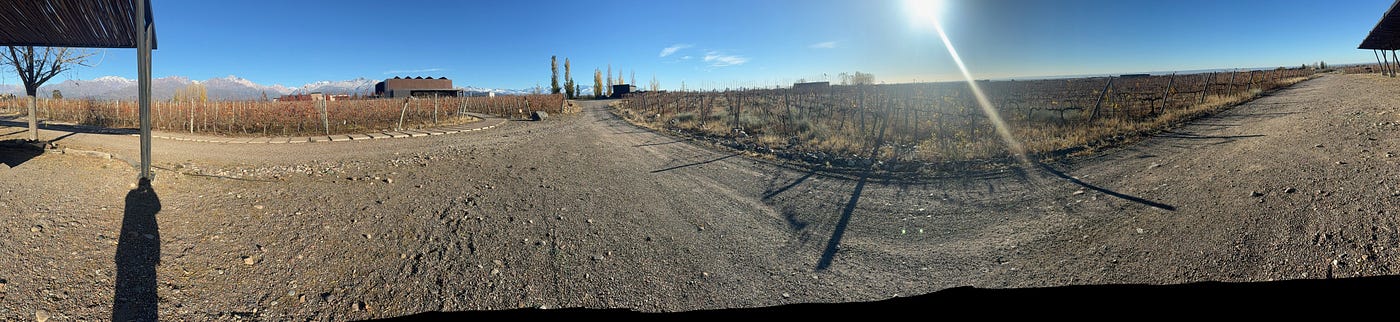
#15 — What I Learned in Argentina (The South City — Plaza de Mayo, San Telmo, La Boca and a Night…
After two weeks of estancias, wine country, and the leafy north end of the city, Day 14 pointed us the other way — south, into the older…
#15 — What I Learned in Argentina (The South City — Plaza de Mayo, San Telmo, La Boca and a Night of Tango)
After two weeks of estancias, wine country, and the leafy north end of the city, Day 14 pointed us the other way — south, into the older, grittier, more historic half of Buenos Aires. Joe Sandillo at Exeter had it on the itinerary as a half-day city tour, 9 to 1, and it ran from the seat of the government to the painted tin houses on the river. Then, after dark, we went and embarrassed ourselves at a tango class. More on that.
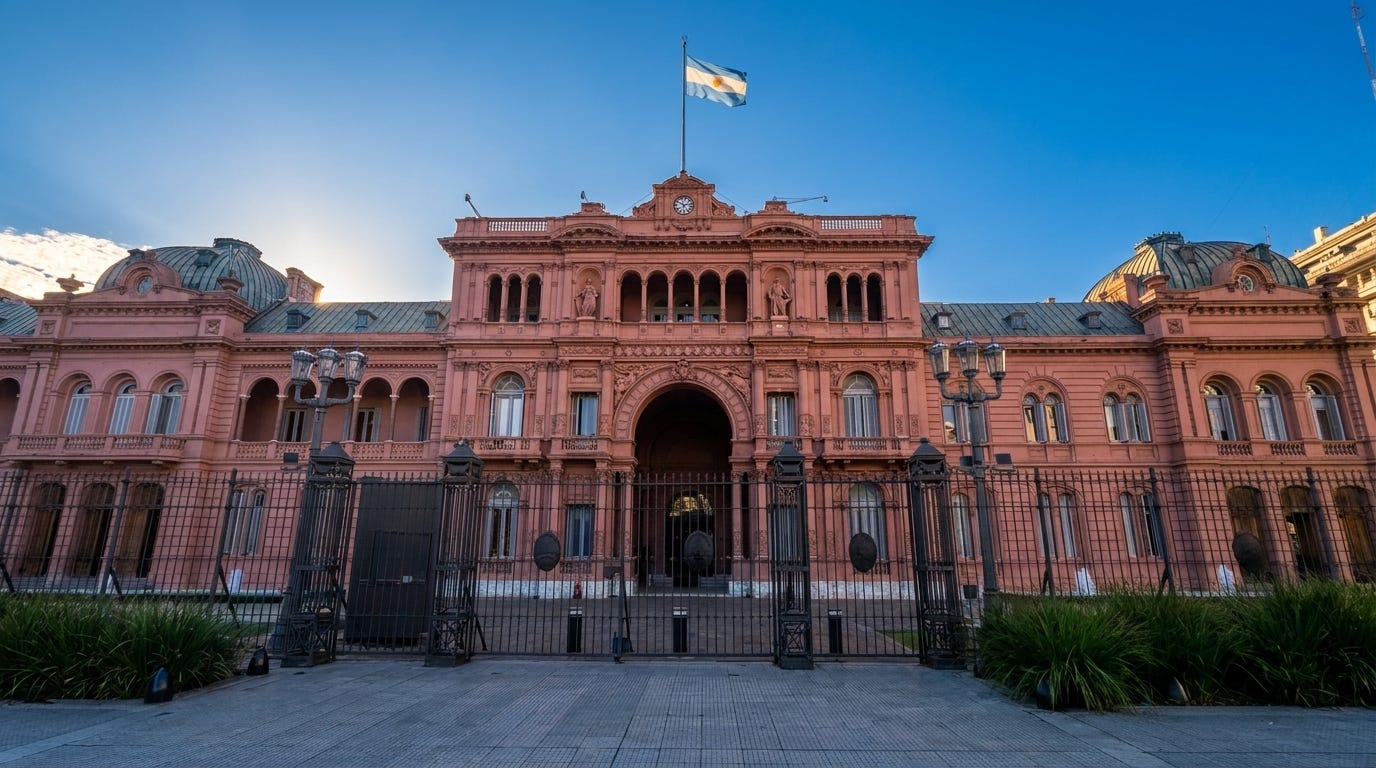
Plaza de Mayo facing the pink Casa Rosada in morning light
Plaza de Mayo
We started where the country starts. The **Plaza de Mayo** is the political heart of Argentina — the square where the 1810 revolution kicked off, where the Madres de Plaza de Mayo have marched for their disappeared children every Thursday for decades, where every protest and celebration in the country’s history seems to have ended up.


Facing the square is the **Casa Rosada*, the Pink House — the presidential office, and yes, the balcony from Evita*. The color is the thing everyone asks about. The usual story is that a 19th-century president had it painted pink to split the difference between the two warring political factions, the red Federalists and the white Unitarians. The better-documented version is that the original paint was mixed with ox blood to waterproof it, which gave it the rosy tone. Take your pick.


The honest detail I didn’t expect: the whole front of the palace was fenced off behind steel security barriers, and the barriers were plastered with political posters and graffiti — anti-fascist broadsides, slogans, faces. It’s a working seat of power in a country with a loud, ongoing argument about itself, and nobody bothers to pretend otherwise. I liked that more than a swept-clean plaza.


Right off the square we ducked into the **Catedral Metropolitana* — the main cathedral of Buenos Aires, where General San Martín’s tomb sits and where Pope Francis served as archbishop before Rome. From the plain neoclassical front, like a Greek temple dropped on the corner, you’d never guess the inside: an enormous gilded barrel-vaulted nave under a painted dome, the words EGO VICI MUNDUM* (“I have overcome the world”) ringing the cupola.
San Telmo
From there we walked into **San Telmo** — the oldest neighborhood in the city, cobblestone streets, antique shops, the faded grandeur of mansions the rich abandoned when yellow fever pushed them north in the 1870s. The poorer immigrants moved into the leftover palaces, and the neighborhood has kept that lived-in, slightly worn texture ever since.
The anchor is the **Mercado de San Telmo**, the covered market that’s been running since 1897 under a beautiful wrought-iron and glass roof. Half of it is still a real food market and half is antiques and tourist stalls, and the whole thing hums. They’d set up long communal tables down the central aisle under the old ironwork.


We came out at **Plaza Dorrego, the little square that turns into the famous antiques fair on Sundays and hosts open-air tango the rest of the week. There’s a heritage plaque on the corner marking the [Bar Plaza Dorrego](https://en.wikipedia.org/wiki/Plaza_Dorrego) and the silver workshop of [Juan Carlos Pallarols](https://en.wikipedia.org/wiki/Juan_Carlos_Pallarols)**, the master silversmith whose family has hammered out ceremonial batons for Argentine presidents for generations. Defensa 1094, if you want to find it.

We also stepped into the neighborhood’s namesake church, the **Parroquia San Pedro Telmo** — one of the oldest in the city, begun by the Jesuits in the 1730s — a grand interior with a checkerboard tile floor running back under a pale dome.


La Boca and Caminito
Then the tour did the thing every Buenos Aires tour eventually does, and took us down to **La Boca** — the old port neighborhood at the mouth of the Riachuelo, where the Italian immigrants from Genoa first landed and built their houses out of corrugated tin and leftover ship paint. That’s why the houses are every color at once: the shipyards gave out the dregs of whatever paint was left, so people patched their walls in mismatched panels, and the neighborhood turned its poverty into its signature.


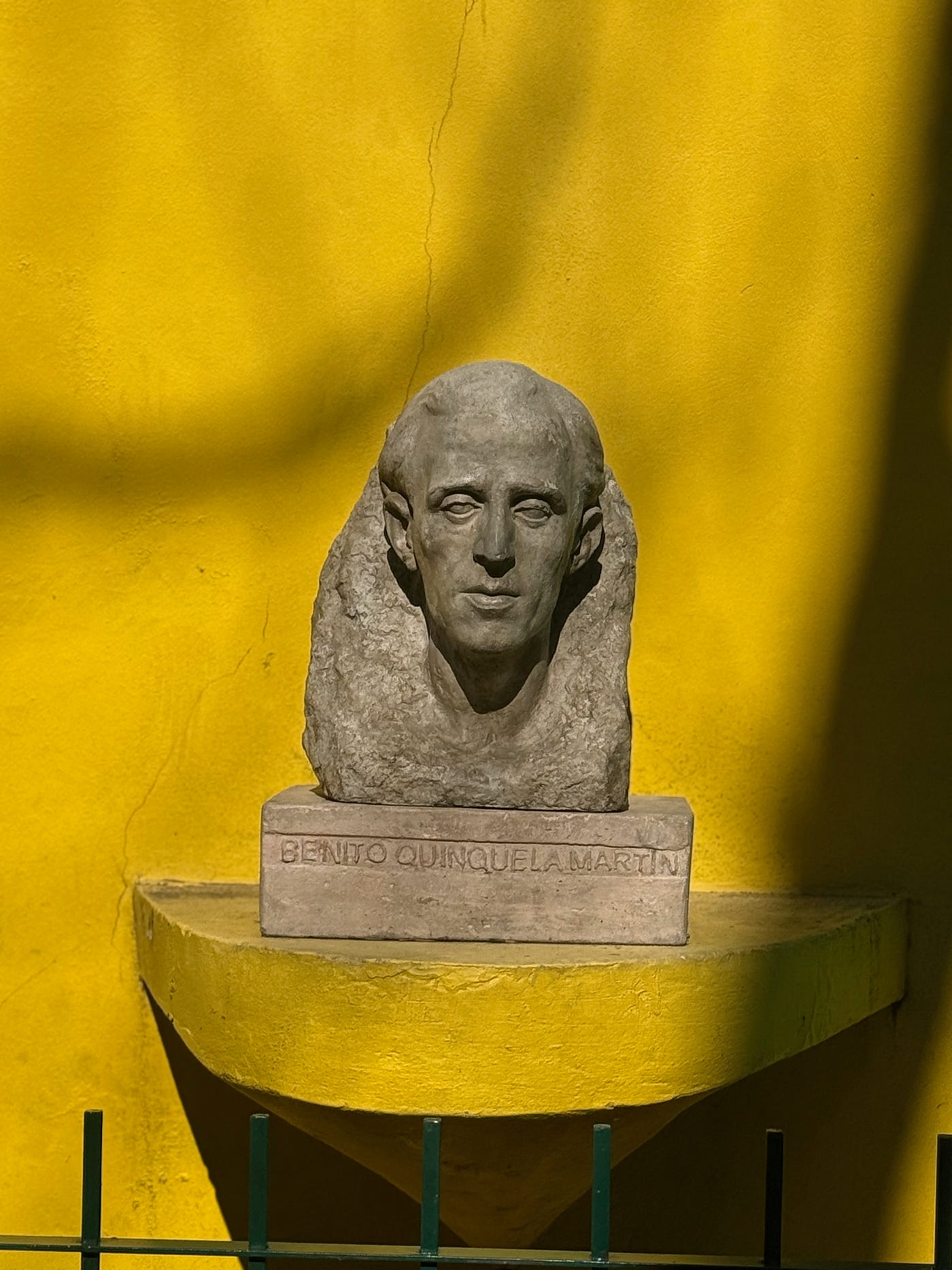


The patron saint of all this is **Benito Quinquela Martín**, La Boca’s own painter — an orphan who grew up in the neighborhood, made his name painting the dockworkers and the port, and then poured his money back into the place, building a school and a museum. His bust sits on a yellow wall in the middle of it all.
His subject — the laborers of the port — is painted all over the walls down here, relief murals of bare-chested men hauling rope and coal against the skyline of the docks. It’s the neighborhood telling its own working-class origin story to itself.
This is also where I’ll keep the doors thread honest. Regular readers know I can’t get through one of these trips without the doors and entryways grabbing me — it happened in Saudi, it happened all over Japan, it happened in Palermo. La Boca is the loudest version yet: there are no quiet carved doors here, just whole housefronts thrown together in clashing painted panels, every surface a color. The neighborhood treats the building itself as the canvas.

San La Muerte
And then the part the tour doesn’t always slow down for. Tucked under a tree off the main drag I found a folk shrine — a small red roadside chapel crowded with offerings, a skeletal figure in a hood standing in the back. That’s **San La Muerte**, Saint Death, a folk saint the Catholic Church wants nothing to do with but plenty of people quietly keep faith with.
That wrapped the tour around 1 p.m. We headed back to **Mio Buenos Aires** to clean up before the Tango events for the evening.
Tango!
You cannot come to Buenos Aires and skip the **tango. It would be like going to New Orleans and skipping the music. So the evening was a tango night — a [milonga](https://en.wikipedia.org/wiki/Milonga_(dance_event))** (which is what they call the social dance gathering, and the venue, and a related dance, all at once) with a private lesson built in beforehand.
The lesson came first. We headed to a private residence with a mirrored studio with wood floors, a real instructor (Gustavo Braña, our guide) and the dawning realization that tango is much, much harder than the dancers make it look. There’s a hat involved — I wore one — and Mary had a red flower in her hair and a pair of yellow dance shoes, and we did our genuine best. I won’t claim we were good. I will claim we were game.

The venue had a small museum of **bandoneóns** — the squeezebox that gives tango its sound, a German instrument that somehow drifted across the Atlantic and became the most Argentine thing imaginable — lit up in glass cases on a checkerboard floor.


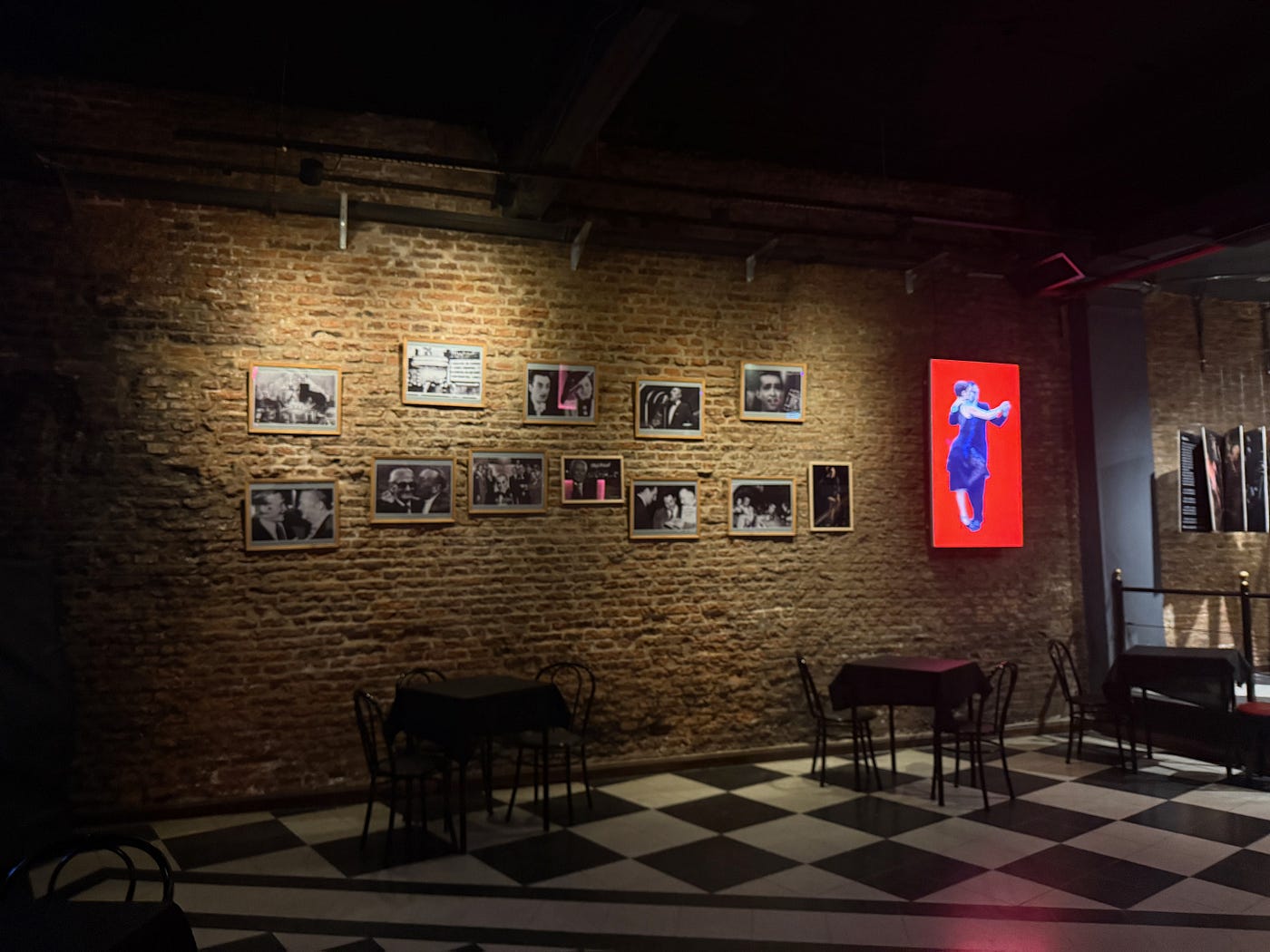
Then the show, or really the milonga proper — a dim red room, a live orchestra at the back, and the floor filling with couples who actually knew what they were doing, moving in that tight, fast, dead-serious way that made our afternoon lesson feel like exactly what it was. We had dinner, we watched, and once or twice we got pulled up to try it for real. It’s a humbling, wonderful thing to watch people do something that well in the place they invented it.
[embed]A live orchestra at the back and they are amazing musicians!
A whole city in one day, top to bottom: the seat of power, the oldest streets, the painted port, and a dance floor at midnight. The south end of Buenos Aires earns its reputation.
Next Story…
메타데이터
- post_id
- f5fd8bb3e644
- slug
- 15-what-i-learned-in-argentina-the-south-city-plaza-de-mayo-san-telmo-la-boca-and-a-night-f5fd8bb3e644
- url
- https://medium.com/@larouex/15-what-i-learned-in-argentina-the-south-city-plaza-de-mayo-san-telmo-la-boca-and-a-night-f5fd8bb3e644
- canonical_url
- https://medium.com/@larouex/15-what-i-learned-in-argentina-the-south-city-plaza-de-mayo-san-telmo-la-boca-and-a-night-f5fd8bb3e644
- author_url
- https://medium.com/@larouex
- status
- ok
- fetched_at
- 2026-07-10 03:02:36