Ukraine’s First Amphibious Landing of a Ground Drone
Russia’s defences are now being challenged in many ways unthought of four years ago as Ukraine’s military and naval innovations keep Moscow…
Ukraine War
Ukraine’s First Amphibious Landing of a Ground Drone
Russia’s defences are now being challenged in many ways unthought of four years ago as Ukraine’s military and naval innovations keep Moscow on the back foot
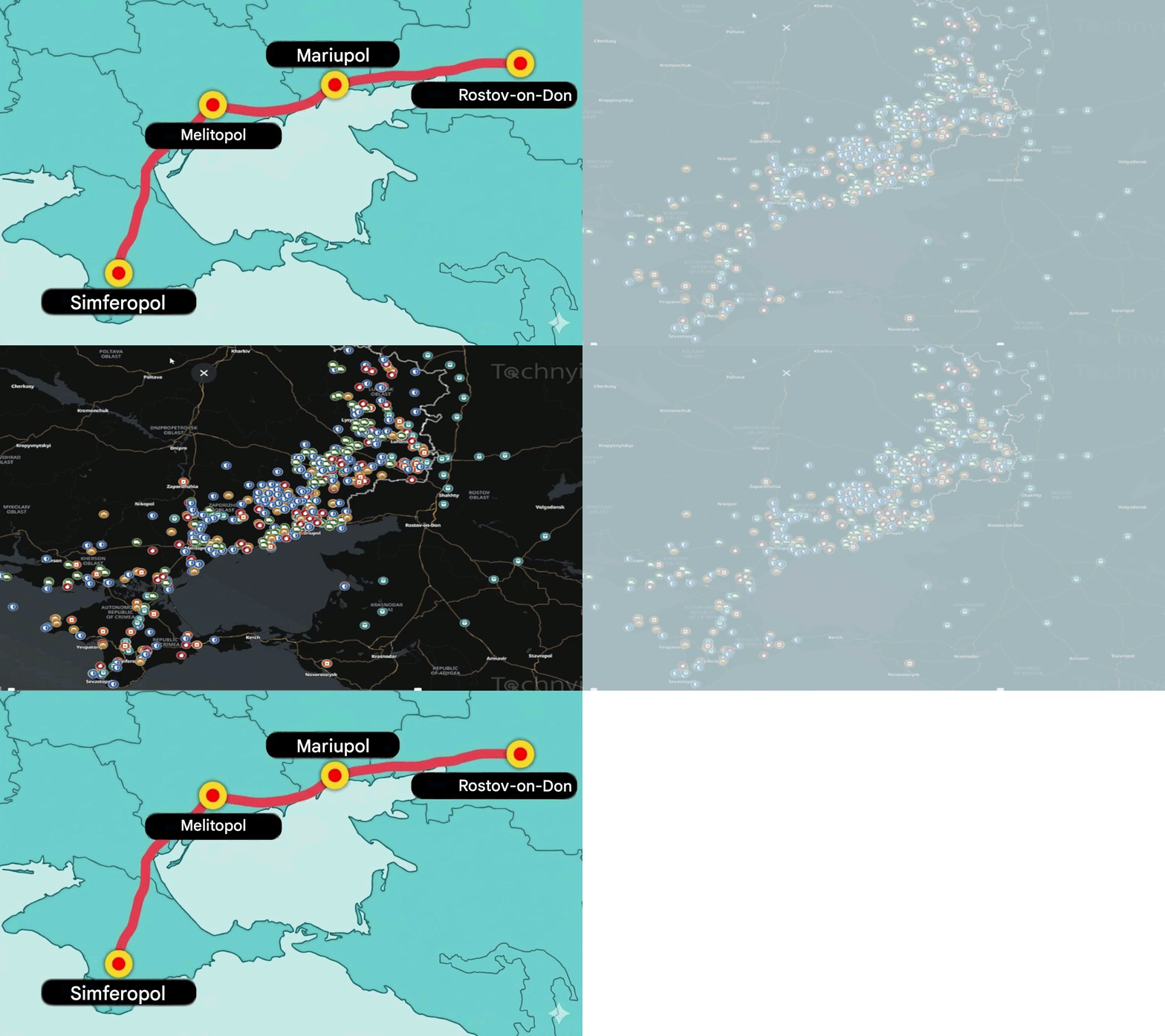
Site of Ukrainian amphibious landing using a drone LCT to land a ground drone. Image: Roman Sheremeta on Twitter
The 123rd Territorial Defense Brigade of the Ukrainian armed forces has conducted an operation that marks a development in maritime and ground-based tactical manoeuvres.
Operators navigated an unmanned landing craft across the Black Sea to the occupied Kinburn Spit. On arrival, the platform deployed a ground robot which then advanced behind Russian lines. This mission represents a shift in how automated systems are utilised to project force into denied territory and opens up major possibilities for amphibious assaults.
It appears from video analysis that the landing probably happened shortly after moonrise.
The design challenge
The primary obstacle for the Ukrainian forces involved the transition from a maritime environment to a terrestrial one. Moving hardware across the Black Sea requires a vessel capable of navigating open water while remaining undetected by surveillance systems.
The Kinburn coast presents a difficult environment for landing operations due to its geography and the presence of Russian defensive positions. The integration of a maritime delivery vehicle with a ground-based asset demanded a secure mounting and deployment mechanism. Engineers had to ensure the vessel remained stable during the approach and that the ramp or release system for the ground drone functioned in shallow, potentially unstable coastal waters.
Ensuring consistent communication between the operators and the platforms across the expanse of the Dnipro estuary required reliable data links to prevent the loss of the assets before they could complete the mission objectives.
Significance of the Kinburn Spit
The Kinburn Spit is a strategically vital sandy peninsula in southern Ukraine, positioned between the Dnipro-Buh estuary and the Black Sea. Its control has been significant throughout the conflict because it overlooks critical shipping routes, allowing occupying forces to obstruct maritime access to the vital ports of Mykolaiv and Kherson.
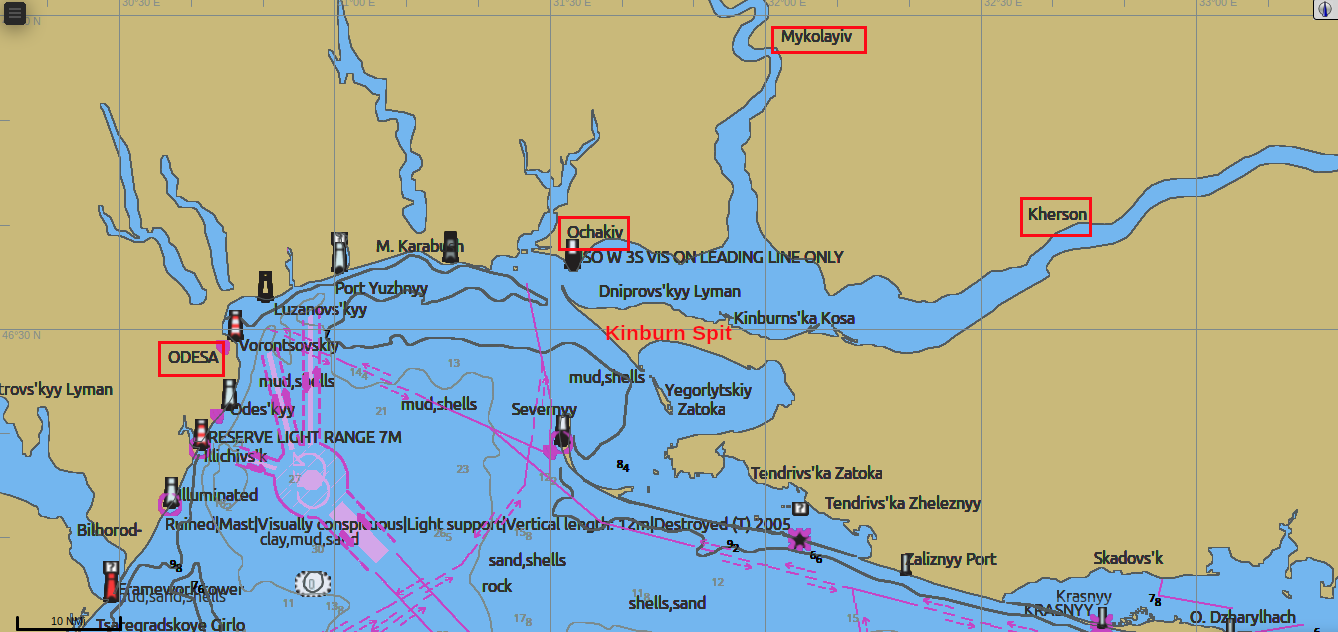
Kinburn Spit location. Screenshot from author’s nautical chart with overlay.
The spit is located about eight miles directly across the Dnieper-Bug estuary from the Ukrainian-held city of Ochakiv. This narrow strait is the primary area of friction. It is generally shalloe with depths of less than five metres except in the central shipping channel with depths typically 8–10 metres.
Kinburn is the westernmost portion of a larger peninsula. Its landward connection to the Russian-occupied left bank of the Kherson region is the primary route for Russian logistics, which have been a consistent target of Ukrainian interdiction efforts.
The spit has served as a launch point for Russian artillery and electronic warfare, enabling strikes on southern Ukrainian coastal cities and has become a testing ground for innovative multi-domain operations involving unmanned maritime and ground robotic systems.
The LCT (landing craft)
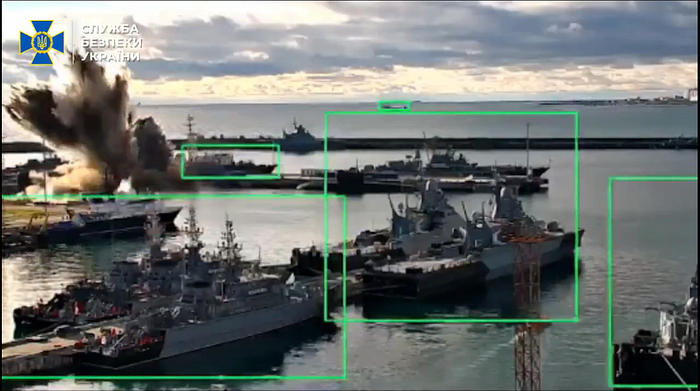
The vessel used for this operation acted as an autonomous landing craft, designed for low visibility and ease of operation. The design prioritises a shallow draft, which allows the craft to approach the shoreline without grounding itself prematurely. There are tides in the Black Sea but they are insignificant. Nevertheless the landing site would have to be carefully chosen for the LCT to run its landing ramp on to the beach without grounding its propeller(s).
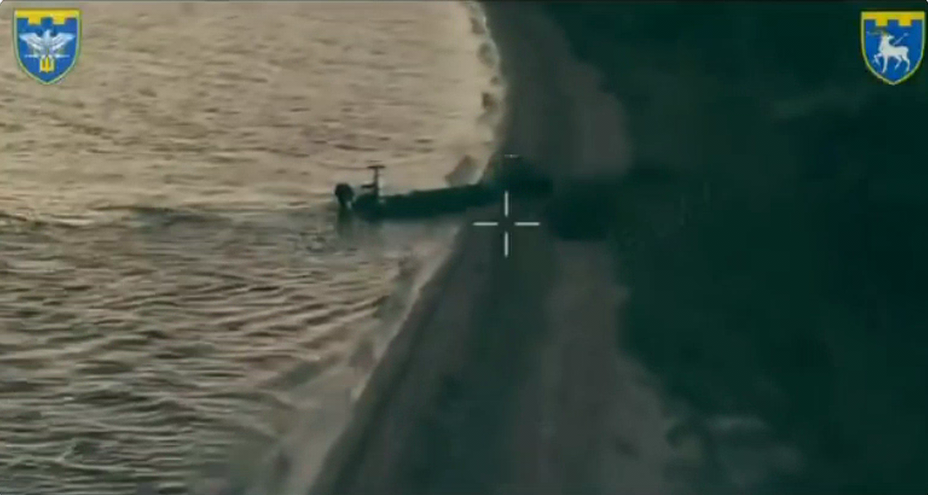
Screenshot from video (link at end)
Its construction focuses on modularity, enabling the carriage of diverse payloads. By using this platform, Ukrainian forces reduced the risk to human personnel who would otherwise be required to conduct a landing in a contested zone.
The craft relies on remote guidance, allowing operators to remain at a distance from the front line while directing the approach. The success of the assault indicates that these maritime platforms possess the range and endurance to traverse the necessary distance to reach the southern coast from secure Ukrainian positions.
It also indicates that Russian radar (if any) was unable to detect it during the ten mile passage, which would have taken about an hour, perhaps less.
The ground drone
The unmanned ground vehicle (UGV) delivered to the shore is a tracked vehicle built for traverse in varied terrain, such as the sandy and marshy conditions found on the Kinburn Peninsula. The drone is reported to be a member of the Rys family of robotic systems, produced by the Ukrainian company Roboneers.
Rys drone (UGV). Pic : Ukraine MoD
Visual analysis of the equipment used in this mission indicates it is a Rys-series platform. These systems are frequently utilised by Ukrainian forces for a variety of tasks, including logistics, casualty evacuation, and combat support.
Its tracks provide the necessary traction to move through soft ground, while its low profile reduces its radar and visual signature. Once deployed from the landing craft, the drone operates independently of the maritime vessel, moving inland to perform its surveillance or offensive tasks. Its capacity to travel behind enemy lines demonstrates the utility of small, unmanned systems in disrupting defensive perimeters.
Armament
In the operation on the Kinburn Spit, the vehicle was equipped with a PKT machine gun. The military did not officially identify the specific model. These are originally of Soviet design by Kalashnikov and they are plentiful in Ukraine. It is a belt-fed general-purpose machine gun, chambered for the 7.62×54mmR rimmed cartridge.
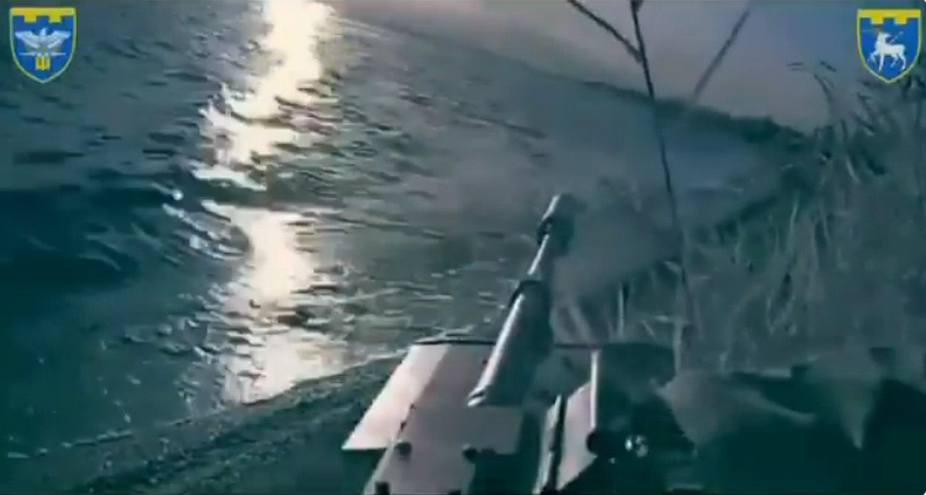
Video screenshot of Rys UGV armament.
The control of the weapon system occurs remotely, with cameras providing the operator with a view of the target area. In the case of this Kinburn ‘test’ assault, the signal range is likely to have been about ten miles, within reasonable line of sight over water with an elevated base station aerial or further inland with a relay. Certainly the reasonable colour quality and definition of the observation drone signal indicates no problems, and of course the observation drone may itself have had relay capabilities (observation video at end of story).
Implications
This mission highlights the broader trajectory of Ukrainian military innovation, which increasingly relies on the seamless integration of unmanned systems across air, sea, and land domains.
The ability to coordinate a maritime drone to ferry a ground asset onto occupied territory suggests that future tactical operations will place a premium on modular, multi-domain robotic teams. By removing the soldier from the initial assault phase, commanders can pursue aggressive objectives in high-threat environments where the cost of human life would otherwise be prohibitive.
The operation highlights the growing decentralisation of tactical authority, as small, specialised units leverage commercial and modified technology to bypass traditional defensive architectures.
As Ukraine continues to scale its production of ground robotic systems, the deployment of such platforms behind enemy lines may evolve from a bespoke, high-visibility operation into a standard tactical practice, forcing adversaries to contend with an unpredictable, persistent, and automated threat throughout the depth of their occupied zones.
[embed]
메타데이터
- post_id
- f601da43004d
- slug
- ukraines-first-amphibious-landing-of-a-ground-drone-f601da43004d
- url
- https://medium.com/the-dock-on-the-bay/ukraines-first-amphibious-landing-of-a-ground-drone-f601da43004d
- canonical_url
- https://medium.com/the-dock-on-the-bay/ukraines-first-amphibious-landing-of-a-ground-drone-f601da43004d
- author_url
- https://medium.com/@james-marinero
- status
- ok
- fetched_at
- 2026-07-16 20:04:03