Chasing Pink Horizons
Exploring the path less travelled.
Chasing Pink Horizons
This March, I found myself back in Jaipur on a work trip after a long interval. Thanks to Air India, a rescheduled flight left me with twelve unexpected hours to spare before returning to Mumbai. Rather than surrendering to familiar sights and well worn itineraries, I felt an urge to wander farther afield.
I wanted something quieter and more contemplative, a place that promised discovery rather than repetition. Sambhar Lake, long postponed by the tyranny of time, and practical constraints, finally seemed within reach. Sitting a few hours away from Jaipur, it is a place spoken of with curiosity but rarely acted upon.
With time finally in my favour, hesitation dissolved and before sunrise, I set off with two office colleagues. Cruising along the Delhi Jaipur highway before branching off into a rustic stretch lined with dusty village roads, we arrived in Sambhar town, gateway to India’s largest inland salt lake.

Sambhar Lake is widely known for its salt production, contributing nearly ten percent of India’s total output, with large scale extraction typically beginning after March.
Apart from its economic importance, the lake is ancient and steeped in geological mystery, with two prevailing theories explaining its origin. The first suggests that Sambhar is a remnant of the prehistoric Tethys Sea, trapped when the Gondwana landmass collided with the Eurasian plate millions of years ago, leaving behind a naturally saline body of water. A second, more widely accepted theory proposes that the lake was once freshwater and gradually turned saline due to climatic shifts, declining rainfall, desertification, and winds carrying mineral salts into the basin. The drying up of perennial rivers that once fed the lake accelerated this transformation, which explains why the salt produced here is non marine in nature.
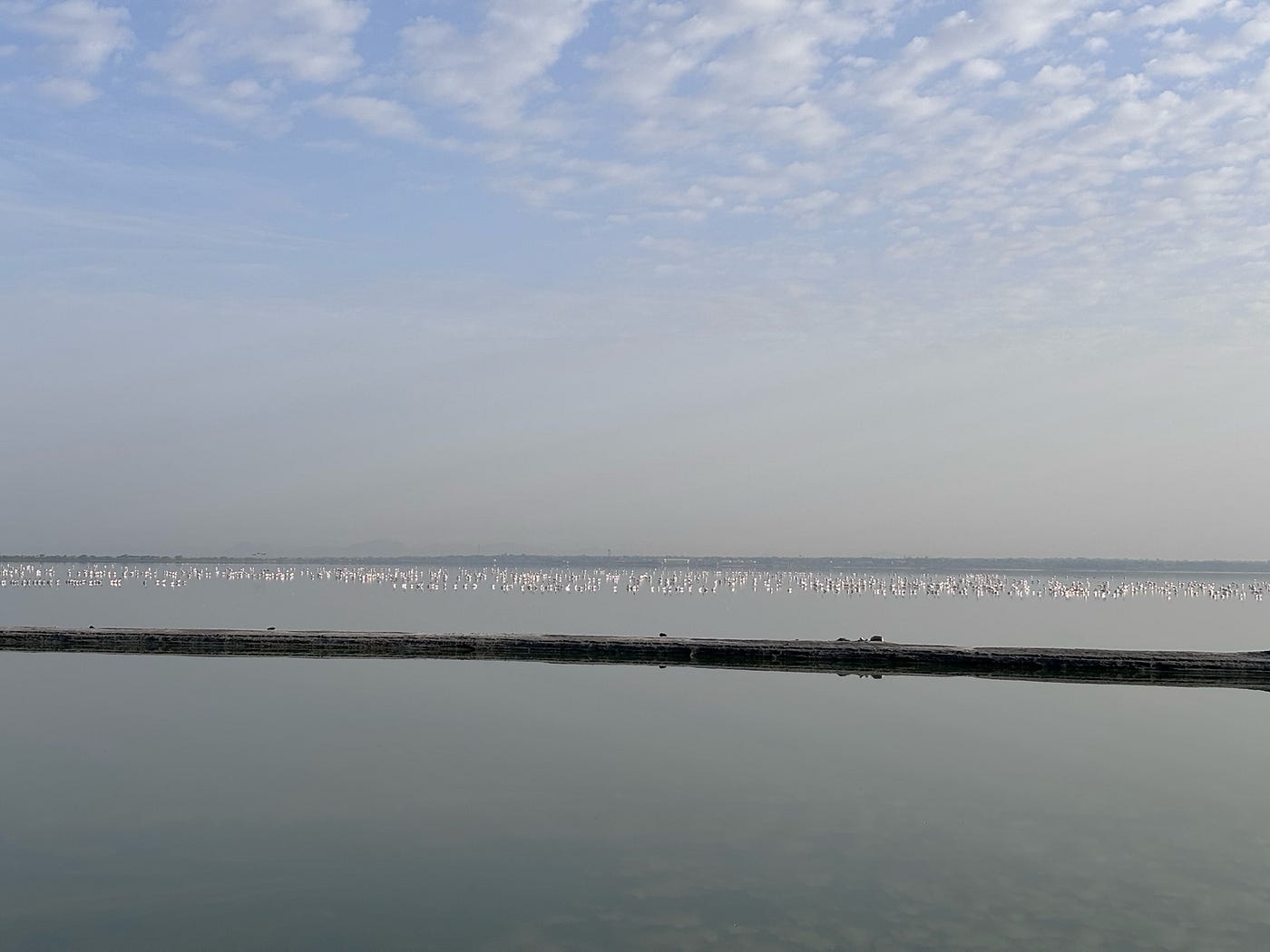
The first glimpse of the lake was humbling. A vast white expanse stretched endlessly, quietly asserting its presence. Yet, it was not the lake itself that would hold me spellbound. It was the flamingoes. As we edged closer, hundreds soon turned into thousands. They stood clustered in the shallow waters, their soft pink bodies forming living brushstrokes across the muted landscape. Moments later, many took flight in unison, wings slicing through the air in slow, deliberate rhythm. Watching them move felt almost meditative, as if time had slowed to match their grace.

Flamingoes have a strange way of captivating attention. There is elegance in their stillness and poetry in their movement. At Sambhar, they seemed entirely at ease, feeding calmly in the saline waters, seemingly unbothered by our quiet presence. Their colour shifted with the light, from pale blush to deeper rose, reflecting not just sunlight but mood. Standing there, I realised how little effort nature needs to leave a lasting impression. It does not demand anything, only patience and presence.
Sambhar Lake is among the most important winter habitats for flamingoes in India, second only to the Rann of Kutch. Every year, thousands arrive here along the Central Asian Flyway, drawn by abundant food like algae and brine shrimp, shallow water for feeding, and safe resting grounds. Storks, pelicans, ducks, and sandpipers share the wetland, but the flamingoes reign supreme, commanding attention without noise or drama.

As we walked carefully over the cracked earth, the lake felt deserted apart from the birds. The silence was broken only by soft calls and the occasional flap of wings. At one point, we watched a lively cluster of flamingoes feeding together, splashing water and calling out, a scene that felt almost celebratory in its joy. It was impossible not to smile.

Beyond its beauty, Sambhar Lake is steeped in legend. Ancient texts associate it with the Mahabharata, while local lore speaks of Shakambhari Devi, the Chauhan clan goddess who is believed to have transformed the land into a shimmering lake. Temples dedicated to Shakambhari Devi and Devayani still stand near the shores, their weathered stones echoing centuries of faith and folklore.
Travel often inspires through grand monuments and thrilling adventures, but sometimes its greatest gift is perspective. Sambhar reminded me that stepping off the usual path opens space for quiet wonder. Watching the flamingoes, unhurried and perfectly at home, I felt grounded in a way no sightseeing checklist could offer. In those stolen hours, travel became less about reaching somewhere new and more about reconnecting with a sense of awe that modern life so easily dulls.
-chalatmusafir (HD)
메타데이터
- post_id
- f6047c7deaa5
- slug
- chasing-pink-horizons-f6047c7deaa5
- url
- https://medium.com/@chalatmusafir/chasing-pink-horizons-f6047c7deaa5
- canonical_url
- https://medium.com/@chalatmusafir/chasing-pink-horizons-f6047c7deaa5
- author_url
- https://medium.com/@chalatmusafir
- status
- ok
- fetched_at
- 2026-06-22 05:41:33