Cloud Infrastructure for iGaming: Balancing Performance, Security, and Cost
iGaming is one of the most demanding cloud environments in any industry. Traffic is volatile by design — a major football match or a large…
Cloud Infrastructure for iGaming: Balancing Performance, Security, and Cost
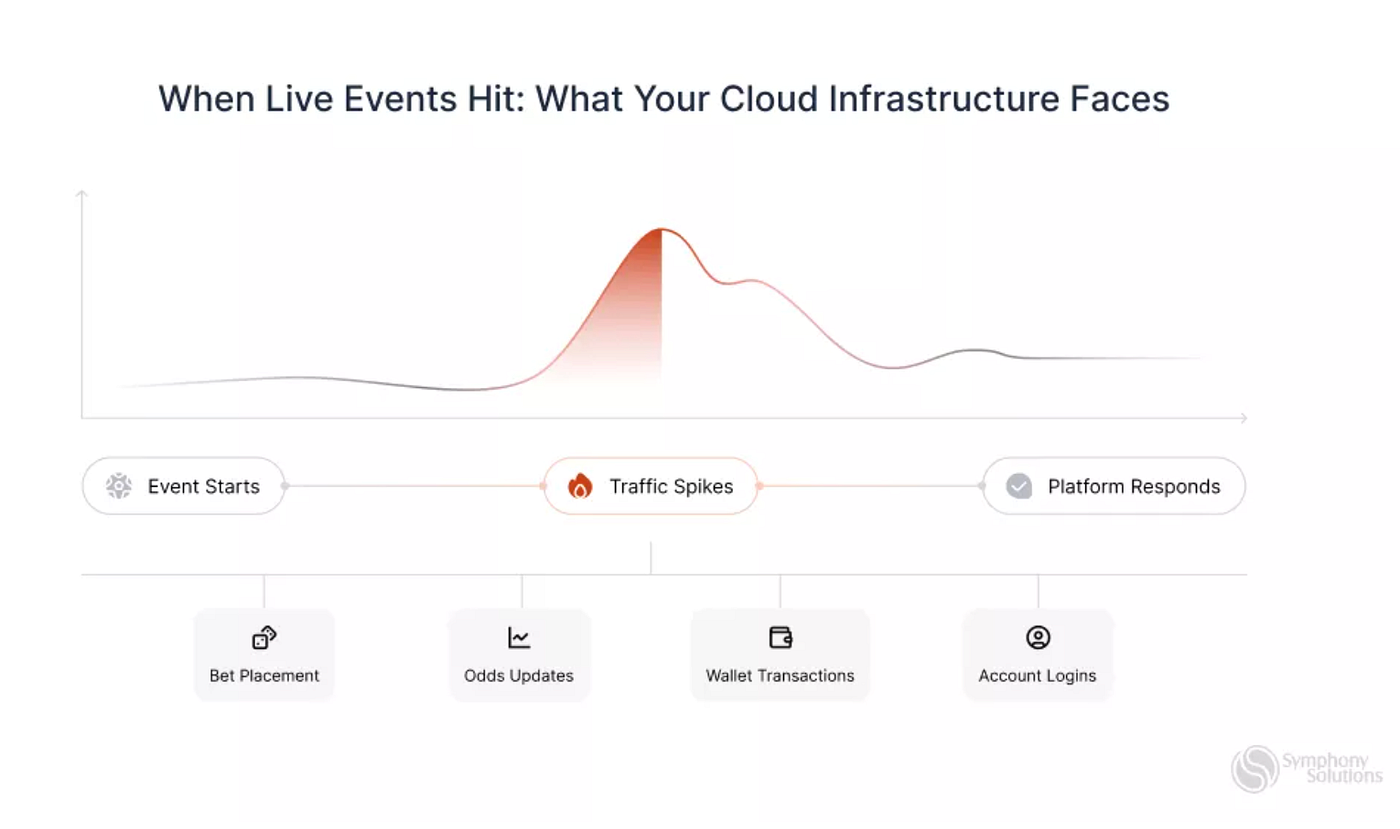
iGaming is one of the most demanding cloud environments in any industry. Traffic is volatile by design — a major football match or a large casino promotion can drive a sharp spike in concurrent sessions, bet placements, wallet transactions, and account logins within minutes. Regulatory requirements vary by jurisdiction and affect where data lives, how it moves, and what operators must prove to licensing authorities. And the cost of getting the infrastructure wrong compounds over time: wasted capacity that was never needed, security incidents from misconfigured access, or performance degradation at precisely the moments when player trust is highest.
Cloud infrastructure in iGaming isn’t a background function. It determines what the platform can do, what it costs to run, and whether it holds together under pressure.
Performance: Designing for Volatility, Not Average Load
The fundamental challenge in iGaming cloud design is that average load is misleading. Platforms run quietly for most of the day, then absorb 5–10× normal traffic during a Champions League match or a major promotional window — and then return to baseline. Infrastructure designed for average conditions will fail at peak. Infrastructure designed for permanent peak will waste capital the other 22 hours.
Autoscaling is the mechanism that resolves this tension, but only when configured correctly. Scaling policies need to be based on real traffic patterns from historical events — not theoretical benchmarks. Warm capacity must be available to absorb sudden spikes before the scaling layer catches up. Load balancing across availability zones prevents a regional surge from saturating a single cluster.
Regional deployment is the second essential dimension for live-betting performance. Latency in a real-time betting environment isn’t just a user experience issue — it’s an operational risk. Delayed odds refresh or slow bet confirmation creates doubt. Doubt reduces stake size and betting frequency. Even 200–300ms of avoidable latency, compounded across millions of in-play events, has measurable revenue impact. Deploying services close to target users, using CDN and edge delivery for cacheable content, and using private connectivity between critical services are the architectural choices that keep latency stable as demand scales.
Containerization and distributed systems make performance sustainable as the platform grows. Containerized workloads are easier to deploy, scale, and recover. Distributed services prevent excessive dependence on any single node or availability zone. Together, they allow operators to isolate high-demand components, recover from partial failures cleanly, and deploy updates without service interruptions — all of which matter during live events when any disruption is immediately visible to players.
Security: What iGaming Cloud Environments Must Get Right
iGaming platforms process sensitive data at high volume: player identity records, payment credentials, transaction histories, account balances, and behavioral data tied to regulatory risk profiles. The security posture of the cloud environment has direct compliance, financial, and reputational consequences.
Data and transaction protection starts with consistent encryption across storage, processing, and transfer — and with strict access control that limits who and what can touch financial-critical systems. Wallet services, payment gateways, and settlement infrastructure should operate inside tightly governed environments with minimal surface area, logged administrative access, and clear separation from development or third-party integration workloads. The principle is straightforward: systems that sit close to money and identity data deserve the strictest access controls in the environment.
Regulatory compliance often drives cloud architecture choices as much as technical requirements do. GDPR data residency requirements determine which regions workloads can run in. Local gambling authority rules define logging obligations, audit readiness standards, and data retention requirements. Jurisdiction-specific requirements around KYC verification, AML transaction monitoring, and responsible gambling tooling all have infrastructure implications — they affect how systems are deployed, how data flows between services, and what operators must be able to demonstrate to regulators on demand.
The critical operational principle: cloud providers manage their layer of the shared responsibility model. Operators own workload configuration, access policy, monitoring design, and compliance execution inside their environments. That line cannot be blurred.
Monitoring, observability, and incident response close the security loop. A security posture without visibility is not a posture — it’s a hope. Continuous monitoring should cover access activity, configuration changes, unusual traffic patterns, suspicious transaction behavior, and anomalies in third-party integrations. Observability means teams can trace events across services and understand root causes, not just detect that something went wrong. And incident response procedures — including defined ownership, escalation paths, tested recovery playbooks, and validated backups for systems tied to balances and transaction history — should exist before an incident occurs, not be assembled during one.
Cost: Matching Spend to How iGaming Actually Behaves
Cloud costs in iGaming accumulate quietly. Instances that were provisioned for peak stay running at baseline. Non-production environments keep consuming resources after the sprint ends. Storage grows without review. The traffic model changes, but the infrastructure model doesn’t change with it.
The correction isn’t a one-time exercise. It requires embedding cost discipline into how the platform is operated, not just how it was originally configured.
Avoiding overprovisioning means treating peak capacity as peak capacity — elastic, temporary, and expensive by design — rather than locking it into the baseline environment. The contrast between live-event load and everyday load in iGaming is stark enough that permanent over-provisioning is a significant and recurring cost. Regular instance right-sizing, scheduled shutdowns for non-production environments, and clear retention policies for logs and backups are the operational habits that prevent this accumulation.
FinOps practices give this discipline organizational structure. In iGaming, cloud spend is influenced by engineering decisions, product launches, new market entries, and major sporting events — meaning finance teams can’t govern it alone. Giving each functional team visibility into its own cloud consumption, tracking cost patterns before and after live events, and connecting infrastructure spend to specific business activities makes optimization concrete and continuous rather than reactive and periodic.
Workload segmentation aligns spend with operational priority. Stable, always-on workloads — core player account infrastructure, compliance-sensitive systems, payment processing — are the right candidates for reserved or committed capacity. Burst-driven workloads tied to live events should rely on elastic scaling rather than permanently provisioned headroom. Lower-priority services should not consume the same infrastructure tier as revenue-critical ones.
The workloads that operators should protect from aggressive cost optimization are clear: wallet services, payment infrastructure, compliance systems, and monitoring. These support core platform operations and need stable performance and governance. Savings opportunities live in unused resources, weak sizing discipline, storage sprawl, and idle non-production environments — all of which can be addressed without touching the systems that matter most.
The Balance Point
Performance, security, and cost in iGaming cloud infrastructure are not independent variables. Traffic spikes affect scaling policies, which affect spend. Compliance requirements affect workload placement, logging design, and region strategy. Security controls affect architecture choices that in turn affect latency and cost.
The operators who get this right don’t treat infrastructure as a background function that engineering maintains and finance reviews quarterly. They treat it as part of the platform — designed deliberately for how iGaming actually behaves, governed continuously, and evolved as the business grows.
A cloud environment that scales reliably under live-event pressure, meets regulatory requirements across multiple jurisdictions, and keeps costs aligned with actual usage isn’t just an operational achievement. It’s a competitive one.
Originally based on insights from Symphony Solutions https://symphony-solutions.com/insights/cloud-infrastructure-igaming-performance-security-cost
메타데이터
- post_id
- f611dc441aca
- slug
- cloud-infrastructure-for-igaming-balancing-performance-security-and-cost-f611dc441aca
- url
- https://medium.com/@symphony-solutions/cloud-infrastructure-for-igaming-balancing-performance-security-and-cost-f611dc441aca
- canonical_url
- https://medium.com/@symphony-solutions/cloud-infrastructure-for-igaming-balancing-performance-security-and-cost-f611dc441aca
- author_url
- https://medium.com/@symphony-solutions
- status
- ok
- fetched_at
- 2026-07-21 10:43:05