Why Fiber Is Becoming as Important as Power for AI Data Centers
Why power alone won’t win the data center site race anymore — and what the data is telling us.
Why Fiber Is Becoming as Important as Power for AI Data Centers
Why power alone won’t win the data center site race anymore — and what the data is telling us.
For the past few years, data center site selection has operated on a single governing principle: find the power. Developers pushed into markets they would have ignored five years ago — secondary cities, rural counties, places without the name recognition of Northern Virginia or Phoenix — simply to get ahead of the queue and lock in megawatt commitments before someone else did.
That logic made sense when power was the binding constraint. It’s becoming insufficient.
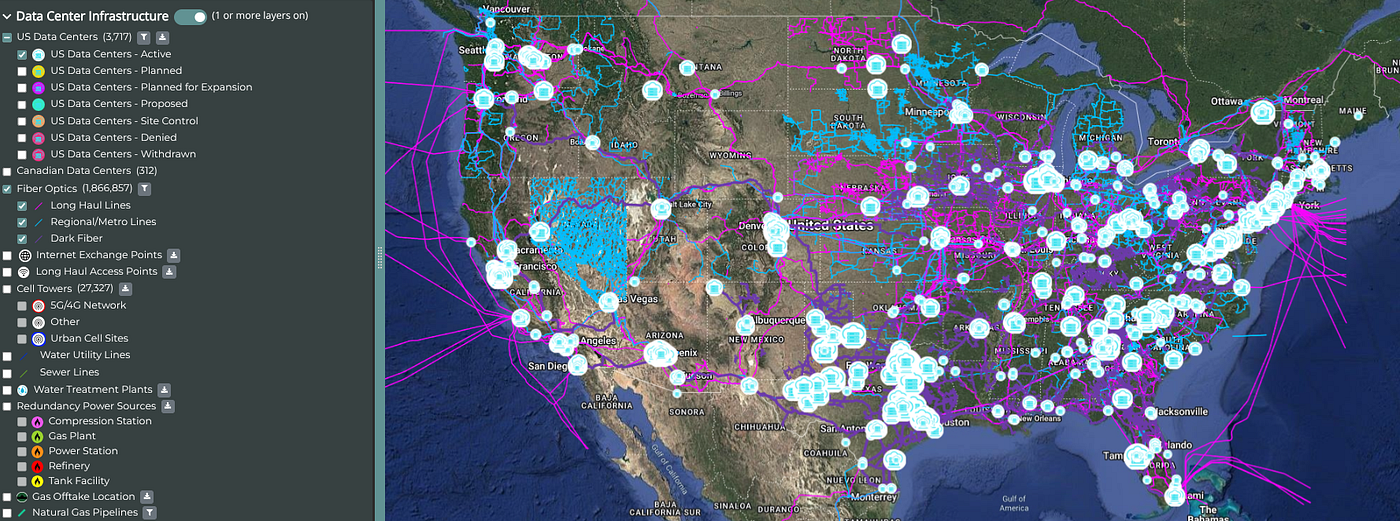
As AI workloads scale and hyperscale deployments grow larger, fiber infrastructure is becoming just as critical as electrical infrastructure in determining whether a site is truly viable. In some markets, access to fiber is beginning to resemble the power constraints developers have spent years navigating. And the imbalance between the two is creating a new infrastructure problem entirely.
At LandGate, we track infrastructure data across the country — substations, transmission capacity, fiber routes, interconnection queues. What the data is showing us is that a second constraint has quietly moved to the front of the line for a lot of data center projects, particularly those being built for AI workloads: fiber. And unlike interconnection queue position, which at least shows up early in due diligence, fiber gap costs have a habit of surfacing late, oftentimes after the land is under contract, after the underwriting is done, when repricing the deal is much harder.
The Industry Focused on Power, But Connectivity Didn’t Scale at the Same Pace
The explosion of AI infrastructure has dramatically increased demand for both electricity and data movement.
Modern AI data centers don’t simply consume enormous amounts of power. They also require massive low-latency connectivity between:
- Cloud regions
- Inference clusters
- Enterprise networks
- Internet exchanges
- GPU training environments
That means proximity to high-capacity fiber routes is now foundational. The challenge is that many emerging power-rich markets were never designed to support hyperscale digital traffic at this scale.
Some regions may have:
- Available land
- Favorable permitting
- Utility capacity
- Transmission access
…but limited long-haul fiber infrastructure or insufficient carrier density to support next-generation AI workloads. As a result, developers are increasingly discovering that solving for power alone is no longer enough. A site with 100 MW of available capacity but no viable path to high-throughput fiber isn’t a data center site for AI. It’s a site for something else.
The Hidden Cost Nobody Talks About Early Enough
Here’s the scenario that keeps coming up: a developer identifies a parcel with immediate substation access, strong available capacity, reasonable land cost. It looks like a win. Then, buried in later-stage diligence, someone notices the nearest long-haul fiber Point of Presence is 15 miles away. That gap has a price tag.
Conduit installation (just the trenching, not the lit service) runs roughly $100,000 to $250,000 per mile depending on terrain and right-of-way complexity. A 15-mile gap can mean $1.5 million to nearly $4 million in direct infrastructure spend before a single server rack is installed. And that’s assuming the permitting goes smoothly.
It often doesn’t. Right-of-way acquisition across rail corridors, private parcels, or jurisdictions with environmental review can take 12 to 24 months. In a lot of cases, that timeline ends up exceeding the power interconnection queue, meaning fiber, not power, becomes the actual schedule constraint on the project. A site acquired at a land cost discount can give back that spread quickly once middle-mile connectivity costs are properly modeled in.
A Simple Framework: Three Tiers of Infrastructure Readiness
Not all sites are created equal, and the power-fiber combination determines what a site is actually useful for. Here’s a rough framework that helps clarify the decision:
Tier 1, The Golden Zone: Direct adjacency to both a high-voltage substation (115kV or above) and a long-haul fiber backbone. These are the sites that command the highest premiums and move fastest. They’re the right fit for hyperscale AI and inference workloads that need both power and low latency without construction risk.
Tier 2, The Build-Out: Strong power capacity, but sitting 2 to 5 miles from a fiber Point of Presence. These are viable (enterprise data centers can absorb the middle-mile capital cost if the IRR still works), but the connectivity gap needs to be fully modeled before the deal is priced. The risk is in underestimating permitting timelines.
Tier 3, Power-Only: High power capacity, but 10+ miles from fiber. These sites have real use cases, like Bitcoin mining, HPC batch processing, archival storage, but AI inference and real-time serving aren’t among them. A lot of developers are buying Tier 3 sites thinking they’re buying Tier 1. That’s where value destruction happens.
The Fragmentation Problem
The practical obstacle for most site selection teams isn’t analytical because they understand this framework once they see it. The obstacle is data. Electrical infrastructure information lives in one place. Fiber carrier maps live somewhere else. Environmental and right-of-way constraint data is somewhere else entirely. Reconciling all of it manually is slow, and in a market where competitive letters of intent move within days of a site coming to market, slow analysis has a real cost.
This fragmentation is why fiber gap costs keep surfacing late. It’s not that teams are ignoring the variable — it’s that the data isn’t in front of them at the point in the process where it would change the decision. The developers winning this market are the ones who’ve figured out how to run the full infrastructure screen (power, fiber, constraints) simultaneously at the start of the process, not as a sequential checklist that buries the hard variable at the end.
What This Means for Site Selection in 2026
The market for data center land has compressed dramatically. Good sites get multiple offers. The edge goes to developers who can move from initial screen to LOI faster than the competition, which means having confidence in the full infrastructure picture before making an offer, not discovering problems in due diligence after one.
Power access remains necessary. A site without megawatts isn’t a data center site. But in 2026, power is the table stakes. The differentiator is knowing — before you’re under contract — exactly how far you are from fiber, what it costs to close that gap, how long the permitting will take, and whether that math still works at the price you’re paying for the land. The sites that hold value through lease-up are the ones where both variables were evaluated together from day one.
As AI infrastructure demand continues accelerating, the next generation of successful data center markets may not simply be the ones with the cheapest land or fastest permitting. They may be the markets that best align power and connectivity at scale.
At LandGate, where we track power infrastructure, fiber routes, and land data to help energy and data center developers make faster, more confident siting decisions. If you’re running a site selection process and want to see what the infrastructure picture looks like for a specific region, you can learn more at landgate.com.
메타데이터
- post_id
- f61292a3f4fa
- slug
- why-fiber-is-becoming-as-important-as-power-for-ai-data-centers-f61292a3f4fa
- url
- https://medium.com/@landgate/why-fiber-is-becoming-as-important-as-power-for-ai-data-centers-f61292a3f4fa
- canonical_url
- https://medium.com/@landgate/why-fiber-is-becoming-as-important-as-power-for-ai-data-centers-f61292a3f4fa
- author_url
- https://medium.com/@landgate
- status
- ok
- fetched_at
- 2026-07-31 11:00:11




