How Smart Traders Avoid Costly Delays with Bills of Lading and Sea Waybills
In a perfect world of international trade, the Bill of Lading (the official document that proves ownership of the goods, often called the…
How Smart Traders Avoid Costly Delays with Bills of Lading and Sea Waybills
In a perfect world of international trade, the Bill of Lading (the official document that proves ownership of the goods, often called the “Title”) would arrive at the buyer’s bank long before the ship reaches the port.
But in reality, things don’t work that smoothly.
Modern ships are very fast, while paperwork and couriers are often slow. So, the ship frequently arrives at the port before the original Bill of Lading (B/L) gets there.
The problem is when a multi-million-dollar cargo arrives, but the buyer’s bank doesn’t have the original Bill of Lading yet, the goods can’t be released. The cargo sits idle at the pier, and costs start piling up every hour — things like:
- Demurrage fees (charges for using the port space longer than allowed)
- Storage fees
- Delayed delivery to customers
- Potential damage to buyer relationships
This situation is called the “Document Gap” — when the physical goods arrive faster than the critical paperwork.
Hence, knowing how to handle this common delay (through letters of indemnity, bank guarantees, or better document planning) is one of the things that separates beginner traders from experienced global professionals.
Mastering this gap helps avoid expensive surprises and keeps your trade running smoothly.
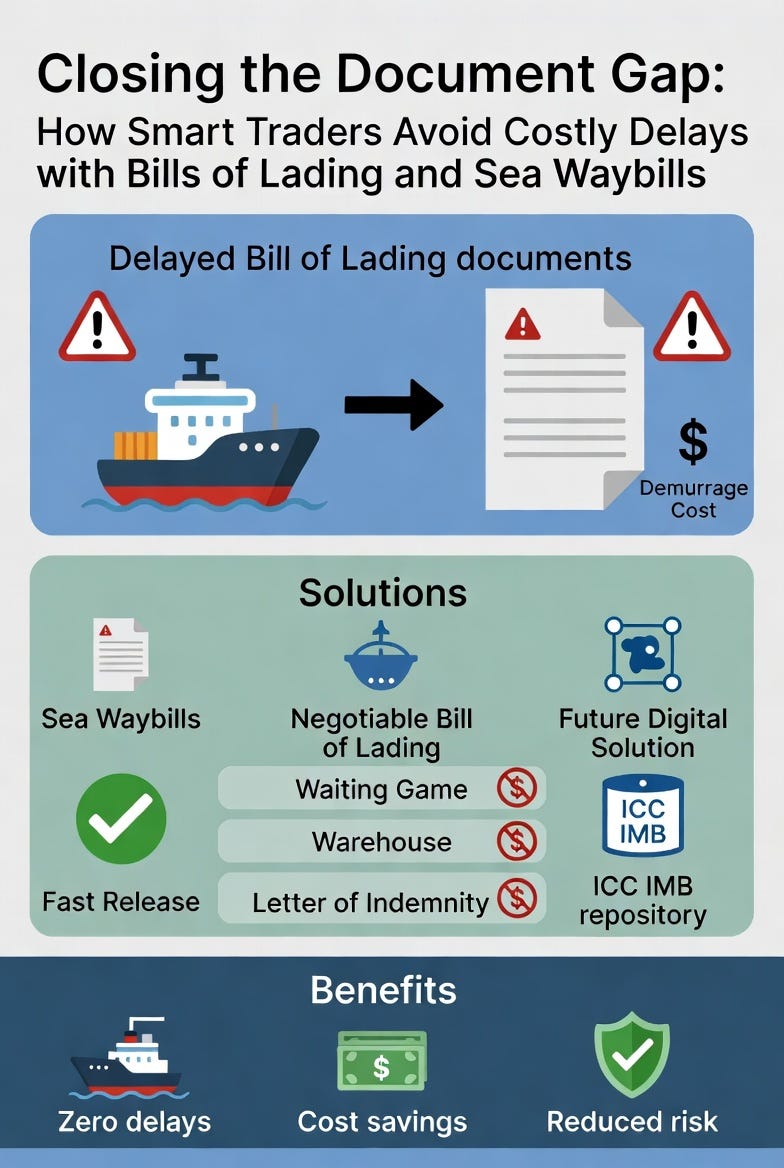
Info-graphic illustration of How Smart Traders Avoid Costly Delays with Bills of Lading and Sea Waybills
Alternatives to Negotiable Bill of Lading
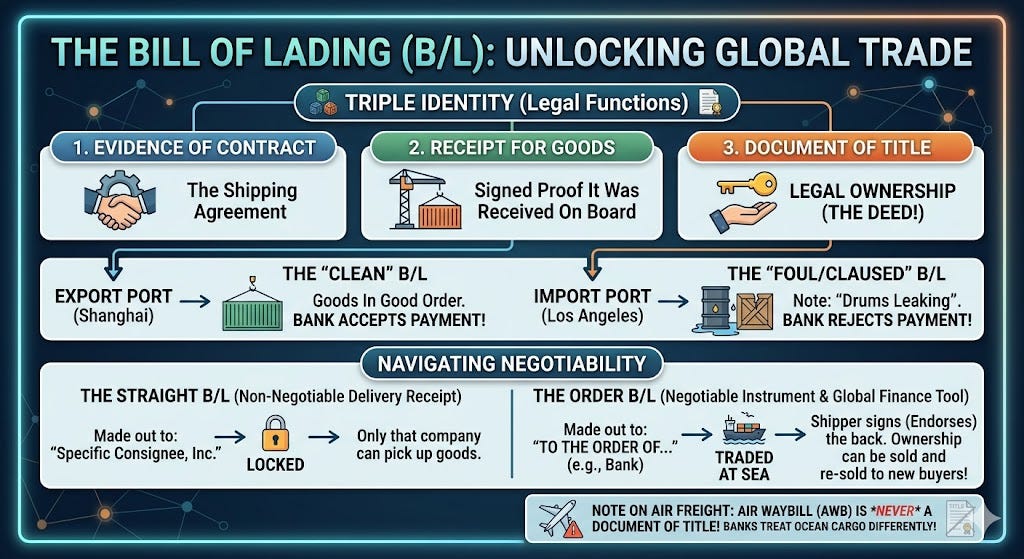
In recent years, many companies have started moving away from the traditional negotiable Bill of Lading (the full ownership document).
Why the Change?
For many deals, especially with raw materials or retail stock, the buyer doesn’t plan to sell the goods while they’re still on the ship. In these cases, the complicated “Title” (ownership transfer) function of the Bill of Lading becomes unnecessary extra work.
Instead, they are choosing simpler options:
- Sea Waybills and Liner Waybills. These work similarly to an Air Waybill. They prove the carrier received the goods, but they do not act as a title document.
The Big Advantage:
Because these documents are non-negotiable, the buyer doesn’t need to present the original paper at the port to collect the cargo. The shipping line only needs to confirm the identity of the named consignee (receiver).
This completely eliminates the “Document Gap” we talked about earlier — the ship and the paperwork no longer create expensive delays.
The Trade-Off (The Catch):
You lose the ability to sell the goods while they are still at sea by transferring the document to a new buyer.
It’s a clear choice:
- Traditional Bill of Lading: More flexible (you can trade the cargo mid-voyage), but slower and riskier at delivery.
- Sea Waybill: Faster and simpler delivery, but no mid-shipment selling.
In essence, smart traders now choose the right document based on whether they actually need to trade the goods during transit or just want fast, smooth delivery.
This is a major reason why experienced professionals are increasingly using non-negotiable waybills for many routine shipments.
The Solutions to a “Late” Bill of Lading
When using a traditional negotiable Bill of Lading and the ship arrives before the original document, you have three main options. They range from safe but expensive to fast but risky.
Solution A: The Waiting Game (The Costly Path)
- You simply wait for the original Bill of Lading to arrive.
- Problem: The ship is not allowed to release the cargo without it.
- Result: The vessel sits idle at the port. You get charged Demurrage (fees for delaying the ship) and Detention (fees for holding containers). These can cost thousands of dollars per day.
Solution B: Warehouse Custody (The Regulated Path)
- The ship’s captain releases the cargo into a secure, bonded warehouse at the port instead of delivering it directly to the buyer.
- Problem: Many countries require you to pay a deposit or provide a financial guarantee for duties/taxes before allowing this.
- Result: You avoid delaying the ship, but you still pay for warehouse storage and insurance. Your money and goods remain “trapped” until the Bill of Lading finally arrives.
Solution C: The Letter of Indemnity — LOI (The Risky Path)
- You (or your bank) give the shipping company a Letter of Indemnity — a legal promise that you will compensate them for any problems if they release the cargo without the original Bill of Lading.
- The Cost: These are serious financial guarantees, often covering 200% of the cargo’s value to protect the carrier against future claims.
- The Downside:
- Banks will issue them, but they tie up your credit line for a long time.
- In some countries, releasing cargo against an LOI is technically against the law because it breaks the carrier’s original contract.
Hence, there is no perfect solution when the Bill of Lading is late. Professionals try to avoid this situation entirely by using Sea Waybills when possible, or by planning document flow much earlier. Understanding these three options helps you manage the problem when it does occur.
The Fraud Trap of using Letter of Indemnity (LOI) and the ICC Solution
Using a Letter of Indemnity (LOI) can be risky. If the wrong person (someone who doesn’t actually own the goods) uses an LOI to get the cargo released, the shipping company can be sued for the full value of the shipment. This opens the door to serious fraud.
To fix this problem, the ICC International Maritime Bureau (IMB) has proposed a better system.
Instead of relying on slow physical courier deliveries or risky Letters of Indemnity, the IMB wants to act as a trusted central repository (like a secure digital vault) for original Bills of Lading.
How It Would Work:
- The IMB holds and tracks the original Bill of Lading (digitally).
- They verify the ownership trail and confirm the correct person is receiving the goods.
- This allows the cargo to be released safely at the port without waiting for physical paper documents to travel around the world.
Main Benefits:
- Reduces delays.
- Lowers the risk of fraud.
- Makes the whole process much more secure and efficient.
This is part of a bigger push toward digitalization in shipping — moving from old paper-based systems to more modern, secure methods.
This solution aims to solve the “Document Gap” and the dangers of Letters of Indemnity that we discussed earlier.
As we look toward the future of trade, the “Document Gap” is becoming a relic of the past. The adoption of the MLETR (Model Law on Electronic Transferable Records) has given electronic Bills of Lading the same legal weight as paper ones.
Digital B/Ls can be endorsed and transferred in seconds via secure ledgers. This doesn’t just save money; it removes the friction that has plagued international trade since the 16th century.
Conclusion
The main goal for any modern trader is simple:
Make sure your paperwork and information always move faster than the actual physical goods.
How to Achieve This:
- Use Sea Waybills (or Liner Waybills) whenever you don’t need to transfer ownership during the voyage. These allow the goods to be released quickly without waiting for original documents.
- When you do need the title/ownership function, switch to modern digital Bill of Lading platforms.
When done right, your cargo can move smoothly from the ship straight to the warehouse or buyer — with zero expensive delay days at the port.
Stop letting slow paperwork hold up your multi-million dollar shipments.
Smart traders design their supply chain so that documents are no longer the weakest link. By choosing the right type of transport document for each deal, you reduce costs, lower risks, and create a fast, efficient operation.
This is what separates professional global traders from those who lose money on avoidable delays.
메타데이터
- post_id
- f615fbc66bdf
- slug
- how-smart-traders-avoid-costly-delays-with-bills-of-lading-and-sea-waybills-f615fbc66bdf
- url
- https://medium.com/@ifow2008/how-smart-traders-avoid-costly-delays-with-bills-of-lading-and-sea-waybills-f615fbc66bdf
- canonical_url
- https://medium.com/@ifow2008/how-smart-traders-avoid-costly-delays-with-bills-of-lading-and-sea-waybills-f615fbc66bdf
- author_url
- https://medium.com/@ifow2008
- status
- ok
- fetched_at
- 2026-07-13 06:23:13