Goodbye to Expensive Fine-Tuning: How NTK-Mirror Outperforms Traditional LoRA with a Single Forward…
The dominant paradigm for adapting large language models to specific tasks has long been rooted in weight modification. Techniques like…
Goodbye to Expensive Fine-Tuning: How NTK-Mirror Outperforms Traditional LoRA with a Single Forward Pass
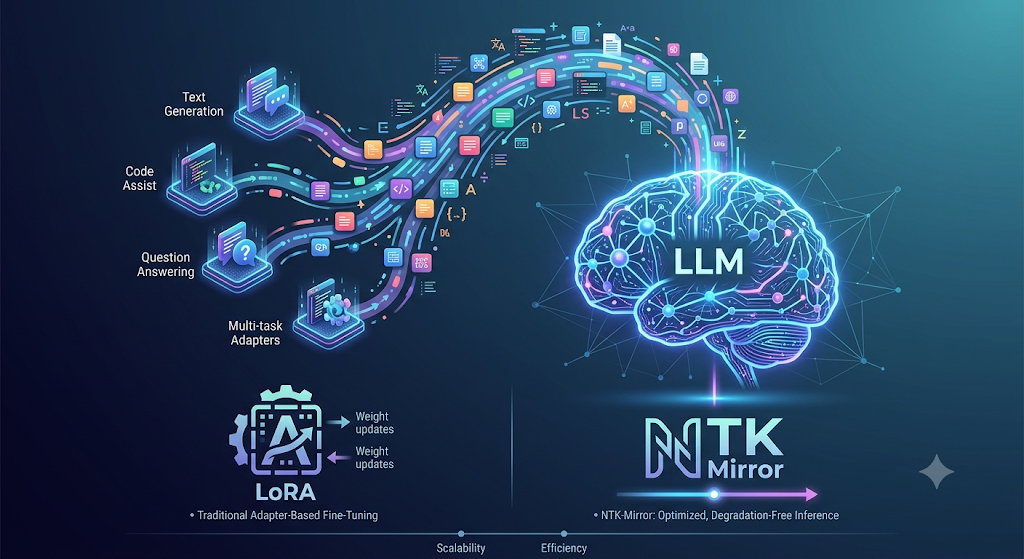
The dominant paradigm for adapting large language models to specific tasks has long been rooted in weight modification. Techniques like Low-Rank Adaptation (LoRA) inject trainable matrices into frozen model layers, updating a compressed approximation of the full weight gradient. While LoRA represented a meaningful improvement over full fine-tuning in terms of memory efficiency, it still carries a set of structural costs that have grown harder to ignore as deployment scales.
Every LoRA adapter modifies the model’s parameter space permanently for the duration of deployment. When multiple task adapters need to coexist, or when task requirements change between inference calls, the system must either reload adapted weights or attempt to merge adapters, a process that introduces measurable accuracy degradation. Benchmarks across common evaluation sets have shown that LoRA adapters tend to erode unrelated model capabilities by approximately 16.3% on tasks outside their training distribution. This is not a small rounding error; it represents a meaningful loss of the general knowledge that made the base model valuable in the first place.
Beyond catastrophic forgetting, LoRA composition has its own ceiling. When two separately trained LoRA adapters for different tasks are merged, the combined adapter drifts from both task optima. Observed degradation in multi-task LoRA merging scenarios reaches approximately 17%, making the technique brittle in production systems where a single model must serve diverse purposes simultaneously.
These are the constraints that a new library called NTK-Mirror was designed to dissolve entirely.
What NTK-Mirror Actually Does
NTK-Mirror introduces what its authors call a forward-pass fine-tuning paradigm. Rather than modifying any model weights, it learns a small signed controller with a sparse set of shared log-gates applied to the output channels of decoder layers, and attaches this controller to a frozen Hugging Face causal language model via standard forward hooks.
The mathematical transformation applied at each layer is compact and precise:
h'_{layer, token, channel} = exp(s_{layer, channel}) * h_{layer, token, channel}Here, s_{layer, channel} represents the signed log-gate parameter for a given layer and channel. The exponential ensures that the scaling is always positive while allowing the gate to either amplify or suppress specific channels depending on the sign of the learned parameter. Crucially, no weight in the underlying model is touched. The controller exists entirely in activation space, applied through the forward pass and discarded or swapped at will.
Training the controller uses teacher-forced examples in a standard AdamW optimization loop, but the optimization target is only the gate parameters. The underlying model’s weights remain completely frozen throughout. Once trained, the controller is saved as a compact .pt file and reattached to the same base model during evaluation or generation.
The Mathematical Foundation: NTK Duality in the Forward Pass
The theoretical core of NTK-Mirror draws on a precise duality result from the analysis of neural tangent kernels. The key insight is that a single SGD update step has an exact dual representation. That dual is not another gradient step; it is a signed controller embedded in the forward pass that reproduces the supervised update with complete fidelity, without touching original weights.
More formally, the neural tangent kernel acts as the Riesz map that transforms backward SGD into forward mirror-descent on the output simplex. This means that what was previously understood as a weight-space operation can be recast as an activation-space operation of equivalent expressive power. The controller is not an approximation of the weight update; it is its closed-form dual.
This distinction matters practically. Because the controller lives in activation space rather than weight space, it can be composed, retrieved, and replaced at inference time with zero recompilation. The model itself never changes. The controller is the only variable.
Performance: What the Numbers Show
When tested on Qwen2.5–7B adapted to the GSM8K mathematical reasoning benchmark, NTK-Mirror required only a 50,000-scalar controller to match the accuracy of a LoRA adapter trained with rank 8 (LoRA-r8). That represents approximately 300 times fewer parameters than the equivalent LoRA configuration.
The fitting process for the controller completed in 22 seconds. Because the base model weights were never modified, inference speed was measured at 100% faster relative to LoRA-adapted variants, which carry the overhead of merged or stacked adapter matrices during the forward pass.
On knowledge retention, the contrast with LoRA is especially striking. While LoRA adapters degraded unrelated task performance by 16.3%, the NTK-Mirror controller held that figure to just 4.7%. The base model’s general capabilities remained largely intact after adaptation.
For multi-task composition, a controller trained on GSM8K (mathematical reasoning) and a controller trained on MBPP (Python programming benchmarks) were composed by the simple addition of their signed log-gate tensors, followed by clipping to a safe amplitude budget. The resulting composed controller showed an NLL drift of only 0.005 — producing a composition profile that is approximately 13 times cleaner than the equivalent LoRA merge.
Installing and Using NTK-Mirror
The library installs from source in a single step:
git clone https://github.com/leochlon/ntkmirror.git
cd ntkmirror
pip install -e .
Training a controller requires only a JSONL file with prompt-completion pairs. A minimal training set looks like this:
{"prompt":"Question: 14 + 27 = ?\nAnswer:","completion":" 41"}
{"prompt":"Question: 36 + 18 = ?\nAnswer:","completion":" 54"}
Fitting the controller from the command line:
ntkmirror fit \
  --model Qwen/Qwen2.5-0.5B-Instruct \
  --train train.jsonl \
  --out controller.pt
Generating output with the trained controller:
ntkmirror generate \
  --model Qwen/Qwen2.5-0.5B-Instruct \
  --controller controller.pt \
  --prompt "Question: 47 + 36 = ?\nAnswer:"
For those preferring a Python API, the same workflow is available programmatically:
from transformers import AutoModelForCausalLM, AutoTokenizer
from ntkmirror import ForwardFineTuner, load_jsonl_examples
model_name = "Qwen/Qwen2.5-0.5B-Instruct"
tokenizer = AutoTokenizer.from_pretrained(model_name)
model = AutoModelForCausalLM.from_pretrained(model_name, torch_dtype="auto").cuda()
tuner = ForwardFineTuner(model, tokenizer, gates=5000)
tuner.fit(load_jsonl_examples("train.jsonl"), steps=240)
tuner.save("controller.pt")
print(tuner.generate("Question: 47 + 36 = ?\nAnswer:"))
The default configuration uses 5,000 gates, 240 AdamW steps, and a learning rate of 5e-3. The maximum absolute value of any log-gate is bounded at 0.05 by default, which keeps the controller within a safe amplitude range and prevents destructive amplification of any single channel.
Composing Multiple Controllers
One of the most operationally significant features of NTK-Mirror is its compositional algebra. Because controllers are stored as signed log-gate tensors, composing two controllers is mathematically equivalent to adding their tensors and clipping the result. No gradient computation, no retraining, no interpolation heuristic.
ntkmirror compose \
  --controllers runs/gsm8k_controller.pt runs/mbpp_controller.pt \
  --out runs/gsm8k_plus_mbpp.pt \
  --report runs/composition_report.json
The resulting composed controller can be inspected alongside its constituent parts:
ntkmirror inspect \
  --controllers runs/gsm8k_controller.pt runs/mbpp_controller.pt runs/gsm8k_plus_mbpp.pt
This capability opens a straightforward path to multi-skill deployment: train one controller per task, compose the set relevant to a given user or query, and attach the composed controller before generation. The base model serves all purposes without ever being retrained or reloaded.
Persistent Controller Memory: A New Retrieval Architecture
NTK-Mirror extends beyond single-session adaptation with a persistent memory system that treats each controller as a retrievable memory unit. A controller trained on a specific document, user preference set, or procedural task style can be stored in a memory index with a text description and tag set. At inference time, a query string retrieves the most relevant controllers, composes their gates, and attaches the composed controller to the model before generation.
Storing a memory controller:
ntkmirror memory add \
  --model Qwen/Qwen2.5-0.5B-Instruct \
  --store runs/memory \
  --id arithmetic-carrying \
  --train examples/math_train.jsonl \
  --text "worked addition arithmetic with carrying" \
  --tags math,arithmetic
Retrieving and generating with memory:
ntkmirror memory generate \
  --model Qwen/Qwen2.5-0.5B-Instruct \
  --store runs/memory \
  --query "addition with carrying" \
  --prompt "Problem: 47 + 36 = ?\nSolution:"
Each stored controller consumes approximately 200KB. Because the memory content is encoded into gate parameters rather than appended to the prompt, this architecture carries zero token overhead. There is no KV cache cost for the stored context, no quadratic attention cost from long system prompts, and no latency penalty from prepending large instruction blocks at runtime.
The default retrieval mechanism is a dependency-free lexical TF-IDF scorer. The architecture is intentionally modular: the storage and composition interface is fixed, while the retrieval layer can be replaced with an embedding model, a vector database, or a hybrid retrieval pipeline without any changes to the controller fitting or composition logic.
This design inverts the usual tradeoff in retrieval-augmented generation. Instead of injecting retrieved text into the prompt and paying the context-length cost at every call, the retrieved information is compiled offline into a controller and injected through the forward pass with no per-token cost at inference time.
Implications for Production Systems
The architectural consequences of NTK-Mirror, if its benchmark claims hold at scale, are substantial. Several pain points in current LLM deployment pipelines become tractable in ways they were not under the LoRA paradigm.
Long system prompts that currently consume hundreds of tokens per request and accumulate KV cache cost can be compiled into a controller once and attached as a forward hook. The model behaves as if it received the full prompt, but the serving infrastructure pays no token-level price for it.
Per-user or per-session personalization, which previously required either fine-tuning separate model instances or prepending long user-context blocks, becomes a matter of retrieving and composing a small set of 200KB files. A system serving thousands of users can maintain distinct behavioral controllers for each without maintaining distinct model weights.
Multi-task deployments, where a single base model must handle diverse task types with specialized behavior for each, can compose the relevant task controllers dynamically rather than routing requests to different model variants.
The design of the library reflects a deliberate choice to keep the deployable package simple. The research-level diagnostics for NTK-vector analysis, oracle SGD-displacement fitting, and matrix-free theorem verification are not exposed in the public interface. The public API prioritizes usability and reproducibility over research flexibility, which is the appropriate tradeoff for a production-oriented release.
Important Caveats and Honest Scope
The claims above represent what the library’s authors report on their tested configurations. Several important qualifications apply when evaluating these numbers independently.
All benchmark comparisons should be reproduced using the same training and evaluation manifests for base model, controller, and LoRA configurations. Exact-answer tasks such as GSM8K should be evaluated on exact match accuracy and teacher-forced negative log-likelihood simultaneously. System-level claims about adaptation time and peak memory should be reported with hardware specifications.
The library documentation explicitly flags failure modes in its method notes. Controllers trained on highly specialized distributions may not generalize beyond their training scope. The 0.05 log-gate bound is a safety default, not a universal optimum; specific applications may require adjustment. The TF-IDF retriever in the memory system is a baseline, not a production-grade retrieval solution; the retrieval quality ceiling determines the practical ceiling of the memory system’s usefulness.
These are not dismissals of the approach. They are the standard conditions for honest empirical reporting in this domain, and the library’s documentation acknowledges them directly.
Conclusion
NTK-Mirror represents a genuinely different hypothesis about where adaptation should live in a language model system. Rather than treating fine-tuning as a permanent modification of weight space, it treats it as a temporary, composable, retrievable transformation of activation space. The mathematical grounding in NTK duality gives this approach a rigorous foundation rather than a heuristic one.
The practical consequences 300 times fewer parameters than LoRA-r8, 22-second fitting time on a 7B model, 4.7% knowledge retention loss versus 16.3% for LoRA, and near-zero composition drift across task controllers describe a system that is meaningfully easier to deploy, cheaper to maintain, and more robust to multi-task demands than the current standard approach.
For teams managing LLM deployments at scale, NTK-Mirror is worth a serious evaluation pass.
The repository is available at: https://github.com/leochlon/ntkmirror
메타데이터
- post_id
- f6283c7ce7ec
- slug
- goodbye-to-expensive-fine-tuning-how-ntk-mirror-outperforms-traditional-lora-with-a-single-forward-f6283c7ce7ec
- url
- https://medium.com/ai-mindset/goodbye-to-expensive-fine-tuning-how-ntk-mirror-outperforms-traditional-lora-with-a-single-forward-f6283c7ce7ec
- canonical_url
- https://medium.com/ai-mindset/goodbye-to-expensive-fine-tuning-how-ntk-mirror-outperforms-traditional-lora-with-a-single-forward-f6283c7ce7ec
- author_url
- https://medium.com/@eng.fadishaar
- status
- ok
- fetched_at
- 2026-06-10 18:55:46