Gucci Mane & Schizophrenia: The Parallel Between Black Boys In The Hood & Mental Disorders
Gucci Mane & Schizophrenia: The Parallel Between Black Boys In The Hood & Mental Disorders
On October 20th, 2025, Gucci Mane & Keyshia Ka'oir aired on The Breakfast Club to discuss his new book, ‘Episodes: The Diary of a Recovering Mad Man.’ The married couple openly talked about Gucci Mane’s schizophrenia diagnosis, psychosis episodes, triggers, and life experiences that may have led up to the mental health disorder. It is also worth noting that Keyshia explained her experience being a caregiver to someone with schizophrenia and what progression looks like on their pathway towards recovery.

Gucci Mane’s public history reveals a life shaped by violence, substance use, unstable attachments, financial precarity, profound loss, and the weight of systemic oppression. While this article is not a biographical analysis, these elements matter because they mirror the same structural forces that put Black boys and men at heightened risk for trauma-related disorders, psychosis, and schizophrenia-spectrum symptoms. Many of these conditions are not the result of individual failure, but of short-sighted policies and political regimes that create environments where survival eclipses well-being.
As someone who grew up close enough in the hood to witness the psychological cost of survival, yet sheltered enough to avoid its most severe consequences, I aim to draw parallels between these lived realities and the clinical frameworks that often overlook them. What does mental health look like for a person who grows up having to choose between paying light bills or water, securing childcare or taking a lower-paying job, and facing hunger or the risk of jail time? These are not abstract questions. They are the daily moral injuries imposed on Black communities. Too often, Black individuals are denied the same grace, clinical recognition, and diagnostic legitimacy that other groups with similar symptoms receive. This is where the nuance begins.
This article aims to cover:
- Social Determinants of Health within the African American Community.
- General synopsis of Black boys and men in underprivileged communities and developing mental disorders.
- Most common symptoms of psychosis within Black men, referencing the Diagnostic and Statistical Manual, 5th edition.
- Explanation of episodes and triggers via PTSD, drug- or medication-induced disorders, and prison.
- Black boys and men going underdiagnosed or misdiagnosed, which leads to them forgoing treatment.
- Recovery and resources for caregivers.
- Disclaimer: There is a notable lack of Black men, who remain significantly underrepresented in clinical and epidemiological research. Because many studies report findings for Black adults as a combined group, some data in this article reflect broader patterns across Black communities that are relevant to both Black men and Black women. Also, Schwartz and Blankenship (2014) reported that African Americans are both disproportionately diagnosed with schizophrenia at 4 times the rate of White Americans and often misdiagnosed. Typically due to racist undertones, harmful stereotypes, lack of cultural competence, and/or the close resemblance that psychotic disorders present when compared to one another.
Social Determinants of Mental Health
To understand why schizophrenia-spectrum symptoms appear at higher rates among Black boys and men, we must first examine the environmental conditions that shape their earliest experiences and often prime the nervous system for psychological vulnerability long before a diagnosis is ever made. Growing up as a Black boy in the hood means inheriting a landscape of Adverse Childhood Experiences (ACE), economic scarcity, and systemic abandonment; conditions that magnify the very symptoms we later diagnose as mental health disorders. High ACE scores, unstable housing, community violence, and limited access to care shape the earliest formative years of mental health for Black boys, creating patterns of trauma and survival that are frequently misdiagnosed, overlooked, or pathologized.
African Americans are more vulnerable to developing psychotic risk factors than any other ethnic group (American Psychiatric Association, n.d.). At the same time, a lack of resources and care disproportionately affects African Americans. Therefore, psychotic risk factors must be inextricably linked to systemic abandonment and presenting mental disorders.
- Homelessness: Unstable housing leads to an increase in deteriorating mental health conditions such as anxiety disorder, depression disorder, and psychosis. Generally, these conditions are accompanied by substance use disorders and suicidal ideation. According to the National Alliance to End Homelessness (2020), more than one-third (40%) of African Americans face homelessness, despite representing only 14% of the overall population. Once they experience homelessness, Black adolescents are 69% more likely to reenter homelessness compared to their White counterparts (BMC Public Health, 2024). This is greatly due to historical institutionalized racism (e.g., redlining, housing policies, discriminatory lending, and devaluation of assets in predominantly Black neighborhoods.)
- Economic Instability: The lack of financial resources is partially responsible for mood disorders, anxiety, chronic stress, SUD, and a heightened risk of Alzheimer’s disease (APA, n.d.). Approximately 95% of individuals diagnosed with mental health disorders report that they lack the funds to meet their basic needs, much less afford health care costs and treatment. The Center for Economic Policy & Research (2021) confirms what many of us already know: Black youth have been jobless at nearly double the rate of white youth since 2007. Black men in their prime working years have carried the highest unemployment burden of any racial or gender group from 2000 to 2020. Their imprisonment? Six times more frequent than that of white men, making the picture even bleaker. Because most incarcerated people work for little or no pay, they’re not counted in employment data, meaning entire segments of Black men disappear from the nation’s labor statistics.
- Food and Nutrition Insecurity: A lack of food security can lead to mood dysregulation, resulting in both physical and psychological harm (Psychiatry.org, n.d.). Studies demonstrate that children and adolescents suffer the most from food insecurity, directly impacting their ability to utilize cognitive functioning, decision-making, and emotional regulation. This vulnerability is plainly correlated to behavioral health issues. Children who experience food insecurity are at a higher risk of taking on additional mental health care costs as they transition into adulthood. The Annie E. Casey Foundation revealed that 2 out of 5 Black children experience food insecurity, which is double their White peers. It is important to note that schools often misinterpret behavioral challenges as ADHD, ADD, or defiance, etc. This misdiagnosis pattern begins in childhood and extends into adulthood, where environmental trauma continues to be labeled as pathology rather than recognized as a systemic injury. While getting a diagnosis is important, assessing a child's environment should take precedence. Otherwise, clinicians and educators risk pathologizing children for simply reacting to an environment that does not holistically support their well-being.
- Social Environments: Studies show that relational wounds such as family trauma, attachment injuries, discrimination, prejudice, social exclusion, etc., contribute to higher levels of chronic stress and mental illnesses (APA, n.d.) Persons who have lived through Adverse Childhood Experiences, including intimate partner violence or food insecurity, are more at risk of developing Major Depressive Disorder (MDD) and/or Schizophrenia Spectrum Disorder (SSPD). All of which disproportionately affects marginalized groups.
- Physical Environments: Communities that are placed within environments plagued with toxic air pollution and heavy lead show a correlation with high levels of depression and psychiatric disorders (APA.org, n.d.). Children who live in areas with poor air quality, high noise levels, and little to no green landscape have a 55% chance of developing a mental disorder. With that said, Villarose (2020) reported that African Americans are 75% more likely to live in neighborhoods near power plants and hazardous facilities. We saw this firsthand with the water contamination in Flint, Michigan; the oil spill that rained down on a predominantly Black community in Roseland, Louisiana; and the railroad site near the Fifth Ward of Houston, Texas, that contaminated the soil and air, leading to open investigation claims and cases of cancer.
Oil Explosion in Roseland, Louisiana
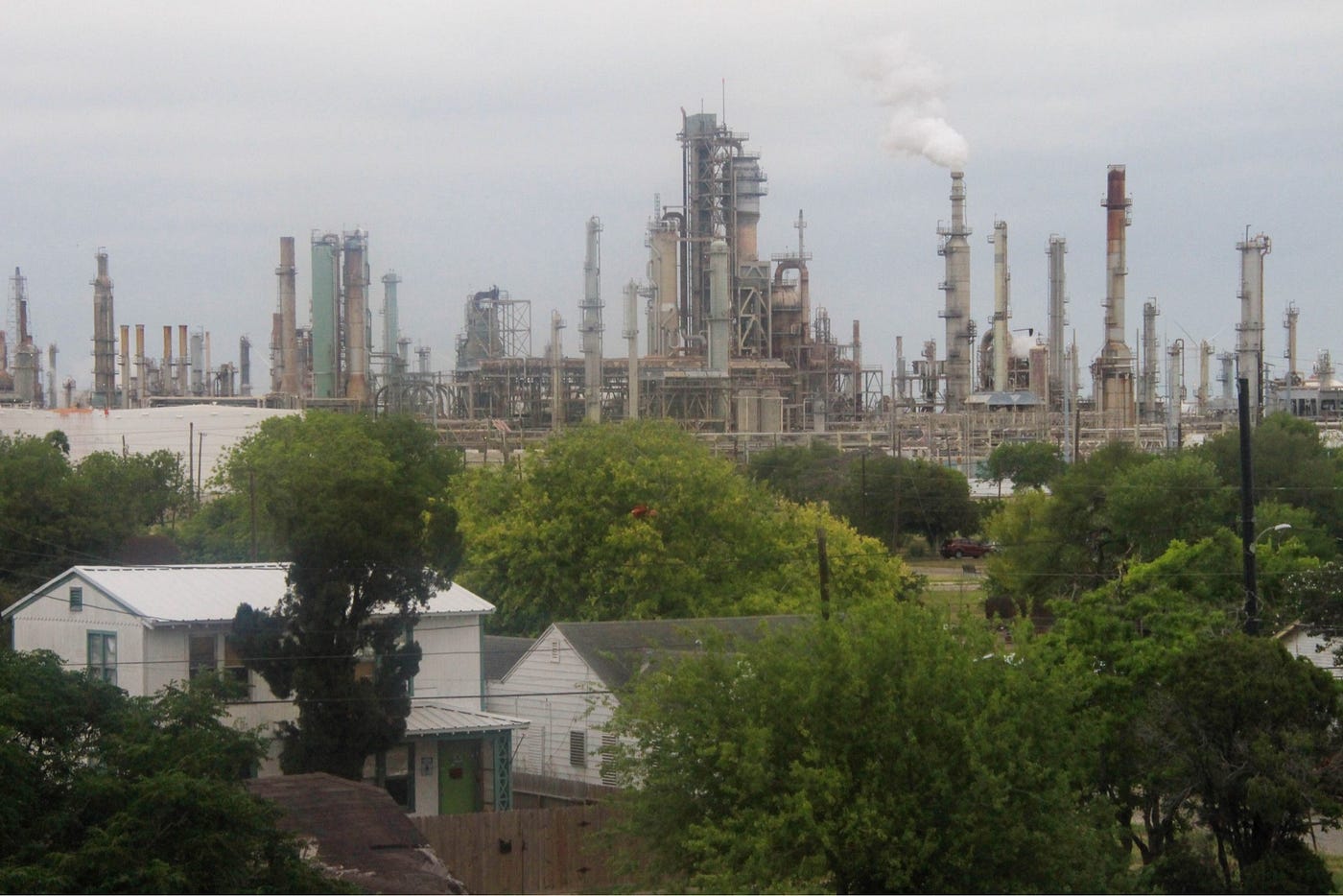
Power plants and hazardous facilities across the street from Hillcrest; a predominantly black and brown neighborhood in Corpus Christi, TX.
Most Common Symptoms of Psychosis
Once these systemic pressures accumulate across childhood and adolescence, they can manifest in adulthood as a range of psychotic symptoms that are often misunderstood, misdiagnosed, or stripped from their environmental context.
“While genetic factors may increase the risk of experiencing psychosis, it is environmental stressors [such as traumatic life events, autoimmune insult, or substance use] that often act as the trigger and barriers to care such as lack of knowledge about the symptoms, lack of possibilities for treatment (i.e., no local specialists), and lack of access (i.e., no insurance) which can exacerbate the condition.” (Williams et al., 2023, para. 2)
It is important to acknowledge that not all symptoms of psychosis are the same as those of schizophrenia. Other disorders present similar symptoms, such as Bipolar and Major Depressive. The National Library of Medicine (2023) suggests that 2.6 million American adults (18 years of age or older) display symptoms of schizophrenia, 40% of whom go untreated largely due to mass incarceration, early passing, or unstable housing.
Below is a list of some psychotic symptoms from the Diagnostic and Statistical Manual, 5th edition:
- Recurring relationship problems of work or school performance.
- Experience with hearing voices and being uncertain if they are really present. (Referential delusions, Grandiose delusions, erotomanic delusions, somatic delusions.)
- Seeing visions or images that aren’t present.
- Overt paranoia and suspicion.
- Inappropriate behavior (i.e., wearing summer clothes in the winter), impulsive actions, swift mood swings, disorganized thoughts, and speech.
- Catatonic behavior, or maintaining a rigid, inappropriate or bizarre posture, to a complete lack of verbal and motor responses
- Anhedonia, or the inability to experience pleasure and joy.
- Lack of motivation or self-initiation
- Little to no emotional expression
- …And many, many more
Substance/Medication-Induced Psychosis
While some psychotic experiences emerge independently of substance exposure, others are triggered or intensified by drugs and medications, particularly when a person already carries unresolved trauma or genetic vulnerability.
Drug-induced schizophrenia is described as a chronic psychotic disorder that resembles drug-induced psychosis but persists long after substance use has stopped (Holland, 2022). The condition typically emerges when a person already has underlying vulnerabilities (i.e., genetic risk or previous mental health challenges) and then uses substances that trigger or worsen psychotic symptoms.
Research shows that cannabis, hallucinogens, and amphetamines carry the strongest association with transitioning from temporary substance-induced psychosis to a long-term schizophrenia-spectrum condition. Other substances, including inhalants, sedatives, stimulants, and even certain prescription or over-the-counter medications, may also contribute to symptom onset.
PTSD-Induced Psychosis
But substances are not the only precipitating factor. For many Black boys and men, trauma (especially early, chronic, or repeated trauma) can destabilize the nervous system so deeply that psychotic symptoms surface in moments of extreme stress or emotional overwhelm.
Post-Traumatic Stress Disorder-induced psychosis is typically caused by one's experience being intensely stressful to the point of losing touch with reality (Charlie Health, n.d). Developmental trauma, along with chronic exposure to abuse, neglect, and extreme stress during childhood, is strongly linked to complex PTSD and increases an individual's vulnerability to psychosis later in life. Early trauma leaves lasting psychological and neurological imprints that make individuals more reactive to stress and more susceptible to trauma-related triggers in adulthood.
When new stressors arise or when reminders of past harm resurface, these unresolved wounds can manifest as hallucinations, delusions, or other psychotic symptoms. PTSD also frequently co-occurs with other mental health conditions, including bipolar disorder, panic disorder, and borderline personality disorder, which can further elevate the risk of psychosis.
Together, these overlapping conditions create a heightened state of psychological instability, significantly complicating individuals' ability to navigate their PTSD and manage co-occurring symptoms effectively.
Penitentiary-Induced Psychosis
And for those who enter the criminal justice system, a system that disproportionately targets Black men, the psychological impact can be even more severe, with carceral environments amplifying existing symptoms or generating new ones.
Harsh environments and inhumane treatment while in jail or prison can offset a myriad of psychotic symptoms. The Center for Addiction & Mental Health (n.d.) suggests that the prison system sees mental illness rates roughly 4–7 times higher than in the general community. Integrally, the overlap between offending and severe mental illness is shaped by shared developmental risk factors, such as broken families, poverty, substance use in the home, and early trauma, which increase both criminal-justice involvement and later mental-illness risk.
People with serious mental health problems are more likely to face unemployment, live in impoverished neighborhoods, struggle with daily life management, and engage in behaviors that bring them into conflict with the law. Simultaneously, untreated symptoms can directly trigger some offenses, indicating a direct correlation between mental illness and criminal behavior. To address this over-representation, CAMH recommends moving away from fear-based responses and instead adopting treatment-oriented, inclusive approaches where mental health care, early intervention, and social support replace pure punitive measures.
Preventing the incarceration of individuals with mental illness requires stable housing, income support, accessible addiction services, and targeted efforts in communities with high needs. When individuals with mental illness enter the criminal justice system, priorities should include timely screening for mental health problems, appropriate care during incarceration, and coordinated reintegration plans that address housing, employment, community mental health linkage, substance use treatment, and family support.
Mutual Aid, Recovery & Resources for Caregivers
The path toward recovery for Black boys and Black men affected by trauma, untreated psychosis, or environmentally induced mental health symptoms cannot rely on the medical system alone. Especially when that system has historically ignored, misdiagnosed, or pathologized them. Mutual aid networks, community-based care, and caregiver support systems often serve as the first line of defense. These informal structures provide what formal institutions frequently fail to offer: consistent emotional presence, culturally competent understanding, and sustained support through crisis and recovery.
For caregivers (often mothers, grandmothers, partners, siblings, or close friends), the burden is heavy. They are asked to interpret symptoms without training, de-escalate crises without resources, and navigate medical, legal, and social systems that were never designed with Black families in mind. Caregivers frequently experience their own forms of secondary trauma, chronic stress, and burnout while trying to keep their loved ones safe. Their work is invisible labor, yet it is foundational to the survival of Black men living with trauma-related or psychotic symptoms.
Mutual aid fills the gaps that traditional institutions neglect. Community members may pool funds for medication costs, facilitate transportation to appointments, offer temporary housing during episodes, share food during periods of instability, or provide emotional grounding during psychotic breaks. These networks function as culturally specific safety nets built on reciprocity, not charity; on solidarity, not saviorism. For many Black families, mutual aid is more than support. It's primarily about survival.
Recovery for individuals living with schizophrenia and other disorders is most sustainable when caregivers are supported too. This includes access to psychoeducation about symptoms, crisis-response planning, respite care, support groups, and trauma-informed training that empowers family members instead of blaming them. It also requires addressing the structural barriers that worsen mental health outcomes, such as unstable housing, poverty, discrimination, and a lack of early intervention. When caregivers receive adequate support, the entire recovery ecosystem becomes stronger.
Ultimately, healing in Black communities must be communal, political, and culturally grounded. While mutual aid does not replace structural change, it does offer immediate relief while pursuing long-term systemic reform. As we reimagine what mental health recovery looks like for Black boys and Black men, we must invest in the individuals who support them. Caregivers deserve resources, recognition, and rest, and communities deserve systems that affirm that recovery is possible for both individuals and the collective.
References
Austin, A. A. (2021, December 8). The jobs crisis for Black men is a lot worse than you think. Center for Economic & Policy Research.
Bell, J. B. (2016, April 25). 5 Things to Know About Communities of Color and Environmental Justice. The Center for American Progress. Retrieved November 20, 2025, from https://www.americanprogress.org/article/5-things-to-know-about-communities-of-color-and-environmental-justice/#:~:text=Landfills,%20hazardous%20waste%20sites,%20and,continue%20to%20suffer%20the%20most.
Faber, S. C., Khanna Roy, A., Michaels, T. I., & Williams, M. T. (2023). The weaponization of medicine: Early psychosis in the Black community and the need for racially informed mental healthcare. Frontiers in psychiatry, 14, 1098292. https://doi.org/10.3389/fpsyt.2023.1098292
Holland, K. (2022, October 20). What is Drug-Induced schizophrenia and how you can address it? Healthline. https://www.healthline.com/health/schizophrenia/drug-induced-schizophrenia
Lolk, A. (2013). Diagnostic and Statistical Manual of Mental Disorders. In American Psychiatric Association eBooks. https://doi.org/10.1176/appi.books.9780890425596
Nakphong, M. K., Bright, D. J., Koreitem, A., Mocello, A. R., Lisha, N. E., Leslie, H. H., Estrada, I., Libby, M. K., Lippman, S. A., & Lightfoot, M. A. (2024). Housing instability patterns among low-income, urban Black young adults in California and associations with mental health outcomes: baseline data from a randomized waitlist-controlled trial. BMC Public Health, 24(1), 2492. https://doi.org/10.1186/s12889-024-19948-y
Mental illness and the prison system. (n.d.). CAMH. https://www.camh.ca/en/camh-news-and-stories/mental-illness-and-the-prison-system
National Alliance to End Homelessness. (2025, March 9). Racial inequalities in homelessness, by the numbers — National Alliance to End Homelessness. https://endhomelessness.org/resources/sharable-graphics/racial-inequalities-homelessness-numbers/
Schwartz, R. C., & Blankenship, D. M. (2014). Racial disparities in psychotic disorder diagnosis: A review of empirical literature. World journal of psychiatry, 4(4), 133–140. https://doi.org/10.5498/wjp.v4.i4.133
Social determinants of mental health. (n.d.). https://www.psychiatry.org/psychiatrists/diversity/education/social-determinants-of-mental-health
The Annie E. Casey Foundation. (2025, May 27). Child food insecurity in America. https://www.aecf.org/blog/child-food-insecurity#:~:text=25%25%20of%20Black%20households%20with,with%20kids%20faced%20food%20insecurity.
Villarosa, L. (2020). Pollution is killing Black Americans. this community fought back. The New York Times, 1–26. https://law.news.niu.edu/wp-content/uploads/sites/5/2024/03/Pollution-Is-Killing-Black-Americans.-This-Community-Fought-Back.-.pdf
메타데이터
- post_id
- f628e28d6f5a
- slug
- gucci-mane-schizophrenia-the-parallel-between-black-boys-in-the-hood-mental-disorders-f628e28d6f5a
- url
- https://medium.com/@beasleykyra72/gucci-mane-schizophrenia-the-parallel-between-black-boys-in-the-hood-mental-disorders-f628e28d6f5a
- canonical_url
- https://medium.com/@beasleykyra72/gucci-mane-schizophrenia-the-parallel-between-black-boys-in-the-hood-mental-disorders-f628e28d6f5a
- author_url
- https://medium.com/@beasleykyra72
- status
- ok
- fetched_at
- 2026-07-10 01:40:30




