Why Roses Wilt the Next Day: 7 Mistakes We Make After Buying Them
The evening went perfectly. The roses were presented, the emotions were received, the photos were taken, and the bouquet was ceremoniously…
Why Roses Wilt the Next Day: 7 Mistakes We Make After Buying Them
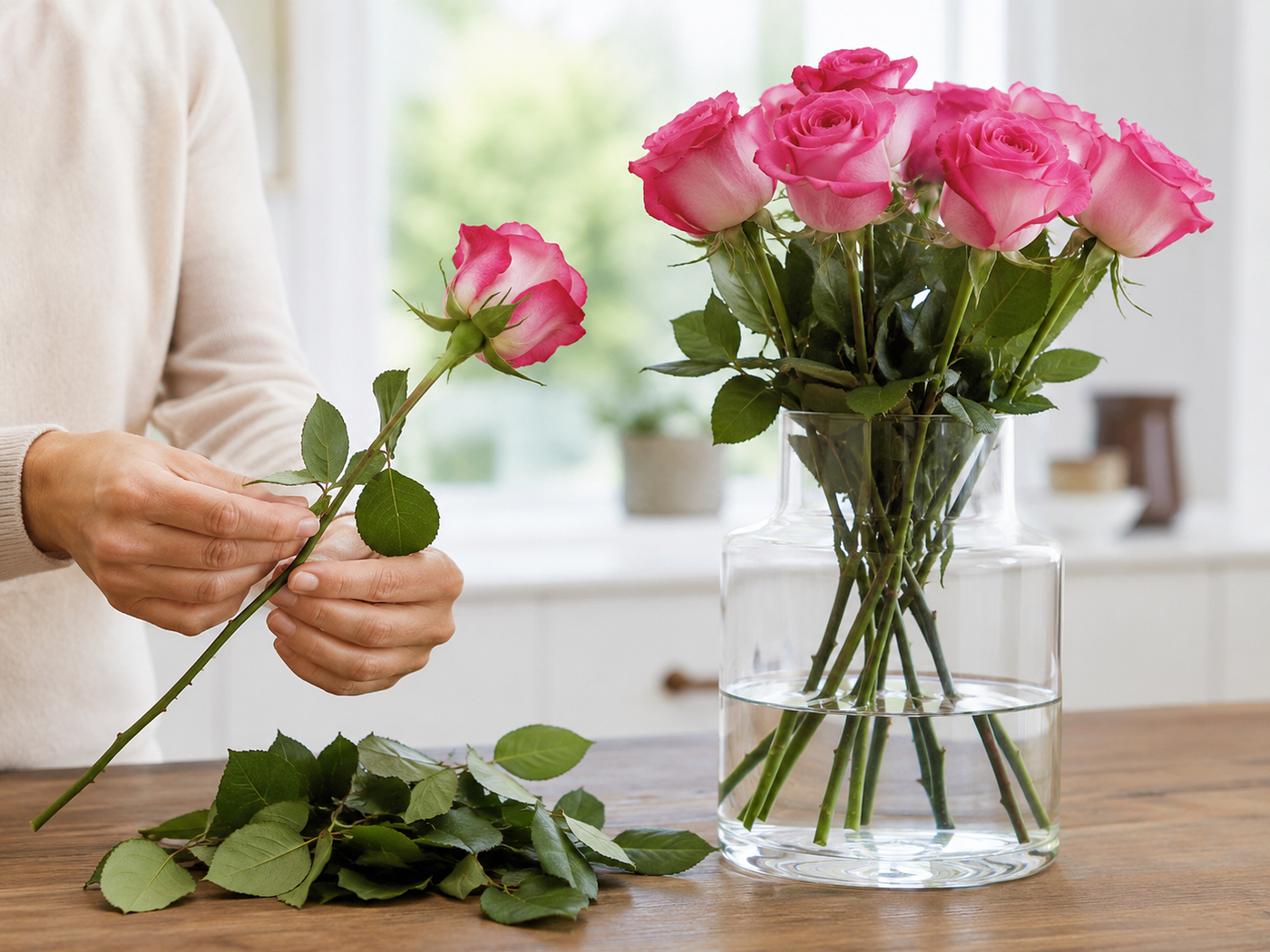
The evening went perfectly. The roses were presented, the emotions were received, the photos were taken, and the bouquet was ceremoniously placed in a vase in the most visible spot in the room. Beautiful!
Then morning comes, and something strange has happened.
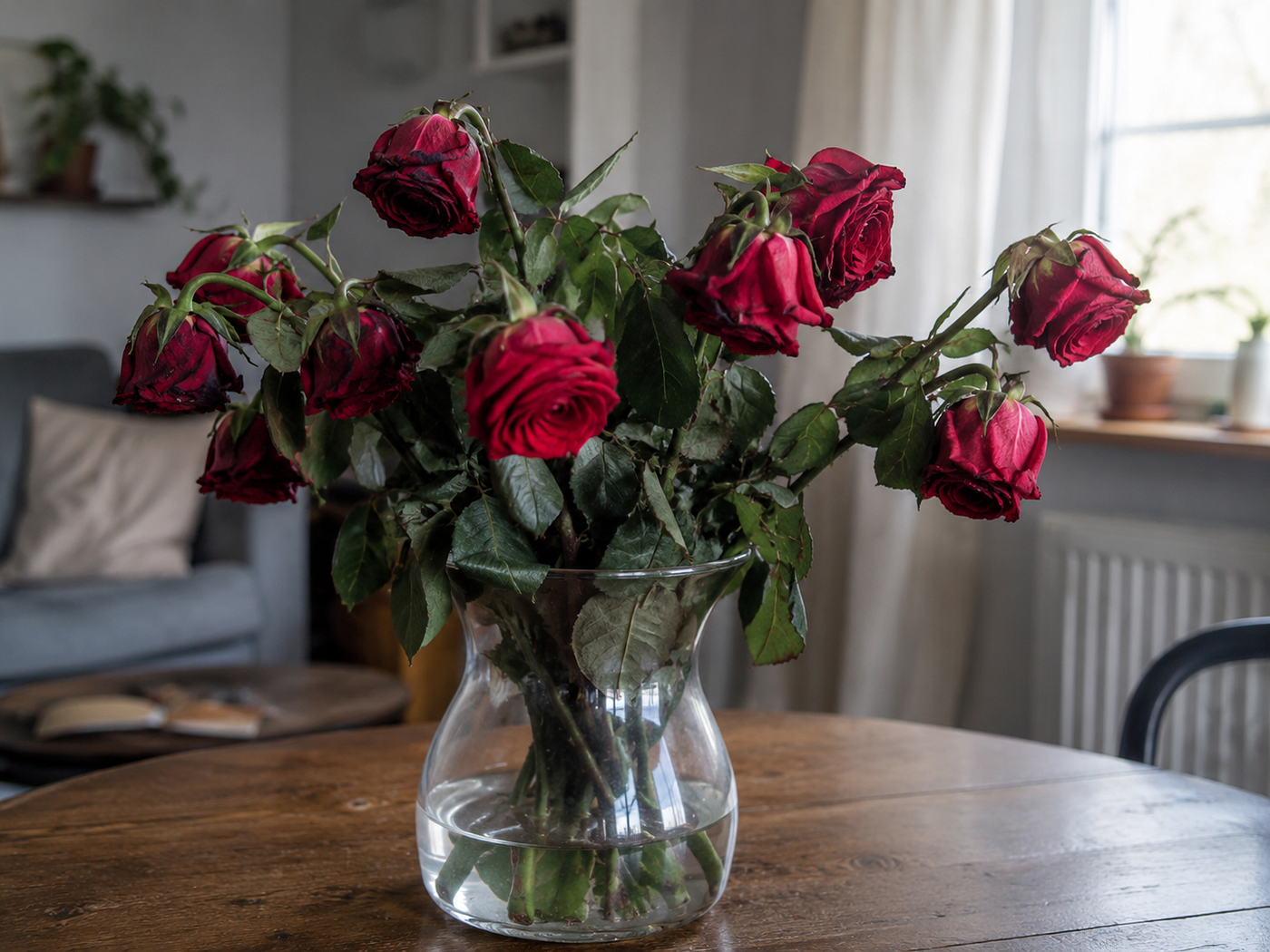
Yesterday, the roses looked fresh, proud, and full of life. Today, they have all lowered their heads, as if they spent the entire night thinking about bills, taxes, and the meaning of life.
The first thought is usually obvious:
“They sold me old flowers!”
I am not going to defend every flower shop. Sometimes roses really have been stored for too long, transported incorrectly, or sold when they are already past their best.
But from what I have seen, a perfectly fresh bouquet often loses its appearance at home because of simple mistakes that we do not even consider mistakes.
So, let’s figure this out together.
No magic pills, no dancing around the vase, and no advice like, “Just add everything you can find in the kitchen cupboard.”
Mistake №1: Leaving Roses Without Water for Too Long
You buy a bouquet, stop at another shop, visit friends, drink coffee, take a few photos — and only several hours later remember that the flowers have been lying without water the entire time.
Once a rose has been cut, it continues to lose moisture. This happens especially quickly inside a warm room, a heated car, or outside on a hot summer day.
The large flower head and all those leaves keep releasing moisture, while the stem cannot take in any fresh water.
If the journey home takes 15 or 20 minutes, there is usually no reason to worry. A healthy, fresh rose can handle that.
But if the flowers will be travelling for several hours, ask the florist to prepare temporary water packaging. Flower shops may use special hydration bags, moist wrapping material, or small water containers around the stems.
It is important to understand one simple thing: beautiful wrapping does not replace water.
Even when the bouquet looks expensive and luxurious and is wrapped in five layers of designer paper.
As soon as you get home, do not leave the roses lying on the table “for just a few minutes.” Somehow, those few minutes always turn into an hour.
Mistake №2: Putting Roses Into a Vase That Was Only Rinsed
This is where things get interesting.
The vase looks clean. There is no soil inside it, no forgotten bouquet from last year, and nothing obviously suspicious.
So, you rinse it with water and put the flowers in.
However, residue from the previous bouquet may still remain on the sides of the vase. Bacteria feel perfectly comfortable there. Once fresh water is added, they begin multiplying and gradually block the water-conducting vessels inside the stems.
As a result, the vase is full of water, but the roses can no longer drink properly.
Before placing a new bouquet in a vase, wash it thoroughly with warm water and dish soap. Use a sponge or a bottle brush to clean the inside walls.
A quick rinse is not always enough.
Penn State also recommends starting with a thoroughly cleaned vase, since residue and contamination encourage bacterial growth and shorten the life of cut flowers.
Personally, I prefer transparent glass vases.
Not only because they look elegant. You can immediately see when the water becomes cloudy, when sediment appears at the bottom, or when leaves have fallen into the water.
Mistake №3: Not Recutting the Stems
This is a very common situation:
“The florist already cut the stems. Why should I do it again?”
While the bouquet is being transported without water, the cut ends begin to dry out. A bacterial blockage may also form at the base of the stem.
The rose may be standing in a vase full of water, but it is still unable to absorb enough of it.
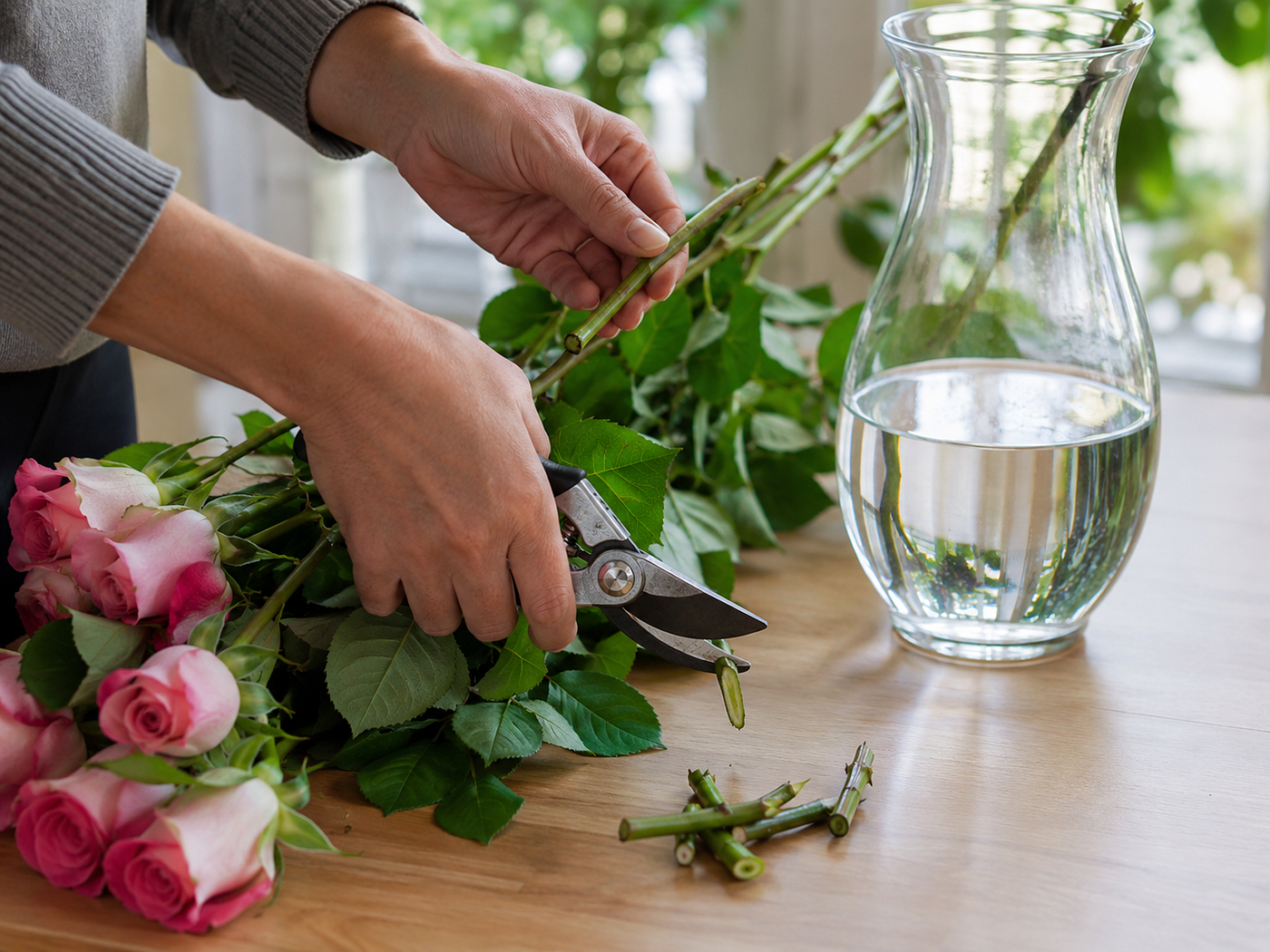
Before placing the bouquet in water, recut approximately one or two centimetres from the bottom of each stem.
Use a sharp knife or a good pair of pruning shears. Blunt scissors can crush and damage the stem. We need a clean cut, not an industrial accident.
Make the cut at an angle.
This increases the surface area available for water absorption and prevents the stem from sitting completely flat against the bottom of the vase.
Recutting flower stems with a sharp, clean tool before placing them in water is one of the basic recommendations for extending the life of cut flowers.
And one more important point: do not cut the stems once and forget about them for the rest of the week.
Each time you change the water, it is a good idea to remove another small section from the bottom of the stems.
Mistake №4: Leaving Foliage Below the Waterline
A bouquet looks fuller when it has plenty of greenery, so people are often reluctant to remove anything.
But leaves submerged in water no longer add beauty to the arrangement.
They begin to soften, rot, and contaminate the water. The water becomes cloudy, an unpleasant smell appears, and bacteria multiply much faster.
Then we wonder why the roses wilted even though there was plenty of water in the vase.
Remove all leaves, small side shoots, and damaged plant material that will sit below the waterline.
The foliage above the water can remain. It contributes to the overall appearance of the bouquet.
Below the water, however, there should be nothing but clean stems.
This is one of the simplest ways to help roses last longer. Penn State also recommends removing leaves and other plant material below the waterline because decomposition contaminates the water and reduces vase life.
Important!
There is no need to strip absolutely everything from the stem and turn the rose into a bare stick. Remove only the foliage that would otherwise be submerged.
Mistake №5: Topping Up the Water Instead of Replacing It
Roses drink a lot of water, especially during the first day.
So yes, you should check the water level every day.
But there is a big difference between adding some fresh water and completely replacing the old water.
Imagine that the water is already cloudy. Pieces of leaves are floating in it, and bacteria are actively multiplying.
You add clean water on top.
It looks slightly better, but the contents of the vase have not really changed.
Replace the water completely every two or three days. During hot weather, or whenever the water becomes visibly cloudy, change it more often.
Rinse the vase, wash the stems, and recut the ends before returning the flowers to the water.
The Royal Horticultural Society recommends changing the water and recutting the base of the stems every two to four days.
Use clean water at a comfortable temperature.
Not boiling water and not a glass full of ice cubes. Ordinary cool or room-temperature water is usually perfectly suitable.
Also, keep an eye on the water level.
A narrow vase may look full, but after one day the roses may have drunk half the water, leaving some stems above the waterline.
Mistake №6: Placing the Vase Near a Radiator, Direct Sunlight, or Fruit
The place of honour in the room is often the worst place for a bouquet.
The windowsill is flooded with sunlight. A radiator is heating the air below it. The kitchen is warm from cooking. And a beautiful bowl of apples and bananas is sitting next to the vase.
Perfect for a photograph.
Not so perfect for keeping roses fresh.
Heat makes flowers lose moisture and age faster. Keep the bouquet in a cooler part of the room, away from direct sunlight, radiators, fireplaces, kitchen appliances, and strong air currents.
Both Penn State and the Royal Horticultural Society recommend keeping cut flowers in a cool location away from heat sources.
Fruit creates another problem.
Ripening fruit releases ethylene, a natural gas involved in the ripening and ageing of plant material. This is why cut flowers should not be placed beside a fruit bowl.
The Royal Horticultural Society specifically recommends keeping cut flowers away from ripening fruit.
There is no need to hide your bouquet in the refrigerator and visit it according to a schedule.
Just find a place without excessive heat, direct sunlight, or an entire fruit market nearby.
Mistake №7: Adding Everything We Can Find to the Water
Sugar. Aspirin. Vodka. Lemon juice. A coin. Dishwashing liquid.
Sometimes it feels as though we are not preparing water for roses but mixing a complicated party cocktail.
Home remedies can sound convincing, especially when the advice begins with:
“My grandmother always did this.”
The problem is dosage.
Sugar can provide carbohydrates, but sweet water is also a wonderful environment for bacteria.
Acid can alter the pH of the water, but adding too much will not make the roses happier.
And random amounts of household chemicals can hardly be described as controlled flower care.
The most reliable option is to use a professional cut-flower preservative and dilute it according to the instructions.
These products normally contain nutrients, ingredients that help regulate the acidity of the water, and substances that slow bacterial growth.
Penn State notes that commercial flower preservatives generally work more reliably than homemade mixtures, but the correct water-to-product ratio is important.
More product does not mean better results.
This is not a situation where a double portion will keep the roses fresh until the next birthday.
When professional flower food is not available, a clean vase, fresh water, properly cut stems, and a cool location will usually help much more than a random collection of ingredients from the medicine cabinet and refrigerator.
What Should You Do if the Roses Have Already Dropped Their Heads?
Start by checking the simplest things:
- Is there enough water in the vase?
- Are the roses standing near a radiator?
- Is the water clean?
- Are any leaves submerged?
- Were the stems recut?
Then remove the flowers, wash the vase, cut several centimetres from the stems, and place the roses in fresh water.
Sometimes the problem is simply poor water absorption. Once the cut is refreshed, the flowers may gradually recover.
But let’s be honest: revival techniques do not always work.
If the stem below the flower head has become soft, the petals have darkened, there is an unpleasant smell, or the rose is already losing petals, you will not return it to a “fresh from the shop” condition.
Flowers are living material — and once cut, they have a limited lifespan. They are not plastic decorations.
So, Who Is Actually to Blame?
Sometimes the flower shop is responsible.
Sometimes the journey home was too long.
Sometimes the apartment is simply too warm.
And sometimes we place a fresh bouquet in a dirty vase, do not recut the stems, leave leaves in the water, and add an aspirin tablet just to be safe.
Then, the next morning, we look at the drooping flower heads and begin a full investigation.
In reality, caring for roses does not require complicated rituals.
A clean vase, freshly cut stems, no leaves below the waterline, regular water changes, and a cool location — that is the foundation.
These details may seem small.
But they determine whether your bouquet will brighten the room for several days or begin its sad farewell the very next morning.
Share your knowledge with friends, gain experience, keep growing, love, and bring joy.
Until next time!
메타데이터
- post_id
- f63d8a7c41e4
- slug
- why-roses-wilt-the-next-day-7-mistakes-we-make-after-buying-them-f63d8a7c41e4
- url
- https://medium.com/@ukraine.olex/why-roses-wilt-the-next-day-7-mistakes-we-make-after-buying-them-f63d8a7c41e4
- canonical_url
- https://medium.com/@ukraine.olex/why-roses-wilt-the-next-day-7-mistakes-we-make-after-buying-them-f63d8a7c41e4
- author_url
- https://medium.com/@ukraine.olex
- status
- ok
- fetched_at
- 2026-07-23 09:30:10