The Contender
The King Who Never Was Reza Pahlavi
The Contender
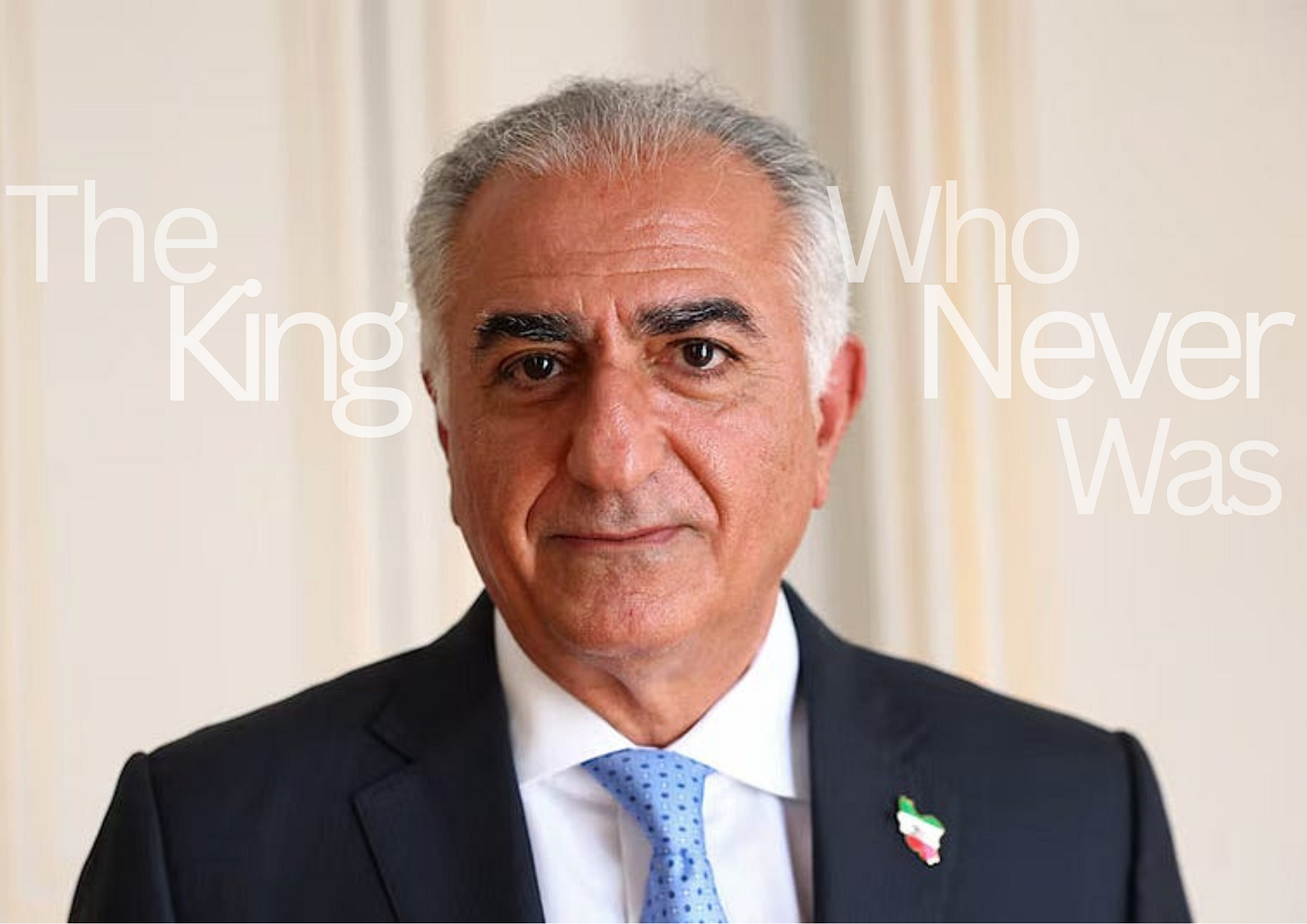
The King Who Never Was Reza Pahlavi
We have heard this satire before, but in a very different place:

House of Dragon series (2022)
The Queen Who Never Was Rhaenys Targaryen in House of Dragon.
Reza Pahlavi is an Iranian politician and dissident living in exile in the United States. As a member of the Pahlavi Dynasty, he is the eldest son of the last Shah of Iran, Mohammad Reza Pahlavi, and Farah Diba. He remains one of the leading figures in the opposition against the Islamic Republic of Iran.
After the 1979 Iranian Revolution led by Ruhollah Khomeini, his father was deposed, and the monarchy was abolished. Following his father’s death in exile in Cairo, Egypt, in 1980, Reza Pahlavi declared himself Shah of Iran (as “Reza Shah II”) on his 20th birthday and began actively participating in political activities against the Islamic Republic from abroad.
Like his father, he was sent into exile in the USA, and up till now, he has remained an active contender for Iran’s throne.
As the saying goes:
History repeats itself.
And the Islamic world has witnessed it in one of its worst forms.
Contenders for the Throne
The Islamic Revolution in Iran saw the Mullah regime overtake the country, replacing the monarch known as “the Shah of Iran.”

The Islamic Revolution in Iran grew as various sections of society rose up against shah Mohammad Reza Pahlavi of Iran. (AP Photo: File)
The revolutionaries exiled Reza Pahlavi’s father, and Reza himself has lived in exile ever since — but we all know that the status quo never stays the same.
Rumors circulated that he planned to overthrow the regime, which later proved to be true.
In 1982, Israeli businessman and intelligence officer **Yaakov Nimrodi revealed in a BBC radio interview that he had attempted to bring Pahlavi to power in Iran by planning a coup with Reza Pahlavi and General Said Razvani, along with [Adolph Schwimmer](https://en.wikipedia.org/wiki/Al_Schwimmer) and [Adnan Khashoggi](https://en.wikipedia.org/wiki/Adnan_Khashoggi)**.
According to **Samuel Segev**, a journalist for Israel’s Maariv newspaper, this plan was approved by both the CIA and the Israeli cabinet. However, it was shelved after the resignation of Prime Minister Menachem Begin in 1983; the new prime minister, Yitzhak Shamir, avoided implementing the idea, arguing that “Israel should not embark on a new adventure” during his tenure.
21st Century
Pahlavi has used his high profile as an Iranian in exile to campaign for human rights, democracy, and unity among Iranians both inside and outside Iran.
On his website, he calls for the separation of religion and state in Iran, along with free and fair elections “for all freedom-loving individuals and political ideologies.”
He urges all groups dedicated to a democratic agenda to work together for a democratic and secular Iranian government.
In a December 2018 presentation at the Washington Institute for Near East Policy, Pahlavi called for non-military support for those in Iran seeking to replace the Islamist regime with a secular democracy. According to news reports, he was “not openly calling for the restoration of the Peacock Throne… He casts himself more as a symbol than a politician but has called himself ‘ready to serve my country.’”
In February 2019, Reza Pahlavi launched the Phoenix Project of Iran think tank in Washington, D.C., building on the short-lived Iran Future Association he initiated in Toronto in 2008.
According to The National Interest, it is “designed to bring the various strains of the opposition closer to a common vision for a post-clerical Iran.”Support within Iran
A 2009 report by the Brookings Institution noted that Pahlavi lacked an organized following inside Iran, as there was no serious monarchist movement at the time. The report described him as having “little in common with the intellectuals and students who make up the core of the reform movement.”
During the 2017–18 Iranian protests, some social media videos showed demonstrators chanting slogans in favor of Pahlavi’s grandfather and calling for his return — though on many occasions, royalist slogans prompted others in the crowd to shout them down.

Reza Pahlavi, the exiled son of the last shah of Iran, speaks during a press conference about the situation in Iran and the need to support Iranians, in Paris, France, June 23, 2025. (Reuters: Abdul Saboor)
Over the years, he has garnered an impressive number of supporters, particularly in the diaspora and amid recent protests (including 2025–2026 waves).
However, after Ali Khamenei’s death, when Trump was asked about anyone fit to rule (or restore) the Peacock Throne, he did not mention Pahlavi. Instead, Trump described him as a “nice person” but expressed skepticism about his domestic support, suggesting someone from within the current leadership in Iran would be more appropriate.
This highlights how, for now, his advocacy for human rights and his long struggle for Iran’s throne may be fading into the background.
But let us hope for the best and wait for what the coming days hold, as the conflict has now continued for about 11–12 days.
메타데이터
- post_id
- f643bcd3d327
- slug
- the-contender-f643bcd3d327
- url
- https://medium.com/@velorum_analysis/the-contender-f643bcd3d327
- canonical_url
- https://medium.com/@velorum_analysis/the-contender-f643bcd3d327
- author_url
- https://medium.com/@velorum_analysis
- status
- ok
- fetched_at
- 2026-08-01 16:46:21