Painting the Walls of a Massacre
The 1919 ‘Black Act’ That Turned a Garden Into a Graveyard
JALLIANWALA BAGH MASSACRE | APRIL 13TH
Painting the Walls of a Massacre
The 1919 ‘Black Act’ That Turned a Garden Into a Graveyard
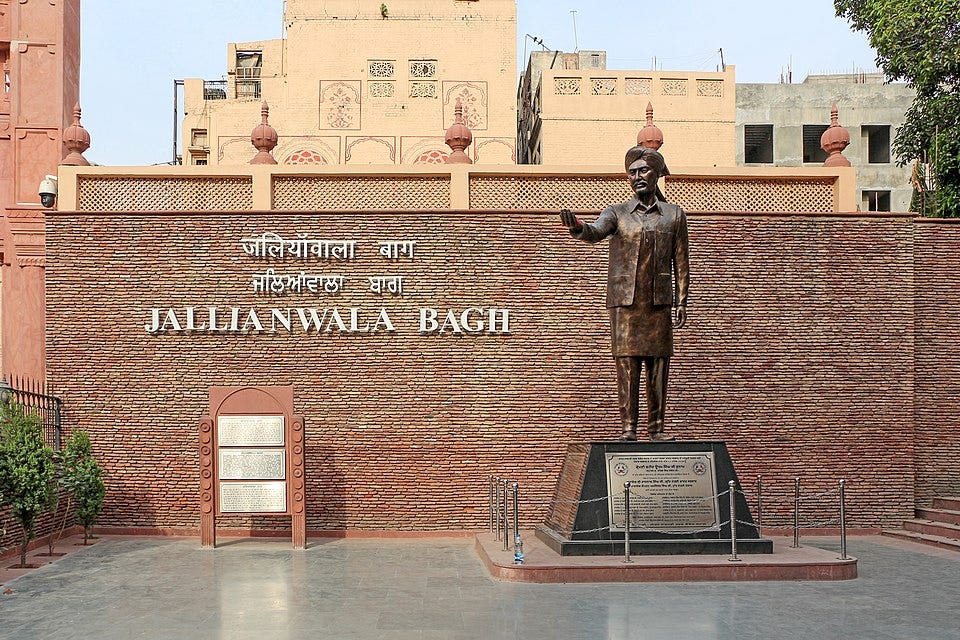
Entrance of Jallianwala Bagh, Amritsar, India. Photo by Bernard Gagnon, via Wikimedia Commons (CC BY-SA 4.0).
Before the first shot was fired in Amritsar, the massacre was already written into law. It wasn’t an act of sudden madness; it was a legislative achievement
In March of 1919, the British colonial government passed the **Rowlatt Act — *officially the Anarchical and Revolutionary Crimes Act, 1919 (Act No. XI of 1919). It was a “Black Act*” that bypassed basic legal safeguards, allowing detention without trial and proceedings without meaningful legal recourse. Through this Act, the government gave itself sweeping powers to shut down political campaigns, meetings, and rallies merely on suspicion. Individuals could be detained for up to two years without trial or appeal.
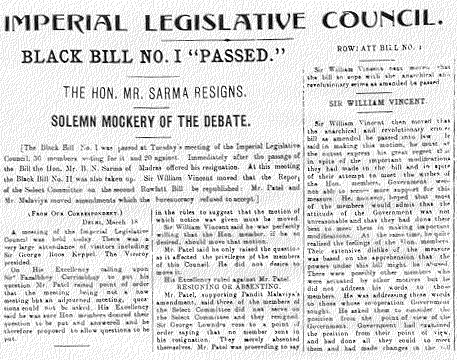
The legislative blueprint for the Bagh: Newspaper headlines from March 1919 reporting on the passage of the Rowlatt Act — the 'Black Bill' that suspended habeas corpus. Public domain, via Wikimedia Commons.
As it came to be known across India:
“Na Dalil, Na Vakil, Na Appeal” — no argument, no lawyer, no appeal.
Despite fierce opposition from every Indian member, the Act was passed and what it left behind was humiliation — and anger.
Against this backdrop, Mahatma Gandhi issued a call for a nationwide, civil disobedience hartal — the Rowlatt Satyagrah, on 6 April. He urged Indians to show united and peaceful opposition through countrywide strikes, marches, and demonstrations. In Punjab, the response was especially intense — what began as a strike became a space to voice their anguish and accumulated grievance.
In Amritsar, the movement found leadership in Dr. Saifuddin Kitchlew and Dr. Satyapal, whose influence cut across communities. For a brief moment, political resistance and social unity moved together.
The colonial administration saw in this unity not only protest, but the outline of something larger and decided to end it at its nascent stage. The authorities deceitfully arrested and deported Dr. Satyapal and Dr. Kitchlew.
And the consequences — people reacted. Crowds gathered. Protests swelled. When police fired upon a peaceful procession, anger spilled outward, provoking attacks on railway stations, banks, government offices — towards anything that stood in for the state.
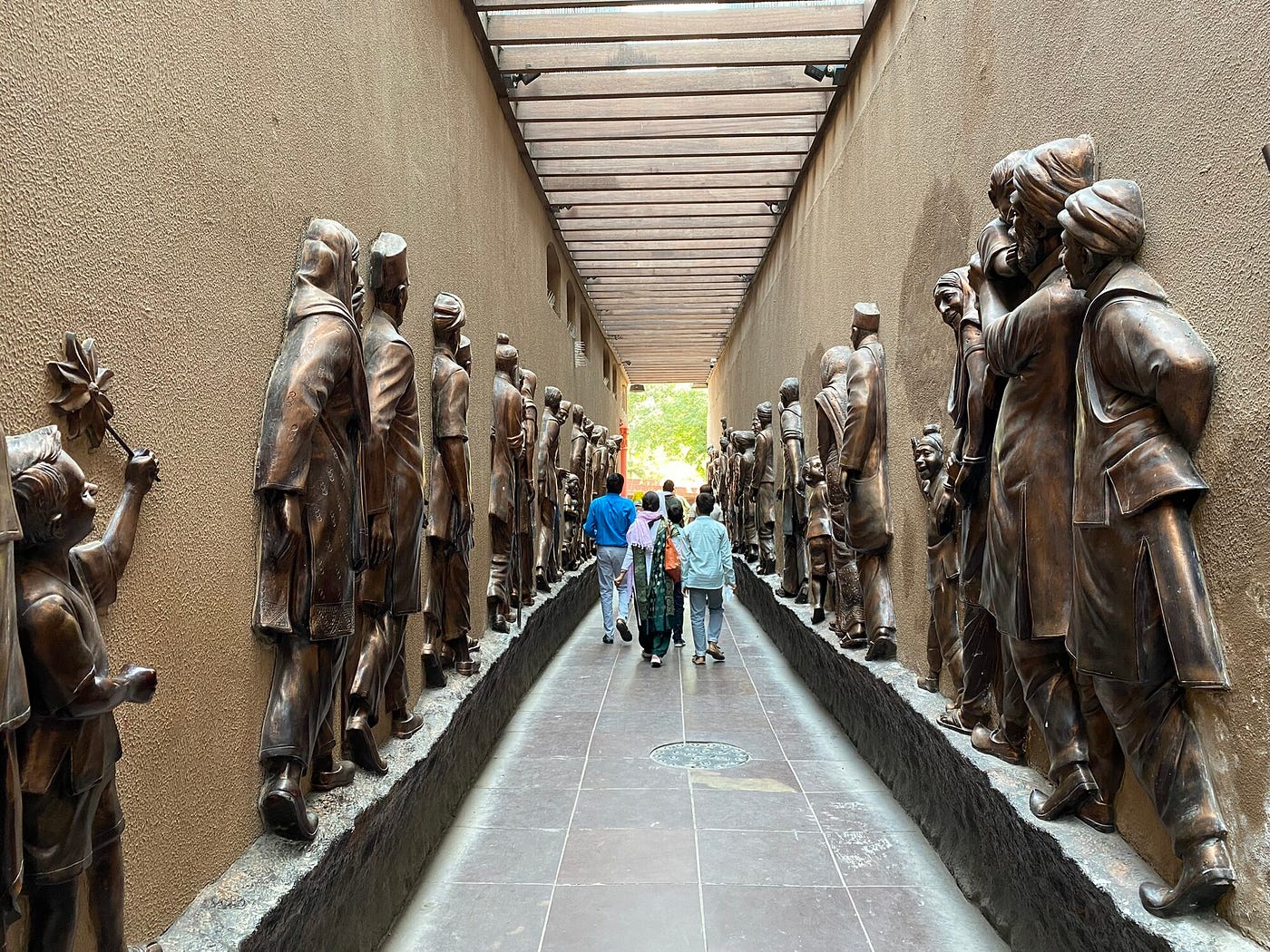
The narrow entrance to Jallianwala Bagh, which Dyer’s troops blocked to ensure no one could escape the firing. Photo by Tamjeed Ahmed, via Wikimedia Commons (CC BY-SA 4.0).
To contain what it now perceived as an insurrection, the British administration deployed Brigadier-General Reginald Dyer. Martial law followed. Civil liberties like freedom of assembly and association were suspended. Gatherings of more than four people were prohibited, and surveillance extended even to the skies.
And yet, on the day of Baisakhi, nearly 20,000 people gathered inside Jallianwala Bagh — some to demand the release of their arrested leaders, others to celebrate Baisakhi, the spring harvest festival. There were families, children, and nothing that suggested what was about to unfold.
No warning was issued. No call to disperse.
The soldiers positioned themselves at the narrow entrance, sealing the only exit.
What followed was not chaos, but method.
Over ten minutes, approximately 1,650 rounds were fired into a trapped crowd, till the troops ran out of ammunition as later recorded in the Hunter Committee Report (1920), including Brigadier-General Dyer’s own testimony. People ran, collided, fell. Some jumped into the well (now known as the Martyrs’ Well) to escape the bullets.
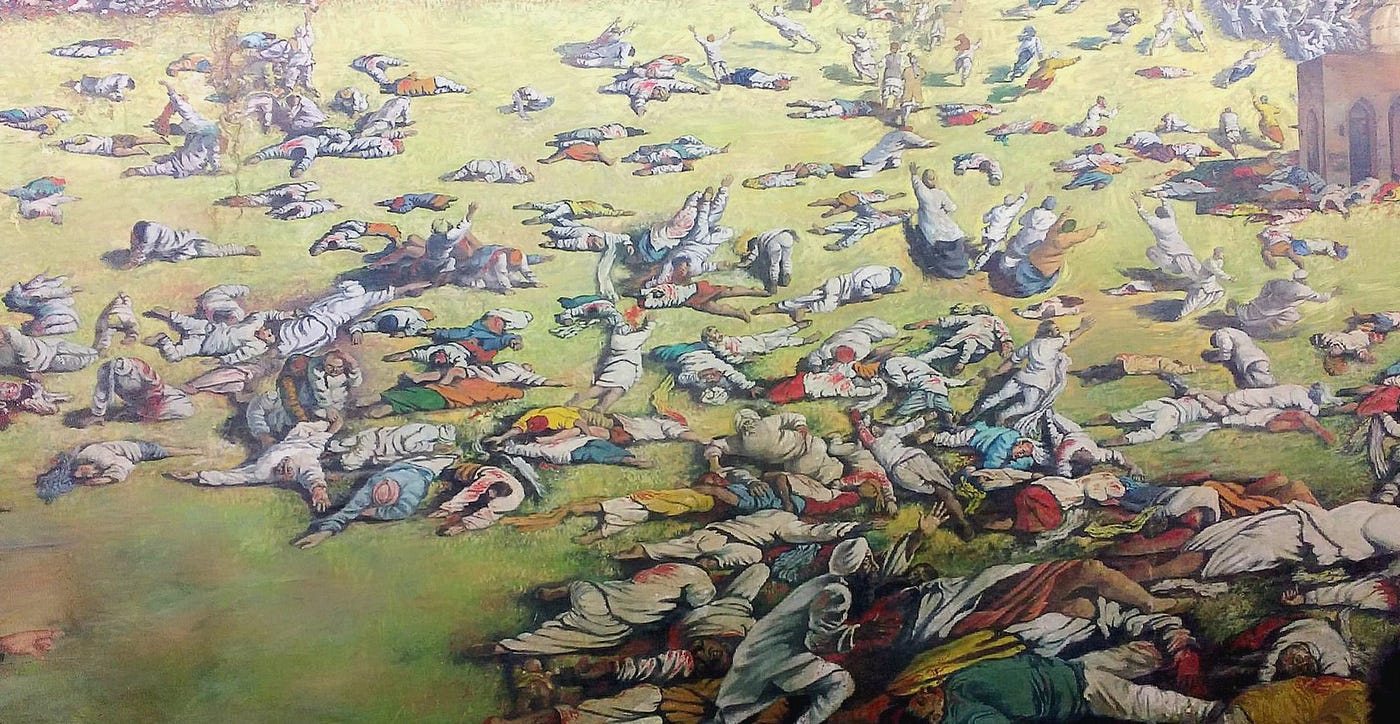
This artistic depiction captures the concentrated density of the crowd inside the garden during the firing. Image by JesusisGreat7, via Wikimedia Commons (CC BY 4.0).
The official count would later claim 379 dead. Other estimates, including analyses like Vajiram & Ravi, place the toll well above 500 — and possibly into the thousands.
The walls of Jallianwala Bagh still stand. They remember what numbers tried to soften.
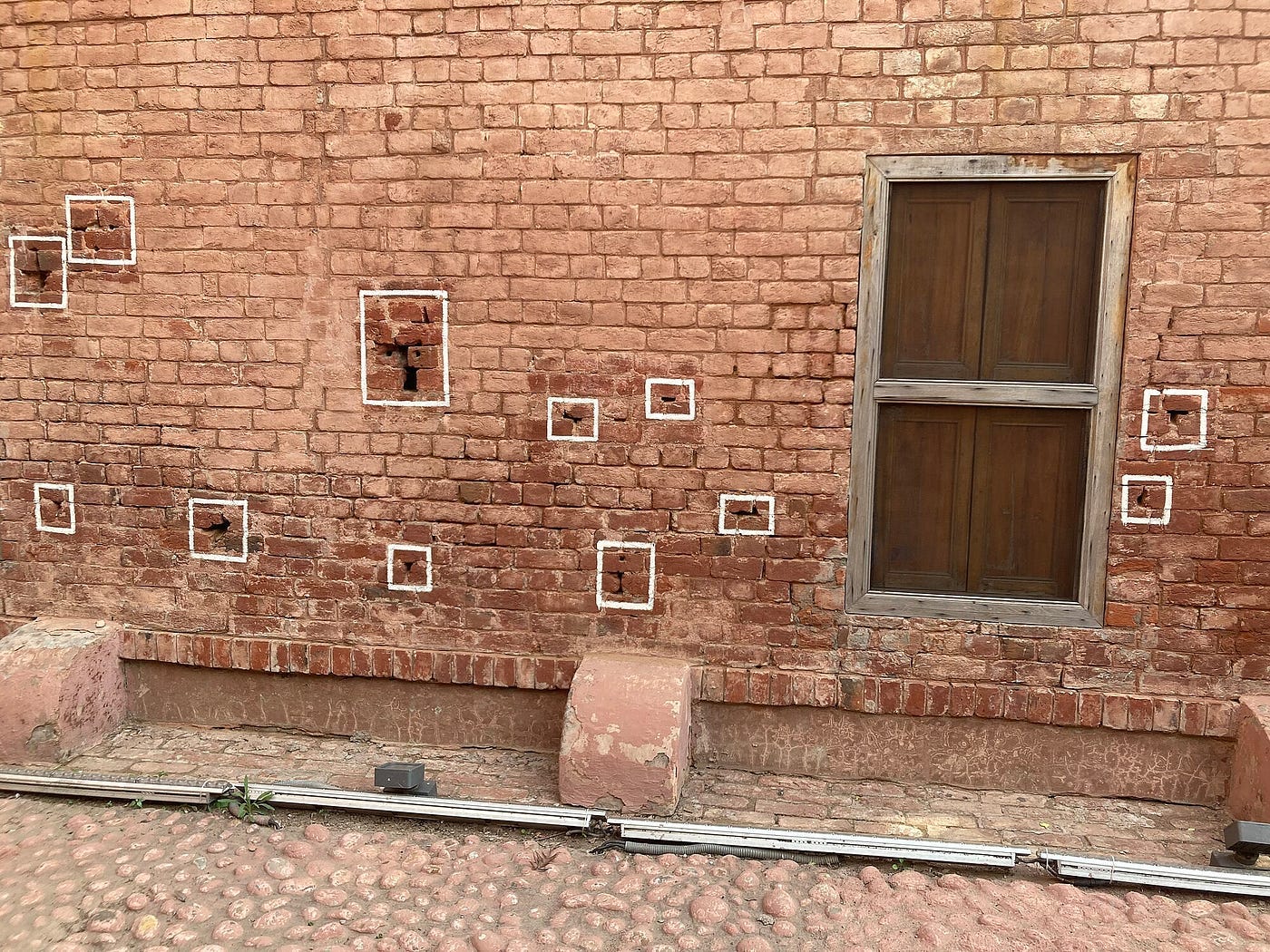
Preserved bullet indentations on the original brick walls of the Bagh, marking the height and trajectory of the 1,650 rounds fired. Via Wikimedia Commons (CC BY-SA 4.0)
Today, the sepia tones of 1919 have faded, but what remains is the pattern of the massacre — the closed exits, the controlled crowd, the calculated use of force.
Today, the Rowlatt Act no longer exists, but its skeletal logic remains the blueprint for modern governance.
It appears under different names: emergency powers, preventive detention laws, security frameworks that expand authority while shrinking accountability.
According to Human Rights Watch (World Report 2026), the world is experiencing a deepening democratic recession, with a significant majority of the global population — often cited around 70% or more — living under authoritarian or partially authoritarian systems. The language changes. The structure does not.
The defining horror of Jallianwala Bagh was not only the firing — it was the absence of escape.
In 2026, that absence has scaled.
The International Rescue Committee (Emergency Watchlist 2026) reports that just a small group of countries accounts for nearly 89% of people in humanitarian need.
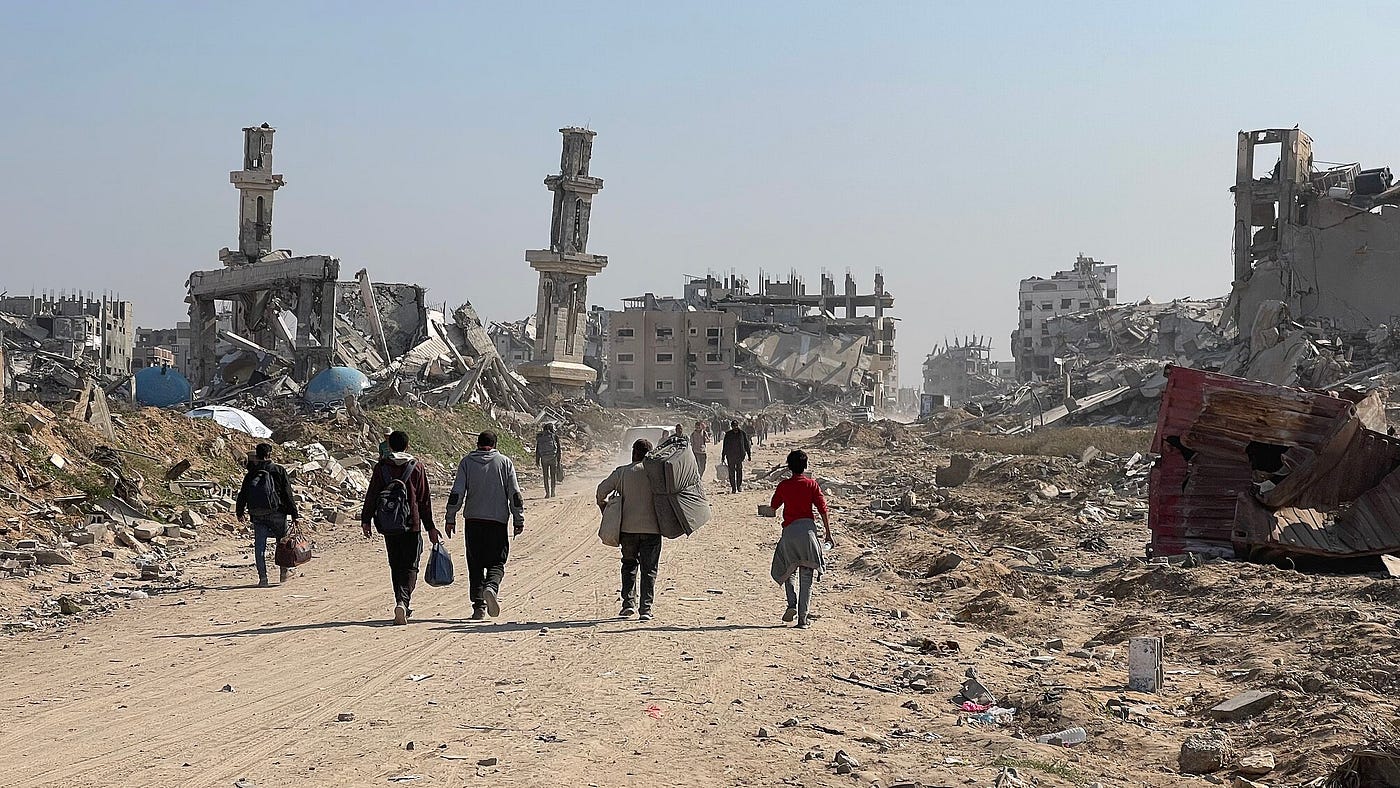
Forced Displacement of Gaza Strip Residents During the Gaza-Israel War, via Wikimedia Commons(CC BY-SA 4.0).
In places like Sudan and parts of the Middle East, civilians are often trapped in conditions where movement is restricted, aid is limited, and leaving is not an option.
The garden has expanded.
The International Committee of the Red Cross warns that modern conflicts are eroding the rules meant to protect civilians. Attacks on healthcare, displacement, and the collapse of basic services are no longer exceptions (International Committee of the Red Cross, 2026).
And then there is silence.
Where once information was controlled by colonial censorship, today it is obscured by digital blackouts and fragmented visibility. In 2026, the walls have become invisible, but no less impenetrable.
On April 7, 2026, the Imphal Valley (Manipur, India) became a modern-day Bagh. After suspected extremists hurled a bomb into a home in Moirang Tronglaobi, killing a five-year-old boy and a six-month-old girl, the state’s reaction followed the 1919 blueprint with startling precision. It was not just a security response; it was a total closure. The government ordered the immediate suspension of mobile data, Broadband, VSATs, and VPNs across five districts. And this is not something new for the state. A detailed discussion on the roots of this unrest is a matter for another time — and a much longer investigation.
When the internet goes dark, the exit is sealed. The numbers arrive late, or they do not arrive at all. While the Chief Minister chairs high-level meetings and refers cases to the NIA — painting the walls of justice with institutional procedure — the families of the victims are left in a garden of silence, trapped between the violence of the night and the "security" of the day.
News of the massacre spread across the country with startling speed. Rabindranath Tagore — who had become the first non-European Nobel laureate just six years prior — renounced his knighthood in a blistering letter to the Viceroy. Mahatma Gandhi returned the Kaisar-i-Hind medal. What had once been cautious negotiation began to shift into organized non-cooperation.
The illusion of a 'benevolent empire' could not survive the narrow exits of the Bagh; the massacre exposed the raw mechanics of imperialism, stripping away the carefully maintained facade of British civilization.
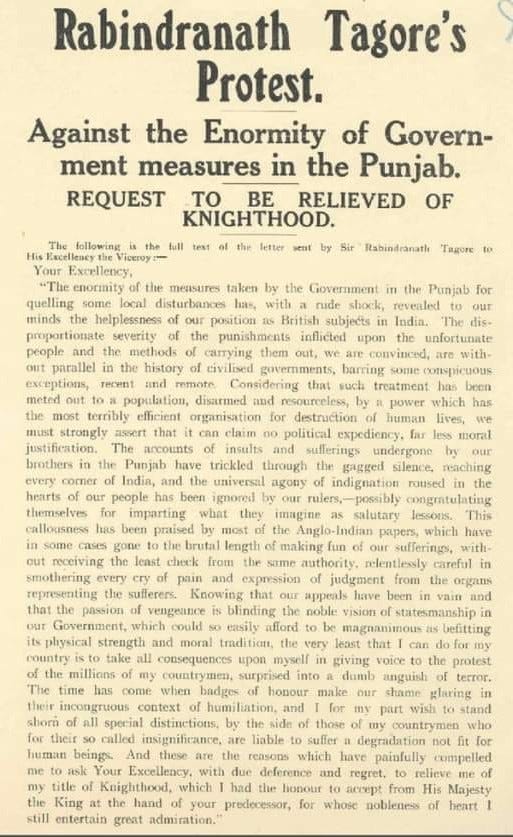
Rabindranath Tagore, the first non-European Nobel laureate, whose renunciation of his knighthood in 1919 signaled the moral collapse of British colonial authority. Image via Wikimedia Commons (public domain).
The "Jallianwala Bagh" is not confined to history. It appears wherever people are contained, unheard, and left without recourse. It emerges when law begins to shield power instead of protecting individuals.
To remember 1919 is to see clearly.
Because when the law stops protecting the people, even a garden can become a graveyard.
And the question is no longer what happened then but where, and to whom, it is happening now.
If you found this analysis of historical structures impactful, you may also want to read my investigation into the modern judicial and educational shifts of 2026:
As we mark another April 13th, we must ask: Are we opening the doors of justice, or are we simply painting the walls of the garden?
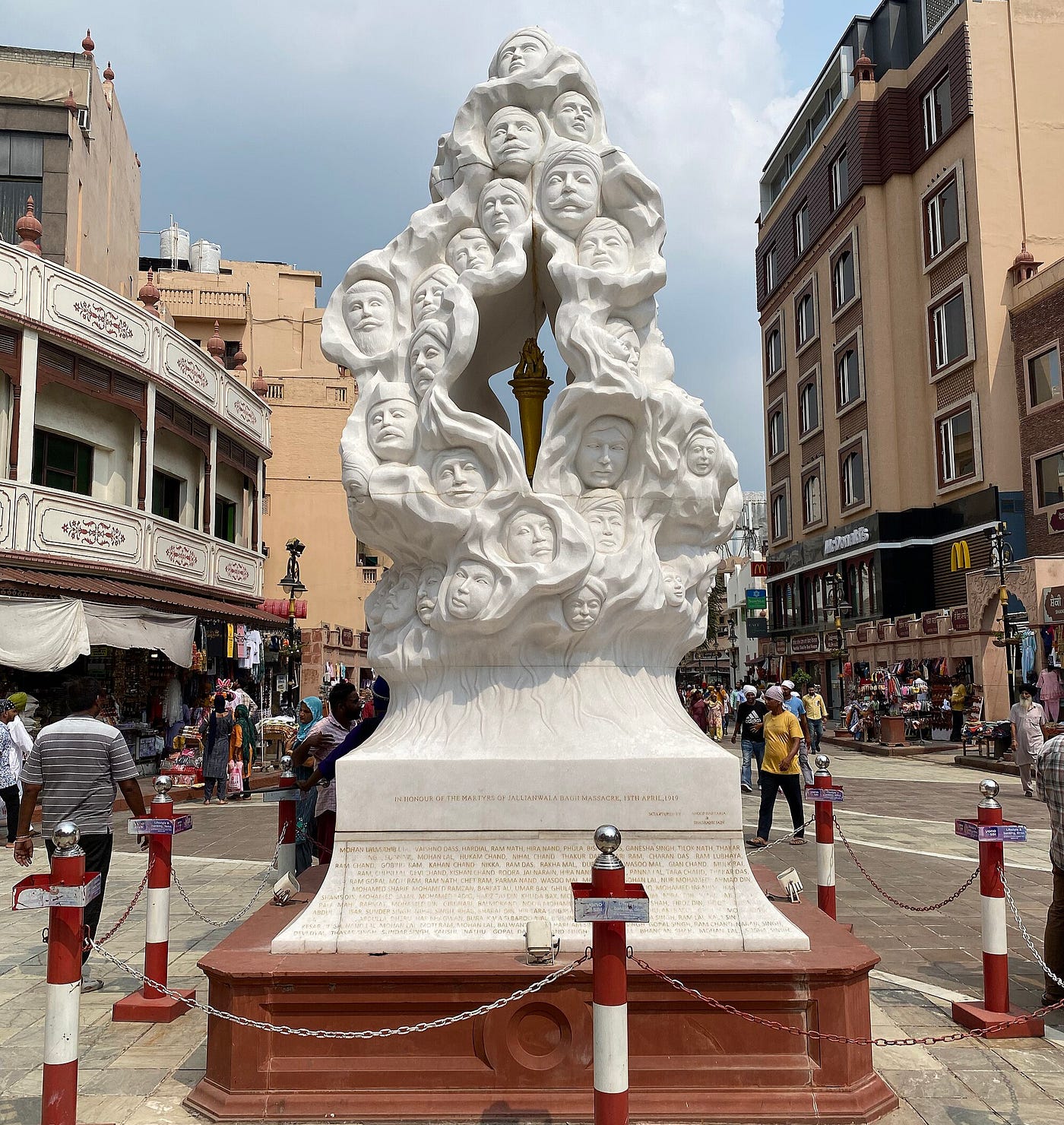
Jallianwala Bagh Memorial, Amritsar, India. Photo by Vinayaraj (Wikimedia Commons), cropped (CC BY-SA 4.0).
메타데이터
- post_id
- f647af873b9b
- slug
- painting-the-walls-of-a-massacre-f647af873b9b
- url
- https://medium.com/illumination-local-news-and-documentary/painting-the-walls-of-a-massacre-f647af873b9b
- canonical_url
- https://medium.com/illumination-local-news-and-documentary/painting-the-walls-of-a-massacre-f647af873b9b
- author_url
- https://medium.com/@vipulmaurya
- status
- ok
- fetched_at
- 2026-07-18 17:54:28