I Thought AI Would Help Me Work Faster. I Didn’t Expect It to Expose My Fears.
Most people talk about artificial intelligence as if it’s changing the future.
I Thought AI Would Help Me Work Faster. I Didn’t Expect It to Expose My Fears.
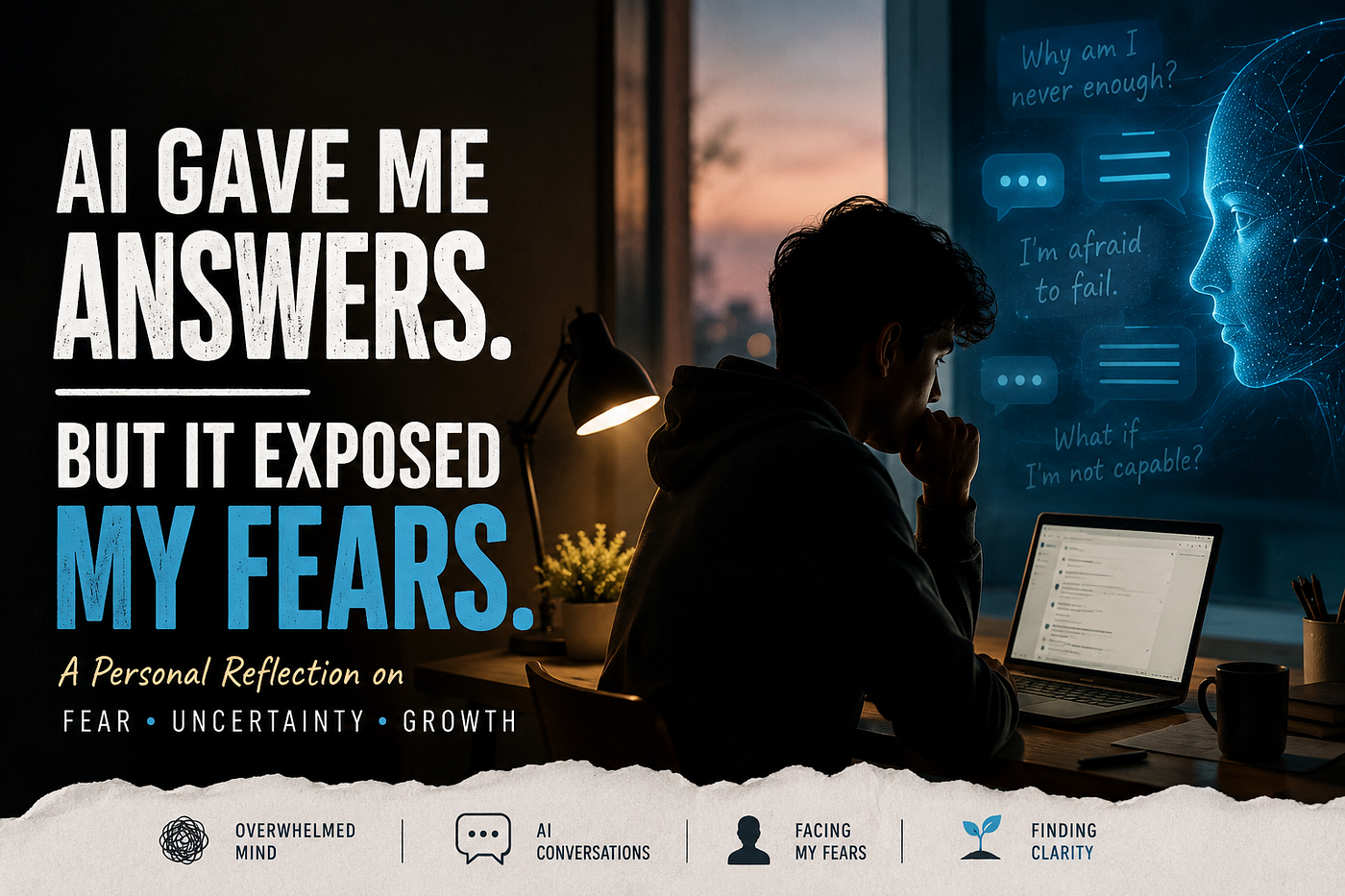
Most people talk about artificial intelligence as if it’s changing the future.
For me, it changed a quiet Tuesday evening.
Nothing dramatic happened that day. No breakthrough. No life-changing discovery. I was simply sitting in front of my laptop, exhausted after another day of trying to keep up with everything I thought I should already have figured out.
The screen was crowded with unfinished work. A document I couldn’t complete. Articles I had saved but never read. Notes filled with ideas that sounded exciting when I wrote them down but somehow felt meaningless when I looked at them later.
I remember staring at the blinking cursor longer than I was actually writing.
It wasn’t laziness.
It was something much harder to admit.
I was afraid.
Afraid that I wasn’t smart enough.
Afraid that everyone else was moving forward while I was standing still.
Afraid that if I finally gave something my best effort, it still wouldn’t be enough.
Those thoughts had been living quietly inside my head for months. I had simply become used to them.
That evening, almost without thinking, I opened an AI chatbot.
At first, I treated it like a search engine with better manners.
I asked questions about writing.
Then productivity.
Then learning.
Every answer arrived almost instantly.
It felt impressive, but something unexpected happened over the next few weeks.
The questions slowly stopped being about work.
Instead of asking how to write a better paragraph, I found myself asking why I struggled to start writing at all.
Instead of searching for ways to become more productive, I was trying to understand why I felt guilty every time I rested.
Without planning to, I had stopped using AI as a tool.
I was using it as a place where I could think out loud.
That realization made me uncomfortable.
Not because the conversations were strange.
Because they sounded painfully familiar.
When I looked back through them, I noticed a pattern I had never seen before.
Nearly every question carried an apology.
“I know this might sound stupid…”
“Maybe I’m overthinking…”
“I’m probably wrong, but…”
Nobody had asked me to write those words.
They appeared because somewhere along the way, I had started believing my thoughts needed permission before they deserved attention.
Seeing those sentences collected in one place felt like reading pages from a diary I didn’t remember writing.
For a while, I wondered whether AI had somehow uncovered something hidden inside me.
Eventually, I understood the truth.
It hadn’t discovered anything.
It had simply reflected what I was already carrying.
The fears were mine.
The uncertainty was mine.
The habit of doubting myself before anyone else could do it was mine too.
That realization stayed with me long after I closed my laptop.
One evening, after another long conversation with AI, I shut the screen and sat in complete silence.
No notifications.
No glowing cursor.
No perfectly structured responses.
Just my own thoughts.
At first, the silence felt uncomfortable.
I had become so accustomed to looking for immediate answers that I had forgotten how to sit with unanswered questions.
Yet something surprising happened.
The longer I stayed there, the less urgent everything seemed.
Not because my problems disappeared.
Because I finally stopped running from them.
For years, I believed confidence came from knowing the right answers.
Now I think it begins with asking honest questions.
Questions that don’t need to sound intelligent.
Questions that admit confusion instead of hiding it.
Questions that make room for growth instead of pretending we’ve already arrived.
Technology helped me reach that realization, but it didn’t create it.
The hardest part happened after I turned the computer off.
That’s where real change began.
Today, AI still has a place in my daily life.
It helps me brainstorm ideas when I’m stuck.
It explains concepts I don’t understand.
Sometimes it even challenges the way I think.
I’m grateful for that.
What I no longer expect it to do is quiet the voice inside my head that tells me I’m not enough.
That work belongs to me.
Some days I still catch myself hesitating before sharing an idea.
Some days I still question whether I’m capable of becoming the person I hope to be.
The difference is that I recognize those thoughts now.
I don’t mistake them for the truth.
Looking back, I realize the most valuable thing AI ever gave me wasn’t an answer.
It was a clearer view of the person asking the questions.
And perhaps that’s the strange gift of this technology.
It doesn’t just reveal how intelligent machines are becoming.
Sometimes, if we’re willing to pay attention, it quietly reveals the stories we’ve been telling ourselves all along.
Those stories can keep us trapped.
Or they can become the place where healing begins.
The choice, unlike any algorithm, has always been ours. And the one who will make a wise choice will win this game of life.
메타데이터
- post_id
- f656e87d3efb
- slug
- i-thought-ai-would-help-me-work-faster-i-didnt-expect-it-to-expose-my-fears-f656e87d3efb
- url
- https://medium.com/@faizanhash33/i-thought-ai-would-help-me-work-faster-i-didnt-expect-it-to-expose-my-fears-f656e87d3efb
- canonical_url
- https://medium.com/@faizanhash33/i-thought-ai-would-help-me-work-faster-i-didnt-expect-it-to-expose-my-fears-f656e87d3efb
- author_url
- https://medium.com/@faizanhash33
- status
- ok
- fetched_at
- 2026-08-16 19:45:22




