Why White People Brought Children to Witness Violent Lynchings
This was an effort to socially condition the next generation
PSYCHOLOGY
Why White People Brought Children to Witness Violent Lynchings
This was an effort to socially condition the next generation
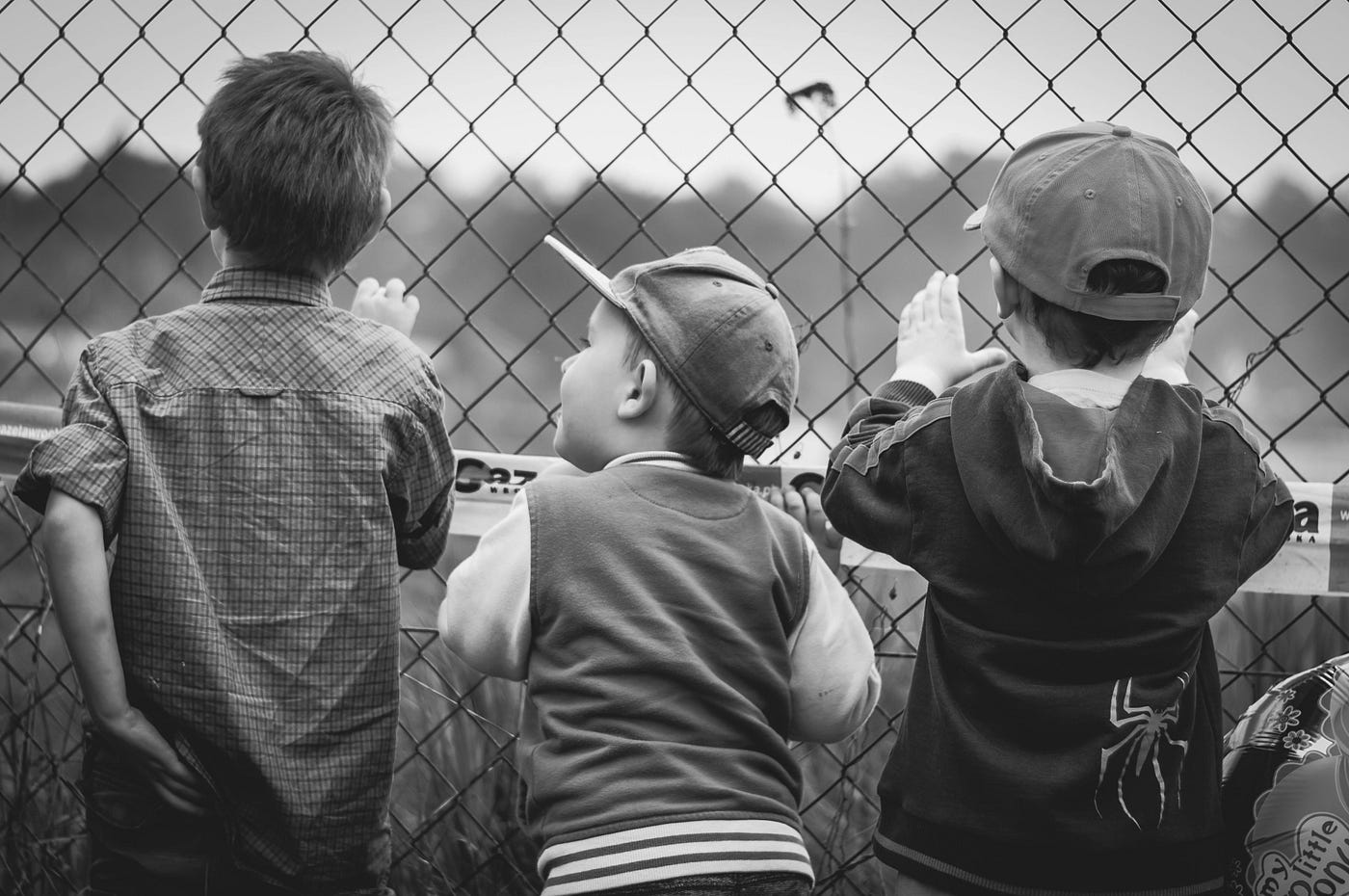
Three boys facing a fence, watching a game | Photo by Pixabay via Pexels
In my community, there's a quote painted on the side of a pale green house that reads, "A precondition to doing violence to any group of people or nation is to make them less than human.” It offers an answer to the question many have pondered after learning about acts of cruelty toward marginalized groups — how could this happen? For example, some are shocked to learn that White children often attended lynchings. This shameful history is rarely discussed, but it was common practice as witnesses treated these events like family affairs. They bought postcards and kept other souvenirs, as if they were visiting the gift shop of a theme park, rather than a homicide scene. Bringing children to witness racist mob violence was a form of social conditioning.
Americans often discuss racism as if discriminatory attitudes are the endgame. However, this prejudice frequently acts as a warning sign for racial violence. Lynchings are a clear example of this pattern. One NAACP pamphlet highlighted the 1935 lynching of Rubin Stacy. White people in Fort Lauderdale, Florida, claimed he was "threatening and frightening a White woman." According to his great-great niece, Tenille Brown, a group of White men not only lynched an innocent man but also shot him 17 times, "and tied [his body] to the back of a car and dragged.” Stacy's lifeless body can be seen hanging from a tree, surrounded by White people. The most disturbing part of the ordeal, aside from the senseless murder of a Black man, is the well-dressed children standing underneath the body, the youngest of whom was four years old. “Look at the seven WHITE children who gaze at this gruesome spectacle. Is it horror or gloating on the face of the neatly dressed seven-year-old girl on the right?" They asked, "What psychological havoc is being wrought in the minds of the white children?" questioning what kind of citizens they would become.
Upon learning of this example, some White people respond defensively. They may argue, for instance, that the children appearing in a photo at the lynching of Rubin Stacy are nothing more than an isolated event. But the gruesome tradition of postcards documenting these events reveals this critique as shallow. "Without Sanctuary," a book featuring lynching photographs, documents several instances where White children were present. One postcard, for example, shows an "unidentified African American male," hanging in a tree on September 3, 1915. The onlookers include "young boys," who seem unaffected by what they've seen. Another from 1920 depicts the "lynching of [a] gagged black male hanging from a tree in autumn." Among the onlookers are "mostly boys," who appear proud to be photographed alongside his lifeless body. The lynching of Lige Daniels on August 3 of the same year shows "onlookers, including young boys," some of whom seem to be snickering. This pattern persists.
What are we to make of this strange behavior—White parents taking children to participate in acts of violence against Black people? Even those aware of the nation's history of slavery and racial persecution may still be taken aback by the presence of children in such settings. Citizens cannot blame those living abroad. This tradition predates the World War II era German Nazis enlisting children in the Hitler Youth organization, where they were exposed to racist, antisemitic propaganda. It's uniquely American in that regard. While the chattel slavery created a racial hierarchy, racist laws and policies during Jim Crow sought to uphold it. Groups like the Children of the Confederacy (1896) and the Ku Klux Kiddies in the 1920s spread white supremacist ideology. Lynching Black people in front of White children exposed them to the experience of harming Black people without consequence. For those old enough to participate, lynchings became a rite of passage, similar to acts of violence gangs often require from new members.
Looking back at these images can be deeply upsetting for Black people who share familial ties and a racial identity with the victims. It serves as a stark reminder of how this nation has fallen short of its promise of "equal rights and justice for all." However, these images can also be unsettling for White people who feel uncomfortable with discussions about racism. Such events shatter the myth that race doesn't matter or that racism only reflects acts of personal prejudice. In reality, thousands of these incidents, with few individuals ever held accountable, show a clear pattern of systemic racism. As journalist Ida B. Wells noted in 1900, "our country's national crime is lynching. It is not the creature of an hour, the sudden outburst of uncontrolled fury, or the unspeakable brutality of an insane mob. It represents the cool, calculating deliberation of intelligent people." Lynchings rose in popularity after the Civil War, often used to terrorize black communities.
Quiet as it is kept, White people often brought their children to witness these horrific events. They did so to condition future generations to see Black people as less than human—the regularity of such events positioned these atrocities as normal. And while the practice of public lynchings is no longer socially acceptable, there is evidence that this culture has persisted in American society. For one, Black people remain the group most likely to be victims of violent hate crimes. They are nearly three times as likely to be killed by police as White people. And they are more than seven times as likely to be falsely convicted of serious crimes. Despite the passage of time and the efforts of many, Black Americans continue to live in a nation that treats them as second-class citizens.
Research has shown that parents' racial attitudes directly influence their children. One study found that White American children aged 3 to 6 were more likely to associate pictures of Black people's faces with negative emotions when their parents held anti-Black attitudes (Castelli et al., 2009). So, if parents are racist, it increases the likelihood that their children will adopt this worldview. Ruba et al. (2022) argued, "that the racial biases in emotion reasoning, which develop in early childhood, persist and contribute to miscommunications, inaccurate social perceptions, and negative interracial interactions later in life." While not every child with racist parents will embrace their views, their findings suggest that the racial attitudes of parents are significant influences. This problem is compounded in the wake of anti-critical race theory and anti-woke legislation that restricts or prohibits discussions about racism in the classroom.
What are the consequences of exposing White children to racial terror lynchings? The culture of anti-Black racism was further cemented by this process. Whenever this topic arises, someone scoffs at these crimes as ancient history. Yet, in recent years, some White children have engaged in mock lynchings, targeting Black children as victims. In 2017, an 8-year-old biracial boy "barely survived" after an attempted lynching by White teenagers in Claremont, New Hampshire. They yelled racial slurs and threw rocks at him, according to both the victim and his older sister. The mother recounted the incident, saying her son "got up on the table and put the rope around his neck, and another kid came from behind and pushed him off the picnic table. And they walked away and left him there, hanging." The local police chief described the event as an "accident," but considering the history of White people lynching Black people in this country, many suspected foul play.
A year earlier, in Waco, Texas, a 12-year-old Black girl faced a similar situation. She endured bullying from White students, who pushed her around but refused to speak to her or include her in activities. While playing on a swing set, she was "violently jerked to the ground." In an interview with the Dallas Morning, she said, "When it got around my neck, no one helped me, so I had to pull it off by myself." The wounds around her neck were visibly deep. Likewise, authorities dismissed the seriousness of the attempted lynching, trivializing it as a mistake. But children are not unaware of racism. They watch, listen, and learn from others. Sadly, in a society flooded with racism, they are likely exposed to harmful ideas, some of which justify violence against Black people. The best defense against such a worldview is to become anti-racist and actively reject racist ideas, beliefs, policies, laws, and systems. While controversial in this political climate, this reversal is an essential step toward restorative justice.
References
Castelli, L., Zogmaister, C., & Tomelleri, S. (2009). The transmission of racial attitudes within the family. Developmental Psychology, 45(2), 586–591. https://doi.org/10.1037/a0014619
DeAngelis, R. T. (2024). Systemic Racism in Police Killings: New Evidence From the Mapping Police Violence Database, 2013–2021. Race and Justice. https://doi.org/10.1177/21533687211047943
FBI hate crimes statistics. Community Relations Service. (2025, January 29). https://www.justice.gov/crs/news/2023-hate-crime-statistics#:~:text=Race%2DBased%20Crimes%3A%20Hate%20crimes,highest%20racial%20or%20ethnic%20category.
FBI Crime Data Explorer. (n.d.-a). Hate Crime in the United States Incident Analysis. https://cde.ucr.cjis.gov/LATEST/webapp/#/pages/explorer/crime/hate-crime
Florido, A., Lim, M., & Handel, S. (2022, February 7). How black activists used lynching souvenirs to expose American violence. NPR. https://www.npr.org/2022/02/07/1078930036/how-black-activists-used-lynching-souvenirs-to-expose-american-violence
Jones, C. (2023, October 3). Documentary recounts lynching of Black Man in Broward County. CBS News. https://www.cbsnews.com/miami/news/documentary-recounts-lynching-of-black-man-in-fort-lauderdale/
McGloin, C. (2024, November 5). Rubin Stacy: Lynched, Florida 1935: CRRJ. The Civil Rights and Restorative Justice Project | at Northeastern University School of Law. https://crrj.org/efforts/rubin-stacy-lynched-florida-1935/#:~:text=Rubin%20Stacy%2C%2030%2C%20was,custody%2C%20hung%20and%20shot%20him.
Patton, S. (2017, September 18). There’s a long history of white kids “play-lynching” black children | Dame Magazine. https://www.damemagazine.com/2017/09/18/theres-long-history-white-kids-play-lynching-black-children/
Report: Black people 7.5 times more likely to be wrongfully convicted of murder than whites, risk even greater if victim was white—death Penalty Information Center. (2025, March 14). https://deathpenaltyinfo.org/report-black-people-7-5-times-more-likely-to-be-wrongfully-convicted-of-murder-than-whites-risk-even-greater-if-victim-was-white
Ruba, A. L., McMurty, R., Gaither, S. E., & Wilbourn, M. P. (2022). How White American Children Develop Racial Biases in Emotion Reasoning. Affective Science, 3(1), 21. https://doi.org/10.1007/s42761-022-00111-y
🌹You can learn more about the author here and subscribe to the newsletter, *For Black Women.*
메타데이터
- post_id
- f65aa6164038
- slug
- why-white-people-brought-children-to-witness-violent-lynchings-f65aa6164038
- url
- https://medium.com/cultured-network/why-white-people-brought-children-to-witness-violent-lynchings-f65aa6164038
- canonical_url
- https://medium.com/cultured-network/why-white-people-brought-children-to-witness-violent-lynchings-f65aa6164038
- author_url
- https://medium.com/@allyfromnola
- status
- ok
- fetched_at
- 2026-06-13 07:35:29