Robotaxi Success May Have Nothing to with LiDAR.
Why Tesla’s 10 billion mile data lead may be the key to everything.
Robotaxi Success May Have Nothing to with LiDAR.
Why Tesla’s 10 billion mile data lead may be the key to everything.
Last October, on a rainy Saturday morning, a Waymo robotaxi made a routing error and drove onto US 101 just south of the Golden Gate Bridge.
The vehicle was not qualified for freeway operation. It stopped in the right lane, roughly 30 meters past an entrance ramp. There was no shoulder.
For 2 minutes and 18 seconds, nothing happened. Four cars routed around the stationary Waymo cleanly. Then a Honda SUV entered the freeway and tried to swing around it. The SUV clipped a pickup truck in the next lane. The pickup lost control, swerved right, crashed through a steel railing, and fell more than 15 feet onto a road below.
The Waymo never touched another vehicle. It just sat there. But its presence — frozen in a place no rational driver would stop — triggered a cascade that nearly killed two people.
That is not a sensor problem.
The Wrong Debate
The media feeds are full of armchair engineers who point to Tesla’s vision-only approach being ‘unsafe’ and that only full sensor arrays will be. But aside from not actual data confirming or refuting this claim yet, this frames around the wrong axis.
Does the vehicle need LiDAR, or is vision sufficient? Are five radars enough, or do we need eight? Capital has flowed accordingly — into Luminar, Ouster, Innoviz, Aeva, and the Mobileye hybrid stack — on the premise that more sensors meant more safety meant more autonomy.
That framing was always wrong.
The hard part of driving was never seeing. Anyone who has driven through Manhattan knows the cars are easy to spot. The hard part is predicting which one is about to do something stupid.
Anticipation — the ability to model what other agents will do half a second from now — is the actual battleground in autonomy. And anticipation is not built by stacking sensors. It is built by training neural networks on enough examples of human behavior that the system develops something like intuition for it.
We have written before that the real winner in the AI buildout is inference. The autonomy race is the same story playing out one layer below the data center. The companies that win will not be the ones with the best cameras or the most LiDAR units. They will be the ones with the best inference, trained on the largest behavioral dataset.
👉 Interested in more about Inference? Read — Inference Wins: Tesla, Nvidia & Google Lead AI’s Real Payoff in 2026

The Scaling Law Being Ignored
The reason this matters now, and not in the abstract, is that we now have peer-reviewed evidence that driving prediction scales with data the same way language modeling does.
A CVPR 2025 paper from Naumann et al. tested end-to-end autonomous driving architectures across internal datasets ranging from 16 hours to 8,192 hours of driving. Their finding was unambiguous: performance follows clean power-law scaling with training data. Unsurprisingly, larger models extract more gain from additional data in the high-data regime.
Lane keeping scales the steepest. Lane changes scale more slowly. Turning scales consistently up to roughly 8,000 hours before a plateau begins to emerge. The curves look remarkably similar to the Kaplan and Hoffmann scaling laws that underwrite the entire large language model industry.

Waymo published its own research in June 2025 confirming the same conclusion, using a 500,000-hour internal dataset. The blog post — written by Waymo’s own engineers — states plainly that data scaling is critical to model performance, that scaling inference compute also improves handling of more challenging driving scenarios, and that closed-loop performance follows a similar scaling trend.
That second point is significant for two reasons. First, the institution most incentivized to argue that data scale doesn’t matter — because it has dramatically less of it — published research saying it does. Second, the dataset Waymo used for that study was 500,000 hours of driving. Tesla, at an average speed of roughly 30 mph, has now logged the equivalent of more than 300 million hours of FSD-engaged driving.
That is a 600x data gap, not a 6x data gap. In a scaling-law regime, that kind of gap is not closed by clever engineering.
The 10 Billion Mile Threshold
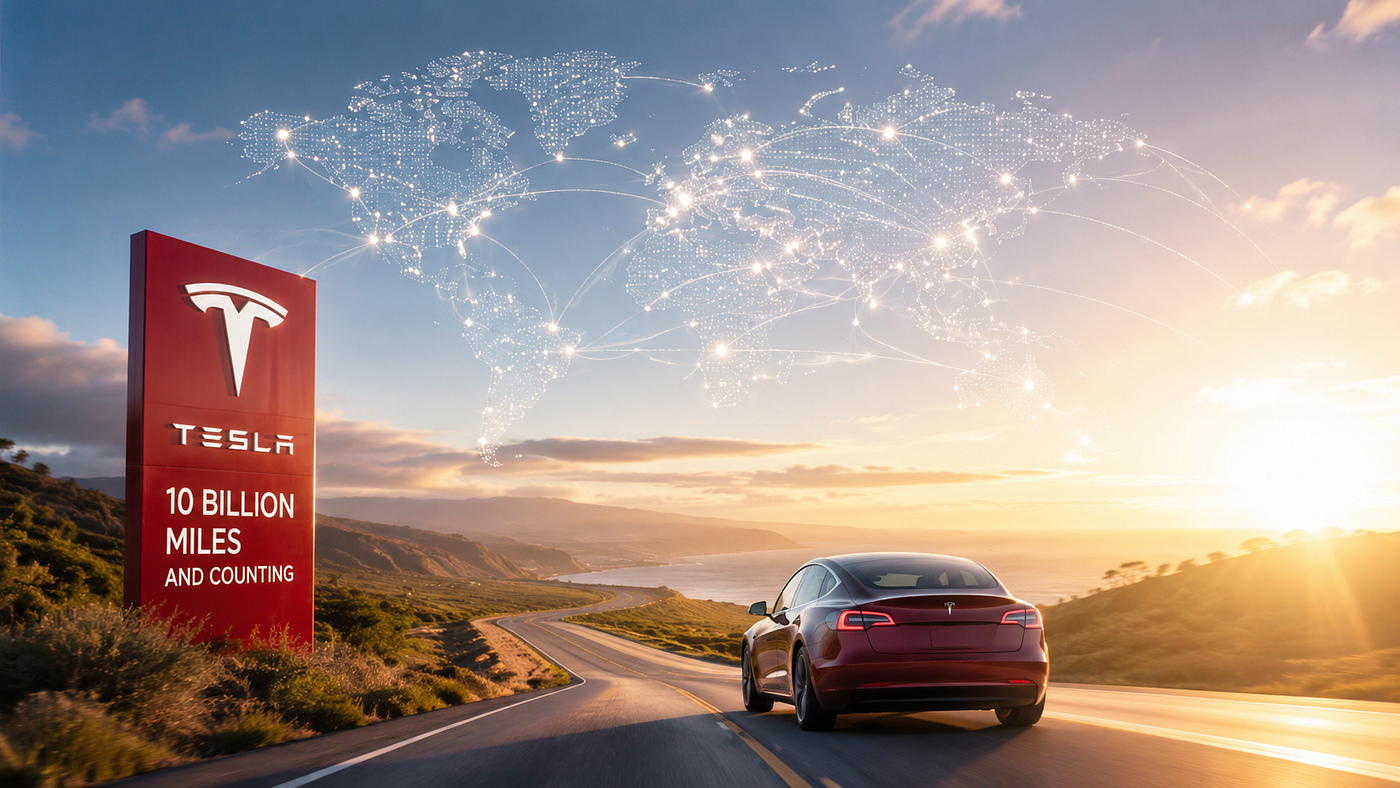
On January 8, 2026, Elon Musk posted on X that roughly 10 billion miles of training data would be needed for safe unsupervised self-driving. He cited the “super long tail of complexity” in real-world driving as the reason the bar was higher than his previous 6 billion mile estimate.
Tesla crossed that threshold the first week of May.
The Tesla FSD Supervised fleet is now adding roughly 29 million miles per day to the training corpus, up from 14 million per day at the start of 2026. The acceleration is itself accelerating. The fleet went from 7 billion miles to 8 billion in 53 days. Then 8 to 9 billion in 43 days. Then 9 to 10 billion in 31 days.
Waymo, by comparison, crossed 170 million cumulative autonomous miles in December 2025 and is adding roughly 15 million miles per month. That is a different unit of measure entirely. Tesla adds Waymo’s entire monthly mileage every 12 hours.
Now — to be fair to the skeptics — Musk has been spectacularly wrong about FSD timelines for a decade. The 10 billion mile figure was itself a moved goalpost. Unsupervised consumer FSD has been pushed to Q4 2026 at the earliest, and even that timeline carries caveats. We are not arguing that Tesla flips a switch this year and Level 4 is solved.
We are arguing something different. The data flywheel is real. It is mathematical and it is compounding. Whatever the unsupervised launch date turns out to be — if at all — the inference advantage is structural and widening.
👉 This matters most for Tesla’s Robotaxi. Here’s why it is such a challenge — Tesla’s Robotaxi Gamble: The Last Mile Is a Bitch
What The Waymo Crash Reports Actually Reveal
The most useful empirical data on this thesis comes from reading Waymo’s own NHTSA filings.
Timothy Lee’s Understanding AI Substack reviewed 78 serious crashes Waymo reported between mid-August 2025 and mid-March 2026, across roughly 100 million driverless miles.
The headline finding: most of the crashes were caused by human drivers running into Waymos. 48 of the 78 were rear-end collisions into a stationary or slow-moving Waymo. That is precisely the failure mode Tesla’s small Austin robotaxi fleet has experienced — most of its incidents to date have been rear-end hits while the Tesla was stationary, with the human driver clearly at fault.
The Waymo number, in aggregate, is not bad. The company claims an 82% reduction in injury crashes relative to human drivers in the same geographies, and the data appears to support that claim. We are not arguing Waymo is unsafe. It clearly is not.
But look more carefully at the mistakes Waymo’s vehicles did make. The pattern, in Lee’s framing, is “mistakes of excessive caution.”
The Golden Gate freeway incident above is one example. A Waymo in Miami stopping diagonally across a highway on-ramp for 45 minutes when it hit a geofence boundary is another. A Waymo in Scottsdale that ran over a teenager’s foot at 4 mph after he opened the door at 35 mph — and then remained parked on his foot for more than eight minutes, because its post-crash protocol said not to move — is a third.
These are not perception failures. The Waymo saw everything correctly in each case. They are failures of judgment — of anticipating what the right action was given the full context.
They are inference failures.
If you read the incident reports from the NHTSA database, they mostly point to human driver’s fault, but reading them carefully you begin to see some curious events. These are actual incident descriptions from the latest AV report:
March 2026 at 9:09 AM CT in Austin, Texas
“The Waymo AV was traveling southbound on [XXX] when it approached a passenger car that was stopped facing east, perpendicular to the roadway, partially in the adjacent center two-way left turn lane and partially in the northbound lane on [XXX], attempting a multi-point turn. While the Waymo AV proceeded straight, the passenger car began to reverse, entering the Waymo AV’s lane of travel, and the rear right side of the passenger car made contact with the rear left side of the Waymo AV.”
The interesting question is whether a system with stronger behavioral anticipation would have adjusted earlier to this unusual situation.
March 2026 at 6:45 PM PT in San Francisco, California
“The Waymo AV was stopped in-lane facing east on [XXX] to yield to a pickup truck that began to reverse in-lane directly in front of the Waymo AV in an attempt to parallel park at the curb on the right side. While the Waymo AV was stopped, the pickup truck proceeded forward into the roadway before coming to a stop in-lane. The Waymo AV proceeded forward momentarily to begin passing the pickup truck on the left, then slowed to a stop behind the pickup truck as the pickup truck began reversing again. The pickup truck continued to reverse towards the right curb, and the rear left side of the pickup truck made contact with the front right side of the Waymo AV.”
Again, would a more adaptive system accommodate a truck trying to park without an incident? Almost certainly — ‘yes’.
March 2026 at 2:10 AM CT in Austin, Texas
“The Waymo AV was traveling eastbound on [XXX] in the rightmost lane when an SUV traveling northbound in a parking lot at [XXX] exited the parking lot without stopping and entered the Waymo AV’s lane of travel. The Waymo AV began to maneuver to the adjacent left lane, and the front left side of the SUV made contact with the rear right side of the Waymo AV.”
Perhaps, this may have been unavoidable, but perhaps maybe not — anticipating even a small chance of the human driver breaking the rules could be enough to adjust and avoid incident.
The question worth asking about every Waymo near-miss in the recent reports is the same: would a system trained on 10 billion miles of human anticipation have handled this differently?
We think the honest answer is probably yes, in many of these cases. Not all. But enough to matter.

The Investor Implications
If anticipation is what wins, and if scaling laws govern its development, the current market structure is mispriced.
The LiDAR pure-plays — Luminar, Ouster, Innoviz, Aeva — have been valued on the premise that sensor fusion is non-negotiable for L4 autonomy. That premise was always contested, but it was at least defensible.
With Tesla now publicly demonstrating scaling effects on a vision-only stack at a data scale no peer can match, the premise becomes harder to defend.
Mobileye sits in a more nuanced position. Its hybrid approach is more pragmatic than the LiDAR purists, but it still bets on sensor differentiation as the path to defensibility. If inference quality, not sensor configuration, is what wins, Mobileye’s competitive position depends on data partnerships it does not fully control.
Alphabet’s Waymo continues to operate the most refined autonomous service in the world. Its safety record in deployed conditions is genuinely excellent. But its structural problem is one of throughput.
Waymo cannot collect data at Tesla’s rate without first deploying vehicles, and it cannot deploy vehicles at Tesla’s rate because each Jaguar I-PACE robotaxi costs multiples of a Tesla. The deal with Hyundai will help in the future.
The Waymo data flywheel is not broken. It is just slower by roughly two orders of magnitude, and that gap is widening every day.
Tesla, at current valuations, is priced for many things — EV growth, energy storage, Optimus, the AI compute buildout. The autonomy thesis is in there too, but it remains contested by analysts who anchor on Musk’s history of missed timelines rather than the empirical evidence that the underlying data flywheel is producing scaling-law-consistent improvement.
The investor question is not “will Tesla solve full autonomy by Q4 2026.” It almost certainly will not, on Musk’s stated timeline. The better question is: if anticipation is the durable edge, and Tesla’s training corpus is now an order of magnitude larger than the next competitor’s, what is that asymmetric position worth — and is the market pricing it?
👉 Our read: Tesla positions are in our Portfolio. The asymmetry is in the data and as more real-world results are compiled the asymmetry of Tesla’s advantage will likely become clearer. (You can see that Here as an Evervests Portfolio member).
What This Thesis Doesn’t Prove
The disciplined version of this argument requires acknowledging what the evidence does not show.
It does not show that Tesla has solved unsupervised autonomy in any demonstrable scale. The autonomous fleet is small. The entire autonomous robotaxi autonomous pool is at 39 vehicles at last look.
Every FSD timeline Musk has ever given has slipped.
It does not prove scaling laws will hold all the way to L5. The Naumann paper saw plateaus emerge in turning scenarios past 8,000 hours. Tesla operates in regimes where no peer-reviewed scaling studies exist. The long tail of edge cases — the precise reason Musk moved the goalpost from 6 to 10 billion miles — may prove resistant to pure data scaling.
It does not show that vision-only is strictly better than sensor fusion. It shows that vision-only with vastly more data may produce better anticipation than sensor fusion with less data. Those are different claims, and the distinction matters.
And it does not address whether regulators will accept the argument when they ultimately decide whether to grant unsupervised operation at scale, regardless of what the empirical data shows.
What it does show is that the entire autonomy debate has been framed around the wrong axis.
The market has been pricing a sensor race. The actual race is an inference race. And in inference races, the company with the most behavioral training data has a structural advantage that compounds.
That is not a Tesla cheerleading position. It is an observation about which advantage actually matters and who currently holds it.
Month by month data will continue to be released. The latest NHTSA reports will be scrutinized. When the sample sets are large enough, the performance will be measured and the results become clear.
For now, the questions for investors should not be about LiDAR specs or pixel counts. They should be about which companies in this stack are still being valued on the old framing, and how long the gap between framing and reality can persist before the market and supporting data catches up.
Thank you for reading.
👉 Want to get market updates first, consider becoming a member at Evervests.com. All articles, investment research, resources and even our investment portfolio are all available.
Images: Unless specifically noted, all charts were created by Evervests.com.
Disclaimer: This content is for informational and educational purposes only and should not be considered financial, investment, or trading advice. The views expressed are based on publicly available information and analysis at the time of writing. Markets and conditions change. Always perform your own research, verify data independently, and consult with a licensed financial advisor before making investment decisions. The author may hold positions in the securities discussed.
메타데이터
- post_id
- f664d22b50b3
- slug
- robotaxi-success-may-have-nothing-to-with-lidar-f664d22b50b3
- url
- https://ai.plainenglish.io/robotaxi-success-may-have-nothing-to-with-lidar-f664d22b50b3
- canonical_url
- https://ai.plainenglish.io/robotaxi-success-may-have-nothing-to-with-lidar-f664d22b50b3
- author_url
- https://medium.com/@joe_62117
- status
- ok
- fetched_at
- 2026-06-09 15:37:30