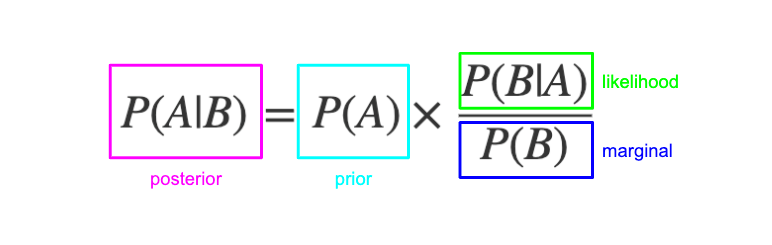
Bayesian probability
Bayesian probability is a way of representing uncertainty about the likelihood of an event happening, based on prior knowledge or evidence…
Bayesian probability

https://www.freecodecamp.org/news/content/images/2020/07/Screenshot-2020-07-19-at-22.58.48.png
Bayesian probability is a way of representing uncertainty about the likelihood of an event happening, based on prior knowledge or evidence. It is a mathematical framework that allows us to update our beliefs about an event as new evidence becomes available.
Here is an example of Bayesian probability: Imagine that you are trying to predict the weather tomorrow. You might start by looking at the forecast, which says that there is a 60% chance of rain. This is your prior belief about the likelihood of it raining tomorrow. But then, as you learn more about the weather (e.g., you see dark clouds forming), your belief about the likelihood of it raining tomorrow might change. This updated belief is called the posterior probability.
Another example of Bayesian probability is when you are trying to diagnose a medical condition. You might start by looking at the symptoms of the patient, which suggest a certain diagnosis. This is your prior belief about the diagnosis. But then, as you learn more about the patient (e.g., you order a blood test), your belief about the diagnosis might change. This updated belief is the posterior probability of the diagnosis.
Bayesian probability works by combining prior knowledge or evidence with new evidence to update our beliefs about the likelihood of an event happening. The steps involved in using Bayesian probability are as follows:
- Identify the event or outcome that you are trying to predict or estimate. This could be anything from the weather tomorrow to the likelihood of winning a game.
- Gather any available information or evidence that is relevant to the event. This could be the forecast for tomorrow’s weather or the record of a sports team.
- Use the information or evidence to calculate the prior probability of the event happening. This is your initial belief about the likelihood of the event happening before you have any additional evidence.
- Acquire new evidence or information about the event. This could be observations, experiments, or additional data.
- Use the new evidence to update the prior probability and calculate the posterior probability of the event happening. This is your updated belief about the likelihood of the event happening, after taking the new evidence into account.
- Use the posterior probability to make a decision or prediction about the event. This could be a forecast, a diagnosis, or a recommendation.
By using Bayesian probability, we can incorporate new evidence and update our beliefs about the likelihood of an event happening, in order to make more accurate predictions or decisions.
메타데이터
- post_id
- f681ae5b40bf
- slug
- bayesian-probability-f681ae5b40bf
- url
- https://medium.com/@vinay1996/bayesian-probability-f681ae5b40bf
- canonical_url
- https://medium.com/@vinay1996/bayesian-probability-f681ae5b40bf
- author_url
- https://medium.com/@vinay1996
- status
- ok
- fetched_at
- 2026-07-23 00:21:48