The Essential Storytelling Library
12 Books. Zero Fluff. An anti-listicle for mastery.
The Essential Storytelling Library
12 Books. Zero Fluff. An anti-listicle for mastery.
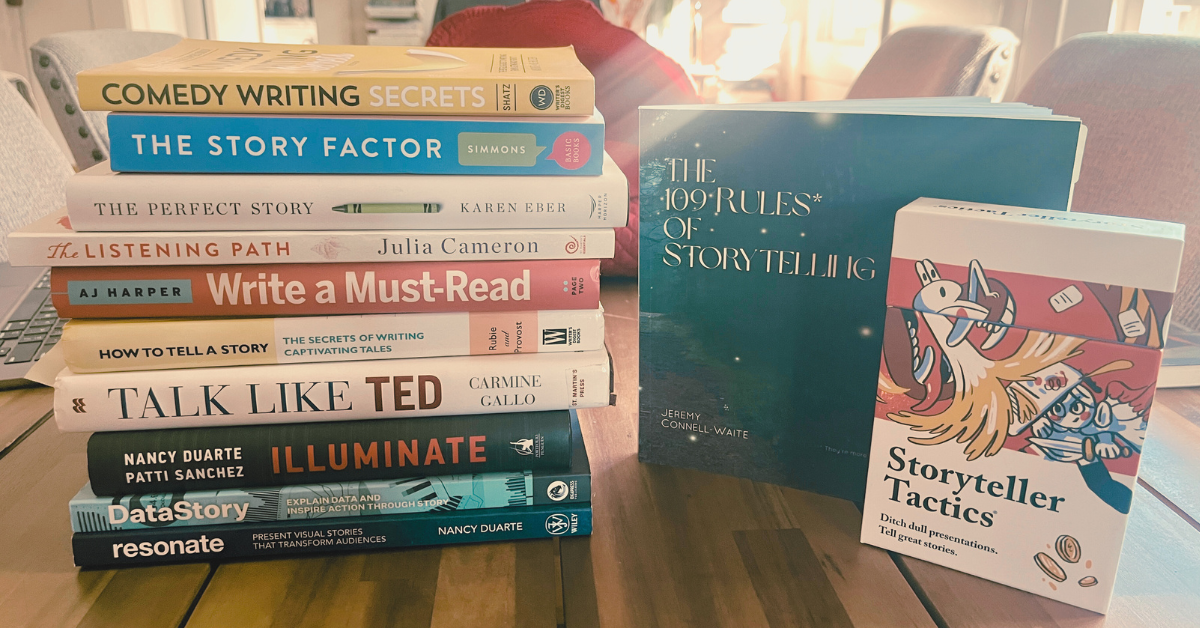
Image by author
The Listicle Paradox
I’m about to do something that might seem contradictory: write a listicle about storytelling, the very format Benjamin Cain describes as “tea leaves at the bottom of a mug.”
But here’s the twist: a list without context is just data. Add intention, narrative, and a little lived experience, and it becomes a toolkit. And if there’s any skill worth building a real toolkit for in 2026, it’s storytelling.
This library is built for that purpose.
Not a Medium member? Read for free
In 1997, Steve Jobs said something that rewired how I saw the world: “The most powerful person in the world is the storyteller.” That quote didn’t just inspire me; it funded my entire education.
Strategic storytelling has opened doors, built trust, shifted perspectives, and created opportunities I never imagined. It’s the skill that makes us memorable when credentials blur together. It’s what transforms data into meaning and information into influence.
If you want to read more while investing in one skill that will yield dividends for decades, go deep with storytelling. Here are twelve books, twelve tools, that will keep doing the hard work for both me and you.
I. Tools for Nurturing and Stewarding Stories
1. The Listening Path by Julia Cameron
Julia Cameron has been a steady force for creatives experiencing drought, and I was among them. For me, those droughts followed long stretches of academic work — finishing a master’s degree, writing a doctoral dissertation, publishing dense scientific articles and grant proposals.
I felt like a recovering academic who had forgotten how to write, ironic since writing was all I had done. My head was filled with long, compound sentences, APA-style references, and hermetic academic quotes. I could construct an argument, but I’d lost my voice.
Cameron’s iconic The Artist’s Way introduced me to morning pages and artist dates. But it was *The Listening Path* that taught me something I desperately needed: that finding your story (before you can appreciate others’ stories) begins with learning to listen again.
Through practices like focused-attention walks and deliberate silence, you’ll start hearing things you’ve tuned out: the rhythm of your own thoughts, the stories embedded in ordinary moments, the voice that is drowned out by academic rigor (for me) or the noise all around us.
This is a crucial practice in a time when stuck writers and creatives are tempted to run to AI to produce what won’t flow from within. And though AI can generate content, it can’t listen to your life.
It can’t hear the story only you can tell.
The raw material of great storytelling isn’t found in prompts or algorithms. It’s found in attention. In listening. In the willingness to sit with silence until something authentic emerges.
2. The Perfect Story by Karen Eber
I’ll never forget sitting in a lab meeting with other grad students and a faculty mentor. It was a place meant for asking questions. Yet, when a student asked for tools to evaluate qualitative data collected from subjects’ stories, the mentor said, “I have no idea. I’m a scientist.” It was a sad reminder that hard sciences have historically been elevated over the social sciences where shared stories (qualitative data) live.
Yet times are changing. We’ve discovered that while numbers might be the bones and sinew of a data story, it’s the actual stories, the details and the voices, that provide the skin, the color, the heart.
Neuroscience has shown us that story shapes how we feel toward one another, how we trust, how we develop empathy. Karen Eber brings this science to life, showing how stories activate our brains differently than data alone, how they create neural coupling, release oxytocin, and make information stick.
This book gives you tactics too, but starting with the science matters because understanding how stories function in the brain gives you the foundation for everything that follows: the shaping, the delivery, the impact. It’s not just philosophy or inspiration. It’s biology. And once you understand the mechanism, you can’t unknow it.
II. Tools for Shaping Your Stories
3. The Story Factor by Annette Simmons
I still have my first edition, the very first book I ever bought on the art and craft of storytelling. I stumbled across it by accident when I was an up‑and‑coming corporate leader: green, ambitious, armed with technical skills but lacking the one trait that separates competent leaders from the ones people choose to follow — influence.
Annette Simmons teaches six stories every leader should be able to tell: “Who I Am,” “Why I Am Here,” “Vision,” “Teaching,” “Values in Action,” and “I Know What You’re Thinking.” These became my staples, helping me sell myself and advocate for my projects even when they didn’t seem to fit neatly under my job description.
Those six story types still run on autopilot. When I’m meeting a new client, I reach for a “Who I Am” story. When I’m proposing something unconventional or must address an elephant in the room, I deploy “I Know What You’re Thinking” to disarm resistance. Simmons gave me a portfolio before I even knew I needed one, and that portfolio has paid dividends for over two decades, for which I’ll be forever grateful.
4. How to Tell a Story by Peter Rubie and Gary Provost
When one of your favorite authors credits this book for learning how to write her first and second bestseller, you buy it. It walked me through the story in my own first book and has remained a go‑to whenever story‑writing anxiety creeps in.
Then I remember: every sentence must fight for its right to exist, and each line must advance the story, reveal character, or build emotion. Does this detail move us forward? Does it deepen understanding? Does it create a feeling? And just like that, I’m on my way again.
This one will make you better at understanding story structure even if you never want to write a book.
5. Write a Must-Read by AJ Harper
Whether you’ve spent your days writing academic articles or crafting a Medium story, it’s easy to succumb to the temptation of showcasing what you know instead of serving the needs of readers.
AJ Harper’s “Reader First” philosophy reorients that mindset, teaching that the best writing and story doesn’t just informs, it transforms. It transforms the reader and you, the writer or storyteller.
You’ll understand that a “must-read” or a story worth listening isn’t about being clever; it’s about being clear, honest, and committed to changing someone’s life, even if just a little.
III. Tools for Delivering Great Stories
6. *Talk Like TED *by Carmine Gallo
What storyteller or change-maker doesn’t dream of standing on a TED stage? If you have an “idea worth sharing,” that opportunity may come knocking. But when I say lucky, I’m thinking of that old adage:
Luck is when preparation meets opportunity.
Talk Like TED became a priceless resource when Brandon Steppe, founder of The David’s Harp Foundation, needed help preparing his TED talk, [True Mentorship Requires Bold Transparency](http://True Mentorship Requires Bold Transparency).
It remains an excellent guide to the art of storytelling and a constant reminder of why — and how — the best presentations don’t feel like presentations at all. They feel like conversations with someone who cares deeply about an idea and wants to share it generously.
7–9. The Definitive Duarte (and Patti Sanchez) Library: Resonate, Illuminate, and DataStory
After hearing Nancy Duarte’s TED talk, *The Secret Structure of Great Talks*, I decided to invest in the Duarte library, one book at a time. These three volumes continue to be essential reference manuals — part art, part science, part inspiration, part tactics.
- ***Resonate** teaches how to structure presentations that transform audiences by understanding the rhythm of what is versus what could be*.
- ***Illuminate*** shows how leaders guide people through change using stories, ceremonies, and symbols.
- ***DataStory*** walks through the steps that make mere data meaningful by learning to understand and then articulate the story behind the data.
Together, they’re not quick reads or easy tactics; they’re meaty, well-researched journeys for the committed storyteller who wants to do more than inform. They want to transform.
IV. Tools for Sharpening Your Storyteller’s Edge
10. Storyteller Tactics by Pip Decks
Sometimes you don’t need another book on the philosophy of storytelling or a comprehensive framework. Sometimes you just need a timely, clear, simple, and immediately actionable tactic. This card deck is the equivalent of having a strategic playbook on your fingertips.
It offers recipes, concepts, and frameworks like “The Hero’s Journey,” “Problem–Solution–Benefit,” and “Before–After–Bridge” in a format you can use on the spot.
It’s also a fun tool for collaborative story-building, drawing from time-tested structures on character, style, and organization.
11. The 109 Rules of Storytelling by Jeremy Connell-Waite
This little workbook has quickly become one of my favorite companions.
Part philosophy, part inspiration, part invitation to get to work right away, it synthesizes ideas from Plato to the latest neuroscience of narrative, layered with Connell-Waite’s personal twist and generous sharing of resources on LinkedIn.
Like Storyteller Tactics, it’s learn-by-doing, learn-as-you-go, and build-mastery-through-practice. You don’t just read it; you use it. And that’s where the transformation happens.
12. Comedy Writing Secrets by Mel Helitzer and Mark Shatz
This is a must-have for anyone who wants to embed humor more effectively into story structures. Like most people, I can be very funny (at time) but until this book came along, I didn’t know why… or why the attempt to be funny sometimes flopped.
You learn that being funny isn’t about telling jokes. It’s about telling truth in a way that opens the mind and invites partnership, because what’s better than sharing a laugh together?
Understanding the mechanics of comedy, like timing, surprise, specificity can make you a more intentional storyteller. It’s not about becoming a comedian. It’s about earning trust through moments of levity and connection.
What’s Missing
Reading lots and lots of stories. Fiction. Nonfiction. Watching comedy shows. Consuming TED talks and paying attention to how stories are strung together. Seeing the tools in action, then refining yours based on what you observe and put into practice.
Your Turn
Let me say it again: If you invest in mastering one skill this year, make it storytelling.
These twelve tools can transform your inate ability to tell stories to a master storyteller who can move hearts and minds and even transform the world one life at a time.
If you are ready, let’s go!
Maria
P.S. What book/tool would you add to this list?
And if you are still considering how to close out your year with more intention, you may be interested in …
Note. This piece includes book affiliate links, which may help support this piece at no additional cost to you.
메타데이터
- post_id
- f690bf336503
- slug
- 12-books-zero-fluff-the-anti-listicle-storytelling-library-f690bf336503
- url
- https://medium.com/the-structural-skills-project/12-books-zero-fluff-the-anti-listicle-storytelling-library-f690bf336503
- canonical_url
- https://medium.com/the-structural-skills-project/12-books-zero-fluff-the-anti-listicle-storytelling-library-f690bf336503
- author_url
- https://medium.com/@drmariakeckler
- status
- ok
- fetched_at
- 2026-06-15 20:49:13