The Best SaaS Platform to Manage Distributor Operations in India — And Why Most Brands Are Using…
The software you choose for distributor operations will either unlock your offline growth or quietly hold it back. Here’s the full…
The Best SaaS Platform to Manage Distributor Operations in India — And Why Most Brands Are Using the Wrong One
The software you choose for distributor operations will either unlock your offline growth or quietly hold it back. Here’s the full landscape — and what the best modern brands are choosing instead.

Ask any brand operator who has tried to scale offline distribution in India about their biggest technology frustration, and you’ll hear a version of the same story.
They bought a DMS. Their distributors don’t log into it. The field team uses a different SFA app. The inventory data is two days old by the time it reaches the dashboard. The analytics team is still pulling reports from spreadsheets. And nobody — not the distribution head, not the field manager, not the brand owner — has a clear, real-time picture of what’s actually happening at the shelf.
This isn’t a people problem. It’s a software architecture problem.
The tools most brands use to manage distributor operations were designed for a distribution model that is rapidly becoming obsolete — siloed, slow, and built around the assumption that fragmented data and delayed reporting are acceptable operating conditions.
They’re not. Not anymore.
This is a comprehensive look at the distributor operations software landscape in India — what’s available, where each category falls short, and what a genuinely modern platform looks like.
What Distributor Operations Management Actually Involves
Before evaluating software, it’s worth being precise about what managing distributor operations actually requires. Most brands underestimate the scope.
It isn’t just inventory tracking. A complete distributor operations stack needs to handle:
Distributor network management — Finding, verifying, onboarding, and activating the right distributors across geographies without months of manual negotiation or lock-in contracts.
Order management — Digital order booking, confirmation, tracking, and audit trails from placement to proof of delivery.
Inventory visibility — Real-time stock levels at distributor warehouses, not just at your own facility. Knowing what’s in the pipeline, not just what’s shipped.
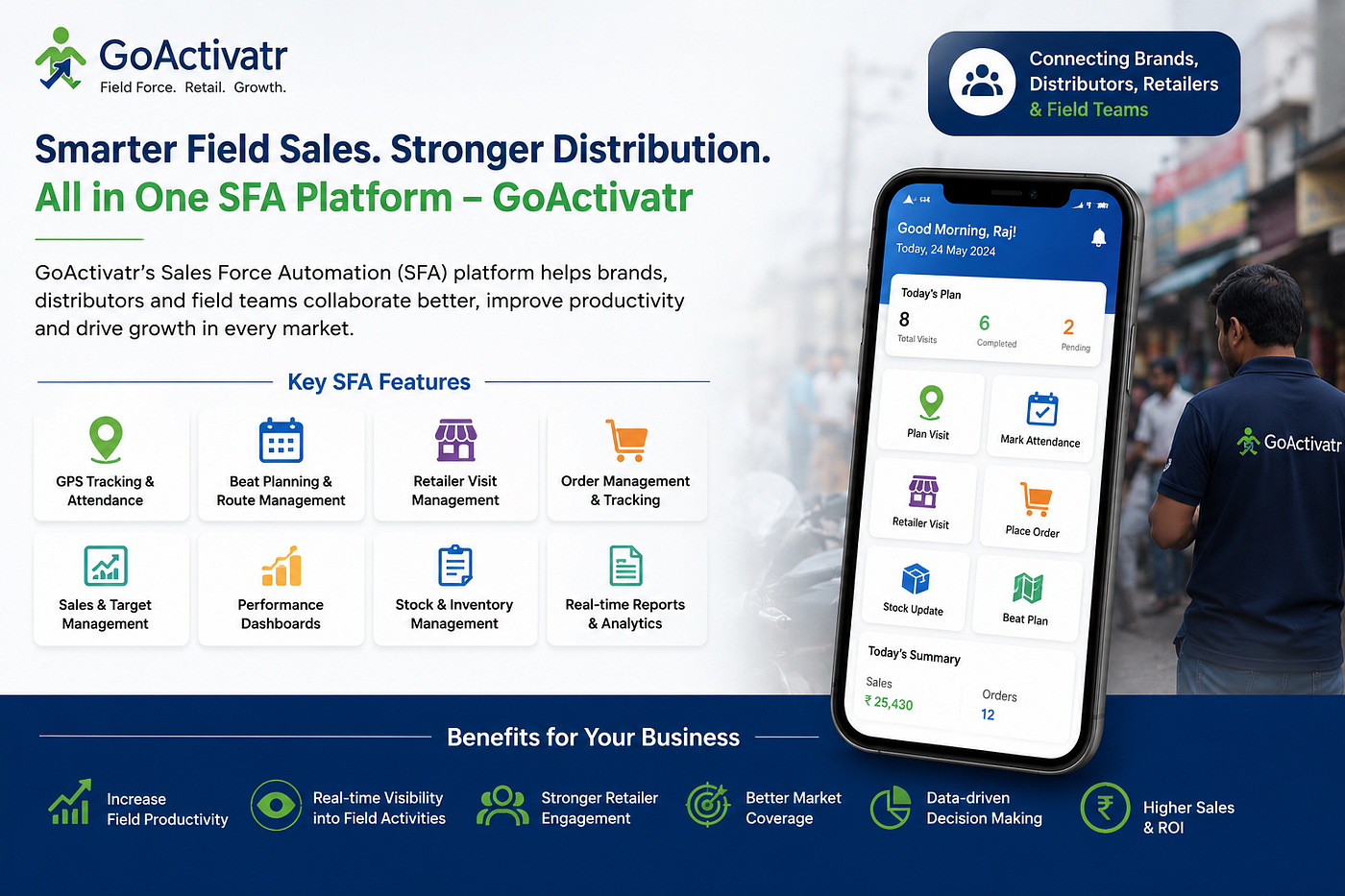
Field force management — PSR beat plans generated automatically, GPS-verified store visits, mobile order booking, performance scoring, and automated incentive disbursement.
Retail execution — Shelf audits, merchandising compliance tracking, stock-out alerts, POS material verification, and competitor shelf share monitoring.
Trade scheme management — Communicating, applying, and tracking complex promotional schemes across every level of the distributor network — accurately and automatically.
Payments and credit — Distributor credit management, retailer financing, and reconciliation without manual intervention.
Competitive intelligence — Shelf share data, competitor pricing, and market movement captured from the field in real time.
Predictive analytics — Demand forecasting, store scoring, and coverage optimization that tells you what’s going to happen — not just what happened last week.
Most legacy DMS software handles three or four of these. The best modern platforms handle all of them — in real time, through a unified interface, with full API access.
Understanding this scope is the first step to choosing software that actually solves the problem.
The Software Landscape: Three Categories and Their Honest Limitations
Category 1: Traditional DMS Software
Tools like Ivy Mobility, Bizom, and Salesbeat — along with older enterprise platforms like SAP DSD — were built to digitize the traditional distributor model. Order management, basic inventory tracking, van sales routing. For large, established FMCG companies with mature distributor networks and dedicated IT teams, they’ve served a purpose.
But they carry fundamental limitations that make them a poor fit for growth-stage and modern brands.
They assume you already have distribution. Traditional DMS software starts at the point where you have a distributor network in place. Finding, vetting, and activating new distributors is left entirely to you. For a brand entering a new city or state, this is a major gap.
Their data is delayed, not live. Most traditional DMS platforms operate on batch data — nightly syncs, weekly uploads, monthly MIS reports. In a fast-moving retail environment, data that’s 48 hours old is already stale. A stockout that’s detected a week after it happened has already cost you sales you’ll never recover.
They have no intelligence layer. Dashboards that show what happened are table stakes. What modern brands need is software that predicts what’s going to happen — which stores are at risk of stockout, which distributors are losing velocity, where to focus coverage for maximum impact. Traditional DMS tools don’t offer this.
They’re not API-first. Integrating traditional DMS software with your ERP, your e-commerce platform, or your internal analytics stack typically requires expensive custom development and long implementation timelines. They were not designed to be programmable infrastructure.
They’re overbuilt in the wrong places. Implementation timelines of 6–12 months and upfront costs in the lakhs make traditional DMS tools inaccessible for brands that need to move quickly and test before committing.
Category 2: SFA (Sales Force Automation) Tools
FieldAssist, Beatroute, and Spotio focus primarily on field team management — beat plans, visit tracking, and mobile order booking for PSRs. They solve a real problem: the opacity and inconsistency of traditional field team management.
But they are point solutions, not complete platforms.
They cover field execution only. An SFA tool tells you whether your PSR visited a store and booked an order. It doesn’t tell you whether the distributor has stock to fulfill that order, whether the product is actually on the shelf, or whether a competitor is eating your share in that outlet.
You end up stitching tools together. SFA for field execution. DMS for distributor management. A separate analytics tool for reporting. A spreadsheet for trade scheme tracking. This fragmentation creates exactly the data silo problem that software was supposed to solve. Your field visit data, distributor inventory data, and retail intelligence data never talk to each other — so your decisions are still based on incomplete information.
The intelligence layer is thin. Compliance tracking is not the same as intelligence. Knowing that a PSR visited a store is different from knowing whether the visit resulted in a correctly executed shelf, whether the product was visible, or whether the retailer is likely to reorder.
Category 3: Generic CRM and ERP with Distribution Modules
Salesforce, Zoho, and Microsoft Dynamics can be configured to manage distributor relationships — but configuring them correctly for Indian FMCG distribution requires significant customization, expensive implementation partners, and timelines that don’t match the speed at which brands need to move.
They are relationship management tools adapted for distribution, not distribution platforms built from the ground up. The difference shows up in every India-specific requirement: kirana store complexity, trade scheme structures, beat planning logic, cash-dominant trade, and regional language requirements. None of this is built into generic CRM or ERP platforms — it all has to be customized, which means it’s slow, expensive, and fragile.
The Modern Alternative: ACTIVATR — Distribution Intelligence and Execution Platform
ACTIVATR represents a genuinely different category of software — not a traditional DMS, not an SFA tool, not a CRM with distribution modules. It is a unified distribution intelligence and execution platform built specifically for modern Indian consumer brands.
The difference starts with the problem statement. Every other tool in this landscape assumes you already have distribution infrastructure and are trying to manage it better. ACTIVATR solves the entire distribution challenge — from finding and activating distributors to generating demand at the retail level to delivering real-time shelf intelligence — in a single, unified platform.
Here is what that looks like across every core function.
Distributor Orchestration — Network Access Without Lock-In
ACTIVATR’s distributor orchestration capability solves the problem that no traditional DMS touches: getting distribution activated in the first place.
Intelligent brand-distributor matching connects brands with a verified network of distributors across India — already vetted for category fit, geographic coverage, and financial health. Instead of 6–9 months of manual negotiation, brands activate distribution in 2–4 weeks. Without exclusivity contracts. Without territorial lock-in. Without pre-loading inventory.
Once activated, the entire distributor relationship is managed through the platform. Order workflows, inventory coordination, scheme compliance, and performance metrics — all in one dashboard, with full audit trails.
PSR Management and Deployment — Field Execution as a Service
ACTIVATR’s field execution layer transforms how brands deploy and manage Product Sales Representatives.
PSRs receive daily beat plans generated automatically by the system based on store coverage priorities, geography, and performance data. Every store visit is GPS-verified and time-stamped — no manual check-ins, no self-reported visit logs. Order booking is digital and mobile-first, with offline functionality for markets with inconsistent connectivity.
Performance is scored automatically based on verified output — visits completed, orders booked, merchandising executed — removing subjectivity from appraisals entirely. Incentive disbursement is automated based on this verified data.
The result: a full-strength field team without the HR complexity, attrition management, and supervision overhead of owning one internally.
Real-Time Retail Intelligence — The Shelf, Visible at Last
This is where ACTIVATR creates the most dramatic separation from legacy distribution management software.
Shelf intelligence in a traditional model arrives monthly, if it arrives at all — a manually compiled audit report that tells you what the shelf looked like three weeks ago. ACTIVATR delivers continuous retail intelligence through a combination of mobile capture and computer vision processing.
PSRs capture shelf photos during every store visit. These images are processed automatically to assess product facings, detect stockouts, measure share-of-shelf against competitors, and verify pricing compliance. Brands receive real-time alerts when a stockout is detected — not a report three weeks later.
At enterprise scale, this means 20,000 monthly audits across 15,000 stores — automated, consistent, and processed in real time rather than compiled manually by an audit team. The cost difference alone justifies the platform.
Order and Inventory Sync — The Full Order Lifecycle, Automated
Automated order booking with digital signatures, automated credit checks, 3PL integration, and delivery tracking — all connected in one system with full audit trails for compliance and forecasting.
The entire order lifecycle — from PSR booking to distributor confirmation to 3PL handoff to proof of delivery — is transparent, trackable, and auditable. Brands know the status of every order in real time. Distributors spend less time on reconciliation. Retailers get faster, more reliable fulfillment.
This is the order management experience that modern e-commerce brands take for granted — brought to offline distribution, finally.
Predictive Analytics — Intelligence That Tells You What’s Next
ACTIVATR’s ML layer is what turns distribution management from a reporting function into a strategic capability.
Store scoring models identify which retail outlets in a target geography have the highest probability of performing well for your category — before you’ve invested field time or trade marketing spend. Demand forecasting predicts stockout risk at the store level, giving operations teams the lead time to act before sales are lost. Market recommendations optimize coverage allocation across geographies based on actual performance signals.
This is the layer that separates brands operating on intelligence from brands operating on intuition.
API-First Architecture — Distribution as Programmable Infrastructure
Perhaps the most distinctive capability of ACTIVATR for technology-forward brands is its fully programmable architecture.
The entire distribution infrastructure is accessible via API:
- OAuth 2.0 authentication with a sandbox environment for testing before production deployment
- ML model queries — store recommendations, demand forecasts, and competitive intelligence delivered as JSON responses in milliseconds
- Programmatic execution — create orders, assign PSR tasks, and schedule content distribution via API calls
- Real-time sync — WebSocket connections for live updates, webhook notifications for state changes, and batch exports for historical analysis
What used to take weeks of vendor negotiations and manual coordination now launches with a few API calls. Distribution becomes programmable infrastructure — as observable, controllable, and integratable as any other part of the modern technology stack.
How ACTIVATR Compares — The Full Picture

Real Brand Results — What the Platform Delivers in Practice
A ₹75Cr online beauty brand entering offline retail for the first time used ACTIVATR’s ML store scoring to identify 3,000 high-probability retail outlets across target cities. All 3,000 stores were reached within 90 days — with POS machines deployed to 800 priority stores for digital payments. A timeline that would have taken 18+ months through traditional distribution management.
A ₹300Cr Tamil Nadu snacks brand used ACTIVATR to test the Maharashtra market without committing to new distributor relationships. Variable-cost distribution across 5,000 stores, weekly competitive intelligence reports, and content distribution on 500 in-store screens — market validation before full commitment.
A ₹8,000Cr national beverage company needed 20,000 monthly retail audits across 15,000 stores. ACTIVATR’s API-first infrastructure automated task assignment, real-time reporting, and compliance monitoring — reducing total audit cost by 45%. At that revenue scale, 45% is a material P&L impact, not a rounding error.
An ₹8Cr health foods startup used ACTIVATR as their complete distribution infrastructure — product distribution to 1,200 stores, weekly retail execution, retailer financing extended to 300 stores, and content distribution on 200 in-store screens. The brand scaled to ₹40Cr using the platform as their entire offline distribution function.
Three Plans — Built for Every Stage of Your Offline Journey
LAUNCH PLAN (3–6 Months) — For Brands Entering Offline Best for D2C brands testing 1–3 cities for viability or optimizing pricing and SKU acceptance before full commitment. Deliverables include retailer mapping and onboarding, first-order acquisition, basic merchandising protocols, market feedback reports, and distributor coordination support.
GROWTH PLAN (6–18 Months) — For Brands Solving Reorder and Coverage Gaps Best for brands with established market pull focused on beat discipline, retailer retention, and coverage expansion. Deliverables include order booking as a service, daily beat execution, trade scheme communication, repeat-order nurturing, active retailer percentage optimization, and optional retail media upsell.
SCALE PLAN (National / Multi-State) — For Brands Ready to Move Aggressively Best for brands with proven product-market fit expanding to multiple cities simultaneously. Deliverables include multi-city PSR deployment, dedicated city managers, advanced intelligence dashboard, compliance and visibility audits, optional exclusive PSR assignment, and automated stock-out alerts.
The Technology Infrastructure — Built for Enterprise Reliability
ACTIVATR runs on modern, cloud-native infrastructure designed for scale and real-time performance:
Cloud-native architecture with elastic scaling on AWS and Azure ensures the platform handles demand spikes without performance degradation. A microservices design means no single point of failure — individual components can be updated or scaled independently. Real-time streaming analytics powers the live intelligence layer. Machine learning models handle predictive demand forecasting at store level. Computer vision automates shelf-share audit processing. GraphQL APIs provide type-safe, efficient developer integration. Event-driven, asynchronous task execution scales field operations without bottlenecks. And a 99.9% SLA commitment means enterprise-grade uptime for brands whose distribution operations can’t afford downtime.
Which Software Is Right for Your Brand?
The honest answer depends on where you are in your offline journey.
If you are a large enterprise with a mature distributor network and a dedicated IT team, traditional DMS tools may be adequate for basic order management and inventory tracking — though even at this scale, ACTIVATR’s real-time intelligence and API capabilities offer advantages that compound over time.
If you are a growth-stage brand between ₹5Cr and ₹500Cr, ACTIVATR is the most complete, modern, and capital-efficient solution available. It replaces multiple fragmented tools — DMS, SFA, audit platforms, analytics dashboards — with a single unified layer designed for the speed and flexibility that modern brands require.
If you are a D2C brand entering offline for the first time, ACTIVATR removes the biggest barriers entirely — no distributor search, no upfront inventory commitment, no exclusivity lock-in, no separate field team to hire and manage.
The fundamental question is this: Do you want to manage distributor operations the way it was done in 2010 — with fragmented tools, delayed reports, and manual coordination at every step? Or do you want a unified, programmable, intelligence-powered platform that scales with you?
The brands choosing the latter are building distribution advantages right now that will be very difficult for competitors to close once the gap opens.
Ready to see what modern distributor operations management looks like in practice? Visit activatr.solutions to book a 30-minute demo and explore how the platform fits your specific distribution stage and goals.
메타데이터
- post_id
- f6947ad5d445
- slug
- the-best-saas-platform-to-manage-distributor-operations-in-india-and-why-most-brands-are-using-f6947ad5d445
- url
- https://medium.com/@magicmoments6363/the-best-saas-platform-to-manage-distributor-operations-in-india-and-why-most-brands-are-using-f6947ad5d445
- canonical_url
- https://medium.com/@magicmoments6363/the-best-saas-platform-to-manage-distributor-operations-in-india-and-why-most-brands-are-using-f6947ad5d445
- author_url
- https://medium.com/@magicmoments6363
- status
- ok
- fetched_at
- 2026-06-13 00:08:42