How the Ottoman Era Shaped Palestinian Identity
Turkish social media has of late been flush with posts detailing how the Ottoman Empire maintained peace and harmony in the Levant…
How the Ottoman Era Shaped Palestinian Identity
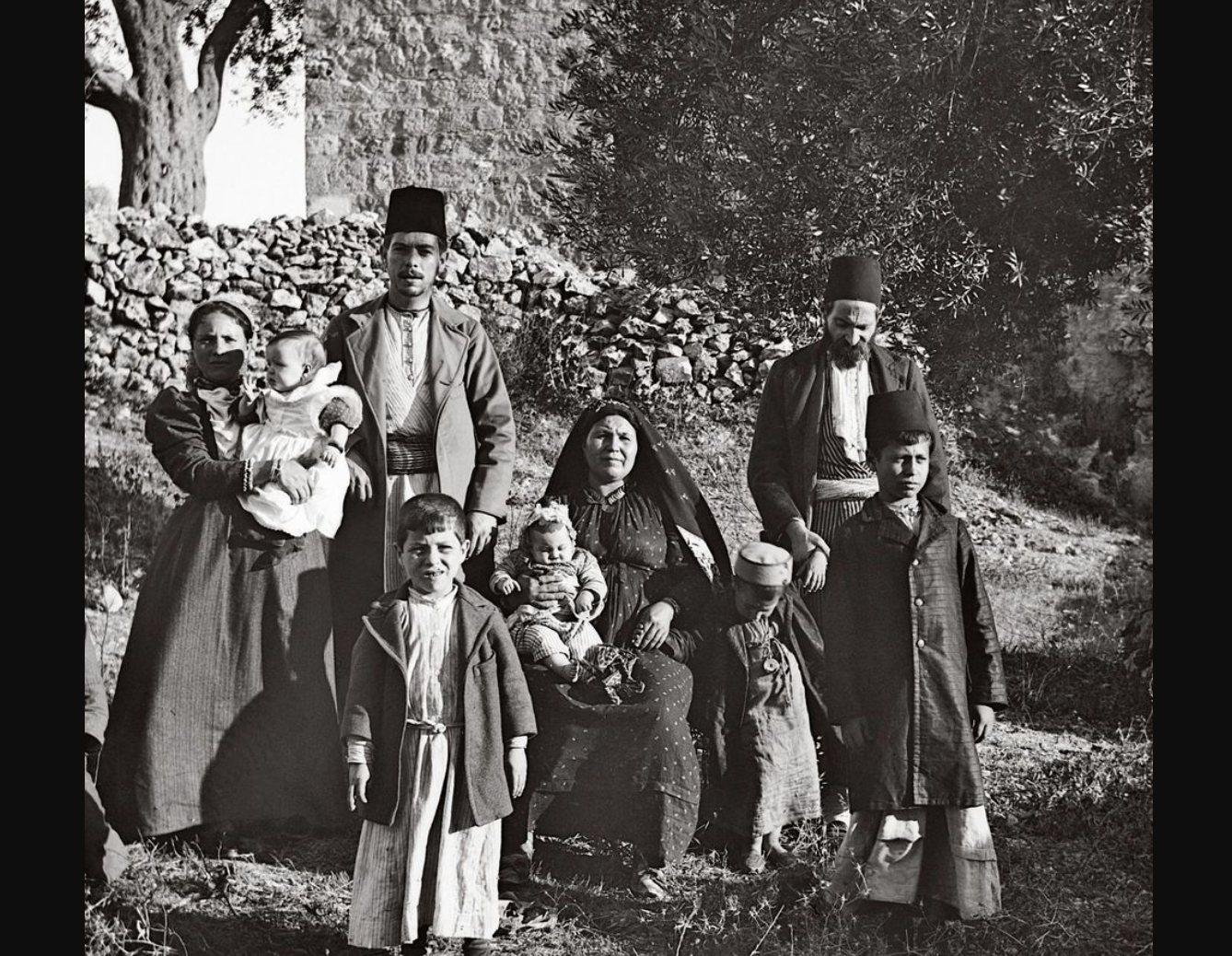
Palestinian family in late Ottoman-era
Turkish social media has of late been flush with posts detailing how the Ottoman Empire maintained peace and harmony in the Levant throughout its four-century reign, particularly in Jerusalem, where Muslims, Christians and Jews lived side-by-side.
The unsaid question being, if Muslim rulers could do this, why can’t Israel’s leaders today do the same? Before Hamas’ horrifying recent assault, there were even whispers that President Recep Tayyip Erdogan would mark Turkey’s 100th birthday, on October 29th, with prayers at Al-Aqsa Mosque, as a reminder of the calming Ottoman presence.
That would have been an interesting choice of location. Al-Aqsa is widely seen as the third holiest site in Islam, but it’s also the birthplace of one of the most meaningful uprisings in the Ottoman era. To tell that tale, we need to first turn back the clock.
The Ottomans under Sultan Selim I finally defeated the Mamluk Sultanate in 1517, taking control of the Levant, Egypt, and the Hejaz in the great triumph of Selim the Grim’s reign. The Sublime Porte made greater Syria an Ottoman province, with Palestine split into five sanjaks, Safad, Nablus, Jerusalem, Gaza, and Lajjun, near today’s Jenin.
Was it all kumbaya from then until the arrival of the British? Far from it. For starters, the Celali revolts unsettled much of southeastern Anatolia and Syria starting in the late 16th century. One of these rebellions, involving a Druze leader partnered with a Kurd and a Tuscan Christian duke, reached almost to Nablus before being quelled by Ottoman forces.
But 16th-century Palestine was home to thousands of Christians and Jews and largely peaceful, mainly thanks to a trio of dynastic families. The Ridwans usually governed Gaza, the Farrukhs mostly oversaw Nablus, and the two often shared control over Jerusalem. The third dynasty was the Turabay, from the Bedouins’ Banu Haritha tribe. Chief Quraja and his son Turabay helped the Ottomans during the Mamluk conquest and were rewarded with the Lajjun governorship.
The three dynasties inter-married, traded frequently and cooperated politically and militarily, ultimately merging into a single family that controlled most of Palestine. By the mid-17th century, the joint dynasty, with Huseyn Pasha at its head, had built strong and stable relations with Christians, farmers, Bedouins, and religious scholars.
But Istanbul was no fan of the dynasty’s growing influence, and in 1657 dispatched a brigade to Palestine to reassert control. The Ottomans soon executed Husayn Pasha, ending the families’ reign. “When these local dynasties were broken by the imperial center and replaced by short-term governors, harmonious coexistence gave way to harsh, and at times violent, confrontation,” Dror Ze’evi writes in An Ottoman Century.
The newly appointed governors lacked the dynastic leaders’ ties with locals and turned a blind eye to exploitation by Ottoman officials and Janissaries. Appointed governor of Jerusalem, Gaza, and Nablus, Mehmed Pasha Kurd Bayram launched brutal military expeditions to punish those who refused to pay his exorbitant taxes. In 1702, he killed more than 200 civilians in Jerusalem and Gaza sanjaks and brought back severed heads, which he placed on spikes atop the gates of the Holy City to send a message.
In spring 1703, Bayram’s troops tried to ransack a village run by Jerusalem’s mufti, which proved to be the last straw. A few weeks later, with Bayram away on a campaign, locals launched a rebellion during Friday prayers at al-Aqsa. With widespread local support, the head (naqib) of the descendants of the Prophet Muhammad (al-ashraf), led the uprising, which is why it’s called the Naqib al-Ashraf Revolt.
The rebels secured the city and prepared for Bayram’s assault. Distracted by another revolt closer to home, in Edirne, Istanbul failed to send reinforcements. Bayram and Damascus Governor Arslan Mehmed Pasha were unwilling to level the Holy City, which the rebels held for more than two years — until an Ottoman-aligned splinter faction retook the city.
Nobles and religious leaders were executed or exiled, and Istanbul sent thousands of troops to secure Jerusalem, squeezing the local economy. That uprising was limited to the Holy City and might today be described as a trial run for the next, much broader revolt.
In 1801, Muhammad Ali, an Albanian turned Ottoman commander and the founder of modern Egypt, forced Istanbul to recognize him as Egypt’s governor. A few decades later his son, Ibrahim Pasha, led a campaign against Ottoman forces in the Levant, taking chunks of territory and holding Haifa as his base.
Yet as with Istanbul’s replacements for the dynastic leaders, Ibrahim’s relations with local communities soured as he dismissed their leaders from key posts, eroded their authority and levied heavy taxes. In April 1834, when Ibrahim issued a conscription order for some 4,000 fighting-age Muslim males in Jerusalem and Nablus, he met with local leaders to remind them they were at war with Christian nations.
“It is necessary for you, if you wish the welfare of Muslims and the nation, to send in your young men from every city and every village,” Ibrahim urged, as detailed in Judith Mendelsohn Rood’s Sacred Law in the Holy City. Locals disagreed, and led by sheikh Qasim al-Ahmad, communities across central Palestine revolted in May 1834. The uprising spread to Gaza, Galilee, and Jerusalem, where the rebels slipped into the Old City via a sewer tunnel and looted Christian, Jewish, and even Muslim shops.
Ibrahim’s forces drove the rebels out of the Holy City within a few weeks before turning to Gaza and the coast. Muhammad Ali arrived with reinforcements and the Egyptians marched on the last rebel holdouts. “Egyptian soldiers reduced 16 villages to ash,” historian Baruch Kimmerling writes in The Palestinian People, adding that their victory at Nablus involved “leveling the city, raping the women, mass killing and conscription of the men.”
Leaders and headmen who had joined the revolt were executed and tens of thousands of locals were exiled to Egypt. Yet despite its dark final chapter, the 1834 Peasants’ Revolt marked the first time rural sheiks, Bedouins, urban nobles and religious scholars from across Palestine had united against a common foe. “It was these groups who would later constitute the Palestinian people,” argues Kimmerling.
This brings us to the crucial point. I’m no historian, and my retelling surely leaves out key details and episodes. But if the Ottomans were indeed able to maintain relative peace in Palestine — clearly a big if — it was not a result of their brilliance at building bridges and embracing religious diversity.
Rather, it was likely because the region’s defining tension had yet to emerge: like Zionism, Palestinian identity did not take root until the late 19th century. This explains why the half-billion short regional histories published in recent days start in the early 20th century, when the seeds of the current conflict were planted. I’ve seen none that mention, for instance, that in evicting the Ottomans, British forces assaulted Gaza repeatedly in 1917, forcing 40,000 to evacuate and all but turning it to rubble.
Yet understanding the Palestinian perspective requires a recounting of the many centuries in which they battled outsider rule and assault, fought and died for the briefest flashes of independence, and finally united over a homeland they still today cannot claim as their own.
One wonders if any people on earth have suffered more for longer while gaining so little.
메타데이터
- post_id
- f69ff5cf1431
- slug
- how-the-ottoman-era-shaped-palestinian-identity-f69ff5cf1431
- url
- https://medium.com/@dlepeska/how-the-ottoman-era-shaped-palestinian-identity-f69ff5cf1431
- canonical_url
- https://medium.com/@dlepeska/how-the-ottoman-era-shaped-palestinian-identity-f69ff5cf1431
- author_url
- https://medium.com/@dlepeska
- status
- ok
- fetched_at
- 2026-07-25 02:07:45



